Introduce Yourself in Korean Flashcards: Study the 24 Cards
A self-introduction is the first thing most learners say in Korean, and it follows a fixed order: greeting, name, origin, job, then a closing request. The lesson behind this deck is introduce yourself in korean, so read it first if a card is new, and use the cards to say each line smoothly.
How Do I Use These Flashcards?
Use the deck above in four steps. It works with tap, click or keyboard, and nothing plays until you press an audio button.
- Choose a mode. Start with recognition (Hangul to meaning). Switch to recall (meaning to Hangul) or listening (audio to meaning) once recognition feels easy.
- Show the answer. Think of the meaning and the politeness level first, then press Show answer (or Space). Say the sentence aloud before you reveal it, and swap in your own name and country. Turn on the romanization toggle only if you need it; the 24-card table below always shows it.
- Grade yourself. Press Got it if you answered correctly without help, or Not yet if you hesitated or guessed.
- Finish the session. A session holds up to 20 cards (you can set 10, 20 or 40). With 24 cards, a first-time learner can split the deck over 3 days, using the default limit of 10 new cards a day.
The Three Study Modes
Recognition shows the Hangul and asks for the meaning, which trains reading. Recall shows the meaning and asks for the Hangul, which trains remembering; you may type the answer with your Hangul keyboard or just recall it in your head. Listening plays a clip and hides the letters, which trains the ear. The pronunciation audio is generated with text-to-speech and a Korean teacher approves it before it is switched on. Listening mode only uses cards whose audio is approved, and cards without approved audio are skipped in that mode with a note.
Got It and Not Yet
Got it moves the card up one Leitner box, so it comes back later. Not yet sends the card back to box 1, so it returns in the same session or within 10 minutes. The grades are your own judgement; the deck does not score you or claim fluency.
Deck Scope: What Is and Is Not Covered
The deck covers self-introduction and first-meeting lines. It has the formal and polite ways to say your name, the questions for asking someone else's name, country, job and age, sentences about where you live and how much Korean you speak, and the set phrases 만나서 반갑습니다 and 잘 부탁드립니다. Two hobby cards give you a natural follow-up.
What Is Left out of This Deck?
The deck does not cover greetings in general or small-talk follow-ups. For hello and goodbye use the Korean greetings flashcards, and for conversation openers use the Korean small talk flashcards. Business introductions with job titles are left to the business Korean phrases flashcards.
All 24 Cards in One Table
All 24 cards appear below in deck order. The table is plain HTML, so you can use it as a drill without the deck: cover the Meaning column, say each sentence aloud, then uncover it.
| # | Hangul | Revised Romanization | Meaning | Note | Audio assetId |
|---|---|---|---|---|---|
| 1 | 안녕하세요, 저는 마리아입니다 | annyeonghaseyo, jeoneun mariaimnida | Hello, I am Maria (formal) | Formal self-introduction for work or class. 입니다 is said [임니다]. | au-pg-flashcards-introductions-flashcards-1; slow: au-pg-flashcards-introductions-flashcards-25 |
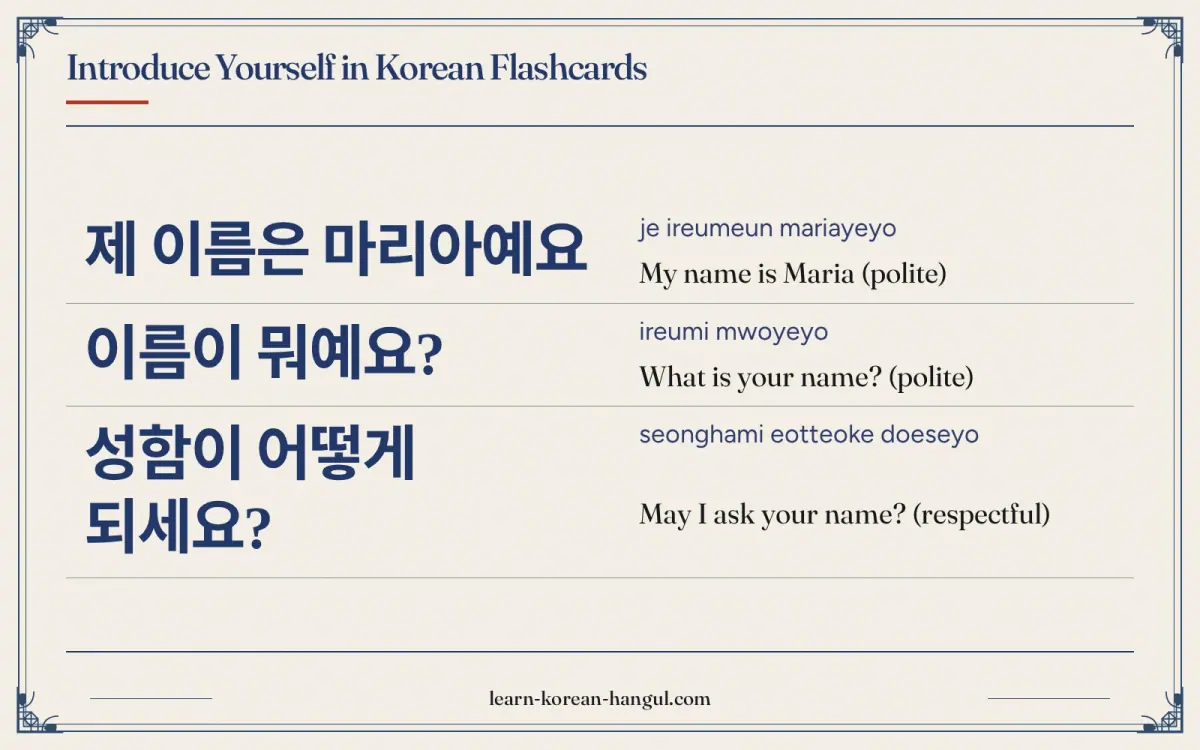
| 2 | 제 이름은 마리아예요 | je ireumeun mariayeyo | My name is Maria (polite) | Relaxed polite version for daily meetings. | au-pg-flashcards-introductions-flashcards-2 |
| 3 | 이름이 뭐예요? | ireumi mwoyeyo | What is your name? (polite) | Plain polite question; fine among peers. | au-pg-flashcards-introductions-flashcards-3 |
| 4 | 성함이 어떻게 되세요? | seonghami eotteoke doeseyo | May I ask your name? (respectful) | 성함 is the honorific word for name; for elders and customers. | au-pg-flashcards-introductions-flashcards-4 |
| 5 | 저는 한국어를 공부해요 | jeoneun hangugeoreul gongbuhaeyo | I study Korean | 한국어를 is said [한구거를]; the final ㄱ links to 어. | au-pg-flashcards-introductions-flashcards-5; slow: au-pg-flashcards-introductions-flashcards-26 |
| 6 | 저는 미국에서 왔어요 | jeoneun migugeseo wasseoyo | I am from the USA | Swap 미국 for your country; 에서 here means from. | au-pg-flashcards-introductions-flashcards-6 |
| 7 | 어느 나라에서 왔어요? | eoneu naraeseo wasseoyo | Which country are you from? | 어느 asks which one. | au-pg-flashcards-introductions-flashcards-7 |
| 8 | 저는 학생이에요 | jeoneun haksaengieyo | I am a student | 이에요 follows a consonant; 학생이에요 is said [학쌩이에요]. | au-pg-flashcards-introductions-flashcards-8; slow: au-pg-flashcards-introductions-flashcards-27 |
| 9 | 저는 회사원이에요 | jeoneun hoesawonieyo | I am an office worker | Another 이에요 example, after the consonant ㄴ. | au-pg-flashcards-introductions-flashcards-9 |
| 10 | 무슨 일을 하세요? | museun ireul haseyo | What do you do for a living? | Honorific 하세요; polite to ask a stranger. | au-pg-flashcards-introductions-flashcards-10 |
| 11 | 저는 서울에 살아요 | jeoneun seoure sarayo | I live in Seoul | 에 marks where you live. | au-pg-flashcards-introductions-flashcards-11 |
| 12 | 한국어를 조금 해요 | hangugeoreul jogeum haeyo | I speak a little Korean | A modest, common line for learners. | au-pg-flashcards-introductions-flashcards-12 |
| 13 | 한국어를 아직 잘 못해요 | hangugeoreul ajik jal motaeyo | I am not good at Korean yet | 못해요 is said [모태요]; 아직 means not yet. | au-pg-flashcards-introductions-flashcards-13 |
| 14 | 천천히 말해 주세요 | cheoncheonhi malhae juseyo | Please speak slowly | Useful right after you say you are a learner. | au-pg-flashcards-introductions-flashcards-14 |
| 15 | 몇 살이에요? | myeot sarieyo | How old are you? (polite) | Common between peers but blunt to elders; said [멷싸리에요]. | au-pg-flashcards-introductions-flashcards-15 |
| 16 | 저는 스물다섯 살이에요 | jeoneun seumuldaseot sarieyo | I am twenty-five years old | Native number plus 살. | au-pg-flashcards-introductions-flashcards-16 |
| 17 | 연세가 어떻게 되세요? | yeonsega eotteoke doeseyo | May I ask your age? (respectful) | 연세 is the honorific word for age; use with elders. | au-pg-flashcards-introductions-flashcards-17 |
| 18 | 만나서 반갑습니다 | mannaseo bangapseumnida | Nice to meet you (formal) | Use with a boss, a client or in a formal meeting. | au-pg-flashcards-introductions-flashcards-18 |
| 19 | 만나서 반가워요 | mannaseo bangawoyo | Nice to meet you (polite) | Everyday polite; not for a formal meeting. | au-pg-flashcards-introductions-flashcards-19 |
| 20 | 잘 부탁드립니다 | jal butakdeurimnida | Please look after me / I look forward to working with you | Closes an introduction and asks for goodwill; no exact English match. | au-pg-flashcards-introductions-flashcards-20 |
| 21 | 저는 민준이에요 | jeoneun minjunieyo | I am Minjun | 이에요 after a name ending in a consonant. | au-pg-flashcards-introductions-flashcards-21 |
| 22 | 이분은 제 친구예요 | ibuneun je chinguyeyo | This person is my friend | 예요 after the vowel ㅜ; 분 is the polite word for person. | au-pg-flashcards-introductions-flashcards-22 |
| 23 | 취미가 뭐예요? | chwimiga mwoyeyo | What is your hobby? | A friendly follow-up question after meeting. | au-pg-flashcards-introductions-flashcards-23 |
| 24 | 제 취미는 음악 듣기예요 | je chwimineun eumak deutgiyeyo | My hobby is listening to music | 듣기 turns the verb 듣다 into a noun. | au-pg-flashcards-introductions-flashcards-24 |
Reading the Table
Hangul is the sentence. Revised Romanization (RR) is a learning aid, so try to read the Hangul before you look at it. RR follows the sound, which is why 입니다 is written imnida. The Meaning column gives the English gloss with its politeness level, and the Note column gives a use or sound hint. The last column lists the audio assetId; a second ID marks a slow clip (0.8x) for the cards where the sound changes most.
Usage Notes for These Cards
Two levels of self-introduction. 저는 ~입니다 is the formal self-introduction for work or presentations, while 저는 ~예요/이에요 is the relaxed polite version for daily meetings. Both are correct; choose by the room. In a classroom or at a club, 예요 and 이에요 sound friendly, and in an interview, 입니다 sounds prepared.
예요 after a vowel, 이에요 after a consonant. Use 예요 after a name or noun ending in a vowel (마리아예요, 민수예요) and 이에요 after one ending in a consonant (민준이에요, 학생이에요). The pair means the same thing, and only the final sound of the noun decides which one you use.
Say 저, not 나. 저 is the humble word for I, and it is the right choice when you introduce yourself. Use 제 이름 instead of 내 이름 for the same reason. 나 and 내 are for close friends and younger people.
잘 부탁드립니다 closes the introduction. It asks the listener for goodwill, with no exact English equivalent, and it fits new classes, jobs and clubs. Say it after your name and a short line about yourself.
Ages are asked with care. 몇 살이에요? is common between peers but can sound blunt to elders, who are asked 연세가 어떻게 되세요? instead.
Which Sounds Do Not Match the Spelling?
입니다 is said [임니다]. The ㅂ turns into ㅁ before ㄴ (nasalization). The RR is imnida.
한국어를 is said [한구거를]. The final ㄱ of 국 moves onto the empty ㅇ of 어 (liaison), so the ㄱ is voiced between vowels.
학생이에요 is said [학쌩이에요]. The ㅅ turns tense after the final ㄱ (tensification). RR does not mark this, so the RR stays haksaengieyo.
몇 살이에요 is said [멷싸리에요]. The final ㅊ of 몇 is said as a [ㄷ] stop, and the ㅅ of 살 turns tense after it. The RR stays myeot sarieyo.
What Mistakes Do Learners Make with Introducing Yourself?
- Using 이에요 after a vowel, as in 저는 마리아이에요. After a vowel it is 마리아예요, and after a consonant 민준이에요.
- Saying 나는 for yourself to adults. Use 저는.
- Saying 만나서 반가워요 to a boss in a formal meeting. Use 만나서 반갑습니다.
- Asking an older person 몇 살이에요?. Use 연세가 어떻게 되세요? or avoid the question.
The 예요 and 이에요 choice causes most slips, so give cards 2, 8 and 21 extra passes in recall mode.
How Does the Review Schedule Work?
The deck uses a simplified Leitner system with five boxes. A new card starts in box 1. Each Got it moves it up one box, and each Not yet returns it to box 1. The box sets how long the card waits before it is due again.
| Box | Wait until the next review |
|---|---|
| 1 | same session or 10 minutes |
| 2 | 1 day |
| 3 | 3 days |
| 4 | 7 days |
| 5 | 21 days |
Each session shows due cards first, oldest due first, and then up to 10 new cards a day by default. A deck of 24 cards is introduced over 3 days at the default of 10 new cards a day, and the later boxes bring each card back at longer gaps. Progress is saved only in this browser, so clearing site data deletes it. Use the export button to save a small JSON file with card IDs, boxes and due dates, and import it on another device. No account is needed.
Cultural and Practical Context
Introductions in Korea often place you in relation to others, so age, school year and job come up quickly, and a question about age is usually curiosity, not rudeness. Handing over a business card with two hands is the usual gesture in business settings. Bowing slightly while you say 만나서 반갑습니다 is normal, and a handshake may follow.
Limits of This Deck
The deck holds 24 cards and uses 마리아, 민준 and 미국 as example names and places, so you must swap in your own. It shows the common patterns, not every job title or country. The remarks on age questions and on the business-card gesture are general. All Korean text is generated and was reviewed and signed off by Min-ji Park on 15 October 2026, and each audio clip is checked by a Korean teacher before publication.
Next Steps after This Deck
After these introduce yourself in korean flashcards, move on to the I love you in Korean flashcards to keep the same routine. If thank you, sorry and please still feel shaky, review the polite Korean phrases flashcards first. The Korean phrases flashcards page lists every phrase deck, and the Korean flashcards hub lists all topics.
Frequently Asked Questions
Should I Say 저는 or 제가 When Introducing Myself?
Say 저는 for a plain introduction: 저는 마리아예요. Use 제가 when you want to stress who is acting or when answering a question, as in 제가 마리아예요 (I am the one called Maria). In a first introduction, 저는 is the safer default.
How Do I Say My Nationality?
Say your country plus 사람이에요, such as 미국 사람이에요, or say where you are from with 에서 왔어요, such as 저는 미국에서 왔어요. Swap 미국 for your own country name. Both forms are polite and natural.
Why Is 잘 부탁드립니다 Said at the End of an Introduction?
It asks the listener for goodwill and support in the relationship ahead. It has no exact English equivalent, and Koreans use it when they join a class, a job or a club. A close translation is Please take care of me or I look forward to working with you.
Is It Rude to Be Asked My Age?
Not usually. Koreans often ask age to choose the right speech level, since the level depends on who is older. You may answer briefly, or smile and say you would rather not. When you ask an older person, use the respectful 연세가 어떻게 되세요?.
Is My Progress Saved If I Close the Page?
Yes, in the same browser on the same device. Card boxes and due dates are stored locally and nothing is sent to a server. Clearing site data, using a private window or switching browsers removes them, so use the export button to keep a backup file. No account is needed.