Korean Emergency Phrases Flashcards: Study the 23 Cards
In an emergency you need a few short sentences you can say without thinking. The lesson behind this deck is korean emergency phrases, so read it first if a card is new, and use the cards to make the key lines automatic before you travel. This deck is a language aid only; it is not medical or legal advice, and in a real emergency you should call the official number and follow the instructions you are given.
How Do I Use These Flashcards?
Use the deck above in four steps. It works with tap, click or keyboard, and nothing plays until you press an audio button.
- Choose a mode. Start with recognition (Hangul to meaning). Switch to recall (meaning to Hangul) or listening (audio to meaning) once recognition feels easy.
- Show the answer. Think of the meaning and the situation first, then press Show answer (or Space). Say the sentence aloud before you reveal it, loudly and clearly. Turn on the romanization toggle only if you need it; the 23-card table below always shows it.
- Grade yourself. Press Got it if you answered correctly without help, or Not yet if you hesitated or guessed.
- Finish the session. A session holds up to 20 cards (you can set 10, 20 or 40). With 23 cards, a first-time learner can split the deck over 3 days, using the default limit of 10 new cards a day.
The Three Study Modes
Recognition shows the Hangul and asks for the meaning, which trains reading. Recall shows the meaning and asks for the Hangul, which trains remembering; you may type the answer with your Hangul keyboard or just recall it in your head. Listening plays a clip and hides the letters, which trains the ear. The pronunciation audio is generated with text-to-speech and a Korean teacher approves it before it is switched on. Listening mode only uses cards whose audio is approved, and cards without approved audio are skipped in that mode with a note.
Got It and Not Yet
Got it moves the card up one Leitner box, so it comes back later. Not yet sends the card back to box 1, so it returns in the same session or within 10 minutes. The grades are your own judgement; the deck does not score you or claim fluency.
Deck Scope: What Is and Is Not Covered
The deck covers calling for help, reporting a crime or accident, and basic medical needs in plain, safe wording. It has the two official numbers 119 (fire, ambulance, rescue) and 112 (police), requests to call for help, accident and fire reports, three pain and breathing lines, where to find the emergency room and pharmacy, lost passport and wallet, a missing child, and lines for getting attention and asking for English help.
What Is Left out of This Deck?
The deck does not cover feelings or body-state words beyond the basics, and it is not medical or legal advice. For feelings use the Korean feelings phrases flashcards. Lines for ordering food are in the Korean restaurant phrases flashcards, and rides are in the Korean taxi phrases flashcards. Other hotlines, such as tourist information lines, are deliberately not included.
All 23 Cards in One Table
All 23 cards appear below in deck order. The table is plain HTML, so you can use it as a drill without the deck: cover the Meaning column, say each sentence aloud, then uncover it.
| # | Hangul | Revised Romanization | Meaning | Note | Audio assetId |
|---|---|---|---|---|---|
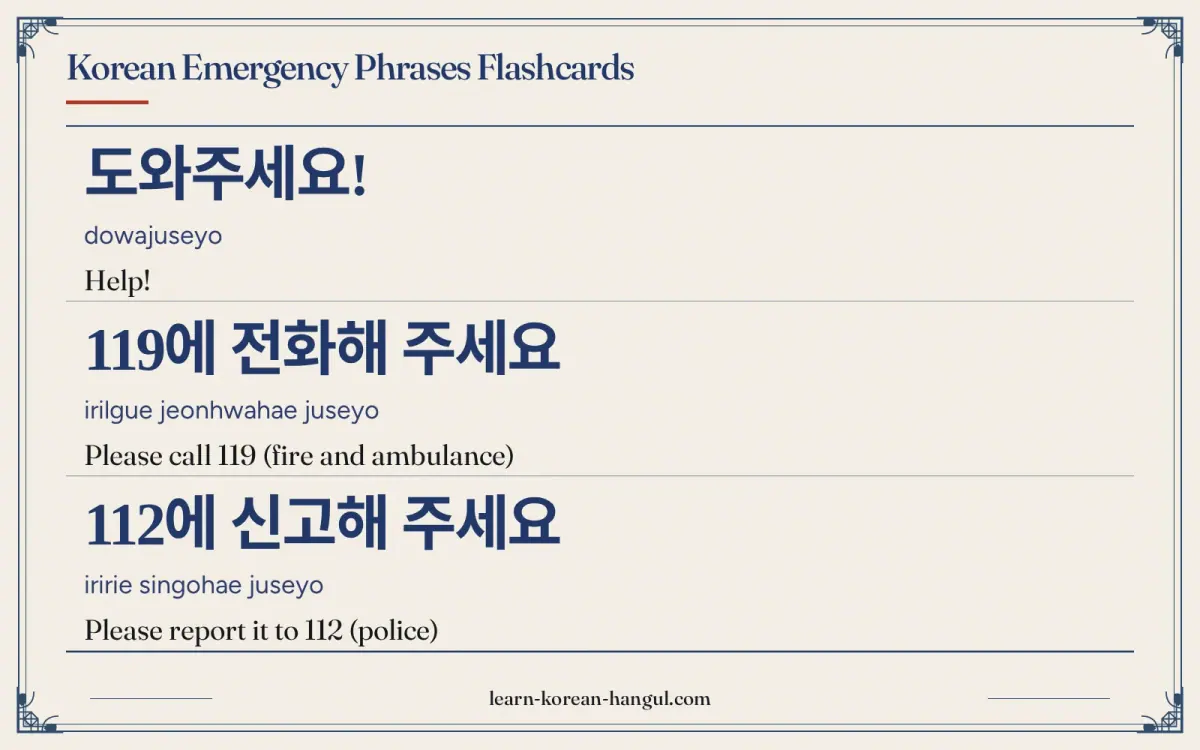
| 1 | 도와주세요! | dowajuseyo | Help! | Shout it in any situation; it needs no extra grammar. | au-pg-flashcards-emergency-phrases-flashcards-1 |
| 2 | 119에 전화해 주세요 | irilgue jeonhwahae juseyo | Please call 119 (fire and ambulance) | 119 is read as digits, 일일구, and said [이릴구]. | au-pg-flashcards-emergency-phrases-flashcards-2; slow: au-pg-flashcards-emergency-phrases-flashcards-24 |
| 3 | 112에 신고해 주세요 | iririe singohae juseyo | Please report it to 112 (police) | 112 is read 일일이, said [이리리]; 신고 means to report. | au-pg-flashcards-emergency-phrases-flashcards-3 |
| 4 | 구급차를 불러 주세요 | gugeupchareul bulleo juseyo | Please call an ambulance | 불러 is the form of 부르다 (to call). | au-pg-flashcards-emergency-phrases-flashcards-4 |
| 5 | 경찰을 불러 주세요 | gyeongchareul bulleo juseyo | Please call the police | Same pattern as the ambulance card. | au-pg-flashcards-emergency-phrases-flashcards-5 |
| 6 | 사고가 났어요 | sagoga nasseoyo | There has been an accident | Reports an accident without naming who is hurt. | au-pg-flashcards-emergency-phrases-flashcards-6 |
| 7 | 다쳤어요 | dachyeosseoyo | I am hurt / someone is hurt | Point and say it; the subject is clear from the scene. | au-pg-flashcards-emergency-phrases-flashcards-7 |
| 8 | 불이 났어요 | buri nasseoyo | There is a fire | 나다 means to break out. | au-pg-flashcards-emergency-phrases-flashcards-8 |
| 9 | 배가 아파요 | baega apayo | My stomach hurts | Body part + 이/가 + 아파요. | au-pg-flashcards-emergency-phrases-flashcards-9 |
| 10 | 머리가 아파요 | meoriga apayo | My head hurts | Same pattern with a different body part. | au-pg-flashcards-emergency-phrases-flashcards-10 |
| 11 | 숨을 못 쉬겠어요 | sumeul mot swigesseoyo | I cannot breathe | 못 means cannot; -겠- shows the feeling now. | au-pg-flashcards-emergency-phrases-flashcards-11 |
| 12 | 병원에 가고 싶어요 | byeongwone gago sipeoyo | I want to go to the hospital | -고 싶어요 states a wish politely. | au-pg-flashcards-emergency-phrases-flashcards-12 |
| 13 | 응급실이 어디예요? | eunggeupsiri eodiyeyo | Where is the emergency room? | Said [응급씨리]; ㅅ is tense after ㅂ. | au-pg-flashcards-emergency-phrases-flashcards-13; slow: au-pg-flashcards-emergency-phrases-flashcards-25 |
| 14 | 약국이 어디예요? | yakgugi eodiyeyo | Where is the pharmacy? | Said [약꾸기]; the final ㄱ links to 이. | au-pg-flashcards-emergency-phrases-flashcards-14; slow: au-pg-flashcards-emergency-phrases-flashcards-26 |
| 15 | 여권을 잃어버렸어요 | yeogwoneul ireobeoryeosseoyo | I lost my passport | 잃어버리다 means to lose for good. | au-pg-flashcards-emergency-phrases-flashcards-15 |
| 16 | 지갑을 잃어버렸어요 | jigabeul ireobeoryeosseoyo | I lost my wallet | Same pattern with a different object. | au-pg-flashcards-emergency-phrases-flashcards-16 |
| 17 | 도둑이에요! | dodugieyo | Thief! | Shouted when you see a theft. | au-pg-flashcards-emergency-phrases-flashcards-17 |
| 18 | 아이가 없어졌어요 | aiga eopseojyeosseoyo | My child is missing | Said [아이가 업써저써요]. | au-pg-flashcards-emergency-phrases-flashcards-18 |
| 19 | 영어 하는 분 계세요? | yeongeo haneun bun gyeseyo | Is there anyone who speaks English? | 분 and 계세요 are the honorific forms for a person. | au-pg-flashcards-emergency-phrases-flashcards-19 |
| 20 | 한 번 더 말해 주세요 | han beon deo malhae juseyo | Please say it once more | Ask for a repeat politely. | au-pg-flashcards-emergency-phrases-flashcards-20 |
| 21 | 저기요! | jeogiyo | Excuse me! | Gets a stranger's attention; no verb needed. | au-pg-flashcards-emergency-phrases-flashcards-21 |
| 22 | 알레르기가 있어요 | allereugiga isseoyo | I have an allergy | Name the cause after it if you know it. | au-pg-flashcards-emergency-phrases-flashcards-22 |
| 23 | 괜찮으세요? | gwaenchaneuseyo | Are you okay? | Honorific polite; ask it when you see someone hurt. | au-pg-flashcards-emergency-phrases-flashcards-23 |
Reading the Table
Hangul is the sentence. Revised Romanization (RR) is a learning aid, so try to read the Hangul before you look at it. RR follows the sound, which is why 119에 is written irilgue. The Meaning column gives the English gloss, and the Note column gives a use or sound hint. The last column lists the audio assetId; a second ID marks a slow clip (0.8x) for the cards where the sound changes most.
Usage Notes for These Cards
도와주세요! works everywhere. Shout it for help in any situation. It needs no extra grammar, and people nearby will understand it.
Emergency numbers are said as digits. 119 is 일일구 and 112 is 일일이, and the particle 에 connects them to a verb, as in 119에 전화해 주세요. In Korea 119 is the number for fire, ambulance and rescue, and 112 is the number for police.
Describe pain with body part + 이/가 + 아파요. Say 머리가 아파요 for a headache and 배가 아파요 for a stomach ache. Name the part first, because 아파요 alone does not tell anyone where it hurts.
Report what happened first. When someone else has been hurt, say 다쳤어요 and point. 사고가 났어요 reports an accident without naming who is hurt, and 불이 났어요 reports a fire.
Ask for English politely. Asking 영어 하는 분 계세요? uses 분 and 계세요, the honorific forms for a person, which is the respectful way to ask a stranger.
Which Sounds Do Not Match the Spelling?
119 (일일구) is said [이릴구], and 112 (일일이) is said [이리리]. The ㄹ of each 일 moves onto the empty ㅇ of the next syllable (liaison). The RR follows the sound: irilgu and iriri.
응급실이 is said [응급씨리]. The ㅅ turns tense after the final ㅂ, and the ㄹ of 실 links to 이 (tensification plus liaison).
약국이 is said [약꾸기]. The ㄱ of 국 turns tense after the final ㄱ of 약, and the final ㄱ of 국 links to 이 (tensification plus liaison).
What Mistakes Do Learners Make with Emergencies?
- Saying 아파요 alone and expecting understanding of where. Add the body part: 배가 아파요.
- Calling a stranger with 계세요? when you only need attention. Use 저기요 (excuse me) first.
- Mixing up 112 and 119. 119 is fire and ambulance, and 112 is police.
- Using 잃어버렸어요 for a thing that was stolen. Say 도둑맞았어요 (dodungmajasseoyo, it was stolen) and report it with 112에 신고해 주세요.
The two numbers are easy to swap under stress, so give cards 2 and 3 extra passes in recall mode.
How Does the Review Schedule Work?
The deck uses a simplified Leitner system with five boxes. A new card starts in box 1. Each Got it moves it up one box, and each Not yet returns it to box 1. The box sets how long the card waits before it is due again.
| Box | Wait until the next review |
|---|---|
| 1 | same session or 10 minutes |
| 2 | 1 day |
| 3 | 3 days |
| 4 | 7 days |
| 5 | 21 days |
Each session shows due cards first, oldest due first, and then up to 10 new cards a day by default. A deck of 23 cards is introduced over 3 days at the default of 10 new cards a day, and the later boxes bring each card back at longer gaps. Progress is saved only in this browser, so clearing site data deletes it. Use the export button to save a small JSON file with card IDs, boxes and due dates, and import it on another device. No account is needed.
Cultural and Practical Context
Korea's emergency numbers are three-digit codes that are easy to remember, and calling from a mobile phone works without a prefix. Large hospitals commonly have English signage, though staff English varies, and a short, clear sentence is more useful than a long one. Keep a note of your address and hotel name in Hangul on your phone.
Limits of This Deck
The deck holds 23 cards and gives wording only, not instructions. It is not medical or legal advice. The remarks on hospitals, signage and calling from a mobile phone are general. All Korean text is generated and was reviewed and signed off by Min-ji Park on 15 October 2026, and each audio clip is checked by a Korean teacher before publication.
Next Steps after This Deck
After these korean emergency phrases flashcards, move on to the korean restaurant phrases flashcards to keep the same routine. To get to a hospital or police station by car, add the korean taxi phrases flashcards. The Korean phrases flashcards page lists every phrase deck, and the Korean flashcards hub lists all topics.
Frequently Asked Questions
Which Number Do I Call for Fire, Ambulance or Police?
In Korea, 119 is the number for fire, ambulance and rescue, and 112 is the number for police. Say it as digits: 일일구 and 일일이. Check the current official guidance before you travel.
How Do I Describe Where It Hurts?
Say the body part, then 이/가, then 아파요: 머리가 아파요 for the head and 배가 아파요 for the stomach. Pointing with the sentence helps. For harder cases, ask for help with 영어 하는 분 계세요?.
How Do I Say I Lost My Passport?
Say 여권을 잃어버렸어요. The verb 잃어버리다 means to lose something for good. For a wallet, say 지갑을 잃어버렸어요. If something was stolen, report it to the police with 112에 신고해 주세요.
Whom Do I Ask for English Help?
Ask 영어 하는 분 계세요?, which means Is there anyone who speaks English?. The words 분 and 계세요 are the respectful forms for a person. Start with 저기요 to get attention.
Is My Progress Saved If I Close the Page?
Yes, in the same browser on the same device. Card boxes and due dates are stored locally and nothing is sent to a server. Clearing site data, using a private window or switching browsers removes them, so use the export button to keep a backup file. No account is needed.