
Korean Taxi Phrases Flashcards: Study the 23 Cards
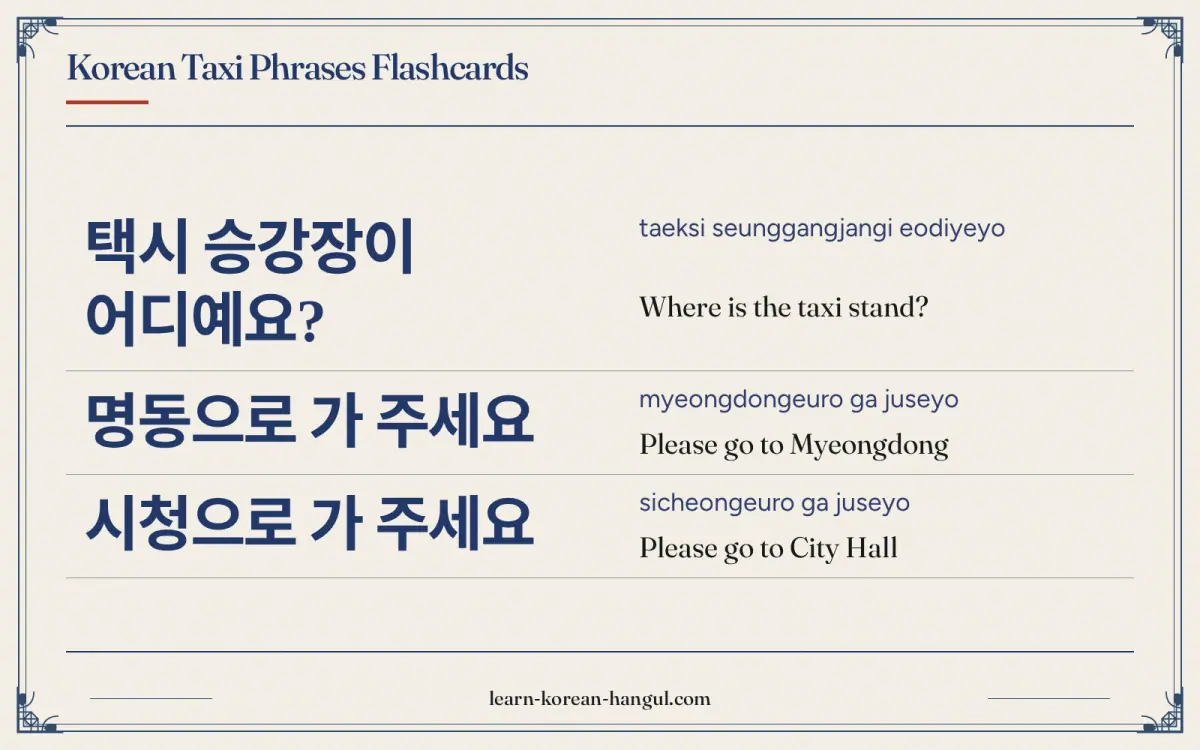
The deck above holds the same 23 cards as the table further down the page. Each card is a whole phrase or a key word, so you practise saying and recognising it, not just spelling it. Nothing plays until you press an audio button.
How Do I Use These Flashcards?
Use the deck in four steps. It works with tap, click or keyboard.
- Choose a mode. Start with recognition (Hangul to meaning). Switch to recall (meaning to Hangul) or listening (audio to meaning) when recognition feels easy.
- Show the answer. Think of the answer first, then press Show answer (or Space). Turn on the romanization toggle only if you need it; the card table below always shows it.
- Grade yourself. Press Got it if you answered correctly without help, or Not yet if you hesitated or guessed.
- Finish the session. A session holds up to 20 cards (you can set 10, 20 or 40). With 23 cards, one session reviews the whole deck once, and a second pass picks up the cards you missed.
What Do the Three Modes Do?
Recognition shows the Hangul and asks for the meaning, which trains reading. Recall shows the meaning and asks for the Hangul, which trains remembering; you may type the phrase with your Hangul keyboard or recall it in your head. Listening plays a clip and hides the letters, which trains the ear. Listening mode only uses a card once its audio is approved, and cards without approved audio are skipped in that mode with a note.
What Do Got It and Not yet Do?
Got it moves the card up one Leitner box, so it returns later. Not yet sends the card back to box 1, so it returns in the same session or within 10 minutes. The grades are your own judgement; the deck does not score you or claim fluency.
Deck Scope: What Is and Is Not Covered
The deck covers finding a taxi stand, giving a destination, stopping the ride, asking the fare, paying and changing subway lines. It does not cover finding places on foot and general directions. Each card uses the same Korean as the matching phrase guide, and the phrase flashcards list has the other decks.
What Is Left out of This Deck?
Left out: finding places on foot and general directions. For related topics, see the Korean directions phrases flashcards and Korean emergency phrases flashcards decks. The full lesson is the korean taxi phrases guide, and the Korean flashcards hub lists every deck, including Hangul, vocabulary, grammar and TOPIK decks.
All 23 Cards in One Table
All 23 cards are listed below. The table is plain HTML and works without the deck.
| # | Hangul | Revised Romanization | Meaning | Note | Audio assetId |
|---|---|---|---|---|---|
| 1 | 택시 승강장이 어디예요? | taeksi seunggangjangi eodiyeyo | Where is the taxi stand? | 승강장 means stand or platform. 택시 sounds like [택씨]. | au-pg-flashcards-taxi-phrases-flashcards-1; slow: au-pg-flashcards-taxi-phrases-flashcards-24 |
| 2 | 명동으로 가 주세요 | myeongdongeuro ga juseyo | Please go to Myeongdong | Place + (으)로 + 가 주세요. | au-pg-flashcards-taxi-phrases-flashcards-2 |
| 3 | 시청으로 가 주세요 | sicheongeuro ga juseyo | Please go to City Hall | Use 으로 after a consonant such as ㅇ. | au-pg-flashcards-taxi-phrases-flashcards-3 |
| 4 | 네, 알겠습니다 | ne, algetseumnida | Yes, understood | A typical driver reply. | au-pg-flashcards-taxi-phrases-flashcards-4 |
| 5 | 어디로 모실까요? | eodiro mosilkkayo | Where shall I take you? | A formal question from a driver. | au-pg-flashcards-taxi-phrases-flashcards-5 |
| 6 | 여기서 세워 주세요 | yeogiseo sewo juseyo | Please stop here | Say it a little early so the car can pull over. | au-pg-flashcards-taxi-phrases-flashcards-6; slow: au-pg-flashcards-taxi-phrases-flashcards-25 |
| 7 | 여기요? | yeogiyo | Here? | A driver checking the stop. | au-pg-flashcards-taxi-phrases-flashcards-7 |
| 8 | 요금이 얼마예요? | yogeumi eolmayeyo | How much is the fare? | Sounds like [요그미 얼마예요]. | au-pg-flashcards-taxi-phrases-flashcards-8; slow: au-pg-flashcards-taxi-phrases-flashcards-26 |
| 9 | 얼마예요? | eolmayeyo | How much is it? | The short price question. | au-pg-flashcards-taxi-phrases-flashcards-9 |
| 10 | 카드 돼요? | kadeu dwaeyo | Do you take cards? | Asks before or after the ride. | au-pg-flashcards-taxi-phrases-flashcards-10 |
| 11 | 네, 카드 돼요 | ne, kadeu dwaeyo | Yes, cards work | A typical driver reply. | au-pg-flashcards-taxi-phrases-flashcards-11 |
| 12 | 현금으로 낼게요 | hyeongeumeuro naelgeyo | I'll pay in cash | Pay with the fare shown. | au-pg-flashcards-taxi-phrases-flashcards-12 |
| 13 | 어디서 갈아타요? | eodiseo garatayo | Where do I transfer? | 갈아타요 means change lines. 타요 means ride. | au-pg-flashcards-taxi-phrases-flashcards-13; slow: au-pg-flashcards-taxi-phrases-flashcards-27 |
| 14 | 2호선은 어디서 갈아타요? | i hoseoneun eodiseo garatayo | Where do I transfer for line 2? | 호선 means line. Use the Sino-Korean number before it. | au-pg-flashcards-taxi-phrases-flashcards-14 |
| 15 | 시청역에서 갈아타세요 | sicheongnyeogeseo garataseyo | Transfer at City Hall Station | A typical reply from staff. 시청역 sounds like [시청녁], with an added [ㄴ] before 역. | au-pg-flashcards-taxi-phrases-flashcards-15 |
| 16 | 몇 호선 | myeot hoseon | Which line? | Sounds like [며토선]. | au-pg-flashcards-taxi-phrases-flashcards-16; slow: au-pg-flashcards-taxi-phrases-flashcards-28 |
| 17 | 몇 번 출구 | myeot beon chulgu | Which exit number? | Ask it when you leave a station. | au-pg-flashcards-taxi-phrases-flashcards-17 |
| 18 | 저기 | jeogi | Over there | Add it to point at a spot. | au-pg-flashcards-taxi-phrases-flashcards-18 |
| 19 | 앞에서 | apeseo | In front | Add it to a stop request. | au-pg-flashcards-taxi-phrases-flashcards-19 |
| 20 | 승강장 | seunggangjang | Stand; platform | Part of 택시 승강장 (taxi stand). | au-pg-flashcards-taxi-phrases-flashcards-20 |
| 21 | 화장실이 어디예요? | hwajangsiri eodiyeyo | Where is the bathroom? | Useful in stations and terminals. | au-pg-flashcards-taxi-phrases-flashcards-21 |
| 22 | 도와주세요 | dowajuseyo | Please help | Polite request for help. | au-pg-flashcards-taxi-phrases-flashcards-22 |
| 23 | 감사합니다 | gamsahamnida | Thank you | Say it when you get out. | au-pg-flashcards-taxi-phrases-flashcards-23 |
How Do I Read the Table?
Hangul is the phrase or word. Revised Romanization (RR) is a learning aid from the South Korean government system of 2000, and it does not show every sound change, so learn the Hangul first. The Meaning column gives the English sense, and the Note column gives a sound or usage tip. The last column lists the audio assetId for the normal-speed clip, with a second ID where a slow clip (0.8x) exists for a sound-focus card.
Usage Notes for These Cards
Give the destination first with (으)로 and then say 가 주세요, such as 명동으로 가 주세요. Use 로 after a vowel or ㄹ, and 으로 after other consonants. Names of stations or well-known buildings are enough, and it helps to show the address in Hangul on your phone.
-(아/어) 주세요 turns almost any verb into a polite request, so 세워 주세요 (stop) follows the same pattern as 가 주세요 (go). Say 여기서 세워 주세요 a little early, because the car needs time to pull over. Add 저기 (over there) or 앞에서 (in front) to point at a spot.
Drivers may answer in formal sentences, such as 어디로 모실까요? ("where shall I take you?"). A short 네 or the place name is a complete reply. Tipping is not expected in Korean taxis, so no tipping phrase is needed.
On the subway, ask about a line with 몇 호선 and an exit with 몇 번 출구. Use Sino-Korean numbers before 호선 and 번. 타요 means "ride" and 갈아타요 means "change lines", so say 갈아타요 for transfers.
Which Sounds Do Not Match the Spelling?
Spelling and sound differ in Korean. Brackets show the sound. The standard pronunciation rules of the National Institute of Korean Language (국립국어원) describe these changes, and the audio shows them.
- 택시 is spoken [택씨]. The ㅅ after ㄱ is tensified.
- 요금이 is spoken [요그미]. The final ㅁ of 금 links to the empty ㅇ of 이 (liaison).
- 몇 호선 is spoken [며토선]. The ㅊ of 몇 is a [ㄷ] sound, which merges with ㅎ into ㅌ.
- 갈아타요 is spoken [가라타요]. The final ㄹ of 갈 links to 아.
What Mistakes Do Learners Make with Taxi Phrases?
- Saying the place name only. The driver needs a verb to be sure, so add 가 주세요.
- Choosing 으로 after a vowel. Use 로 after a vowel or ㄹ.
- Calling the stop too late. Say 여기서 세워 주세요 early.
- Using native numbers for lines, such as 두 호선. Line 2 is 이 호선.
- Mixing 타요 and 갈아타요. 타요 means "ride" and 갈아타요 means "change".
How Does the Review Schedule Work?
The deck uses a simplified Leitner system with five boxes. A new card starts in box 1. Each Got it moves it up one box, and each Not yet returns it to box 1. The box sets how long the card waits before it is due again.
| Box | Wait until the next review |
|---|---|
| 1 | same session or 10 minutes |
| 2 | 1 day |
| 3 | 3 days |
| 4 | 7 days |
| 5 | 21 days |
Each session shows due cards first, oldest due first, and then up to 10 new cards a day by default. A deck of 23 cards fits in two or three short sessions. Progress is saved only in this browser, so clearing site data deletes it. Use the export button to save a small JSON file with card IDs, boxes and due dates, and import it on another device. No account is needed.
Cultural and Practical Context
Taxis in Korean cities take cards in most cases, and tipping is not expected. Station staff and other riders usually answer a transfer question with a station name and an exit number, and they often point to the signs. It is polite to check the payment method with 카드 돼요? before or after the ride.
Limits of This Deck
The deck teaches 23 cards, not every phrase on the topic. Revised Romanization is a reading aid and does not show every sound change. All Korean text on the page is generated and was reviewed and signed off by Min-ji Park on 15 October 2026.
Next Steps after the Korean Taxi Phrases Flashcards
When these cards feel easy, move on to the korean emergency phrases flashcards or the korean directions phrases flashcards. Browse more topics in the korean phrases flashcards list, or open the Korean flashcards hub for every deck.
Frequently Asked Questions
How Do I Tell a Taxi Driver Where to Stop?
Say 여기서 세워 주세요 ("please stop here"). Say it a little early, because the car needs time to pull over. You can add 저기 (over there) or 앞에서 (in front) and point at the spot.
How Do I Tell a Driver Where to Go?
Say the place, then 으로 or 로, then 가 주세요. For example, 명동으로 가 주세요 means "please go to Myeongdong". Use 로 after a vowel or ㄹ and 으로 after other consonants.
Do Taxis Take Cards?
Most taxis in big cities take cards and transit cards, but check by asking 카드 돼요?. If the driver says no, pay in cash with 현금으로 낼게요. Tipping is not expected.
How Do I Ask Where to Change Subway Lines?
Ask 어디서 갈아타요? ("where do I transfer?"). Add the line if you know it, such as 2호선은 어디서 갈아타요?. Staff usually answer with a station name and exit number.
Is My Progress Saved If I Close the Page?
Yes, in the same browser on the same device. Card boxes and due dates are stored locally and no account is needed. Clearing site data, using a private window or switching browsers removes them, so use the export button if you want a backup file to import later.