Korean Greetings Flashcards: Study the 24 Cards
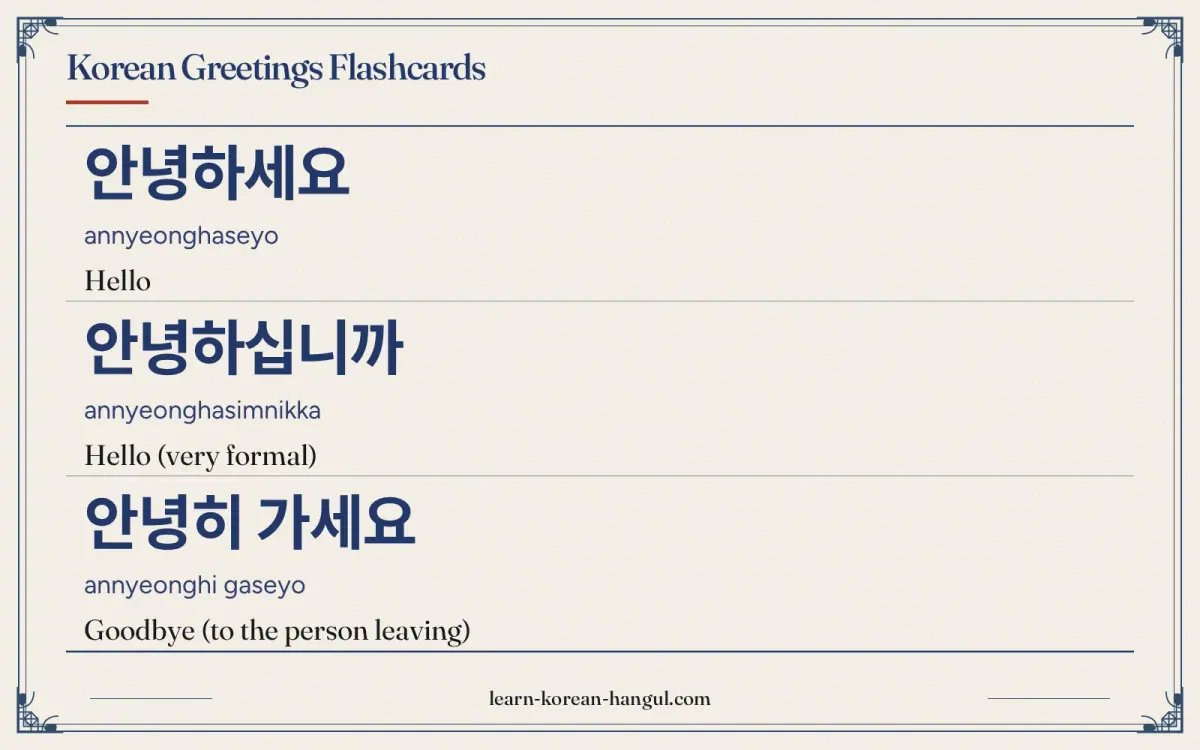
The deck above holds the same 24 cards as the table further down the page. Each card is a whole phrase or a key word, so you practise saying and recognising it, not just spelling it. Nothing plays until you press an audio button.
How Do I Use These Flashcards?
Use the deck in four steps. It works with tap, click or keyboard.
- Choose a mode. Start with recognition (Hangul to meaning). Switch to recall (meaning to Hangul) or listening (audio to meaning) when recognition feels easy.
- Show the answer. Think of the answer first, then press Show answer (or Space). Turn on the romanization toggle only if you need it; the card table below always shows it.
- Grade yourself. Press Got it if you answered correctly without help, or Not yet if you hesitated or guessed.
- Finish the session. A session holds up to 20 cards (you can set 10, 20 or 40). With 24 cards, one session reviews the whole deck once, and a second pass picks up the cards you missed.
What Do the Three Modes Do?
Recognition shows the Hangul and asks for the meaning, which trains reading. Recall shows the meaning and asks for the Hangul, which trains remembering; you may type the phrase with your Hangul keyboard or recall it in your head. Listening plays a clip and hides the letters, which trains the ear. Listening mode only uses a card once its audio is approved, and cards without approved audio are skipped in that mode with a note.
What Do Got It and Not yet Do?
Got it moves the card up one Leitner box, so it returns later. Not yet sends the card back to box 1, so it returns in the same session or within 10 minutes. The grades are your own judgement; the deck does not score you or claim fluency.
Deck Scope: What Is and Is Not Covered
The deck covers everyday greetings and farewells in polite, formal and casual speech, including the 가세요 versus 계세요 split. It does not cover thanks, apologies and self-introduction lines. Each card uses the same Korean as the matching phrase guide, and the phrase flashcards list has the other decks.
What Is Left out of This Deck?
Left out: thanks, apologies and self-introduction lines. For related topics, see the polite Korean phrases flashcards decks. The full lesson is the korean greetings guide, and the Korean flashcards hub lists every deck, including Hangul, vocabulary, grammar and TOPIK decks.
All 24 Cards in One Table
All 24 cards are listed below. The table is plain HTML and works without the deck.
| # | Hangul | Revised Romanization | Meaning | Note | Audio assetId |
|---|---|---|---|---|---|
| 1 | 안녕하세요 | annyeonghaseyo | Hello | Polite. Works at any time of day for anyone you should be polite to. | au-pg-flashcards-greetings-flashcards-1; slow: au-pg-flashcards-greetings-flashcards-25 |
| 2 | 안녕하십니까 | annyeonghasimnikka | Hello (very formal) | The formal -ㅂ니까 form for announcements, ceremonies and business. | au-pg-flashcards-greetings-flashcards-2 |
| 3 | 안녕히 가세요 | annyeonghi gaseyo | Goodbye (to the person leaving) | Say it when the other person leaves. 안녕히 often sounds like [안녕이]. | au-pg-flashcards-greetings-flashcards-3; slow: au-pg-flashcards-greetings-flashcards-26 |
| 4 | 안녕히 계세요 | annyeonghi gyeseyo | Goodbye (said by the person leaving) | Say it when you leave and the other person stays. | au-pg-flashcards-greetings-flashcards-4; slow: au-pg-flashcards-greetings-flashcards-27 |
| 5 | 좋은 아침이에요 | joeun achimieyo | Good morning | Sounds like [조은 아치미에요]. The ㅎ of 좋 is silent. | au-pg-flashcards-greetings-flashcards-5 |
| 6 | 안녕히 주무세요 | annyeonghi jumuseyo | Good night (respectful) | For parents, grandparents, hosts and seniors. | au-pg-flashcards-greetings-flashcards-6 |
| 7 | 잘 지내세요? | jal jinaeseyo | How are you? (respectful) | Literally "are you getting along well?" | au-pg-flashcards-greetings-flashcards-7 |
| 8 | 잘 지내요 | jal jinaeyo | I'm doing well | A natural reply to 잘 지내세요? | au-pg-flashcards-greetings-flashcards-8 |
| 9 | 오랜만이에요 | oraenmanieyo | Long time no see | For someone you have not seen in months or years. | au-pg-flashcards-greetings-flashcards-9 |
| 10 | 어서 오세요 | eoseo oseyo | Welcome | Said by staff and hosts. A nod is enough in reply. | au-pg-flashcards-greetings-flashcards-10 |
| 11 | 들어오세요 | deureooseyo | Please come in | Invites a visitor into a room or home. | au-pg-flashcards-greetings-flashcards-11 |
| 12 | 좋은 하루 보내세요 | joeun haru bonaeseyo | Have a good day | A polite farewell wish. | au-pg-flashcards-greetings-flashcards-12 |
| 13 | 주말 잘 보내세요 | jumal jal bonaeseyo | Have a good weekend | Said on Friday or before a break. | au-pg-flashcards-greetings-flashcards-13 |
| 14 | 조심히 가세요 | josimhi gaseyo | Go safely; have a safe trip | Said to the person who is leaving. | au-pg-flashcards-greetings-flashcards-14 |
| 15 | 몸조심하세요 | momjosimhaseyo | Take care of yourself | From 몸 (body) and 조심 (care). | au-pg-flashcards-greetings-flashcards-15 |
| 16 | 나중에 봐요 | najunge bwayo | See you later | No fixed time for the next meeting. | au-pg-flashcards-greetings-flashcards-16 |
| 17 | 곧 봐요 | got bwayo | See you soon | The next meeting is close in time. | au-pg-flashcards-greetings-flashcards-17 |
| 18 | 내일 봐요 | naeil bwayo | See you tomorrow | For coworkers, classmates and neighbours. | au-pg-flashcards-greetings-flashcards-18 |
| 19 | 다녀왔습니다 | danyeowatseumnida | I'm back (I'm home) | Said when you come home. Literally "I went and came back". | au-pg-flashcards-greetings-flashcards-19 |
| 20 | 뭐 해요? | mwo haeyo | What are you doing? (what's up) | Works as a friendly "what's up". | au-pg-flashcards-greetings-flashcards-20 |
| 21 | 안녕 | annyeong | Hi; bye (casual) | Only for close friends or younger people. Rude to a stranger. | au-pg-flashcards-greetings-flashcards-21 |
| 22 | 잘 가 | jal ga | Bye (casual, to the person leaving) | The casual partner of 안녕히 가세요. | au-pg-flashcards-greetings-flashcards-22 |
| 23 | 잘 있어 | jal isseo | Bye (casual, from the person leaving) | The casual partner of 안녕히 계세요. | au-pg-flashcards-greetings-flashcards-23 |
| 24 | 잘 자 | jal ja | Good night (casual) | For friends, siblings and younger people. | au-pg-flashcards-greetings-flashcards-24 |
How Do I Read the Table?
Hangul is the phrase or word. Revised Romanization (RR) is a learning aid from the South Korean government system of 2000, and it does not show every sound change, so learn the Hangul first. The Meaning column gives the English sense, and the Note column gives a sound or usage tip. The last column lists the audio assetId for the normal-speed clip, with a second ID where a slow clip (0.8x) exists for a sound-focus card.
Usage Notes for These Cards
Say 안녕히 가세요 to the person who is leaving, and 안녕히 계세요 when you are the one leaving. The verb 가다 means "go" and 계시다 means "stay" (honorific). When both people leave together, such as after a meal, each says 안녕히 가세요 to the other.
안녕하세요 works at any time of day with anyone you should be polite to. The same word covers the afternoon and the evening, because Korean has no separate hello for those times. 좋은 아침이에요 is an extra morning greeting, not a required one.
안녕 alone is for close friends or younger people, and it sounds rude to a stranger, a teacher or a boss. 안녕하십니까 is the formal -ㅂ니까 form for news, ceremonies, announcements and business, not for casual chat. The last four cards show the casual partners (안녕, 잘 가, 잘 있어, 잘 자) so you can recognise them in dramas.
A slight bow often goes with a greeting to elders and in service settings. Shop staff will say 어서 오세요 as you enter and do not expect more than a nod.
Which Sounds Do Not Match the Spelling?
Spelling and sound differ in Korean. Brackets show the sound. The standard pronunciation rules of the National Institute of Korean Language (국립국어원) describe these changes, and the audio shows them.
- 안녕히 often sounds like [안녕이] in everyday speech. An ㅎ after ㄴ, ㄹ, ㅁ or ㅇ and before a vowel is weakened or dropped, while careful speech keeps a light [ㅎ].
- 좋은 아침이에요 is spoken [조은 아치미에요]. The ㅎ of 좋 is silent before a vowel, and the ㅊ links to the next syllable.
- 안녕하십니까 is spoken [안녕하심니까]. The ㅂ before ㄴ becomes [ㅁ] (nasalization).
- 다녀왔습니다 is spoken [다녀왇씀니다]. The final ㅆ is a [ㄷ] sound before ㅅ, the ㅅ is tensified, and the ㅂ nasalizes before ㄴ.
What Mistakes Do Learners Make with Greetings?
- Saying 안녕히 계세요 to someone who is walking away from you. Use 안녕히 가세요.
- Using 안녕 with a teacher, boss or stranger. Use 안녕하세요.
- Answering 잘 지내세요? with 안녕하세요 again. A natural reply is 네, 잘 지내요.
- Using 다녀왔습니다 as a greeting to someone else. It is what you say when you come home.
How Does the Review Schedule Work?
The deck uses a simplified Leitner system with five boxes. A new card starts in box 1. Each Got it moves it up one box, and each Not yet returns it to box 1. The box sets how long the card waits before it is due again.
| Box | Wait until the next review |
|---|---|
| 1 | same session or 10 minutes |
| 2 | 1 day |
| 3 | 3 days |
| 4 | 7 days |
| 5 | 21 days |
Each session shows due cards first, oldest due first, and then up to 10 new cards a day by default. A deck of 24 cards fits in two or three short sessions. Progress is saved only in this browser, so clearing site data deletes it. Use the export button to save a small JSON file with card IDs, boxes and due dates, and import it on another device. No account is needed.
Cultural and Practical Context
Koreans often greet each other by asking whether you have eaten (식사하셨어요?), a habit rooted in older times that survives as small talk. A slight bow with the greeting is standard to elders and in service settings. The cards in this deck follow the three speech levels (formal, polite and casual), so choose the level that fits the listener before you choose the phrase.
Limits of This Deck
The deck teaches 24 cards, not every phrase on the topic. Revised Romanization is a reading aid and does not show every sound change. All Korean text on the page is generated and was reviewed and signed off by Min-ji Park on 15 October 2026.
Next Steps after the Korean Greetings Flashcards
When these cards feel easy, move on to the polite korean phrases flashcards. Browse more topics in the korean phrases flashcards list, or open the Korean flashcards hub for every deck.
Frequently Asked Questions
What Is the Difference between 안녕히 가세요 and 안녕히 계세요?
안녕히 가세요 means "go in peace" and you say it to the person who is leaving. 안녕히 계세요 means "stay in peace" and you say it when you are the one leaving. If you both leave at the same time, each says 안녕히 가세요.
Can I Say 안녕 to Everyone?
No. 안녕 is casual and fits close friends or younger people. Use 안녕하세요 for strangers, teachers, coworkers and anyone older. 안녕하십니까 is the very formal version.
Is 안녕하세요 Right for Morning, Noon and Night?
Yes. 안녕하세요 works at any hour of the day. 좋은 아침이에요 is an optional morning greeting, and 안녕히 주무세요 is the respectful good night said when someone goes to sleep.
Do I Have to Bow When I Greet Someone?
A slight bow or nod is normal with elders and in service settings, but it does not need to be deep. With friends your age, a wave or a smile is enough.
Is My Progress Saved If I Close the Page?
Yes, in the same browser on the same device. Card boxes and due dates are stored locally and no account is needed. Clearing site data, using a private window or switching browsers removes them, so use the export button if you want a backup file to import later.