
Polite Korean Phrases Flashcards: Study the 23 Cards
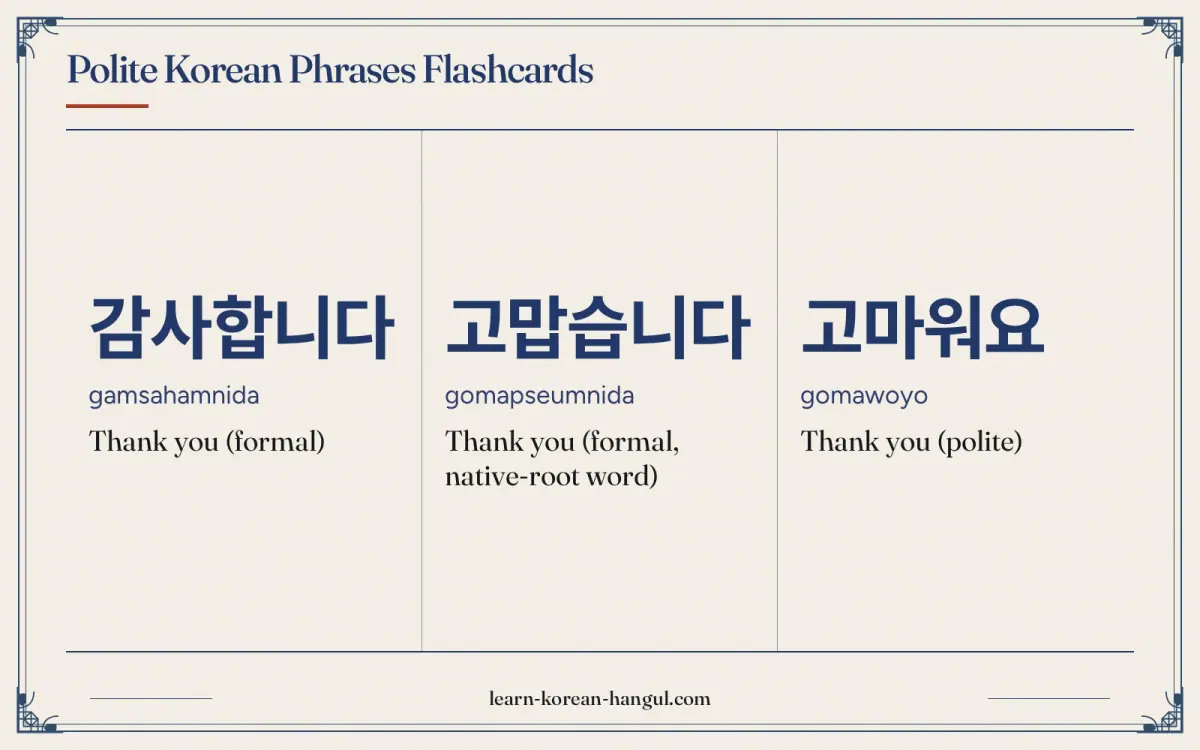
The cards run in four groups: thanks (cards 1 to 8), apologies (9 to 15), getting past and asking (16 to 19), and answering politely (20 to 23). Each Korean phrase is copied from the phrase pages on this site, which give the full explanation and example dialogues, so open the matching page whenever a card needs more context.
How Do I Use These Flashcards?
Use the deck above in four steps. It works with tap, click or keyboard, and nothing plays until you press an audio button.
- Choose a mode. Start with recognition (Hangul to meaning). Switch to recall (meaning to Hangul) or listening (audio to meaning) once recognition feels easy.
- Show the answer. Think of the answer first, then press Show answer (or Space). Turn on the romanization toggle only if you need it; the table below always shows it.
- Grade yourself. Press Got it if you answered correctly without help, or Not yet if you hesitated or guessed.
- Finish the session. A session holds up to 20 cards (you can set 10, 20 or 40). With 23 cards, a first-time learner should expect about 3 days at the default limit of 10 new cards a day, with review sessions on top.
The Three Study Modes
Recognition shows the Hangul and asks for the meaning, so with the first card it shows 감사합니다 and you answer "Thank you (formal)". Recall reverses this: it shows the meaning and asks for the Hangul, and you may type the answer with your Hangul keyboard or just say it in your head. Listening plays a clip and hides the letters, which trains the ear. Listening mode only uses a card once its audio is approved, and cards without approved audio are skipped in that mode with a note. For this deck, listening mode is the best test of the long phrases, because many of them change sound at the joins between words.
Got It and Not Yet
Got it moves a card up one Leitner box, so it comes back later. Not yet sends the card back to box 1, so it returns in the same session or within 10 minutes. The grades are your own judgement; the deck does not score you or claim fluency.
Deck Scope: What Is and Is Not Covered
The deck covers thanks, apologies, requests and the everyday "it's okay" replies, in the formal (합쇼체) and polite (해요체) styles. It leaves out casual forms such as 고마워 and 미안해, which are for close friends and are explained on the phrase pages. The words and letters on these cards are explained in the polite korean phrases lesson, so read it first if a card is new.
What This Deck Leaves Out
Greetings are in the Korean greetings flashcards, and self-introductions are in the next deck listed under Next steps. Ordering food and work-specific courtesy have their own phrase decks and lessons, so they are not mixed in here.
All 23 Cards in One Table
All 23 cards appear below in deck order. The table is plain HTML, so you can use it as a drill without the deck: cover the Meaning column, read each phrase aloud, then uncover it.
| # | Hangul | Revised Romanization | Meaning | Note | Audio assetId |
|---|---|---|---|---|---|
| 1 | 감사합니다 | gamsahamnida | Thank you (formal) | Safe with anyone; said [감사함니다]. | au-pg-flashcards-polite-expressions-flashcards-1; slow: au-pg-flashcards-polite-expressions-flashcards-24 |
| 2 | 고맙습니다 | gomapseumnida | Thank you (formal, native-root word) | As formal as 감사합니다, with a slightly warmer feel. | au-pg-flashcards-polite-expressions-flashcards-2 |
| 3 | 고마워요 | gomawoyo | Thank you (polite) | For people you speak politely with but know a little. | au-pg-flashcards-polite-expressions-flashcards-3 |
| 4 | 정말 감사합니다 | jeongmal gamsahamnida | Thank you very much | 정말 means really; it adds warmth. | au-pg-flashcards-polite-expressions-flashcards-4 |
| 5 | 도와주셔서 감사합니다 | dowajusyeoseo gamsahamnida | Thank you for helping me | Names the help; the 주시 part is respectful. | au-pg-flashcards-polite-expressions-flashcards-5 |
| 6 | 선물 감사합니다 | seonmul gamsahamnida | Thank you for the gift | For elders, bosses, teachers and clients. | au-pg-flashcards-polite-expressions-flashcards-6 |
| 7 | 잘 먹겠습니다 | jal meokgetseumnida | Thank you for the meal (said before eating) | Literally "I will eat well"; said to the host. | au-pg-flashcards-polite-expressions-flashcards-7 |
| 8 | 잘 먹었습니다 | jal meogeotseumnida | Thank you for the meal (said after eating) | Literally "I ate well"; said when you finish. | au-pg-flashcards-polite-expressions-flashcards-8 |
| 9 | 죄송합니다 | joesonghamnida | I am sorry (formal) | The safe apology for customers, teachers and bosses. | au-pg-flashcards-polite-expressions-flashcards-9 |
| 10 | 미안해요 | mianhaeyo | I am sorry (polite) | For peers and people younger than you. | au-pg-flashcards-polite-expressions-flashcards-10 |
| 11 | 정말 죄송합니다 | jeongmal joesonghamnida | I am very sorry | A stronger formal apology. | au-pg-flashcards-polite-expressions-flashcards-11 |
| 12 | 늦어서 죄송합니다 | neujeoseo joesonghamnida | Sorry I am late | The 어서 ending gives the reason: because I am late. | au-pg-flashcards-polite-expressions-flashcards-12 |
| 13 | 불편을 드려 죄송합니다 | bulpyeoneul deuryeo joesonghamnida | Sorry for the inconvenience | Used by staff and in notices. | au-pg-flashcards-polite-expressions-flashcards-13 |
| 14 | 사과드립니다 | sagwadeurimnida | I apologize (formal, humble) | Common in emails and public statements. | au-pg-flashcards-polite-expressions-flashcards-14 |
| 15 | 용서해 주세요 | yongseohae juseyo | Please forgive me | Polite; used for a real mistake. | au-pg-flashcards-polite-expressions-flashcards-15 |
| 16 | 실례합니다 | sillyehamnida | Excuse me | Said before you interrupt or pass someone. | au-pg-flashcards-polite-expressions-flashcards-16 |
| 17 | 잠시만요 | jamsimanyo | Just a moment; excuse me | Polite way to ask people to let you pass. | au-pg-flashcards-polite-expressions-flashcards-17 |
| 18 | 주세요 | juseyo | Please give me | Added to an item: 물 주세요 (water, please). | au-pg-flashcards-polite-expressions-flashcards-18 |
| 19 | 부탁합니다 | butakamnida | I ask this of you (please) | Formal request; said [부타캄니다]. | au-pg-flashcards-polite-expressions-flashcards-19; slow: au-pg-flashcards-polite-expressions-flashcards-25 |
| 20 | 괜찮아요 | gwaenchanayo | It's okay; no thank you | Said [괜차나요]; tone decides the meaning. | au-pg-flashcards-polite-expressions-flashcards-20; slow: au-pg-flashcards-polite-expressions-flashcards-26 |
| 21 | 괜찮습니다 | gwaenchanseumnida | I'm fine; no, thank you (formal) | The formal way to decline an offer. | au-pg-flashcards-polite-expressions-flashcards-21 |
| 22 | 문제없어요 | munjeeopseoyo | No problem | Polite; the formal form is 문제없습니다. | au-pg-flashcards-polite-expressions-flashcards-22 |
| 23 | 천만에요 | cheonmaneyo | You're welcome | The textbook reply to thanks. | au-pg-flashcards-polite-expressions-flashcards-23 |
Reading the Table
Hangul is the phrase. Revised Romanization (RR) is a learning aid, so read the Hangul first. RR follows sound changes between letters, such as nasalization, which is why 감사합니다 [감사함니다] is written gamsahamnida. It does not mark tensing, so 잘 먹겠습니다 is written jal meokgetseumnida although the 겠 and 습 are said tense. The Meaning column gives the English sense, and the Note column says who the phrase suits or how it sounds. A second ID in the last column marks a slow clip.
Usage Notes for These Cards
Two ways to say thank you in formal Korean. 감사합니다 and 고맙습니다 are both formal and interchangeable for strangers and elders, whereas 고마워 without 요 is only for close friends. Adding 요 gives 고마워요, which suits people you speak politely with but know a little. Add 정말 for emphasis: 정말 감사합니다 (thank you very much).
Thank the person for the specific thing. 도와주셔서 감사합니다 (thank you for helping) and 선물 감사합니다 (thank you for the gift) name what you are thanking. Before a meal someone paid for or cooked, say 잘 먹겠습니다, and say 잘 먹었습니다 when you finish; both go to the person who treated you.
Choosing an apology. 죄송합니다 is the safe apology for customers, teachers and bosses, while 미안해요 is for peers and people younger than you. Add 정말 or a reason to make it stronger: 늦어서 죄송합니다 (sorry I am late). 불편을 드려 죄송합니다 apologizes for causing inconvenience, and 사과드립니다 is a formal, humble statement used in emails and notices.
Excuse me before, sorry after. 실례합니다 is said before you interrupt or squeeze past someone, while 죄송합니다 is said after you have made a mistake. 잠시만요 (just a moment) is the polite way to ask people to let you pass.
One word, three meanings. 괜찮아요 can mean "I'm fine", "it's okay" or "no thank you" depending on tone, so a shop offering a bag gets 괜찮아요 as a polite refusal. 괜찮습니다 is the formal version. To accept something, say 주세요 or 네, 부탁합니다 instead.
Which Sounds Do Not Match the Spelling?
감사합니다 is said [감사함니다]: the ㅂ of 합 becomes ㅁ before ㄴ (nasalization). Revised Romanization follows this and writes gamsahamnida.
부탁합니다 is said [부타캄니다]. The ㄱ of 탁 and the ㅎ of 합 merge into an aspirated ㅋ sound, and the ㅂ then nasalizes to ㅁ. The Revised Romanization is butakamnida.
괜찮아요 is said [괜차나요]. The ㅎ in ㄶ is silent before a vowel, and the ㄴ links to the next syllable. The Revised Romanization is gwaenchanayo.
What Mistakes Do Learners Make with Thank You, Sorry and Please?
- Using 고마워 or 미안해 to a boss or someone older. The bare forms are casual, so use 감사합니다 and 죄송합니다.
- Saying 죄송합니다 when you just want to get past someone. 실례합니다 or 잠시만요 fits better.
- Taking 괜찮아요 as "yes please" when offered something. It usually declines, so say 네, 주세요 to accept.
- Using 미안해요 to a customer or teacher. 죄송합니다 is the safe formal apology there.
Most of these slips are about register, so check who you are speaking to before you pick a card's phrase.
How Does the Review Schedule Work?
The deck uses a simplified Leitner system with five boxes. A new card starts in box 1. Each Got it moves it up one box, and each Not yet returns it to box 1. The box sets how long the card waits before it is due again.
| Box | Wait until the next review |
|---|---|
| 1 | same session or 10 minutes |
| 2 | 1 day |
| 3 | 3 days |
| 4 | 7 days |
| 5 | 21 days |
Each session shows due cards first, oldest due first, and then new cards up to the daily limit, which is 10 by default. A deck of 23 cards is introduced in about three days at the default of 10 new cards a day, and the later boxes bring each phrase back at longer gaps. Progress is saved only in this browser, so clearing site data deletes it. Use the export button to save a small JSON file with card IDs, boxes and due dates, and import it on another device. The file holds no personal data.
Cultural and Practical Context
Korean has no single pair of words for thanks and sorry; the right choice depends on the age and rank of the person you are speaking to. Saying 수고하셨습니다 to staff or colleagues at the end of a task is a standard way of acknowledging effort, though some speakers avoid it toward a superior, so listen to what the people around you say. Thanks are often paired with a small nod or bow rather than a deep one.
Limits of This Deck
The deck holds 23 phrases, a starting set rather than a complete etiquette guide. Each card carries its main meaning only, and casual forms are left to the phrase pages. 천만에요 is the textbook "you're welcome", but many speakers simply answer with 아니에요 or a smile, so treat the card as a form to recognize. The Korean text on this page is generated and was reviewed and signed off by Min-ji Park on 15 October 2026.
Next Steps after This Deck
This deck is one of the korean phrases flashcards on the site, so browse the full list if you want a different topic. When these cards feel easy, move on to introduce yourself in korean flashcards to keep the same routine. If a word here still feels shaky, go back to korean greetings flashcards for the earlier material. All flashcard decks, including Hangul, vocabulary, phrases, grammar and TOPIK, are listed on the Korean flashcards hub.
Frequently Asked Questions
Which 'Thank You' Is Best for Strangers?
Use 감사합니다 for strangers, shop staff, teachers and bosses. It is formal and always safe. 고맙습니다 is just as formal and slightly warmer, and 고마워요 suits people you know a little. Avoid bare 고마워 until a friend uses it with you.
When Should I Use 죄송합니다 and When 미안해요?
Use 죄송합니다 with customers, teachers, bosses and strangers, because it is formal and respectful. Use 미안해요 with peers and people younger than you, where a gentler polite style fits. Between close friends, drop the 요 and say 미안해.
Does 괜찮아요 Mean Yes or No?
It depends on tone and context. It can mean "I'm fine", "it's okay" or "no thank you". If a shop offers a bag and you say 괜찮아요, you are refusing. To accept something, say 주세요 or 네, 부탁합니다.
Can I Say 수고하셨습니다 to My Teacher or Boss?
Many people avoid it toward a superior, because it can sound as if you are judging their work. It is common toward staff and colleagues at the end of a task. With a teacher or boss, 감사합니다 is the safer choice.
Is My Progress Saved If I Close the Page?
Yes, in the same browser on the same device. Card boxes and due dates are stored locally and nothing is sent to a server. Clearing site data, using a private window or switching browsers removes them, so use the export button to keep a backup file. No account is needed.