Korean Shopping Phrases Flashcards: Study the 23 Cards
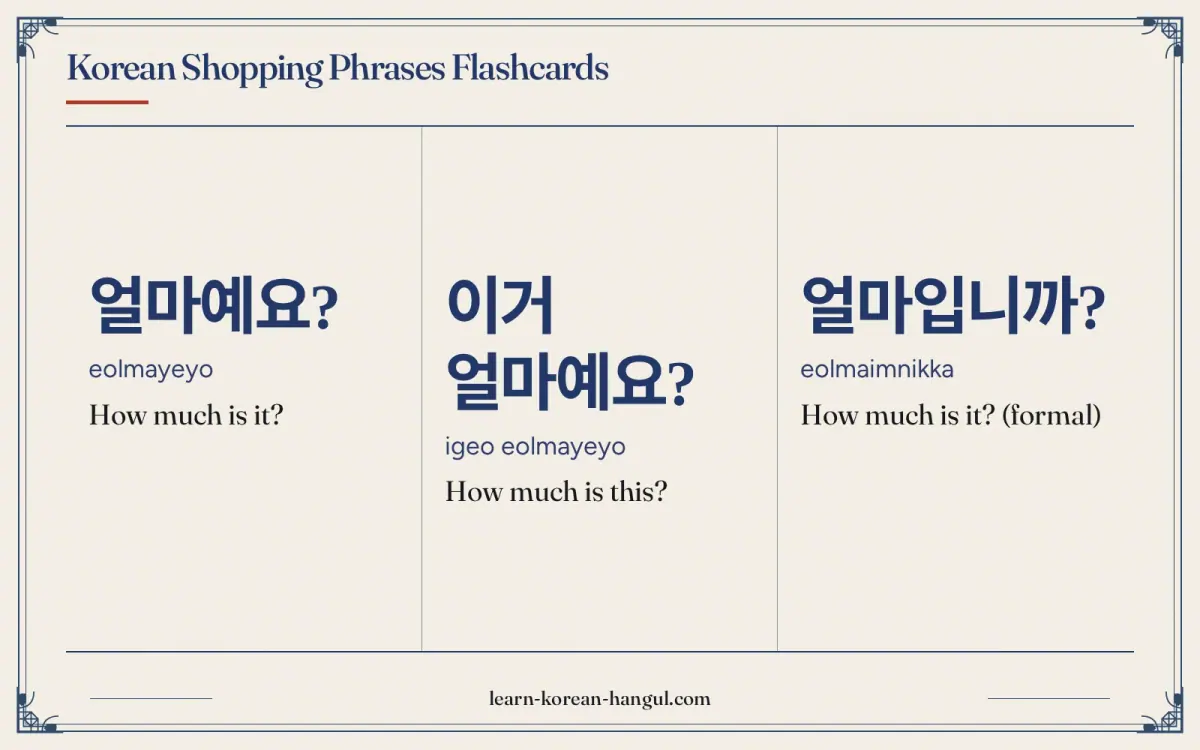
The deck above holds the same 23 cards as the table further down the page. Each card is a whole phrase or a key word, so you practise saying and recognising it, not just spelling it. Nothing plays until you press an audio button.
How Do I Use These Flashcards?
Use the deck in four steps. It works with tap, click or keyboard.
- Choose a mode. Start with recognition (Hangul to meaning). Switch to recall (meaning to Hangul) or listening (audio to meaning) when recognition feels easy.
- Show the answer. Think of the answer first, then press Show answer (or Space). Turn on the romanization toggle only if you need it; the card table below always shows it.
- Grade yourself. Press Got it if you answered correctly without help, or Not yet if you hesitated or guessed.
- Finish the session. A session holds up to 20 cards (you can set 10, 20 or 40). With 23 cards, one session reviews the whole deck once, and a second pass picks up the cards you missed.
What Do the Three Modes Do?
Recognition shows the Hangul and asks for the meaning, which trains reading. Recall shows the meaning and asks for the Hangul, which trains remembering; you may type the phrase with your Hangul keyboard or recall it in your head. Listening plays a clip and hides the letters, which trains the ear. Listening mode only uses a card once its audio is approved, and cards without approved audio are skipped in that mode with a note.
What Do Got It and Not yet Do?
Got it moves the card up one Leitner box, so it returns later. Not yet sends the card back to box 1, so it returns in the same session or within 10 minutes. The grades are your own judgement; the deck does not score you or claim fluency.
Deck Scope: What Is and Is Not Covered
The deck covers asking prices, pointing with 이거 그거 저거, trying on, bargaining, paying by card, receipts, refunds and round-number prices. It does not cover restaurant ordering and taxi fares. Each card uses the same Korean as the matching phrase guide, and the phrase flashcards list has the other decks.
What Is Left out of This Deck?
Left out: restaurant ordering and taxi fares. For related topics, see the Korean restaurant phrases flashcards and Korean taxi phrases flashcards decks. The full lesson is the korean shopping phrases guide, and the Korean flashcards hub lists every deck, including Hangul, vocabulary, grammar and TOPIK decks.
All 23 Cards in One Table
All 23 cards are listed below. The table is plain HTML and works without the deck.
| # | Hangul | Revised Romanization | Meaning | Note | Audio assetId |
|---|---|---|---|---|---|
| 1 | 얼마예요? | eolmayeyo | How much is it? | The polite price question for shops, markets and restaurants. | au-pg-flashcards-shopping-phrases-flashcards-1; slow: au-pg-flashcards-shopping-phrases-flashcards-24 |
| 2 | 이거 얼마예요? | igeo eolmayeyo | How much is this? | Point at the item and add 이거. | au-pg-flashcards-shopping-phrases-flashcards-2 |
| 3 | 얼마입니까? | eolmaimnikka | How much is it? (formal) | Formal style. Sounds like [얼마임니까]. | au-pg-flashcards-shopping-phrases-flashcards-3 |
| 4 | 이거 | igeo | This (near me) | Points to something close to the speaker. | au-pg-flashcards-shopping-phrases-flashcards-4 |
| 5 | 그거 | geugeo | That (near you) | Points to something close to the listener. | au-pg-flashcards-shopping-phrases-flashcards-5 |
| 6 | 저거 | jeogeo | That (far from both) | Points to something over there. | au-pg-flashcards-shopping-phrases-flashcards-6 |
| 7 | 이거 주세요 | igeo juseyo | This one, please | The polite request used in shops and cafés. | au-pg-flashcards-shopping-phrases-flashcards-7 |
| 8 | 이것을 주십시오 | igeoseul jusipsio | This one, please (formal) | Formal style for announcements and business. | au-pg-flashcards-shopping-phrases-flashcards-8 |
| 9 | 저거 주세요 | jeogeo juseyo | That one over there, please | Point as you say it. | au-pg-flashcards-shopping-phrases-flashcards-9 |
| 10 | 그거 보여 주세요 | geugeo boyeo juseyo | Please show me that one | Asks to see the item near the seller. | au-pg-flashcards-shopping-phrases-flashcards-10 |
| 11 | 그냥 구경하는 거예요 | geunyang gugyeonghaneun geoyeyo | I'm just looking | A polite way to say you are not buying yet. | au-pg-flashcards-shopping-phrases-flashcards-11 |
| 12 | 입어 봐도 돼요? | ibeo bwado dwaeyo | Can I try it on? | Sounds like [이버 봐도 돼요]: the final ㅂ links to 어. | au-pg-flashcards-shopping-phrases-flashcards-12; slow: au-pg-flashcards-shopping-phrases-flashcards-25 |
| 13 | 깎아 주세요 | kkakka juseyo | Please give a discount | Sounds like [까까 주세요]. Fine at markets, odd at fixed prices. | au-pg-flashcards-shopping-phrases-flashcards-13; slow: au-pg-flashcards-shopping-phrases-flashcards-26 |
| 14 | 카드 돼요? | kadeu dwaeyo | Do you take cards? | Short and polite. | au-pg-flashcards-shopping-phrases-flashcards-14 |
| 15 | 카드 사용 가능합니까? | kadeu sayong ganeunghamnikka | Can I use a card? (formal) | Formal style. | au-pg-flashcards-shopping-phrases-flashcards-15 |
| 16 | 영수증 주세요 | yeongsujeung juseyo | Receipt, please | Name the item, then 주세요. | au-pg-flashcards-shopping-phrases-flashcards-16 |
| 17 | 영수증 주십시오 | yeongsujeung jusipsio | Receipt, please (formal) | Formal style. | au-pg-flashcards-shopping-phrases-flashcards-17 |
| 18 | 환불하고 싶어요 | hwanbulhago sipeoyo | I'd like a refund | The -고 싶어요 pattern means "I want to". | au-pg-flashcards-shopping-phrases-flashcards-18 |
| 19 | ATM 어디 있어요? | ei-ti-em eodi isseoyo | Where is the ATM? | The English letters ATM are read ei-ti-em. | au-pg-flashcards-shopping-phrases-flashcards-19 |
| 20 | 천 원 | cheon won | 1,000 won | Say 천, not 일천. | au-pg-flashcards-shopping-phrases-flashcards-20 |
| 21 | 오천 원 | ocheon won | 5,000 won | Sino-Korean number + 원. | au-pg-flashcards-shopping-phrases-flashcards-21 |
| 22 | 만 원 | man won | 10,000 won | Say 만, not 일만, for 10,000. | au-pg-flashcards-shopping-phrases-flashcards-22 |
| 23 | 이만 원 | iman won | 20,000 won | 2 × 10,000. | au-pg-flashcards-shopping-phrases-flashcards-23 |
How Do I Read the Table?
Hangul is the phrase or word. Revised Romanization (RR) is a learning aid from the South Korean government system of 2000, and it does not show every sound change, so learn the Hangul first. The Meaning column gives the English sense, and the Note column gives a sound or usage tip. The last column lists the audio assetId for the normal-speed clip, with a second ID where a slow clip (0.8x) exists for a sound-focus card.
Usage Notes for These Cards
Ask the price with 얼마예요?. Answers are Sino-Korean numbers plus 원, such as 이만 원 for 20,000 won. For 10,000 won, Korean says 만 원, not 일만 원. These four price cards show the pattern for most round prices: a Sino-Korean number, then 천 or 만, then 원.
이거, 그거 and 저거 mean "this", "that near you" and "that over there". Point and say 그거 보여 주세요 to ask to see the item near the seller. -(아/어) 주세요 turns almost any verb into a polite request.
Formal-style cards (얼마입니까?, 이것을 주십시오, 카드 사용 가능합니까?, 영수증 주십시오) fit announcements and business counters. The polite 요 style is the safe default in shops. Casual 줘 and 얼마야? are for friends only.
Bargaining with 깎아 주세요 is normal at traditional markets, but fixed-price stores, malls and convenience shops do not bargain. Ask for a refund with 환불하고 싶어요, and keep the receipt.
Which Sounds Do Not Match the Spelling?
Spelling and sound differ in Korean. Brackets show the sound. The standard pronunciation rules of the National Institute of Korean Language (국립국어원) describe these changes, and the audio shows them.
- 깎아 is spoken [까까]. The final ㄲ links to the vowel (liaison).
- 입어 봐도 is spoken [이버 봐도]. The final ㅂ links to 어.
- 얼마입니까 is spoken [얼마임니까]. The ㅂ before ㄴ turns into [ㅁ] (nasalization).
- 싶어요 is spoken [시퍼요]. The final ㅍ of 싶 links to the vowel in 어.
What Mistakes Do Learners Make with Shopping Phrases?
- Using 깎아 주세요 in a department store. It can sound odd at a fixed price.
- Saying 얼마 for "how much". It needs 예요: 얼마예요?.
- Saying 일만 원 for 10,000 won. Say 만 원.
- Mixing up 그거 (near you) and 저거 (far from both). Use 그거 for what the seller holds.
How Does the Review Schedule Work?
The deck uses a simplified Leitner system with five boxes. A new card starts in box 1. Each Got it moves it up one box, and each Not yet returns it to box 1. The box sets how long the card waits before it is due again.
| Box | Wait until the next review |
|---|---|
| 1 | same session or 10 minutes |
| 2 | 1 day |
| 3 | 3 days |
| 4 | 7 days |
| 5 | 21 days |
Each session shows due cards first, oldest due first, and then up to 10 new cards a day by default. A deck of 23 cards fits in two or three short sessions. Progress is saved only in this browser, so clearing site data deletes it. Use the export button to save a small JSON file with card IDs, boxes and due dates, and import it on another device. No account is needed.
Cultural and Practical Context
Haggling is part of market shopping in places such as Namdaemun, but department stores and chain shops have set prices. Many shops give a small free extra, called 서비스, when you buy several things. Cards work in most shops, but small stalls may prefer cash, so 카드 돼요? is a useful question.
Limits of This Deck
The deck teaches 23 cards, not every phrase on the topic. Revised Romanization is a reading aid and does not show every sound change. All Korean text on the page is generated and was reviewed and signed off by Min-ji Park on 15 October 2026.
Next Steps after the Korean Shopping Phrases Flashcards
When these cards feel easy, move on to the korean small talk flashcards or the korean restaurant phrases flashcards. Browse more topics in the korean phrases flashcards list, or open the Korean flashcards hub for every deck.
Frequently Asked Questions
Can I Bargain in Every Shop?
No. Bargaining with 깎아 주세요 fits traditional markets and some street stalls. Fixed-price stores, malls and convenience shops do not bargain, and the request can sound odd there.
How Do I Ask to See Another Item?
Point and say 저거 보여 주세요 ("please show me that one over there") or 그거 보여 주세요 ("please show me that one near you"). Use 이거 for something in your hand.
How Do I Tell the Cashier How I'll Pay?
Ask 카드 돼요? to check that cards work. If a card is not accepted, ask where the ATM is with ATM 어디 있어요?.
How Do I Get a Refund?
Say 환불하고 싶어요 ("I'd like a refund") and show the receipt. Ask for the receipt in advance with 영수증 주세요.
Is My Progress Saved If I Close the Page?
Yes, in the same browser on the same device. Card boxes and due dates are stored locally and no account is needed. Clearing site data, using a private window or switching browsers removes them, so use the export button if you want a backup file to import later.