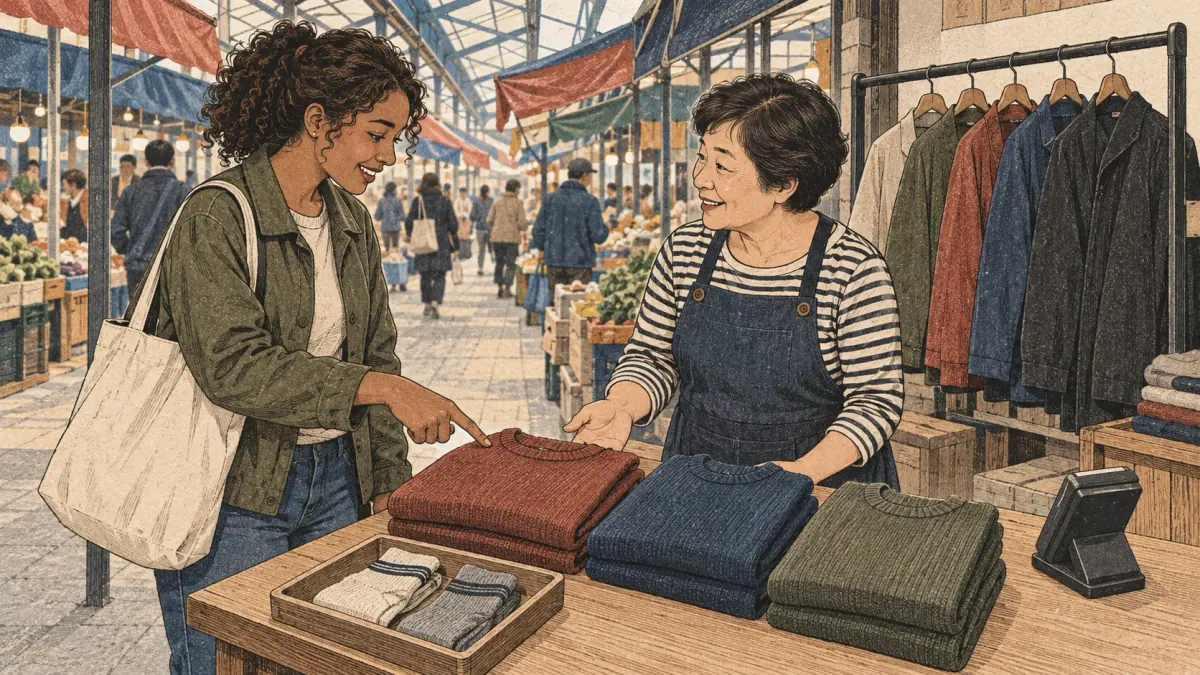
What Are the Most Useful Korean Shopping Phrases to Learn First?
Learn nine lines in the order of a shop visit: browse, ask the price, try on, choose, ask for a discount, pay, take a receipt and, if needed, return the item. Add the ATM line if you need cash. Together they cover almost every step of a shopping trip, and each one is short enough to say after a few tries.
| Order | Situation | Korean | Revised Romanization | Page |
|---|---|---|---|---|
| 1 | Browsing | 그냥 구경하는 거예요 | geunyang gugyeonghaneun geoyeyo | I'm just looking in Korean |
| 2 | Asking the price | 얼마예요? | eolmayeyo | how much is it in Korean |
| 3 | Trying on | 입어 봐도 돼요? | ibeo bwado dwaeyo | can I try it on in Korean |
| 4 | Choosing | 이거 주세요 | igeo juseyo | this one please in Korean |
| 5 | Bargaining | 깎아 주세요 | kkakka juseyo | discount please in Korean |
| 6 | Paying by card | 카드 돼요? | kadeu dwaeyo | do you take cards in Korean |
| 7 | Receipts | 영수증 주세요 | yeongsujeung juseyo | receipt please in Korean |
| 8 | Returns | 환불하고 싶어요 | hwanbulhago sipeoyo | refund in Korean |
| 9 | Getting cash | ATM 어디 있어요? | ei-ti-em eodi isseoyo | where is the ATM in Korean |
Revised Romanization (the South Korean government standard of 2000) is shown only as a reading aid. Learn the Hangul first, because price tags and signs use it. Notice that 이거 주세요 and 깎아 주세요 end the same way: 주세요 is the polite request for "please give me" or "please do for me". The next section explains how to pick the form for each listener.
How Do You Choose between Formal, Polite and Casual Korean Shopping Phrases?
Pick the phrase by the situation first (price, size, payment), then by the listener: the polite style ends in 요 or 주세요 and works with every shop assistant and cashier. Korean grammar marks the listener with three styles, and the page on Korean speech levels explains them in depth. The polite style (해요체) is the safe default, the casual style (해체) is for close friends shopping together, and the formal style (합쇼체) is for announcements, written notices and very formal service.
| Situation | Polite (safe default) | Casual (friends) | Formal (announcements) |
|---|---|---|---|
| How much is it? | 얼마예요? | 얼마야? | 얼마입니까? |
| This one, please. | 이거 주세요 | 이거 줘 | 이것을 주십시오 |
| Can I try it on? | 입어 봐도 돼요? | 입어 봐도 돼? | 입어 봐도 됩니까? |
| Do you take cards? | 카드 돼요? | 카드 돼? | 카드 사용 가능합니까? |
| Receipt, please. | 영수증 주세요 | 영수증 줘 | 영수증 주십시오 |
A shop assistant should always hear the polite column. Three habits shape a Korean shopping trip before the guide list: how to point, where bargaining works, and how to handle cards and prices.
Point with 이, 그 and 저
Korean has three pointing words, not two. 이거 means "this one" and points to something near you. 그거 means "that one" and points to something near the listener or something you have both just mentioned. 저거 means "that one over there" and points to something far from both of you. The same item can therefore be 그거 for you and 이거 for the assistant, depending on who speaks.
| Word | Romanization | Points to | Shop example |
|---|---|---|---|
| 이거 | igeo | near me | 이거 얼마예요? |
| 그거 | geugeo | near you | 그거 보여 주세요 |
| 저거 | jeogeo | far from both | 저거 주세요 |
The grammar is explained in the guide to 이, 그, 저 demonstratives, and the this one please in Korean page shows the polite requests in full.
Next, the question of price.
Where Bargaining Works and Where It Does Not
Bargaining with 깎아 주세요 (kkakka juseyo, "please give a discount") works mainly in traditional markets (재래시장, jaeraesijang) and some street stalls, and even there it is gentle. Department stores, convenience stores, chain shops and online stores charge fixed prices, and asking for a cut there usually draws a polite refusal.
A softer approach in a market is to ask for a bonus item instead: 덤으로 주세요 (deomeuro juseyo, "please add a little extra for free"). Vendors often add a small extra to a larger purchase. Smile, keep the polite ending, and accept a no calmly.
Now the practical side of paying.
Cards, Cash Receipts, ATMs and Prices
Most shops accept cards, and you can check with 카드 돼요? (kadeu dwaeyo, "do cards work?"). If you pay in cash, a cashier may ask whether you want a cash receipt (현금영수증, hyeongeumyeongsujeung), which is used for tax deductions by Korean residents. Visitors can say 필요 없어요 (piryo eopseoyo, "not needed") or ask for a normal receipt with 영수증 주세요. For cash, 현금 인출하고 싶어요 and ATM 어디 있어요? get you to a machine.
To follow a price you need Sino-Korean numbers followed by 원 (won). Listen for these:
| Price | Korean | Romanization |
|---|---|---|
| 1,000 won | 천 원 | cheon won |
| 5,000 won | 오천 원 | ocheon won |
| 10,000 won | 만 원 | man won |
| 20,000 won | 이만 원 | iman won |
The system is explained in money and prices and the won counter, and the money vocabulary page lists related words. Now the guide list itself.
All Korean Shopping Phrases Guides
The list below has all 9 guides, each with its lead phrase and a short audio clip. Start with the four main pages, then use the alphabetical list for the rest. Every published guide follows the same layout: a quick answer, a register table, pronunciation with audio, usage scenes, short dialogues and common mistakes. The Korean phrases hub holds the other situation clusters.
Start Here
How Much Is It in Korean
The lead phrase is 얼마예요? (eolmayeyo), which means "how much is it." It adds 이거 얼마예요? (how much is this?), the formal 얼마입니까? and the casual 얼마야?.
This One Please in Korean
The lead phrase is 이거 주세요 (igeo juseyo), which means "this one, please." It adds 이것 주세요, 저거 주세요 and 그거 주세요 for pointing at items near, far and next to the assistant.
Can I Try It on in Korean
The key phrase is 입어 봐도 돼요? (ibeo bwado dwaeyo), which means "can I try it on."
Discount Please in Korean
The key phrase is 깎아 주세요 (kkakka juseyo), which means "please give a discount."
More Phrases
The remaining 5 guides are listed in alphabetical order.
Do You Take Cards in Korean
The key phrase is 카드 돼요? (kadeu dwaeyo), which means "do you take cards."
I'm Just Looking in Korean
The key phrase is 그냥 구경하는 거예요 (geunyang gugyeonghaneun geoyeyo), which means "I'm just looking."
Receipt Please in Korean
The key phrase is 영수증 주세요 (yeongsujeung juseyo), which means "receipt please."
Refund in Korean
The key phrase is 환불하고 싶어요 (hwanbulhago sipeoyo), which means "I'd like a refund."
Where Is the ATM in Korean
The key phrase is ATM 어디 있어요? (ei-ti-em eodi isseoyo), which means "where is the ATM."
How Do You Practise Korean Shopping Phrases?
Shopping phrases improve fastest when you say them in the order of a real visit. Use this routine for ten minutes a day:
- Play the clip beside a lead phrase above and repeat it twice, matching the speed.
- Say the nine core lines in shop order without looking, then check them against the table.
- Point at objects around you and say 이거, 그거 or 저거 with 주세요.
- Read prices aloud in Sino-Korean numbers: 천 원, 오천 원, 만 원.
- Drill the cluster with the phrase flashcards, which pair each phrase with audio.
Short daily sessions beat one long one, because shop lines must come out without thought when a queue is waiting. For word lists to go with them, see Korean shopping vocabulary and shopping in Korean. After practice, watch for the mistakes below.
What Mistakes Do Learners Make with Korean Shopping Phrases?
Learners most often use the wrong pointing word. Four more mistakes appear often:
- Using 그거 for an item next to you. 그거 points to the listener's side. Fix: use 이거.
- Bargaining in a fixed-price shop. Fix: save 깎아 주세요 for traditional markets and keep it polite.
- Using the casual form with staff. 이거 줘 is rude to an assistant. Fix: say 이거 주세요.
- Mixing number systems. Prices use Sino-Korean numbers (이만 원), while counting items uses native numbers (두 개). Fix: use one system per job.
- Skipping the receipt for returns. Refunds usually need it. Fix: keep it, and say 영수증 있어요.
Most of these fixes come down to pointing correctly and speaking politely. The questions below cover details that the cards do not.
Frequently Asked Questions
The answers below add details about Korean shopping phrases beyond the guides above.
How do I ask the price in Korean?
Point at the item and say 이거 얼마예요? (igeo eolmayeyo), meaning "how much is this?". The shorter 얼마예요? also works. Listen for Sino-Korean numbers plus 원, for example 오천 원 (5,000 won) or 만 원 (10,000 won). If you do not understand, ask 다시 말씀해 주세요 (please say it again).
Can I bargain in Korea?
Yes, but only in some places. Traditional markets and street stalls may accept a polite 깎아 주세요 (please give a discount), especially for several items. Department stores, chain shops, convenience stores and online shops use fixed prices. If a vendor refuses, accept it calmly, or ask for a small extra with 덤으로 주세요.
How do I say I am just looking?
Say 그냥 구경하는 거예요 (geunyang gugyeonghaneun geoyeyo), meaning "I am just looking", or the shorter 구경 중이에요 (I am browsing). When an assistant approaches, a polite smile with 천천히 볼게요 (I'll take my time looking) works too. They will usually leave you alone and wait for 저기요 (excuse me) when you need help.
How do I ask for a different size?
Ask 더 큰 사이즈 있어요? (do you have a bigger size?) or 더 작은 사이즈 있어요? (a smaller size?). For colour, say 다른 색깔 있어요? (do you have another colour?). To try an item first, ask 입어 봐도 돼요? (can I try it on?). Point at the item and say 이거 for clarity.
How do I understand prices in Korean?
Prices use Sino-Korean numbers plus 원 (won). Learn 천 (1,000), 만 (10,000) and the pattern for multiples: 오천 원 is 5,000 won, 이만 원 is 20,000 won. Say the number slowly if you ask the seller to repeat it, or ask them to show it on the screen or write it down.