
Kpop Korean Phrases Flashcards: Study the 23 Cards
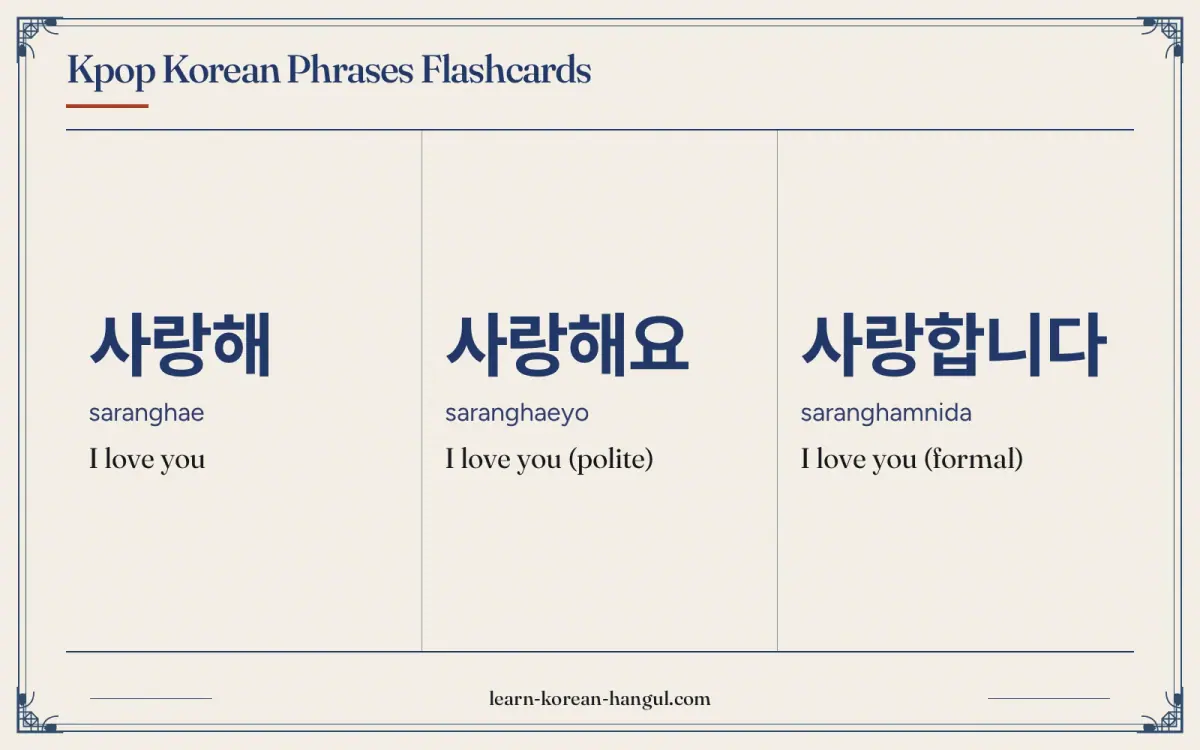
The deck above holds the same 23 cards as the table further down the page. Each card is a whole phrase or a key word, so you practise saying and recognising it, not just spelling it. Nothing plays until you press an audio button.
How Do I Use These Flashcards?
Use the deck in four steps. It works with tap, click or keyboard.
- Choose a mode. Start with recognition (Hangul to meaning). Switch to recall (meaning to Hangul) or listening (audio to meaning) when recognition feels easy.
- Show the answer. Think of the answer first, then press Show answer (or Space). Turn on the romanization toggle only if you need it; the card table below always shows it.
- Grade yourself. Press Got it if you answered correctly without help, or Not yet if you hesitated or guessed.
- Finish the session. A session holds up to 20 cards (you can set 10, 20 or 40). With 23 cards, one session reviews the whole deck once, and a second pass picks up the cards you missed.
What Do the Three Modes Do?
Recognition shows the Hangul and asks for the meaning, which trains reading. Recall shows the meaning and asks for the Hangul, which trains remembering; you may type the phrase with your Hangul keyboard or recall it in your head. Listening plays a clip and hides the letters, which trains the ear. Listening mode only uses a card once its audio is approved, and cards without approved audio are skipped in that mode with a note.
What Do Got It and Not yet Do?
Got it moves the card up one Leitner box, so it returns later. Not yet sends the card back to box 1, so it returns in the same session or within 10 minutes. The grades are your own judgement; the deck does not score you or claim fluency.
Deck Scope: What Is and Is Not Covered
The deck covers love phrases for fans, a K-pop conversation opener, goodbyes, group words and address terms. It does not cover drama exclamations, romance lines and long concert vocabulary. Each card uses the same Korean as the matching phrase guide, and the phrase flashcards list has the other decks.
What Is Left out of This Deck?
Left out: drama exclamations, romance lines and long concert vocabulary. For related topics, see the K-drama Korean phrases flashcards and Korean filler words flashcards decks. The full lesson is the kpop korean phrases guide, and the Korean flashcards hub lists every deck, including Hangul, vocabulary, grammar and TOPIK decks.
All 23 Cards in One Table
All 23 cards are listed below. The table is plain HTML and works without the deck.
| # | Hangul | Revised Romanization | Meaning | Note | Audio assetId |
|---|---|---|---|---|---|
| 1 | 사랑해 | saranghae | I love you | Casual form of the verb 사랑하다. Fans write it on banners. | au-pg-flashcards-kpop-phrases-flashcards-1 |
| 2 | 사랑해요 | saranghaeyo | I love you (polite) | Safer for a message to an idol or an older fan. | au-pg-flashcards-kpop-phrases-flashcards-2 |
| 3 | 사랑합니다 | saranghamnida | I love you (formal) | Formal style for speeches. | au-pg-flashcards-kpop-phrases-flashcards-3 |
| 4 | 보라해 | borahae | I purple you | A fan phrase popularised by BTS. 보라 is purple. | au-pg-flashcards-kpop-phrases-flashcards-4; slow: au-pg-flashcards-kpop-phrases-flashcards-24 |
| 5 | 케이팝 좋아해요? | keipap joahaeyo | Do you like K-pop? | The opening question of fan conversation. 좋아해요 sounds like [조아해요]. | au-pg-flashcards-kpop-phrases-flashcards-5 |
| 6 | 케이팝 좋아해? | keipap joahae | Do you like K-pop? (casual) | For friends and fans of your age. | au-pg-flashcards-kpop-phrases-flashcards-6 |
| 7 | 네, 정말 좋아해요 | ne, jeongmal joahaeyo | Yes, I really like it | A natural reply to 케이팝 좋아해요? | au-pg-flashcards-kpop-phrases-flashcards-7 |
| 8 | 또 만나요 | tto mannayo | Let's meet again | A warm goodbye after fan meetings and concerts. 또 is a tense sound. | au-pg-flashcards-kpop-phrases-flashcards-8 |
| 9 | 다음에 또 만나요 | daeume tto mannayo | Let's meet again next time | Adds 다음에 (next time). | au-pg-flashcards-kpop-phrases-flashcards-9 |
| 10 | 또 보자 | tto boja | See you again (casual) | For friends. | au-pg-flashcards-kpop-phrases-flashcards-10 |
| 11 | 막내 | mangnae | The youngest member | Often spelled maknae in K-pop. It sounds like [망내]. | au-pg-flashcards-kpop-phrases-flashcards-11; slow: au-pg-flashcards-kpop-phrases-flashcards-25 |
| 12 | 리더 | rideo | Leader (of a group) | Borrowed from English. | au-pg-flashcards-kpop-phrases-flashcards-12 |
| 13 | 팬 | paen | Fan | Borrowed from English. | au-pg-flashcards-kpop-phrases-flashcards-13 |
| 14 | 아이돌 | aidol | Idol | Borrowed from English. | au-pg-flashcards-kpop-phrases-flashcards-14 |
| 15 | 컴백 | keombaek | Comeback (new release) | A group's return with new music. | au-pg-flashcards-kpop-phrases-flashcards-15 |
| 16 | 최애 | choeae | Favourite member | Fan slang for the member you like most. | au-pg-flashcards-kpop-phrases-flashcards-16 |
| 17 | 응원봉 | eungwonbong | Lightstick | The official light stick fans wave at concerts. | au-pg-flashcards-kpop-phrases-flashcards-17 |
| 18 | 오빠 | oppa | Older brother (said by women) | A term of closeness. Do not use it in formal messages. | au-pg-flashcards-kpop-phrases-flashcards-18 |
| 19 | 언니 | eonni | Older sister (said by women) | Used by women and girls. | au-pg-flashcards-kpop-phrases-flashcards-19 |
| 20 | 누나 | nuna | Older sister (said by men) | Used by men and boys. | au-pg-flashcards-kpop-phrases-flashcards-20 |
| 21 | 형 | hyeong | Older brother (said by men) | Used by men and boys. | au-pg-flashcards-kpop-phrases-flashcards-21 |
| 22 | 대박 | daebak | Awesome; wow | Slang, mostly casual. | au-pg-flashcards-kpop-phrases-flashcards-22 |
| 23 | 파이팅 | paiting | Fighting! (go for it) | A cheer borrowed from English before a stage or exam. | au-pg-flashcards-kpop-phrases-flashcards-23 |
How Do I Read the Table?
Hangul is the phrase or word. Revised Romanization (RR) is a learning aid from the South Korean government system of 2000, and it does not show every sound change, so learn the Hangul first. The Meaning column gives the English sense, and the Note column gives a sound or usage tip. The last column lists the audio assetId for the normal-speed clip, with a second ID where a slow clip (0.8x) exists for a sound-focus card.
Usage Notes for These Cards
Choose a phrase by who you are talking to. The casual 사랑해 suits friends and fan chants. The polite 사랑해요 suits a message to an idol or an older fan, and the formal 사랑합니다 suits speeches. 보라해 is a fan coinage from BTS fans, not an ordinary Korean sentence.
Address terms depend on who is speaking. Women say 오빠 (older brother) and 언니 (older sister), and men say 형 (older brother) and 누나 (older sister). Fans often call older male idols 오빠, but the word means older brother and is a term of closeness. For a neutral, polite choice, use the name plus 님 (nim) or 씨 (ssi).
Group words are mostly borrowed from English or built from fan slang: 팬, 아이돌, 컴백, 리더. 막내 is the youngest member of a group, a family or a team, and the word carries warmth. 최애 means the member you like most. 응원봉 is the light stick.
On social media and at concerts, polite 요 forms are typical. 파이팅 is cheered before a stage, exam or match. 또 만나요 and 다음에 또 만나요 close a fan meeting warmly.
Which Sounds Do Not Match the Spelling?
Spelling and sound differ in Korean. Brackets show the sound. The standard pronunciation rules of the National Institute of Korean Language (국립국어원) describe these changes, and the audio shows them.
- 막내 is spoken [망내]. The ㄱ becomes [ㅇ] before ㄴ (nasalization), so fans' maknae differs from the Revised Romanization mangnae.
- 좋아해요 is spoken [조아해요]. The ㅎ of 좋 is silent before a vowel.
- 또 is a tense ㄸ, said with a tight throat and no puff of air.
- 컴백 ends in a final ㄱ that is held without a release, so the word stops sharply.
What Mistakes Do Learners Make with K-Pop Fan Phrases?
- Trusting fan spellings. "Maknae" is the popular spelling, but 막내 is said [망내], so the Revised Romanization is mangnae.
- Using the casual 사랑해 with someone you should speak politely to.
- Treating 보라해 as normal Korean. It is a fan coinage, so Koreans outside the fandom may not use it.
- Calling any male idol 오빠 in a formal message. Use the name plus 님.
How Does the Review Schedule Work?
The deck uses a simplified Leitner system with five boxes. A new card starts in box 1. Each Got it moves it up one box, and each Not yet returns it to box 1. The box sets how long the card waits before it is due again.
| Box | Wait until the next review |
|---|---|
| 1 | same session or 10 minutes |
| 2 | 1 day |
| 3 | 3 days |
| 4 | 7 days |
| 5 | 21 days |
Each session shows due cards first, oldest due first, and then up to 10 new cards a day by default. A deck of 23 cards fits in two or three short sessions. Progress is saved only in this browser, so clearing site data deletes it. Use the export button to save a small JSON file with card IDs, boxes and due dates, and import it on another device. No account is needed.
Cultural and Practical Context
Fan culture in Korea is organised: groups have official fan clubs, light sticks and cheering chants during a stage. Fans often prepare cheers in advance. The words on these cards come from that culture, so some of them, such as 보라해 and 최애, are used mostly by fans.
Limits of This Deck
The deck teaches 23 cards, not every phrase on the topic. Revised Romanization is a reading aid and does not show every sound change. All Korean text on the page is generated and was reviewed and signed off by Min-ji Park on 15 October 2026.
Next Steps after the Kpop Korean Phrases Flashcards
When these cards feel easy, move on to the korean filler words flashcards or the kdrama korean phrases flashcards. Browse more topics in the korean phrases flashcards list, or open the Korean flashcards hub for every deck.
Frequently Asked Questions
What Does 보라해 Mean?
보라해 means "I purple you". 보라 is purple, and 해 comes from 사랑해. It is a fan phrase popularised by BTS and their fans, and purple became the colour linked to the group. It is a fan coinage, not an everyday Korean sentence.
How Do I Say "I'm a Fan" or Ask Someone's Taste?
Ask 케이팝 좋아해요? ("do you like K-pop?") and answer 네, 정말 좋아해요. Use 팬 (fan) for the noun. The casual 케이팝 좋아해? fits friends.
Which Phrases Are Safe to Use in a Message to an Idol?
Use polite 요 forms, such as 사랑해요, and add 님 after the name if you want to be respectful. Avoid 오빠 in a formal message, because it is a term of closeness.
What Is the Difference between 사랑해, 사랑해요 and 사랑합니다?
They are casual, polite and formal forms of the same sentence. 사랑해 is for friends and chants, 사랑해요 is the polite default, and 사랑합니다 is for speeches and formal writing.
Is My Progress Saved If I Close the Page?
Yes, in the same browser on the same device. Card boxes and due dates are stored locally and no account is needed. Clearing site data, using a private window or switching browsers removes them, so use the export button if you want a backup file to import later.