
What Are the Most Useful Kpop Korean Phrases to Learn First?
Learn five phrases first: 사랑해 (saranghae, I love you), 보라해 (borahae, I purple you), 케이팝 좋아해요? (keipap joahaeyo, do you like K-pop), 또 만나요 (tto mannayo, let's meet again) and 막내 (mangnae, often spelled maknae in K-pop; the youngest member). Together they cover love, fandom, a first conversation, a goodbye and a group role.
| Order | Situation | Korean | Revised Romanization | Page |
|---|---|---|---|---|
| 1 | Telling someone you love them | 사랑해 | saranghae | Saranghae in Korean |
| 2 | Sharing fan love | 보라해 | borahae | Borahae in Korean |
| 3 | Starting a chat with a fan | 케이팝 좋아해요? | keipap joahaeyo | Do you like kpop in Korean |
| 4 | Saying goodbye | 또 만나요 | tto mannayo | Let's meet again in Korean |
| 5 | Naming a role | 막내 | mangnae | Maknae in Korean |
Revised Romanization (the South Korean government standard of 2000) is shown only as a reading aid. Learn the Hangul first. The last row shows why: fans write maknae, but the Revised Romanization is mangnae, because the sound changes to [망내]. The next section explains how to choose a phrase for your listener.
How Do You Choose between Formal, Polite and Casual Kpop Korean Phrases?
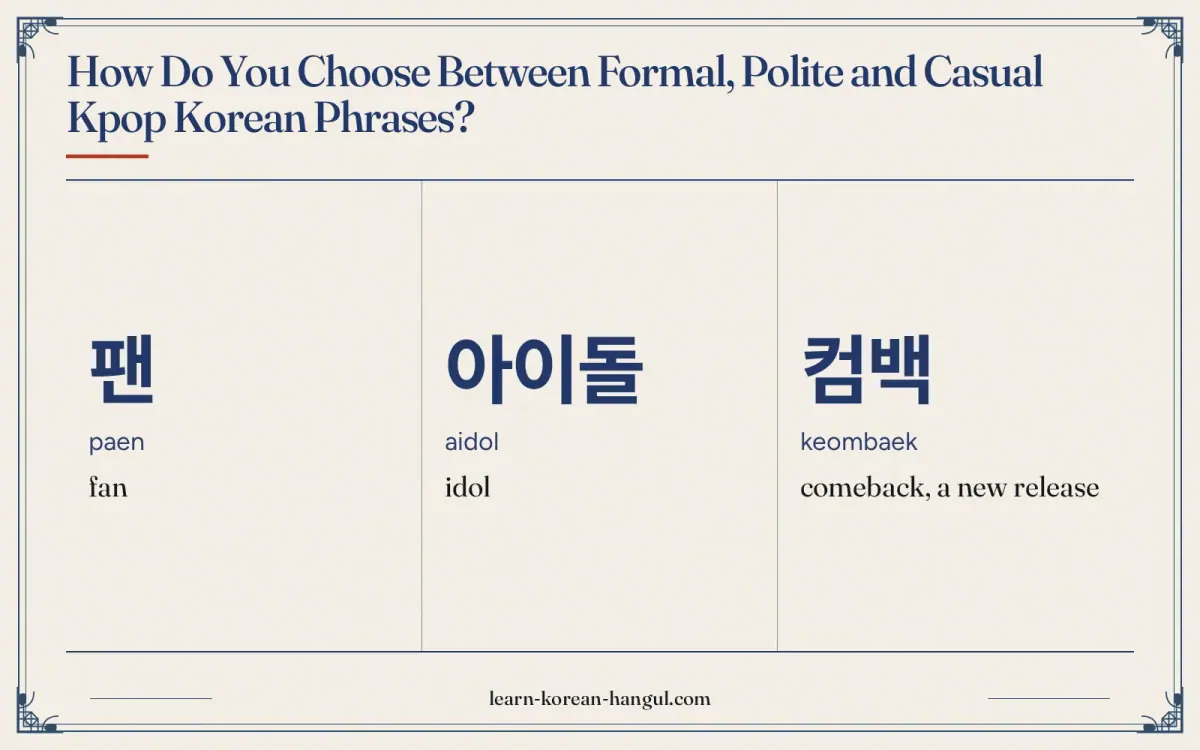
Choose by who you are talking to. Fan phrases are mostly simple verbs with a polite ending, and the ending changes with the listener, as explained in the guide to Korean speech levels. The casual 사랑해 suits friends and fan chants, the polite 사랑해요 suits a message to an idol or an older fan, and the formal 사랑합니다 belongs to speeches and letters.
A few rules help in fan spaces:
- Messages to idols. Use the polite -요 ending, and add 님 (nim) after a name if you want to be respectful.
- Chatting with other fans. Casual endings are common among people of the same age, but start polite if you do not know the other person's age.
- Song lyrics. Many lyrics use casual speech because the singer talks to a lover. Copying a lyric line to an elder can sound too familiar.
- Address terms. Words such as 오빠 (oppa), 언니 (unnie), 누나 (noona) and 형 (hyung) sit in their own hub, terms of address, and the page on oppa in Korean explains the most popular one.
Fan culture also has its own vocabulary, which the next table summarises.
| Korean | Romanization | Meaning |
|---|---|---|
| 팬 | paen | fan |
| 아이돌 | aidol | idol |
| 컴백 | keombaek | comeback, a new release |
| 최애 | choeae | favourite member |
| 응원봉 | eungwonbong | lightstick |
| 리더 | rideo | leader of a group |
| 막내 | mangnae | youngest member |
These are loanwords and fan words that appear in every concert and comment section. The page on kpop korean words teaches a longer themed list with a deck and a worksheet. Now the full list of phrase guides.
All Kpop Korean Phrases Guides
The list below has all 5 guides, each with its lead phrase and a short audio clip. Every published guide follows the same layout: a quick answer, a register table, pronunciation with audio, usage scenes, short dialogues and common mistakes. The Korean phrases hub holds the other situation clusters.
Start Here
Saranghae in Korean
The lead phrase is 사랑해 (saranghae), which means "I love you." It comes from the verb 사랑하다, "to love", with the casual ending -해. Fans write it on banners and in messages. The page explains the polite 사랑해요, the formal 사랑합니다 and the tone for an idol.
Borahae in Korean
The lead phrase is 보라해 (borahae), which means "I purple you." The word 보라 is purple, and 해 comes from 사랑해. It is a fan phrase popularised by BTS, not an ordinary Korean sentence. The page shows how fans use it and what purple stands for.
Do You Like Kpop in Korean
The key phrase is 케이팝 좋아해요? (keipap joahaeyo), which means "do you like K-pop?" It is the opening question of fan conversation.
More Phrases
The remaining 2 guides are listed below.
Let's Meet Again in Korean
The key phrase is 또 만나요 (tto mannayo), which means "let's meet again" or "see you again." A warm goodbye used after fan meetings and concerts.
Maknae in Korean
The key phrase is 막내 (mangnae, often spelled maknae in K-pop), which means "the youngest member." The word is used for the youngest person in a group, a family or a team.
How Do You Practise Kpop Korean Phrases?
Practise with the music itself. Play the audio on a card, repeat the phrase twice, then find it in a lyric sheet and read the Hangul along with the song. Notice the ending of each line: is it casual, polite or formal? Drill the set with the phrase flashcards, which include audio for each form, and keep the Hangul visible while the romanization is hidden. If you want a longer route, the free course on learning Korean with kpop sequences the lessons.
What Mistakes Do Learners Make with Kpop Korean Phrases?
The first mistake is trusting fan spellings. "Saranghae" happens to match the Revised Romanization, but the popular "maknae" does not: 막내 is said [망내], so the official spelling is mangnae. The second is using the casual 사랑해 with someone you should speak politely to. The third is treating 보라해 as normal Korean: it is a fan coinage, so Koreans outside the fandom may not know it. A fourth is calling every older man 오빠 without thinking about the relationship.
Use it to copy rhythm and sound. With a feel for each phrase and its listener, you can pick the right line from these kpop korean phrases and say it with the right ending.
Frequently Asked Questions
What does saranghae mean?
사랑해 (saranghae) means I love you in casual speech. It comes from the verb 사랑하다, to love, with the casual ending -해. Fans write it on banners and in messages. With seniors or strangers, the polite 사랑해요 (saranghaeyo) is the safer choice, and the formal 사랑합니다 (saranghamnida) is used in speeches.
What is borahae?
보라해 (borahae) is a fan phrase popularised by the group BTS. 보라 means purple and 해 is borrowed from 사랑해, so it is often explained as I purple you. Fans use it to show love for the group, and purple became the colour linked to BTS and their fans. It is a fan coinage, not an everyday Korean word.
Can I call an idol oppa?
Many female fans call older male idols 오빠 (oppa), but the word means older brother, and it is a term of closeness that the idol did not choose. If you want a neutral, polite choice, use the name plus 님 (nim) or 씨 (ssi). The address terms hub explains oppa, unnie, noona and hyung.
What is a maknae?
막내 (mangnae, often spelled maknae in K-pop) is the youngest member of a group, a family or a team. K-pop fans use it for the youngest member of an idol group, and the word carries warmth, because the maknae is often treated as the group's baby. In pronunciation, 막내 is [망내], because ㄱ becomes ㅇ before ㄴ.