Kdrama Korean Phrases Flashcards: Study the 24 Cards
Drama dialogue is closer to real speech than a textbook, and much of it is casual. The lesson behind this deck is kdrama korean phrases, so read it first if a card is new, and use the cards to tell reactions you can copy from reactions you should only recognise.
How Do I Use These Flashcards?
Use the deck above in four steps. It works with tap, click or keyboard, and nothing plays until you press an audio button.
- Choose a mode. Start with recognition (Hangul to meaning). Switch to recall (meaning to Hangul) or listening (audio to meaning) once recognition feels easy.
- Show the answer. Think of the meaning and the register first, then press Show answer (or Space). Say the phrase aloud with the feeling a drama actor would give it, then ask who you could say it to. Turn on the romanization toggle only if you need it; the 24-card table below always shows it.
- Grade yourself. Press Got it if you answered correctly without help, or Not yet if you hesitated or guessed.
- Finish the session. A session holds up to 20 cards (you can set 10, 20 or 40). With 24 cards, a first-time learner can split the deck over 3 days, using the default limit of 10 new cards a day.
The Three Study Modes
Recognition shows the Hangul and asks for the meaning, which trains reading. Recall shows the meaning and asks for the Hangul, which trains remembering; you may type the answer with your Hangul keyboard or just recall it in your head. Listening plays a clip and hides the letters, which trains the ear. The pronunciation audio is generated with text-to-speech and a Korean teacher approves it before it is switched on. Listening mode only uses cards whose audio is approved, and cards without approved audio are skipped in that mode with a note.
Got It and Not Yet
Got it moves the card up one Leitner box, so it comes back later. Not yet sends the card back to box 1, so it returns in the same session or within 10 minutes. The grades are your own judgement; the deck does not score you or claim fluency.
Deck Scope: What Is and Is Not Covered
The deck covers exclamations and short lines heard in dramas, with their register. It has surprise and doubt (아이고, 대박, 진짜?, 헐), agreement and reassurance (알았어, 괜찮아?), worry and upset (어떡해, 왜 그래?), apology and promise, and the address terms 오빠, 언니, 형 and 누나. Several cards are casual speech by design, because that is what characters say to friends and family.
What Is Left out of This Deck?
The deck does not cover love confessions or fan chants. For romantic lines use the I love you in Korean flashcards, and for concert and fan language use the kpop korean phrases flashcards. Polite everyday phrases are in the polite Korean phrases flashcards.
All 24 Cards in One Table
All 24 cards appear below in deck order. The table is plain HTML, so you can use it as a drill without the deck: cover the Meaning column, say each phrase aloud, then uncover it.
| # | Hangul | Revised Romanization | Meaning | Note | Audio assetId |
|---|---|---|---|---|---|
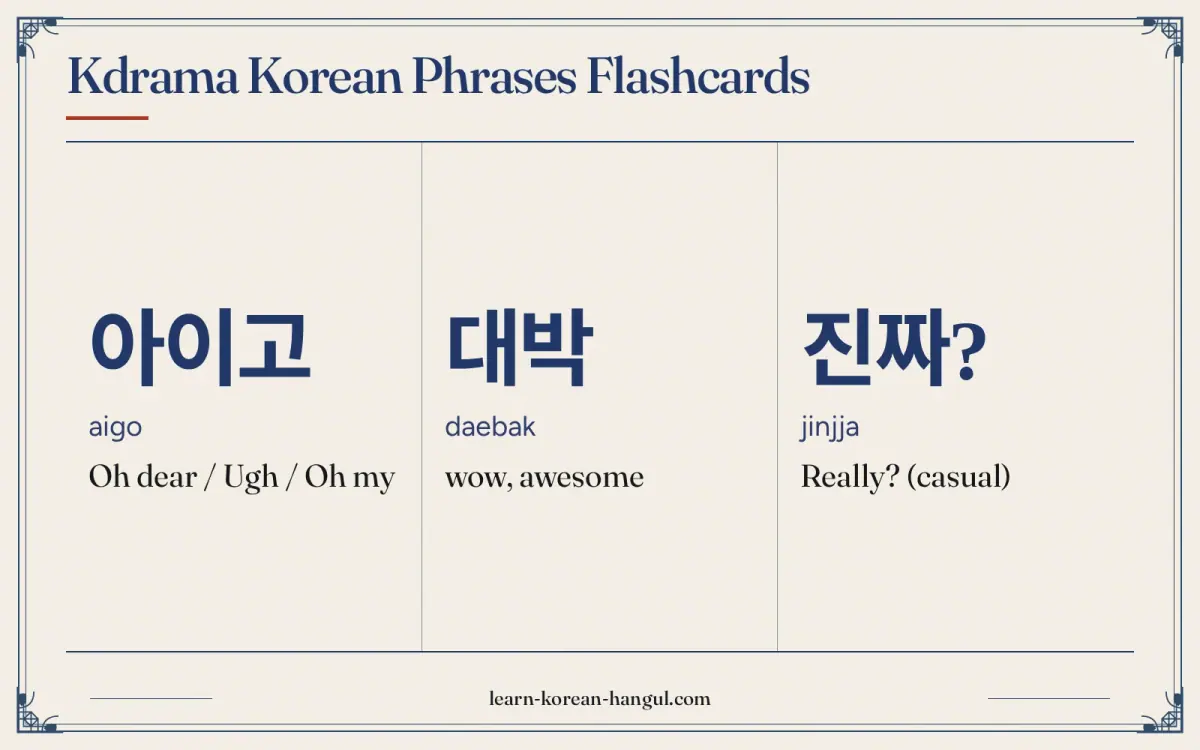
| 1 | 아이고 | aigo | Oh dear / Ugh / Oh my | A sigh for pain, tiredness or pity at any age; older speakers use it most. | au-pg-flashcards-kdrama-phrases-flashcards-1 |
| 2 | 대박 | daebak | wow, awesome | Very informal slang; friends only, not in class or at work. | au-pg-flashcards-kdrama-phrases-flashcards-2 |
| 3 | 진짜? | jinjja | Really? (casual) | Casual; drops 요. Polite form: 진짜요? | au-pg-flashcards-kdrama-phrases-flashcards-3 |
| 4 | 정말요? | jeongmaryo | Really? (polite) | Said [정말료]; safe with strangers, elders and bosses. | au-pg-flashcards-kdrama-phrases-flashcards-4 |
| 5 | 헐 | heol | No way / Whoa | Very informal slang for shock; friends only. | au-pg-flashcards-kdrama-phrases-flashcards-5 |
| 6 | 어머 | eomeo | Oh my | Mainly women; men tend to say 어 or 헉 or 야. | au-pg-flashcards-kdrama-phrases-flashcards-6 |
| 7 | 헉 | heok | Gasp / Whoa | A short gasp of surprise or fear. | au-pg-flashcards-kdrama-phrases-flashcards-7 |
| 8 | 잠깐만 | jamkkanman | Wait a moment (casual) | Casual; polite form is 잠깐만요. | au-pg-flashcards-kdrama-phrases-flashcards-8 |
| 9 | 알았어 | arasseo | Got it / OK (casual) | Casual; to a boss say 알겠습니다. | au-pg-flashcards-kdrama-phrases-flashcards-9 |
| 10 | 알겠습니다 | algetseumnida | Understood (formal) | Formal reply to a boss, teacher or customer. | au-pg-flashcards-kdrama-phrases-flashcards-10 |
| 11 | 어떡해 | eotteokae | What do I do? / Oh no | A full exclamation; said [어떠캐]. | au-pg-flashcards-kdrama-phrases-flashcards-11; slow: au-pg-flashcards-kdrama-phrases-flashcards-25 |
| 12 | 괜찮아? | gwaenchana | Are you okay? (casual) | Said [괜차나]; polite form is 괜찮아요? | au-pg-flashcards-kdrama-phrases-flashcards-12; slow: au-pg-flashcards-kdrama-phrases-flashcards-26 |
| 13 | 믿을 수 없어 | mideul su eopseo | I cannot believe it (casual) | Said [미들쑤 업써]; ㅅ turns tense after the -(으)ㄹ ending 을. | au-pg-flashcards-kdrama-phrases-flashcards-13; slow: au-pg-flashcards-kdrama-phrases-flashcards-27 |
| 14 | 말도 안 돼 | maldo an dwae | No way / That makes no sense (casual) | Literally: even words do not work; 돼 not 되. | au-pg-flashcards-kdrama-phrases-flashcards-14 |
| 15 | 왜 그래? | wae geurae | What is wrong? / Why are you like that? (casual) | Used when someone acts strangely. | au-pg-flashcards-kdrama-phrases-flashcards-15 |
| 16 | 무슨 일이야? | museun iriya | What is going on? (casual) | Said [무슨 니리야]; polite form: 무슨 일이에요? | au-pg-flashcards-kdrama-phrases-flashcards-16 |
| 17 | 내 말 좀 들어 봐 | nae mal jom deureo bwa | Listen to me (casual) | Casual request; polite form: 제 말 좀 들어 보세요. | au-pg-flashcards-kdrama-phrases-flashcards-17 |
| 18 | 미안해 | mianhae | I am sorry (casual) | Casual; polite form: 미안해요, formal: 죄송합니다. | au-pg-flashcards-kdrama-phrases-flashcards-18 |
| 19 | 오빠 | oppa | older brother (said by a female) | A woman says it to a familiar older man; not for strangers. | au-pg-flashcards-kdrama-phrases-flashcards-19 |
| 20 | 언니 | eonni | older sister (said by a female) | A woman says it to a familiar older woman. | au-pg-flashcards-kdrama-phrases-flashcards-20 |
| 21 | 형 | hyeong | older brother (said by a male) | A man says it to a familiar older man. | au-pg-flashcards-kdrama-phrases-flashcards-21 |
| 22 | 누나 | nuna | older sister (said by a male) | A man says it to a familiar older woman. | au-pg-flashcards-kdrama-phrases-flashcards-22 |
| 23 | 약속해 | yaksokae | I promise (casual) | Said [약쏘캐]; polite form: 약속해요. | au-pg-flashcards-kdrama-phrases-flashcards-23 |
| 24 | 가지 마 | gaji ma | Do not go (casual) | Casual command; polite form: 가지 마세요. | au-pg-flashcards-kdrama-phrases-flashcards-24 |
Reading the Table
Hangul is the phrase. Revised Romanization (RR) is a learning aid, so try to read the Hangul before you look at it. RR follows the sound of the phrase, which is why 어떡해 is eotteokae. The Meaning column gives the English gloss with its register, and the Note column gives a use or sound hint and the polite form where one exists. The last column lists the audio assetId; a second ID marks a slow clip (0.8x) for the cards where the sound changes most.
Usage Notes for These Cards
아이고 is a general sigh. It marks pain, tiredness or pity at any age, but older speakers use it most. It is not rude, and it needs no ending.
Casual forms drop 요. 진짜?, 잠깐만 and 알았어 are fine between close friends and with younger people, but rude to strangers or elders. Add 요 or use the polite twins 정말요?, 잠깐만요 and 알겠습니다 when the listener is older, senior or new to you.
대박 and 헐 are very informal slang. Use them only with friends, not in class or at work. You will hear them constantly in dramas, so recognise them even if you do not say them. The 대박 word page also covers its second sense, a jackpot or big hit.
Surprise sounds differ by speaker. 어머 is used mainly by women, while men tend to use 어, 헉 or 야 for surprise. Copying a drama character of the other gender can sound odd in real life.
Address terms are not names. 오빠 and 언니 are used by female speakers for older brother or sister figures, and men use 형 and 누나 for the same. They fit friends and relatives, not every older person. Each has its own word page with examples: 오빠, 언니, 형 and 누나.
Which Sounds Do Not Match the Spelling?
어떡해 is said [어떠캐]. The ㄱ at the end of 떡 and the ㅎ of 해 merge into one ㅋ sound (aspiration). The RR is eotteokae.
믿을 수 is said [미들쑤]. The ㅅ of 수 turns tense after the -(으)ㄹ ending 을 (tensification). RR does not mark this, so the RR stays mideul su.
괜찮아 is said [괜차나]. The final ㄶ of 찮 loses its ㅎ before a vowel, and the ㄴ moves over to 아. The RR is gwaenchana.
What Mistakes Do Learners Make with K-Drama Phrases?
- Using 진짜? or 알았어 to your boss. Use 정말요? or 알겠습니다.
- Saying 오빠 to any older man. It fits a familiar older male for female speakers, not strangers, and men say 형.
- Confusing 어떡해 (what do I do) with 어떻게 (how). The first is a complete exclamation, and the second needs a verb after it.
- Copying slang such as 대박 or 헐 in a classroom or an email.
Register causes most slips, so give cards 3, 4, 9 and 10 extra passes in recall mode.
How Does the Review Schedule Work?
The deck uses a simplified Leitner system with five boxes. A new card starts in box 1. Each Got it moves it up one box, and each Not yet returns it to box 1. The box sets how long the card waits before it is due again.
| Box | Wait until the next review |
|---|---|
| 1 | same session or 10 minutes |
| 2 | 1 day |
| 3 | 3 days |
| 4 | 7 days |
| 5 | 21 days |
Each session shows due cards first, oldest due first, and then up to 10 new cards a day by default. A deck of 24 cards is introduced over 3 days at the default of 10 new cards a day, and the later boxes bring each card back at longer gaps. Progress is saved only in this browser, so clearing site data deletes it. Use the export button to save a small JSON file with card IDs, boxes and due dates, and import it on another device. No account is needed.
Cultural and Practical Context
K-dramas favor expressive reactions, so characters use exclamations and casual speech more than a textbook does. Switching between formal and informal address often signals a change in a relationship on screen: two characters who use polite speech may move to casual speech as they grow close. Watching for that shift is a good way to hear register in action.
Limits of This Deck
The deck holds 24 cards and treats drama language as a sample, not a full guide to slang. Slang and casual forms change fast, and the notes on gender and relationship use are general. The cards cannot teach tone of voice, which carries much of the meaning in drama scenes. All Korean text is generated and was reviewed and signed off by Min-ji Park on 15 October 2026, and each audio clip is checked by a Korean teacher before publication.
Next Steps after This Deck
After these kdrama korean phrases flashcards, move on to the kpop korean phrases flashcards to keep the same routine. For lighter, polite lines you can use right away, try the happy birthday in korean flashcards. The Korean phrases flashcards page lists every phrase deck, and the Korean flashcards hub lists all topics.
Frequently Asked Questions
Is It OK to Use 대박 in Real Life?
Yes, with friends. 대박 is very informal slang for wow or amazing, and many Koreans say it among peers. Avoid it in class, at work or with someone older whom you have just met, and choose 정말요? or 와 instead.
What Is the Difference between 진짜 and 정말?
Both mean really. 진짜 is more casual and common among friends, as in 진짜? or 진짜 맛있어. 정말 is a little more neutral and fits polite speech, as in 정말요?. Adding 요 to either makes the question polite.
Who Can Call Whom 오빠?
A woman uses 오빠 for her older brother or for a close, older male friend. A man uses 형 for an older brother or friend instead. Women say 언니 and men say 누나 for older sisters. Using the terms with strangers can sound odd.
Why Do Characters Speak so Casually?
Characters in dramas often talk with family, friends and coworkers they know well, and casual speech marks closeness. Real learners should start with polite forms and move to casual speech only when a Korean friend invites it.
Is My Progress Saved If I Close the Page?
Yes, in the same browser on the same device. Card boxes and due dates are stored locally and nothing is sent to a server. Clearing site data, using a private window or switching browsers removes them, so use the export button to keep a backup file. No account is needed.