
TOPIK 2 Vocabulary Flashcards: Study the 30 Cards
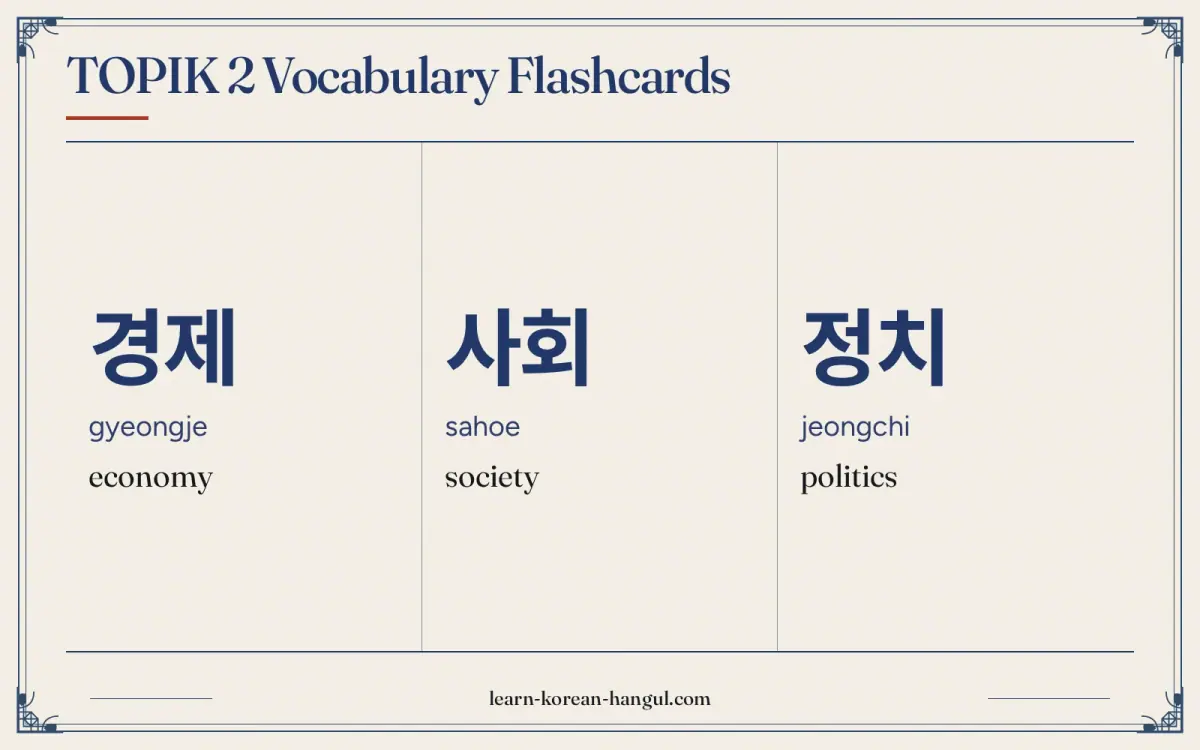
Each card in this deck is one word, and the audio plays the word on its own. The cards run in rough groups. Cards 1 to 5 are the big topics of the news (economy, society, politics, culture, environment), cards 6 to 15 are words for discussing a problem (problem, result, cause, influence, change, development, announcement, plan, support, incident), cards 16 to 20 describe trends and importance, and cards 21 to 30 are words for opinions, reasons and ways of doing things.
How Do I Use These Flashcards?
Use the deck above in four steps. It works with tap, click or keyboard, and nothing plays until you press an audio button.
- Choose a mode. Start with recognition (Hangul to meaning). Switch to recall (meaning to Hangul) or listening (audio to meaning) once recognition feels easy.
- Show the answer. Say the example sentence in the Note column aloud before you look at the answer, then swap one word for another from the deck and say it again. Then press Show answer (or Space). Turn on the romanization toggle only if you need it; the table below always shows it.
- Grade yourself. Press Got it if you answered correctly without help, or Not yet if you hesitated or guessed.
- Finish the session. A session holds up to 20 cards (you can set 10, 20 or 40). With 30 cards, a first-time learner should expect about 3 days at the default limit of 10 new cards a day, with review sessions on top.
What Do the Three Modes Do?
Recognition shows the Hangul and asks for the meaning, so with the first card it shows 경제 and you answer "economy". Recall reverses this: it shows the meaning and asks for the Hangul, and you may type the answer with your Hangul keyboard or just say it in your head. Listening plays a clip and hides the letters, which trains the ear. Listening mode is hardest for words that sound alike, such as 발전 and 발표, so use it after recognition feels easy. The pronunciation audio is generated with text-to-speech and a Korean teacher approves it before it is switched on. Listening mode only uses cards whose audio is approved, and cards without approved audio are skipped in that mode with a note.
What Do Got It and Not yet Do?
Got it moves a card up one Leitner box, so it comes back later. Not yet sends the card back to box 1, so it returns in the same session or within 10 minutes. The grades are your own judgement; the deck does not score you or claim fluency.
Deck Scope: What Is and Is Not Covered
The deck covers 30 words of the kind that reading and listening passages for the second TOPIK level use again and again: the big topics (경제, 사회, 정치, 문화, 환경), the words for describing a situation (문제, 결과, 원인, 영향, 변화, 발전), the words for events and plans (발표, 계획, 지원, 사건), the report verbs 증가하다 and 감소하다, and the words that carry an argument (가능성, 필요하다, 중요하다, 관심, 의견, 경험, 기회, 목적, 이유, 방법, 대부분, 주장하다, 해결하다). The list is a study set built from typical topics. It is not an official TOPIK word list and does not claim to match one.
What Is Left out of This Deck?
Everyday beginner words are in the TOPIK 1 vocabulary flashcards, and patterns for joining words into sentences are in the TOPIK 2 grammar flashcards. The overview of the TOPIK decks is on the TOPIK flashcards page. The full list of topics and sentence patterns for the exam is on the TOPIK II page.
All 30 Cards in One Table
All 30 cards appear below in deck order. The table is plain HTML, so you can use it as a drill without the deck: cover the Meaning column, say each item aloud, then uncover it.
| # | Hangul | Revised Romanization | Meaning | Note | Audio assetId |
|---|---|---|---|---|---|
| 1 | 경제 | gyeongje | economy | 요즘 경제가 어려워요. (The economy is hard these days.) Stays a noun; it does not take 하다. | au-pg-flashcards-topik-2-vocabulary-flashcards-1 |
| 2 | 사회 | sahoe | society | 사회가 빠르게 변해요. (Society changes fast.) Stays a noun; 사회적 (social) is the modifier form. | au-pg-flashcards-topik-2-vocabulary-flashcards-2 |
| 3 | 정치 | jeongchi | politics | 저는 정치에 관심이 있어요. (I am interested in politics.) A politician is a 정치인. | au-pg-flashcards-topik-2-vocabulary-flashcards-3 |
| 4 | 문화 | munhwa | culture | 나라마다 문화가 달라요. (Culture differs from country to country.) 문화적 means cultural. | au-pg-flashcards-topik-2-vocabulary-flashcards-4 |
| 5 | 환경 | hwangyeong | environment | 환경을 보호해야 해요. (We must protect the environment.) Also the surroundings of a person, as in 일하는 환경 (working environment). | au-pg-flashcards-topik-2-vocabulary-flashcards-5 |
| 6 | 문제 | munje | problem; question | 이 문제를 어떻게 해결할까요? (How shall we solve this problem?) Also a test question. 문제가 생기다 means a problem arises. | au-pg-flashcards-topik-2-vocabulary-flashcards-6 |
| 7 | 결과 | gyeolgwa | result | 시험 결과가 나왔어요. (The exam results are out.) The standard pronunciation is [결과]; [결꽈] is often heard. The usual partner verb is 나오다. | au-pg-flashcards-topik-2-vocabulary-flashcards-7; slow: au-pg-flashcards-topik-2-vocabulary-flashcards-31 |
| 8 | 원인 | wonin | cause | 사고의 원인을 조사하고 있어요. (They are investigating the cause of the accident.) Pairs with 결과 as cause and result. | au-pg-flashcards-topik-2-vocabulary-flashcards-8 |
| 9 | 영향 | yeonghyang | influence; effect | 날씨는 기분에 영향을 줘요. (The weather affects your mood.) 영향을 주다 gives influence; 영향을 받다 receives it. | au-pg-flashcards-topik-2-vocabulary-flashcards-9 |
| 10 | 변화 | byeonhwa | change | 도시에 큰 변화가 생겼어요. (A big change happened in the city.) 변화하다 is the verb. 변화가 생기다 means a change appears. | au-pg-flashcards-topik-2-vocabulary-flashcards-10 |
| 11 | 발전 | baljeon | development; progress | 기술이 빠르게 발전하고 있어요. (Technology is developing fast.) Said [발쩐]. Do not mix it up with 발표. | au-pg-flashcards-topik-2-vocabulary-flashcards-11; slow: au-pg-flashcards-topik-2-vocabulary-flashcards-32 |
| 12 | 발표 | balpyo | announcement; presentation | 내일 회의에서 발표해요. (I am presenting at tomorrow's meeting.) 결과 발표 means the announcement of results. | au-pg-flashcards-topik-2-vocabulary-flashcards-12 |
| 13 | 계획 | gyehoek | plan | 여행 계획을 세웠어요. (I made a travel plan.) 계획을 세우다 is the fixed pair for making a plan. | au-pg-flashcards-topik-2-vocabulary-flashcards-13 |
| 14 | 지원 | jiwon | support; application | 회사에 지원했어요. (I applied to a company.) Also support, as in 학생을 지원하다. Context tells you which. | au-pg-flashcards-topik-2-vocabulary-flashcards-14 |
| 15 | 사건 | sageon | incident; event | 어제 큰 사건이 있었어요. (A big incident happened yesterday.) Means an incident or event, not a medical case. | au-pg-flashcards-topik-2-vocabulary-flashcards-15 |
| 16 | 증가하다 | jeunggahada | to increase | 외국인 관광객이 증가했어요. (The number of foreign tourists increased.) Written-register verb for reports; speech often uses 늘다. | au-pg-flashcards-topik-2-vocabulary-flashcards-16 |
| 17 | 감소하다 | gamsohada | to decrease | 학생 수가 감소하고 있어요. (The number of students is decreasing.) Written-register verb for reports; speech often uses 줄다. | au-pg-flashcards-topik-2-vocabulary-flashcards-17 |
| 18 | 가능성 | ganeungseong | possibility; chance | 비가 올 가능성이 높아요. (The chance of rain is high.) Said [가능썽]. 가능성이 높다 and 가능성이 낮다 are common. | au-pg-flashcards-topik-2-vocabulary-flashcards-18; slow: au-pg-flashcards-topik-2-vocabulary-flashcards-33 |
| 19 | 필요하다 | piryohada | to be necessary | 비자가 필요해요. (A visa is necessary.) The thing that is needed takes 이/가. | au-pg-flashcards-topik-2-vocabulary-flashcards-19 |
| 20 | 중요하다 | jungyohada | to be important | 이 시험은 아주 중요해요. (This exam is very important.) Before a noun it becomes 중요한, as in 중요한 일. | au-pg-flashcards-topik-2-vocabulary-flashcards-20 |
| 21 | 관심 | gwansim | interest | 한국 문화에 관심이 많아요. (I am very interested in Korean culture.) 관심이 있다 means to be interested; 관심을 가지다 means to take an interest. | au-pg-flashcards-topik-2-vocabulary-flashcards-21 |
| 22 | 의견 | uigyeon | opinion | 여러분의 의견을 듣고 싶어요. (I want to hear your opinions.) 의견을 내다 means to offer an opinion. | au-pg-flashcards-topik-2-vocabulary-flashcards-22 |
| 23 | 경험 | gyeongheom | experience | 해외에서 일한 경험이 있어요. (I have experience working abroad.) Pair with 있다 or 없다 to say you have or lack experience. | au-pg-flashcards-topik-2-vocabulary-flashcards-23 |
| 24 | 기회 | gihoe | opportunity; chance | 좋은 기회를 놓쳤어요. (I missed a good opportunity.) 기회를 놓치다 means to miss a chance. | au-pg-flashcards-topik-2-vocabulary-flashcards-24 |
| 25 | 목적 | mokjeok | purpose; aim | 여행의 목적이 뭐예요? (What is the purpose of your trip?) Said [목쩍]. | au-pg-flashcards-topik-2-vocabulary-flashcards-25 |
| 26 | 이유 | iyu | reason | 늦은 이유를 말해 주세요. (Please tell me the reason you were late.) 이유가 뭐예요? asks for a reason. | au-pg-flashcards-topik-2-vocabulary-flashcards-26 |
| 27 | 방법 | bangbeop | method; way | 더 좋은 방법이 있을까요? (Is there a better way?) 방법을 찾다 means to look for a way. | au-pg-flashcards-topik-2-vocabulary-flashcards-27 |
| 28 | 대부분 | daebubun | most; the majority | 대부분의 학생이 버스로 와요. (Most students come by bus.) Used as 대부분의 + noun, or alone as an adverb. | au-pg-flashcards-topik-2-vocabulary-flashcards-28 |
| 29 | 주장하다 | jujanghada | to claim; to insist | 그는 자기가 옳다고 주장했어요. (He insisted he was right.) The noun 주장 means a claim. | au-pg-flashcards-topik-2-vocabulary-flashcards-29 |
| 30 | 해결하다 | haegyeolhada | to solve; to settle | 문제를 해결했어요. (I solved the problem.) The passive 해결되다 says the problem got solved by itself or by others. | au-pg-flashcards-topik-2-vocabulary-flashcards-30 |
How Do I Read the Table?
Hangul is the word in its dictionary form. Revised Romanization (RR) is a learning aid, so try to read the Hangul first. The Meaning column gives a short English gloss. The Note column gives an example sentence with its meaning, plus a short use hint. The last column lists the audio assetId, and the clip says the word on its own. A second ID marks a slow clip (0.8x).
Usage Notes for These Cards
Sino-Korean nouns join 하다 to make verbs. Most nouns here become verbs with 하다: 발표하다 (to present), 계획하다 (to plan), 지원하다 (to apply or to support), 변화하다 (to change). Not all of them do. 경제 and 사회 stay nouns, so you say 경제가 좋아요 (the economy is good), not 경제해요.
Abstract nouns pair with fixed verbs. Learn the pair with the noun, because the pair is what you meet in texts. 문제를 해결하다 is to solve a problem, 영향을 주다 is to influence, 계획을 세우다 is to make a plan, 기회를 놓치다 is to miss a chance and 의견을 내다 is to offer an opinion. When a card has a pair in its note, say the pair aloud.
Report verbs have a written feel. 증가하다 and 감소하다 suit reports, graphs and news. In conversation Koreans usually say 늘다 (to grow) and 줄다 (to shrink).
-적 turns a noun into a modifier. Adding -적 makes 경제적 (economic), 사회적 (social) and 문화적 (cultural). They sit before a noun, as in 경제적 문제 (economic problem). Without 적, the noun can still join another noun, as in 경제 문제.
News Korean likes noun headlines. Words such as 발표, 변화 and 발전 often stand alone in headlines with no verb, so recognising the bare noun is useful.
Which Sounds Do Not Match the Spelling?
Several cards sound different from the way they are spelled.
결과 is [결과] in the standard, though many speakers say [결꽈]. In Sino-Korean words a final ㄹ makes only a following ㄷ, ㅅ or ㅈ tense, so the ㄱ of 과 stays plain in the standard pronunciation. The tense [결꽈] is common in everyday speech. RR writes gyeolgwa either way.
발전 is said [발쩐]. After the final ㄹ, the ㅈ of 전 becomes tense. RR writes baljeon, and the tense sound is not shown.
가능성 is said [가능썽]. The suffix 성 is said with a tense ㅅ after ㅇ in this word, so you hear 가 + 능 + 썽. RR writes ganeungseong.
What Mistakes Do Learners Make with TOPIK II Vocabulary?
- Reading 사건 as a medical case. It means an incident or an event, as in 큰 사건 (a big incident).
- Reading 지원 only as support. It also means an application, as in 회사에 지원하다 (to apply to a company).
- Mixing up 발표 (an announcement or a presentation) and 발전 (development). Say each with its partner: 결과를 발표하다 and 기술이 발전하다.
- Writing 경제하다 or 사회하다. These two stay nouns.
Words that look similar cause most slips, so give cards 11, 12, 14 and 15 extra passes in recall mode.
How Does the Review Schedule Work?
The deck uses a simplified Leitner system with five boxes. A new card starts in box 1. Each Got it moves it up one box, and each Not yet returns it to box 1. The box sets how long the card waits before it is due again.
| Box | Wait until the next review |
|---|---|
| 1 | same session or 10 minutes |
| 2 | 1 day |
| 3 | 3 days |
| 4 | 7 days |
| 5 | 21 days |
Each session shows due cards first, oldest due first, then up to 10 new cards a day by default. A deck of 30 cards is introduced over 3 days at 10 new cards a day. If your exam date is close, add a daily 10-minute pass over cards in boxes 1 and 2 first, and leave the long gaps for later. Progress is saved only in this browser, so clearing site data deletes it. Use the export button to save a small file with card IDs, boxes and due dates, and import it on another device. No account is needed.
Cultural and Practical Context
Reading and listening passages for the second TOPIK level often draw on news and social topics, so abstract Sino-Korean nouns carry much of the meaning. Knowing common noun and verb pairs helps more than memorizing isolated words, because a pair such as 영향을 주다 or 계획을 세우다 turns up as a unit. Memorize each word with a whole sentence and say it aloud. The official source for the exam format is topik.go.kr.
Limits of This Deck
The deck is a study aid made by this site. It is not the official TOPIK word list, it does not predict your score and it does not replace the past exam papers published on topik.go.kr. Each word has one example, so the main use is shown, not every sense. All Korean text is generated and was reviewed and signed off by Min-ji Park on 15 October 2026, and each audio clip is checked by a Korean teacher before publication.
Next Steps after This Deck
After these TOPIK 2 vocabulary flashcards, learn the patterns that join the words with the TOPIK 2 grammar flashcards. If a basic word here still feels shaky, go back to the TOPIK 1 vocabulary flashcards. To see how the exam works, read the TOPIK II page. The TOPIK flashcards page lists the TOPIK decks, and the Korean flashcards hub lists all topics.
Frequently Asked Questions
Is This the Official TOPIK II Word List?
No. It is a study set of 30 words chosen by this site for news, society and opinion topics. It is not copied from an official list, it does not predict your score and it does not cover every word that could appear. Use it to practise, and check the official TOPIK site (topik.go.kr) for the exact test.
How Do I Turn These Nouns into Verbs?
Add 하다 to most Sino-Korean nouns: 발표 becomes 발표하다 (to present) and 계획 becomes 계획하다 (to plan). A few nouns do not take 하다, such as 경제 and 사회. Check the example sentence on the card, and learn the noun with its usual verb, like 문제를 해결하다.
Which Words Are Written-Only?
증가하다 and 감소하다 are the clearest. They belong to reports, graphs and news, while speech uses 늘다 and 줄다. Nouns such as 발표, 변화 and 발전 are used in both speech and writing, but they are especially common in headlines and formal texts.
How Do I Remember Sino-Korean Words?
Learn them in pairs and in sentences. A noun like 영향 sticks better as 영향을 주다 than as a single word. Notice shared syllables too: 발전 and 발표 share 발, and 중요하다 and 필요하다 share the 하다 ending. Say each example aloud, then change one word and say it again.
Is My Progress Saved If I Close the Page?
Yes, in the same browser on the same device. Card boxes and due dates are stored locally and nothing is sent to a server. Clearing site data, using a private window or switching browsers removes them, so use the export button to keep a backup file. No account is needed.