TOPIK 1 Vocabulary Flashcards: Study the 30 Cards
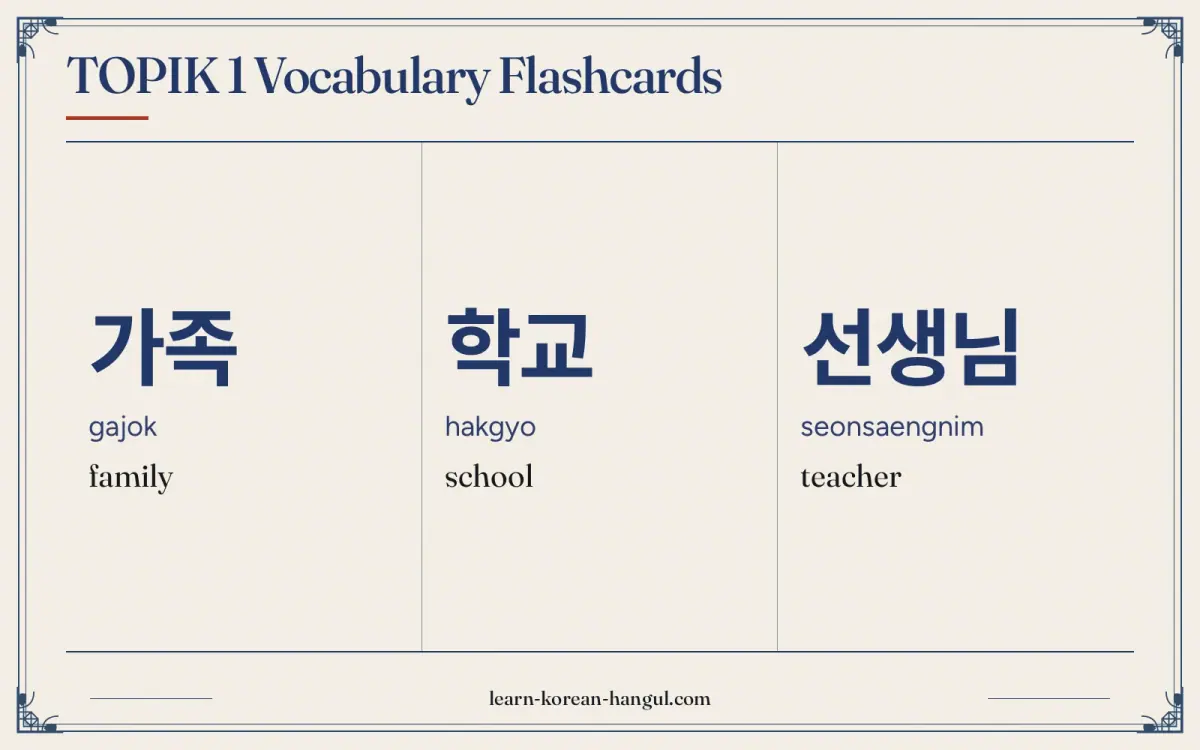
The cards start with people and school (cards 1 to 4), then time words (5 to 8), then six common verbs (9 to 14), five adjectives (15 to 19), and finish with food, places, objects and general words (20 to 30).
How Do I Use These Flashcards?
Use the deck above in four steps. It works with tap, click or keyboard, and nothing plays until you press an audio button.
- Choose a mode. Start with recognition (Hangul to meaning). Switch to recall (meaning to Hangul) or listening (audio to meaning) once recognition feels easy.
- Show the answer. Say the word aloud and, if you can, make a short sentence with it before you reveal the answer. Then press Show answer (or Space). Turn on the romanization toggle only if you need it; the table below always shows it.
- Grade yourself. Press Got it if you answered correctly without help, or Not yet if you hesitated or guessed.
- Finish the session. A session holds up to 20 cards (you can set 10, 20 or 40). With 30 cards, a first-time learner should expect about 3 days at the default limit of 10 new cards a day, with review sessions on top.
What Do the Three Modes Do?
Recognition shows the Hangul and asks for the meaning, so with the first card it shows 가족 and you answer "family". Recall reverses this: it shows the meaning and asks for the Hangul, and you may type the answer with your Hangul keyboard or just say it in your head. Listening plays a clip and hides the letters, which trains the ear. Recall mode is useful for the verbs and adjectives, because you must produce the dictionary form ending in -다 from the English meaning. The pronunciation audio is generated with text-to-speech and a Korean teacher approves it before it is switched on. Listening mode only uses cards whose audio is approved, and cards without approved audio are skipped in that mode with a note.
What Do Got It and Not yet Do?
Got it moves a card up one Leitner box, so it comes back later. Not yet sends the card back to box 1, so it returns in the same session or within 10 minutes. The grades are your own judgement; the deck does not score you or claim fluency.
Deck Scope: What Is and Is Not Covered
The deck covers 30 everyday words in six groups: people and school (가족, 학교, 선생님, 친구, 학생), time (시간, 오늘, 내일, 어제, 아침), six verbs (먹다, 가다, 오다, 보다, 공부하다, 좋아하다), five adjectives (크다, 싸다, 많다, 맛있다, 예쁘다), and objects and places (음식, 물, 집, 병원, 시장, 돈, 책, 날씨, 한국). The words come from the topics that beginner courses teach first, such as family, shopping, food and daily routine. They are not copied from an official list, and the deck does not claim to hold every word you could meet on the exam.
What Is Left out of This Deck?
Grammar patterns are in the TOPIK 1 grammar flashcards. A larger core list of 100 words with audio is on the TOPIK vocabulary page, and numbers, days and colours have their own decks in the Korean vocabulary flashcards. Words for the second level, which lean toward abstract nouns, are in the TOPIK II vocabulary flashcards. The overview of the TOPIK decks is on the TOPIK flashcards page.
All 30 Cards in One Table
All 30 cards appear below in deck order. The table is plain HTML, so you can use it as a drill without the deck: cover the Meaning column, say each item aloud, then uncover it.
| # | Hangul | Revised Romanization | Meaning | Note | Audio assetId |
|---|---|---|---|---|---|
| 1 | 가족 | gajok | family | 우리 가족은 네 명이에요. (My family has four people.) | au-pg-flashcards-topik-1-vocabulary-flashcards-1 |
| 2 | 학교 | hakgyo | school | 학교에 가요. (I go to school.) Said [학꾜]. | au-pg-flashcards-topik-1-vocabulary-flashcards-2; slow: au-pg-flashcards-topik-1-vocabulary-flashcards-31 |
| 3 | 선생님 | seonsaengnim | teacher | Already includes 님, so it is also a polite way to address a teacher. | au-pg-flashcards-topik-1-vocabulary-flashcards-3 |
| 4 | 친구 | chingu | friend | 친구를 만나요. (I meet a friend.) | au-pg-flashcards-topik-1-vocabulary-flashcards-4 |
| 5 | 시간 | sigan | time; hour(s) | 시간이 없어요. (I have no time.) 세 시간 is three hours. | au-pg-flashcards-topik-1-vocabulary-flashcards-5 |
| 6 | 오늘 | oneul | today | 오늘은 월요일이에요. (Today is Monday.) | au-pg-flashcards-topik-1-vocabulary-flashcards-6 |
| 7 | 내일 | naeil | tomorrow | 내일 학교에 가요. (I go to school tomorrow.) No particle is needed. | au-pg-flashcards-topik-1-vocabulary-flashcards-7 |
| 8 | 어제 | eoje | yesterday | 어제 친구를 만났어요. (I met a friend yesterday.) | au-pg-flashcards-topik-1-vocabulary-flashcards-8 |
| 9 | 먹다 | meokda | to eat | 밥을 먹어요. (I eat a meal.) Dictionary form; the polite present is 먹어요. | au-pg-flashcards-topik-1-vocabulary-flashcards-9 |
| 10 | 가다 | gada | to go | 집에 가요. (I go home.) Takes 에 for the place you go to. | au-pg-flashcards-topik-1-vocabulary-flashcards-10 |
| 11 | 오다 | oda | to come | 친구가 와요. (My friend is coming.) The polite present is 와요. | au-pg-flashcards-topik-1-vocabulary-flashcards-11 |
| 12 | 보다 | boda | to see; to watch | 영화를 봐요. (I watch a movie.) | au-pg-flashcards-topik-1-vocabulary-flashcards-12 |
| 13 | 공부하다 | gongbuhada | to study | 한국어를 공부해요. (I study Korean.) 하다 becomes 해요. | au-pg-flashcards-topik-1-vocabulary-flashcards-13 |
| 14 | 좋아하다 | joahada | to like | 한국 음식을 좋아해요. (I like Korean food.) What you like takes 을/를. | au-pg-flashcards-topik-1-vocabulary-flashcards-14 |
| 15 | 크다 | keuda | to be big | 이 집은 커요. (This house is big.) The polite present is 커요. | au-pg-flashcards-topik-1-vocabulary-flashcards-15 |
| 16 | 싸다 | ssada | to be cheap | 이 옷은 싸요. (These clothes are cheap.) No separate word for is. | au-pg-flashcards-topik-1-vocabulary-flashcards-16 |
| 17 | 많다 | manta | to be many; to be much | 사람이 많아요. (There are many people.) Said [만타]. | au-pg-flashcards-topik-1-vocabulary-flashcards-17; slow: au-pg-flashcards-topik-1-vocabulary-flashcards-32 |
| 18 | 맛있다 | masitda | to be delicious | 김치가 맛있어요. (The kimchi is delicious.) Said [마싣따]. | au-pg-flashcards-topik-1-vocabulary-flashcards-18 |
| 19 | 예쁘다 | yeppeuda | to be pretty | 꽃이 예뻐요. (The flowers are pretty.) The polite present is 예뻐요. | au-pg-flashcards-topik-1-vocabulary-flashcards-19 |
| 20 | 음식 | eumsik | food | 한국 음식을 먹어요. (I eat Korean food.) | au-pg-flashcards-topik-1-vocabulary-flashcards-20 |
| 21 | 물 | mul | water | 물을 마셔요. (I drink water.) | au-pg-flashcards-topik-1-vocabulary-flashcards-21 |
| 22 | 집 | jip | house; home | 집에 있어요. (I am at home.) | au-pg-flashcards-topik-1-vocabulary-flashcards-22 |
| 23 | 병원 | byeongwon | hospital | 병원에 가요. (I go to the hospital.) | au-pg-flashcards-topik-1-vocabulary-flashcards-23 |
| 24 | 시장 | sijang | market | 시장에서 과일을 사요. (I buy fruit at the market.) | au-pg-flashcards-topik-1-vocabulary-flashcards-24 |
| 25 | 돈 | don | money | 돈이 없어요. (I have no money.) | au-pg-flashcards-topik-1-vocabulary-flashcards-25 |
| 26 | 책 | chaek | book | 책을 읽어요. (I read a book.) | au-pg-flashcards-topik-1-vocabulary-flashcards-26 |
| 27 | 날씨 | nalssi | weather | 오늘 날씨가 좋아요. (The weather is nice today.) | au-pg-flashcards-topik-1-vocabulary-flashcards-27; slow: au-pg-flashcards-topik-1-vocabulary-flashcards-33 |
| 28 | 한국 | hanguk | Korea | 저는 한국에 살아요. (I live in Korea.) | au-pg-flashcards-topik-1-vocabulary-flashcards-28 |
| 29 | 학생 | haksaeng | student | 저는 학생이에요. (I am a student.) Said [학쌩]. | au-pg-flashcards-topik-1-vocabulary-flashcards-29 |
| 30 | 아침 | achim | morning; breakfast | 아침을 먹어요. (I eat breakfast.) The same word means both. | au-pg-flashcards-topik-1-vocabulary-flashcards-30 |
How Do I Read the Table?
Hangul is the word, and verbs and adjectives are shown in the dictionary form that ends in -다. Revised Romanization (RR) is a learning aid, so try to read the Hangul first. The Meaning column gives a short English gloss. The Note column gives a short example or a use hint, and where the spoken sound differs from the spelling, the sound is shown in brackets. The last column lists the audio assetId, and a second ID marks a slow clip (0.8x).
Usage Notes for These Cards
Verbs and adjectives are listed in the dictionary form. The ending -다 is dropped and an ending is added: 먹다 becomes 먹어요 in the polite present, and 크다 becomes 커요. When you look a word up in a dictionary, search for the form with -다.
Adjectives act like verbs. There is no separate word for is in Korean, so 이 옷은 싸요 means these clothes are cheap, and 김치가 맛있어요 means the kimchi is delicious. This is why the polite endings on this page look the same for verbs and adjectives.
Time words sit near the start and take no particle. Say 내일 학교에 가요 (I go to school tomorrow), not 내일에 학교에 가요. The particle 에 is used with clock times (일곱 시에), not with 오늘, 내일 or 어제.
하다 verbs become 해요. 공부하다 (to study) is 공부해요, and 좋아하다 (to like) is 좋아해요. What you like takes 을/를, as in 한국 음식을 좋아해요, even though English says like food.
친구 does not need a plural. 친구가 와요 can mean a friend or friends are coming. Add 들 (친구들이 와요) only when you want to stress that there are several.
Which Sounds Do Not Match the Spelling?
Some of these words are said differently from the way they are spelled.
학교 is said [학꾜]. The ㄱ after the final ㄱ becomes a tense sound. This is tensification, and RR writes the letters as hakgyo.
많다 is said [만타]. The ㅎ of the final cluster ㄶ joins the ㄷ of 다 and makes ㅌ. This is aspiration. The polite form 많아요 is said [마나요], because the ㅎ is silent before a vowel. RR shows the aspirated sound in 많다 as manta.
맛있다 is said [마싣따]. The final ㅅ is read as ㄷ, and the ㄷ of 다 becomes tense. RR writes masitda.
What Mistakes Do Learners Make with TOPIK I Vocabulary?
- Looking up a verb under its conjugated form, such as 먹어요. Search for the dictionary form, 먹다.
- Putting 이다 after an adjective, as in 비싸이에요. Say 비싸요, because adjectives take the polite ending directly.
- Mixing up 세 시 (three o'clock) and 세 시간 (three hours). 시 names a point on the clock, and 시간 is a length of time.
- Saying 한국을 가요 for go to Korea. 가다 takes the place particle 에, so the usual sentence is 한국에 가요.
The time words are easy to mix up at first, so give cards 6, 7 and 8 extra passes in recall mode.
How Does the Review Schedule Work?
The deck uses a simplified Leitner system with five boxes. A new card starts in box 1. Each Got it moves it up one box, and each Not yet returns it to box 1. The box sets how long the card waits before it is due again.
| Box | Wait until the next review |
|---|---|
| 1 | same session or 10 minutes |
| 2 | 1 day |
| 3 | 3 days |
| 4 | 7 days |
| 5 | 21 days |
Each session shows due cards first, oldest due first, then up to 10 new cards a day by default. A deck of 30 cards is introduced over 3 days at 10 new cards a day, and the later boxes bring every word back at longer gaps. Progress is saved only in this browser, so clearing site data deletes it. Use the export button to save a small file with card IDs, boxes and due dates, and import it on another device. No account is needed.
Cultural and Practical Context
Everyday vocabulary at the first level is practical. It centres on family, daily routine, shopping and places, which mirrors the situations in beginner textbooks. Learners usually meet these words in the order a language course teaches them, so a good way to use the deck is alongside a course or the lessons on this site, and to say each word in a short sentence.
Limits of This Deck
The deck holds 30 words and one short example for each, so it shows the main meaning, not every sense. 시간 and 아침 have more than one meaning, and the note shows the most useful ones. The deck is a study aid made by this site. It is not the official TOPIK I word list, it does not predict your score and it does not replace past exam papers. All Korean text is generated and was reviewed and signed off by Min-ji Park on 15 October 2026, and each audio clip is checked by a Korean teacher before publication.
Next Steps after This Deck
After these TOPIK 1 vocabulary flashcards, practise patterns with the TOPIK 1 grammar flashcards, then learn more words on the TOPIK vocabulary page. To see how the exam works, read the TOPIK I page. The TOPIK flashcards page lists the TOPIK decks, and the Korean flashcards hub lists all topics.
Frequently Asked Questions
Is This an Official TOPIK I Word List?
No. It is a study set of 30 everyday words chosen by this site from beginner course topics. It is not copied from an official list, it does not predict your score and it does not cover every word that could appear. Use it to build a base, and check the official TOPIK site (topik.go.kr) for the exact test.
Why Are the Verbs Listed with -다 at the End?
Dictionaries list verbs and adjectives in the dictionary form, which ends in -다. In speech you remove -다 and add an ending, so 먹다 becomes 먹어요 and 가다 becomes 가요. Learning the dictionary form first lets you look the word up and then build any ending from it.
Do Adjectives Conjugate Like Verbs?
Yes, in the polite present they take the same endings, with no separate word for is, so 싸다 becomes 싸요. Some stems change shape, as the ㅡ drops in 크다 (커요) and 예쁘다 (예뻐요), so learn the polite form of each card as well.
Which Words Should I Learn First?
Start with cards 1 to 14: the people, the time words and the six verbs. They let you make sentences such as 내일 친구를 만나요 right away. Then add the adjectives and the places. Spending a few minutes a day beats one long session.
Is My Progress Saved If I Close the Page?
Yes, in the same browser on the same device. Card boxes and due dates are stored locally and nothing is sent to a server. Clearing site data, using a private window or switching browsers removes them, so use the export button to keep a backup file. No account is needed.