
TOPIK 2 Grammar Flashcards: Study the 26 Cards
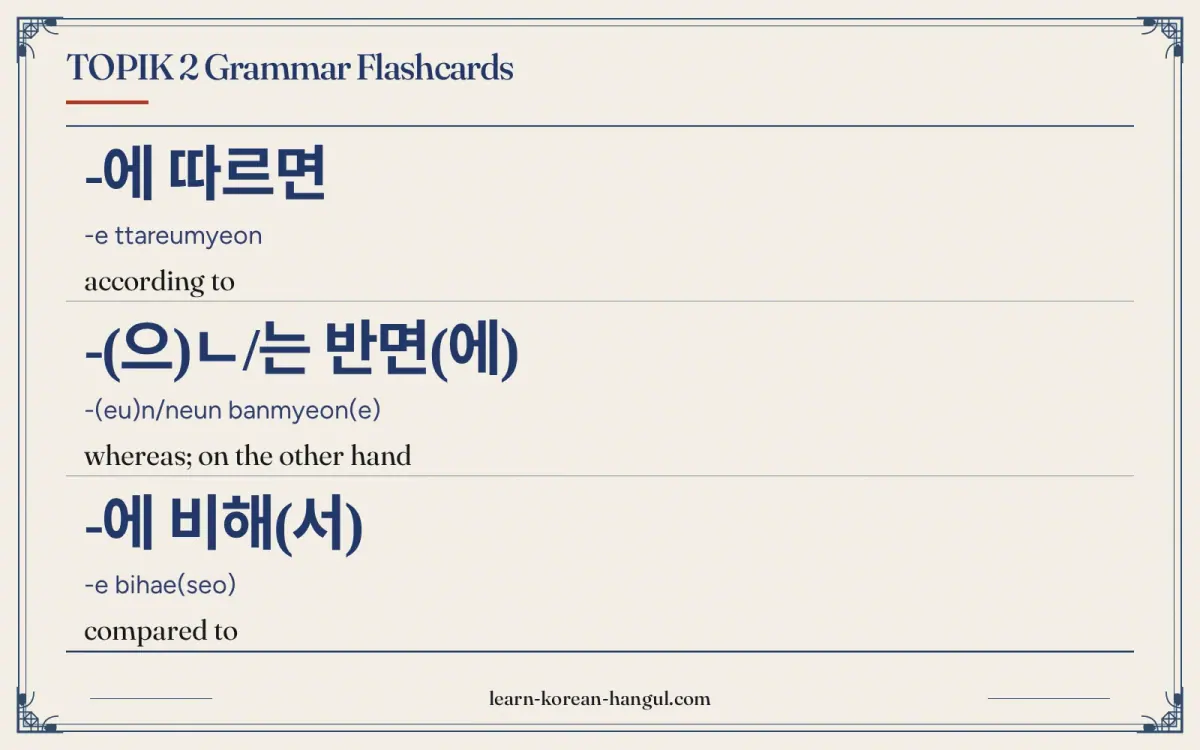
A grammar card works like a vocabulary card, with one difference: the front shows a pattern, and the audio plays an example sentence that contains it. The cards run in groups. Cards 1 to 3 introduce a source and a comparison, 4 to 6 are purpose and cause, 7 to 10 are the four kinds of reported speech, 11 to 13 are passives and causatives, 14 and 15 are time and regret, 16 to 20 are limits, aims and tendencies, and 21 to 26 are guesses, worries, time and interruption.
How Do I Use These Flashcards?
Use the deck above in four steps. It works with tap, click or keyboard, and nothing plays until you press an audio button.
- Choose a mode. Start with recognition (Hangul to meaning). Switch to recall (meaning to Hangul) or listening (audio to meaning) once recognition feels easy.
- Show the answer. Say the example sentence aloud before you look at the answer, then change one word, such as the verb or the object, and say it again. Then press Show answer (or Space). Turn on the romanization toggle only if you need it; the table below always shows it.
- Grade yourself. Press Got it if you answered correctly without help, or Not yet if you hesitated or guessed.
- Finish the session. A session holds up to 20 cards (you can set 10, 20 or 40). With 26 cards, a first-time learner should expect about 3 days at the default limit of 10 new cards a day, with review sessions on top.
What Do the Three Modes Do?
Recognition shows the Hangul and asks for the meaning, so with the first card it shows -에 따르면 and you answer "according to". Recall reverses this: it shows the meaning and asks for the Hangul, and you may type the answer with your Hangul keyboard or just say it in your head. Listening plays a clip and hides the letters, which trains the ear. Listening mode suits this deck well, because the clip plays a whole sentence and you must hear which pattern it contains. The pronunciation audio is generated with text-to-speech and a Korean teacher approves it before it is switched on. Listening mode only uses cards whose audio is approved, and cards without approved audio are skipped in that mode with a note.
What Do Got It and Not yet Do?
Got it moves a card up one Leitner box, so it comes back later. Not yet sends the card back to box 1, so it returns in the same session or within 10 minutes. The grades are your own judgement; the deck does not score you or claim fluency.
Deck Scope: What Is and Is Not Covered
The deck covers 26 patterns of the kind that upper-intermediate textbooks teach for the second TOPIK level: -에 따르면, -(으)ㄴ/는 반면(에), -에 비해(서), the aim and cause patterns -기 위해(서), -(으)ㄴ/는 탓에 and -(으)ㄴ/는 덕분에, the four kinds of reported speech, the passive suffixes, -아/어지다, -게 하다, -(으)ㄴ 지 ... 되다, -(으)ㄹ 걸 그랬다, -(으)ㄹ 뿐이다, -도록, -(으)려고, -(으)ㄹ 만하다, -(으)ㄴ/는 편이다, -(으)ㄹ 것 같다, -(으)ㄹ까 봐, -는 동안(에), -(으)ㄴ 채로, -(으)ㄹ 뻔하다 and -다가. The list is typical of level 3 and 4 study, not copied from an official source.
What Is Left out of This Deck?
Beginner patterns are in the TOPIK 1 grammar flashcards, and the connectors of the middle level are in the intermediate korean grammar flashcards. The fixed expressions of the top level, such as -는 바람에 and -(으)ㄹ 수밖에 없다, are in the advanced korean grammar flashcards. Words for the exam are in the TOPIK 2 vocabulary flashcards, and the overview of the TOPIK decks is on the TOPIK flashcards page.
All 26 Cards in One Table
All 26 cards appear below in deck order. The table is plain HTML, so you can use it as a drill without the deck: cover the Meaning column, say each item aloud, then uncover it.
| # | Hangul | Revised Romanization | Meaning | Note | Lesson | Audio assetId |
|---|---|---|---|---|---|---|
| 1 | -에 따르면 | -e ttareumyeon | according to | Example: 뉴스에 따르면 내일부터 비가 온대요. (nyuseue ttareumyeon naeilbuteo biga ondaeyo.) According to the news, it will rain from tomorrow. Follows a noun that is a source, such as 뉴스, 기사 or 조사. Common in reports. | – | au-pg-flashcards-topik-2-grammar-flashcards-1 |
| 2 | -(으)ㄴ/는 반면(에) | -(eu)n/neun banmyeon(e) | whereas; on the other hand | Example: 형은 키가 큰 반면 동생은 작아요. (hyeongeun kiga keun banmyeon dongsaengeun jagayo.) My older brother is tall, whereas my younger sibling is short. Joins two contrasting facts. It takes -(으)ㄴ after adjectives and -는 after verbs. | -(으)ㄴ/는 반면(에) lesson | au-pg-flashcards-topik-2-grammar-flashcards-2 |
| 3 | -에 비해(서) | -e bihae(seo) | compared to | Example: 작년에 비해 물가가 많이 올랐어요. (jangnyeone bihae mulgaga mani ollasseoyo.) Prices rose a lot compared to last year. Follows the thing you compare with. | – | au-pg-flashcards-topik-2-grammar-flashcards-3 |
| 4 | -기 위해(서) | -gi wihae(seo) | in order to | Example: 건강해지기 위해 매일 운동해요. (geonganghaejigi wihae maeil undonghaeyo.) I exercise every day in order to become healthy. Attaches to a verb stem. After a noun, use -을/를 위해(서). | -기 위해(서) lesson | au-pg-flashcards-topik-2-grammar-flashcards-4 |
| 5 | -(으)ㄴ/는 탓에 | -(eu)n/neun tase | because of (a bad result) | Example: 늦잠을 잔 탓에 지각했어요. (neutjameul jan tase jigakaesseoyo.) Because I overslept, I was late. Blames something for an unwelcome result. It does not take a command. | -(으)ㄴ/는 탓에 lesson | au-pg-flashcards-topik-2-grammar-flashcards-5 |
| 6 | -(으)ㄴ/는 덕분에 | -(eu)n/neun deokbune | thanks to | Example: 선생님이 도와주신 덕분에 합격했어요. (seonsaengnimi dowajusin deokbune hapgyeokaesseoyo.) Thanks to my teacher's help, I passed. Credits something for a good result. It is the positive partner of 탓에. | -(으)ㄴ/는 덕분에 lesson | au-pg-flashcards-topik-2-grammar-flashcards-6 |
| 7 | -다고 하다 | -dago hada | (someone) says that | Example: 친구가 내일 온다고 했어요. (chinguga naeil ondago haesseoyo.) My friend said that he or she is coming tomorrow. Reports a statement. Use -ㄴ/는다고 after verbs and -다고 after adjectives and past forms. | -다고 하다 lesson | au-pg-flashcards-topik-2-grammar-flashcards-7 |
| 8 | -(으)라고 하다 | -(eu)rago hada | (someone) tells you to | Example: 의사가 푹 쉬라고 했어요. (uisaga puk swirago haesseoyo.) The doctor told me to rest well. Reports a command. The form is the stem plus -(으)라고. | -(으)라고 하다 lesson | au-pg-flashcards-topik-2-grammar-flashcards-8 |
| 9 | -자고 하다 | -jago hada | (someone) suggests that we | Example: 친구가 같이 가자고 했어요. (chinguga gachi gajago haesseoyo.) My friend suggested going together. Reports a suggestion. The form is the stem plus -자고. | -자고 하다 lesson | au-pg-flashcards-topik-2-grammar-flashcards-9 |
| 10 | -냐고 하다 | -nyago hada | (someone) asks whether | Example: 친구가 저한테 뭐 먹었냐고 물었어요. (chinguga jeohante mwo meogeonnyago mureosseoyo.) My friend asked me what I ate. Reports a question. The verb after it is often 묻다 (to ask) instead of 하다. | -냐고 하다 lesson | au-pg-flashcards-topik-2-grammar-flashcards-10; slow: au-pg-flashcards-topik-2-grammar-flashcards-27 |
| 11 | -이-/-히-/-리-/-기- (passive) | -i-/-hi-/-ri-/-gi- | passive suffixes | Example: 문이 닫혔어요. (muni dachyeosseoyo.) The door was closed. Added to the verb stem: 닫다 becomes 닫히다. Which suffix a verb takes must be learned word by word. | -이-/-히-/-리-/-기- (passive) lesson | au-pg-flashcards-topik-2-grammar-flashcards-11 |
| 12 | -아/어지다 | -a/eojida | become; get done | Example: 날씨가 따뜻해졌어요. (nalssiga ttatteutaejyeosseoyo.) The weather has become warm. Shows a change of state. With some verbs it also makes a passive. | -아/어지다 lesson | au-pg-flashcards-topik-2-grammar-flashcards-12 |
| 13 | -게 하다 | -ge hada | make or let someone do | Example: 선생님이 학생들에게 책을 읽게 했어요. (seonsaengnimi haksaengdeurege chaegeul ilge haesseoyo.) The teacher had the students read the book. The causative. The person who does the action takes 에게 or 한테. | -게 하다 lesson | au-pg-flashcards-topik-2-grammar-flashcards-13 |
| 14 | -(으)ㄴ 지 ... 되다 | -(eu)n ji ... doeda | it has been ... since | Example: 한국에 온 지 일 년이 됐어요. (hanguge on ji il nyeoni dwaesseoyo.) It has been a year since I came to Korea. Counts time since an event, so it needs a length of time. | -(으)ㄴ 지 ... 되다 lesson | au-pg-flashcards-topik-2-grammar-flashcards-14; slow: au-pg-flashcards-topik-2-grammar-flashcards-28 |
| 15 | -(으)ㄹ 걸 그랬다 | -(eu)l geol geuraetda | I should have | Example: 우산을 가져올 걸 그랬어요. (usaneul gajyeool geol geuraesseoyo.) I should have brought an umbrella. Regret about something you did not do. It points to a past situation, not a future plan. | -(으)ㄹ 걸 그랬다 lesson | au-pg-flashcards-topik-2-grammar-flashcards-15 |
| 16 | -(으)ㄹ 뿐이다 | -(eu)l ppunida | only; nothing but | Example: 저는 사실을 말했을 뿐이에요. (jeoneun sasireul malhaesseul ppunieyo.) I only told the truth. Says that this is all there is. | – | au-pg-flashcards-topik-2-grammar-flashcards-16 |
| 17 | -도록 | -dorok | so that; until | Example: 잊지 않도록 메모했어요. (itji antorok memohaesseoyo.) I wrote a note so that I would not forget. Gives the aim of an action. Attaches to the stem. | -도록 lesson | au-pg-flashcards-topik-2-grammar-flashcards-17 |
| 18 | -(으)려고 | -(eu)ryeogo | intending to | Example: 한국어를 배우려고 한국에 왔어요. (hangugeoreul baeuryeogo hanguge wasseoyo.) I came to Korea to learn Korean. Both clauses share one subject. | -(으)려고 lesson | au-pg-flashcards-topik-2-grammar-flashcards-18 |
| 19 | -(으)ㄹ 만하다 | -(eu)l manhada | be worth doing | Example: 이 영화는 볼 만해요. (i yeonghwaneun bol manhaeyo.) This movie is worth watching. Recommends something. It attaches to verbs. | -(으)ㄹ 만하다 lesson | au-pg-flashcards-topik-2-grammar-flashcards-19 |
| 20 | -(으)ㄴ/는 편이다 | -(eu)n/neun pyeonida | tend to be | Example: 저는 일찍 일어나는 편이에요. (jeoneun iljjik ireonaneun pyeonieyo.) I tend to get up early. Describes a general tendency, not an exact fact. | – | au-pg-flashcards-topik-2-grammar-flashcards-20 |
| 21 | -(으)ㄹ 것 같다 | -(eu)l geot gatda | it seems that; I think | Example: 내일 비가 올 것 같아요. (naeil biga ol geot gatayo.) It looks like it will rain tomorrow. A soft guess about the future. | -(으)ㄹ 것 같다 lesson | au-pg-flashcards-topik-2-grammar-flashcards-21 |
| 22 | -(으)ㄹ까 봐 | -(eu)lkka bwa | for fear that | Example: 늦을까 봐 택시를 탔어요. (neujeulkka bwa taeksireul tasseoyo.) I took a taxi because I was afraid of being late. Gives a worry as the reason for an action. | -(으)ㄹ까 봐 lesson | au-pg-flashcards-topik-2-grammar-flashcards-22 |
| 23 | -는 동안(에) | -neun dongan(e) | while | Example: 자는 동안에 비가 왔어요. (janeun dongane biga wasseoyo.) It rained while I was sleeping. Marks a stretch of time during which something else happens. | -는 동안(에) lesson | au-pg-flashcards-topik-2-grammar-flashcards-23 |
| 24 | -(으)ㄴ 채로 | -(eu)n chaero | while still; leaving as is | Example: 불을 켠 채로 잤어요. (bureul kyeon chaero jasseoyo.) I slept with the light on. Keeps one state unchanged while another action happens. | -(으)ㄴ 채로 lesson | au-pg-flashcards-topik-2-grammar-flashcards-24 |
| 25 | -(으)ㄹ 뻔하다 | -(eu)l ppeonhada | almost did | Example: 길이 미끄러워서 넘어질 뻔했어요. (giri mikkeureowoseo neomeojil ppeonhaesseoyo.) The road was slippery, so I nearly fell. Something almost happened but did not. | – | au-pg-flashcards-topik-2-grammar-flashcards-25; slow: au-pg-flashcards-topik-2-grammar-flashcards-29 |
| 26 | -다가 | -daga | in the middle of; then | Example: 길을 걷다가 친구를 만났어요. (gireul geotdaga chingureul mannasseoyo.) I met a friend while walking down the road. One action is interrupted by another. | -다가 lesson | au-pg-flashcards-topik-2-grammar-flashcards-26 |
How Do I Read the Table?
Hangul is the pattern, and a leading hyphen shows that it attaches to a verb or adjective stem. Revised Romanization (RR) is a learning aid, so try to read the Hangul first. The Meaning column gives a short English gloss. The Note column gives an example sentence with its RR and meaning, plus a use hint. The Lesson column links to the lesson that explains the pattern when it is published; where no lesson exists yet, the cell shows a dash. The last column lists the audio assetId, and the clip says the example sentence, not the bare pattern. A second ID marks a slow clip (0.8x).
Usage Notes for These Cards
Reported speech changes with the kind of sentence. The ending before 하다 depends on what was said, as the table shows with 가다 (to go) and 크다 (to be big).
| What was said | Ending | Example |
|---|---|---|
| Statement | -ㄴ/는다고 (verbs), -다고 (adjectives and past) | 간다고 했어요, 크다고 했어요, 갔다고 했어요 |
| Command | -(으)라고 | 가라고 했어요 |
| Suggestion | -자고 | 가자고 했어요 |
| Question | -냐고 | 가냐고 했어요, 크냐고 했어요 |
탓에 blames, 덕분에 credits. -(으)ㄴ/는 탓에 reports an unwelcome result, and -(으)ㄴ/는 덕분에 reports a welcome one. Neither can be followed by a command or a suggestion. Pick the pattern by how you feel about the result, not by the facts alone.
Passives use a suffix or -아/어지다. The suffixes -이-, -히-, -리- and -기- attach to the stem, so 닫다 becomes 닫히다 and 문이 닫혔어요 means the door was closed. Some verbs use -아/어지다 instead, and the same pattern also marks a change of state, as in 따뜻해졌어요 (it has become warm). Which suffix a verb takes is learned word by word.
-(으)ㄴ 지 ... 되다 needs a length of time. 한국에 온 지 일 년이 됐어요 counts the time since you came. Leave out the time word and the sentence is incomplete.
-(으)ㄹ 걸 그랬다 is about the past. It expresses regret about something you did not do, so it pairs with a past situation, as in 우산을 가져올 걸 그랬어요. It does not state a future plan.
Which Sounds Do Not Match the Spelling?
Several of these patterns sound different from the way they are spelled.
닫혔어요 is said [다처써요]. The ㄷ and ㅎ join into ㅌ, which then becomes ㅊ before the vowel of 히, so the stem is said [다치]. The ㅕ after ㅊ is said as ㅓ, and ㅆ is the past marker. RR writes dachyeosseoyo.
말했을 뿐이에요 is said [말해쓸 뿌니에요]. The ㄴ of 뿐 moves onto the empty ㅇ of 이에요, so you hear 뿌 + 니에요. This is liaison.
가져올 걸 그랬어요 is said [가저올껄 그래써요]. After the ending -(으)ㄹ, the ㄱ of 걸 becomes a tense sound. This is tensification. The bound noun joins the word before it in the bracket, and RR writes gajyeool geol geuraesseoyo.
What Mistakes Do Learners Make with TOPIK II Grammar?
- Using -는 탓에 for a good result, as in 선생님이 도와준 탓에 합격했어요. Use -덕분에: 선생님이 도와주신 덕분에 합격했어요.
- Using -다고 하다 for a command, as in 쉬다고 했어요. The command form is 쉬라고 했어요.
- Using -(으)ㄴ 지 without a duration, as in 한국에 온 지 됐어요. Add the time: 한국에 온 지 일 년이 됐어요.
- Using -(으)ㄹ 걸 그랬다 for a plan, as in 내일 갈 걸 그랬어요. It looks back at the past: 어제 갈 걸 그랬어요.
Cause and reporting cause most slips, so give cards 5, 6 and 7 to 10 extra passes in recall mode.
How Does the Review Schedule Work?
The deck uses a simplified Leitner system with five boxes. A new card starts in box 1. Each Got it moves it up one box, and each Not yet returns it to box 1. The box sets how long the card waits before it is due again.
| Box | Wait until the next review |
|---|---|
| 1 | same session or 10 minutes |
| 2 | 1 day |
| 3 | 3 days |
| 4 | 7 days |
| 5 | 21 days |
Each session shows due cards first, oldest due first, then up to 10 new cards a day by default. A deck of 26 cards is introduced over 3 days at 10 new cards a day. If your exam date is close, add a daily 10-minute pass over cards in boxes 1 and 2 first, and leave the long gaps for later. Progress is saved only in this browser, so clearing site data deletes it. Use the export button to save a small file with card IDs, boxes and due dates, and import it on another device. No account is needed.
Cultural and Practical Context
Reading passages for the second TOPIK level lean on reported speech and written constructions, and TOPIK II also has a writing section, where answers need connectors of cause and contrast. Mastery shows in choosing the right nuance between near-synonyms, such as -탓에 and -덕분에, or -기 위해 and -(으)려고. Memorize each pattern with a whole sentence and say it aloud, because a pattern alone is hard to recall when you meet it inside a passage. The official source for the exam format is topik.go.kr.
Limits of This Deck
The deck is a study aid made by this site. It is not the official TOPIK II grammar list, it does not predict your score and it does not replace the past exam papers published on topik.go.kr. Each pattern has one example, so the main use is shown, not every nuance, and the explanation of the passive is simplified. All Korean text is generated and was reviewed and signed off by Min-ji Park on 15 October 2026, and each audio clip is checked by a Korean teacher before publication.
Next Steps after This Deck
After these TOPIK 2 grammar flashcards, learn the words for the same level with the TOPIK 2 vocabulary flashcards, then move on to the advanced korean grammar flashcards for fixed expressions. If a basic ending feels shaky, go back to the TOPIK 1 grammar flashcards. To see how the exam works, read the TOPIK II page. The TOPIK flashcards page lists the TOPIK decks, and the Korean flashcards hub lists all topics.
Frequently Asked Questions
Is This the Official TOPIK II Grammar List?
No. It is a study set of 26 patterns chosen by this site from upper-intermediate course material. It is not copied from an official list, it does not predict your score and it does not cover every pattern that could appear. Use it to practise, and check the official TOPIK site (topik.go.kr) for the exact test.
How Do I Choose between -탓에 and -덕분에?
Choose by the result. Use -(으)ㄴ/는 탓에 when the result is unwelcome, as in 늦잠을 잔 탓에 지각했어요 (I overslept, so I was late). Use -(으)ㄴ/는 덕분에 when the result is welcome, as in 선생님 덕분에 합격했어요 (thanks to my teacher, I passed). Neither is followed by a command.
How Do I Form Reported Speech?
Put the plain form of the sentence before 고 하다. A statement ends in -ㄴ/는다고 or -다고, a command in -(으)라고, a suggestion in -자고 and a question in -냐고. So 가다 gives 간다고, 가라고, 가자고 and 가냐고 하다. The usual spoken ending is 했어요.
What Are the Passive Endings?
The passive suffixes are -이-, -히-, -리- and -기-, added to the verb stem: 보다 becomes 보이다, 닫다 becomes 닫히다, 열다 becomes 열리다 and 안다 becomes 안기다. Many verbs also form a passive with -아/어지다. Each verb takes a fixed suffix, so learn it with the verb.
Is My Progress Saved If I Close the Page?
Yes, in the same browser on the same device. Card boxes and due dates are stored locally and nothing is sent to a server. Clearing site data, using a private window or switching browsers removes them, so use the export button to keep a backup file. No account is needed.