500 Korean Words Flashcards: Study the 500 Cards
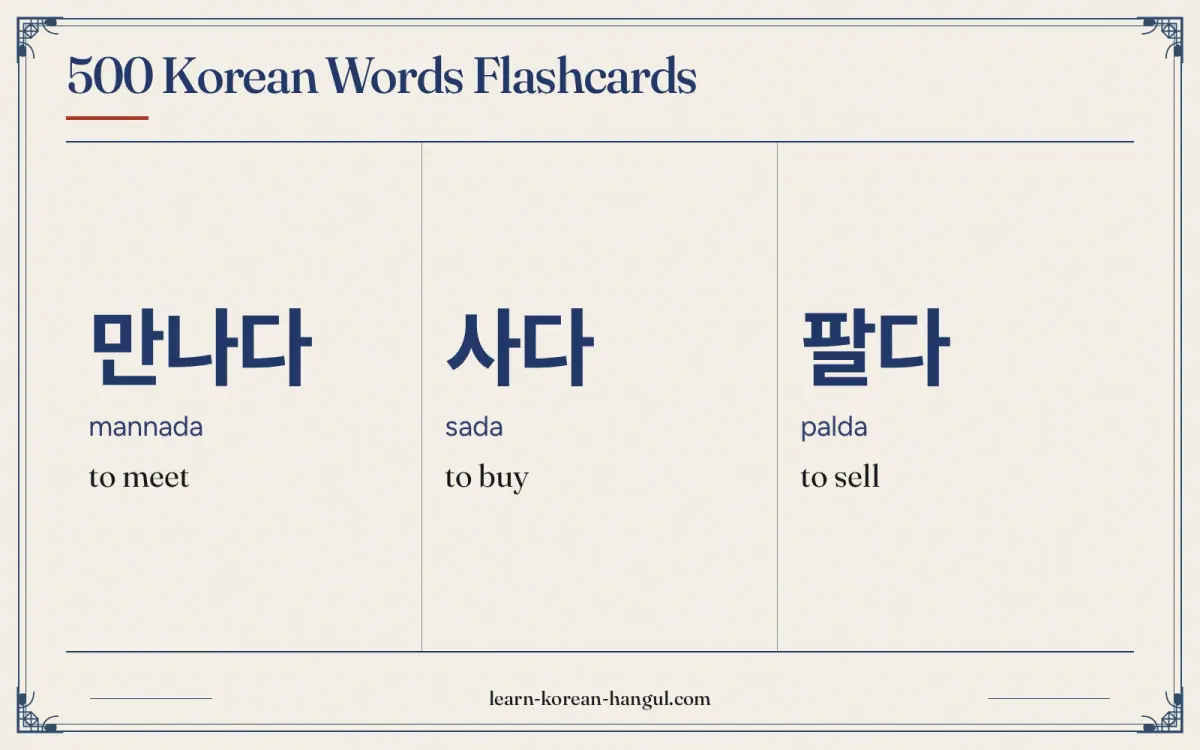
The deck opens with four everyday verbs (cards 1 to 4: 만나다, 사다, 팔다, 읽다), then the rest of the 295 verbs and adjectives in the order of the site's verb list (cards 5 to 295), then 205 nouns (cards 296 to 500) spread across everyday topics such as food, school, travel, health and time. Verbs and adjectives are shown in the dictionary form that ends in 다, and the note gives the polite form you say in speech.
How Do I Use These Flashcards?
Use the deck above in four steps. It works with tap, click or keyboard, and nothing plays until you press an audio button.
- Choose a mode. Start with recognition (Hangul to meaning). Switch to recall (meaning to Hangul) or listening (audio to meaning) once recognition feels easy.
- Show the answer. Think of the answer first, then press Show answer (or Space). Turn on the romanization toggle only if you need it; the table below always shows it.
- Grade yourself. Press Got it if you answered correctly without help, or Not yet if you hesitated or guessed.
- Finish the session. A session holds up to 20 cards (you can set 10, 20 or 40). With 500 cards, a first-time learner should expect about 50 days at the default limit of 10 new cards a day, with review sessions on top.
The Three Study Modes
Recognition shows the Hangul and asks for the meaning, so with the first card it shows 만나다 and you answer "to meet". Recall reverses this: it shows the meaning and asks for the Hangul, and you may type the answer with your Hangul keyboard or just say it in your head. Listening plays a clip and hides the letters, which trains the ear. Listening mode only uses a card once its audio is approved, and cards without approved audio are skipped in that mode with a note. With 500 cards, start with recognition for the verbs and switch to recall only for cards you already know well.
Got It and Not Yet
Got it moves a card up one Leitner box, so it comes back later. Not yet sends the card back to box 1, so it returns in the same session or within 10 minutes. The grades are your own judgement; the deck does not score you or claim fluency.
Deck Scope: What Is and Is Not Covered
The deck covers verbs, adjectives and nouns that sit just beyond the first hundred words, chosen as the next step from the 100-word deck. Only two nouns, 회사 and 학교 (cards 499 and 500), repeat from that deck. Theme vocabulary such as animals, body parts and clothing is left to the theme decks. The words and letters on these cards are explained in the 500 korean words lesson, so read it first if a card is new.
What This Deck Leaves Out
Family words are in the family words flashcards, and greetings and numbers have their own decks. Words that mark grammar, such as particles and endings, are taught in the grammar lessons, not in this deck. Conjugation tables for every verb are in the verb dictionary pages.
All 500 Cards in One Table
All 500 cards appear below in deck order. The table is plain HTML, so you can use it as a drill without the deck: cover the Meaning column, read each word aloud, then uncover it.
| # | Hangul | Revised Romanization | Meaning | Note | Audio assetId |
|---|---|---|---|---|---|
| 1 | 만나다 | mannada | to meet | Polite form 만나요. 저는 친구를 만나요 (I meet my friend). | au-pg-flashcards-top-500-words-1 |
| 2 | 사다 | sada | to buy | Polite form 사요. 저는 시장에서 과일을 사요 (I buy fruit at the market). | au-pg-flashcards-top-500-words-2 |
| 3 | 팔다 | palda | to sell | Polite form 팔아요. The ㄹ drops before ㄴ, ㅂ and ㅅ (팝니다, 파는). 이 가게는 과일을 팔아요 (This shop sells fruit). | au-pg-flashcards-top-500-words-3 |
| 4 | 읽다 | ikda | to read | 책을 읽어요 (I read a book). Said [익따]: the ㄺ cluster simplifies to ㄱ and the ㄷ becomes tense. | au-pg-flashcards-top-500-words-4; slow: au-pg-flashcards-top-500-words-501 |
| 5 | 가다 | gada | to go | Polite form 가요. 저는 매일 학교에 가요 (I go to school every day). | au-pg-flashcards-top-500-words-5 |
| 6 | 오다 | oda | to come | Polite form 와요. 친구가 우리 집에 와요 (My friend comes to my house). | au-pg-flashcards-top-500-words-6 |
| 7 | 먹다 | meokda | to eat | Polite form 먹어요. 저는 아침에 빵을 먹어요 (I eat bread in the morning). | au-pg-flashcards-top-500-words-7 |
| 8 | 마시다 | masida | to drink | Polite form 마셔요. 저는 아침에 커피를 마셔요 (I drink coffee in the morning). | au-pg-flashcards-top-500-words-8 |
| 9 | 하다 | hada | to do | Polite form 해요. 주말에 무엇을 해요? (What do you do on the weekend?). | au-pg-flashcards-top-500-words-9 |
| 10 | 보다 | boda | to see/watch | Polite form 봐요. 저는 저녁에 영화를 봐요 (I watch a movie in the evening). | au-pg-flashcards-top-500-words-10 |
| 11 | 듣다 | deutda | to listen/hear | Polite form 들어요. ㄷ-irregular. 저는 아침에 음악을 들어요 (I listen to music in the morning). | au-pg-flashcards-top-500-words-11; slow: au-pg-flashcards-top-500-words-503 |
| 12 | 말하다 | malhada | to speak | Polite form 말해요. 그는 천천히 말해요 (He speaks slowly). | au-pg-flashcards-top-500-words-12 |
| 13 | 쓰다 | sseuda | to write; to use; to wear (hat); to spend (money) | 편지를 써요 (I write a letter); 돈을 써요 (I spend money). The object tells the meanings apart. | au-pg-flashcards-top-500-words-13 |
| 14 | 자다 | jada | to sleep | Polite form 자요. 저는 보통 열한 시에 자요 (I usually sleep at eleven o'clock). | au-pg-flashcards-top-500-words-14 |
| 15 | 일어나다 | ireonada | to wake up/get up | Polite form 일어나요. 저는 아침 일곱 시에 일어나요 (I get up at seven in the morning). | au-pg-flashcards-top-500-words-15 |
| 16 | 앉다 | anda | to sit | Polite form 앉아요. 여기 앉아요 (Sit here). | au-pg-flashcards-top-500-words-16 |
| 17 | 서다 | seoda | to stand | Polite form 서요. 학생들이 줄을 서요 (The students line up). | au-pg-flashcards-top-500-words-17 |
| 18 | 걷다 | geotda | to walk | Polite form 걸어요. ㄷ-irregular. 저는 매일 공원을 걸어요 (I walk in the park every day). | au-pg-flashcards-top-500-words-18; slow: au-pg-flashcards-top-500-words-504 |
| 19 | 뛰다 | ttwida | to run/jump | Polite form 뛰어요. 아이들이 운동장에서 뛰어요 (The children run on the playground). | au-pg-flashcards-top-500-words-19 |
| 20 | 주다 | juda | to give | Polite form 줘요. 저는 친구에게 선물을 줘요 (I give a present to my friend). | au-pg-flashcards-top-500-words-20 |
| 21 | 받다 | batda | to receive | Polite form 받아요. 저는 매달 용돈을 받아요 (I receive pocket money every month). | au-pg-flashcards-top-500-words-21 |
| 22 | 알다 | alda | to know | Polite form 알아요. The ㄹ drops before ㄴ, ㅂ and ㅅ (압니다, 아는). 저는 그 사람을 알아요 (I know that person). | au-pg-flashcards-top-500-words-22 |
| 23 | 모르다 | moreuda | to not know | Polite form 몰라요. 르-irregular. 저는 그 길을 몰라요 (I do not know that road). | au-pg-flashcards-top-500-words-23 |
| 24 | 배우다 | baeuda | to learn | Polite form 배워요. 저는 한국어를 배워요 (I am learning Korean). | au-pg-flashcards-top-500-words-24 |
| 25 | 가르치다 | gareuchida | to teach | Polite form 가르쳐요. 선생님이 영어를 가르쳐요 (The teacher teaches English). | au-pg-flashcards-top-500-words-25 |
| 26 | 공부하다 | gongbuhada | to study | Polite form 공부해요. 저는 매일 도서관에서 공부해요 (I study in the library every day). | au-pg-flashcards-top-500-words-26 |
| 27 | 일하다 | ilhada | to work | Polite form 일해요. 저는 은행에서 일해요 (I work at a bank). | au-pg-flashcards-top-500-words-27 |
| 28 | 살다 | salda | to live | Polite form 살아요. The ㄹ drops before ㄴ, ㅂ and ㅅ (삽니다, 사는). 저는 서울에 살아요 (I live in Seoul). | au-pg-flashcards-top-500-words-28 |
| 29 | 죽다 | jukda | to die | Polite form 죽어요. 물이 없으면 꽃이 죽어요 (If there is no water, the flower dies). | au-pg-flashcards-top-500-words-29 |
| 30 | 태어나다 | taeeonada | to be born | Polite form 태어나요. 저는 서울에서 태어났어요 (I was born in Seoul). | au-pg-flashcards-top-500-words-30 |
| 31 | 좋아하다 | joahada | to like | Polite form 좋아해요. 저는 한국 음식을 좋아해요 (I like Korean food). | au-pg-flashcards-top-500-words-31 |
| 32 | 싫어하다 | sireohada | to dislike | Polite form 싫어해요. 저는 매운 음식을 싫어해요 (I dislike spicy food). | au-pg-flashcards-top-500-words-32 |
| 33 | 사랑하다 | saranghada | to love | Polite form 사랑해요. 저는 우리 가족을 사랑해요 (I love my family). | au-pg-flashcards-top-500-words-33 |
| 34 | 원하다 | wonhada | to want | Polite form 원해요. 저는 조용한 방을 원해요 (I want a quiet room). | au-pg-flashcards-top-500-words-34 |
| 35 | 필요하다 | piryohada | necessary; to need | Polite form 필요해요. 저는 새 컴퓨터가 필요해요 (I need a new computer). | au-pg-flashcards-top-500-words-35 |
| 36 | 있다 | itda | to exist/have | Polite form 있어요. 책상 위에 책이 있어요 (There is a book on the desk). | au-pg-flashcards-top-500-words-36 |
| 37 | 없다 | eopda | to not exist/not have | Polite form 없어요. 오늘은 시간이 없어요 (I do not have time today). | au-pg-flashcards-top-500-words-37 |
| 38 | 이다 | ida | to be (copula) | Polite form 이에요 / 예요. 저는 학생이에요 (I am a student). | au-pg-flashcards-top-500-words-38 |
| 39 | 아니다 | anida | to not be | Polite form 아니에요. 저는 학생이 아니에요 (I am not a student). | au-pg-flashcards-top-500-words-39 |
| 40 | 되다 | doeda | to become | Polite form 돼요. 여기서 사진 찍어도 돼요? (Is it okay to take a photo here?). | au-pg-flashcards-top-500-words-40 |
| 41 | 들어가다 | deureogada | to enter | Polite form 들어가요. 학생들이 교실에 들어가요 (The students go into the classroom). | au-pg-flashcards-top-500-words-41 |
| 42 | 나가다 | nagada | to go out | Polite form 나가요. 주말에는 밖에 나가요 (I go outside on weekends). | au-pg-flashcards-top-500-words-42 |
| 43 | 나오다 | naoda | to come out | Polite form 나와요. 아이가 집에서 나와요 (The child comes out of the house). | au-pg-flashcards-top-500-words-43 |
| 44 | 돌아가다 | doragada | to go back | Polite form 돌아가요. 저녁에 집으로 돌아가요 (I go back home in the evening). | au-pg-flashcards-top-500-words-44 |
| 45 | 돌아오다 | doraoda | to come back | Polite form 돌아와요. 아빠는 저녁에 집에 돌아와요 (Dad comes back home in the evening). | au-pg-flashcards-top-500-words-45 |
| 46 | 올라가다 | ollagada | to go up | Polite form 올라가요. 저는 계단으로 올라가요 (I go up by the stairs). | au-pg-flashcards-top-500-words-46 |
| 47 | 내려가다 | naeryeogada | to go down | Polite form 내려가요. 저는 계단으로 내려가요 (I go down by the stairs). | au-pg-flashcards-top-500-words-47 |
| 48 | 타다 | tada | to ride | Polite form 타요. 저는 매일 지하철을 타요 (I ride the subway every day). | au-pg-flashcards-top-500-words-48 |
| 49 | 내리다 | naerida | to get off; to fall; to lower | Polite form 내려요. 저는 시청역에서 내려요 (I get off at City Hall station). | au-pg-flashcards-top-500-words-49 |
| 50 | 도착하다 | dochakada | to arrive | Polite form 도착해요. 기차가 서울에 도착해요 (The train arrives in Seoul). | au-pg-flashcards-top-500-words-50 |
| 51 | 출발하다 | chulbalhada | to depart | Polite form 출발해요. 버스가 열 시에 출발해요 (The bus departs at ten). | au-pg-flashcards-top-500-words-51 |
| 52 | 여행하다 | yeohaenghada | to travel | Polite form 여행해요. 저는 가족과 함께 여행해요 (I travel together with my family). | au-pg-flashcards-top-500-words-52 |
| 53 | 기다리다 | gidarida | to wait | Polite form 기다려요. 저는 버스를 기다려요 (I am waiting for the bus). | au-pg-flashcards-top-500-words-53 |
| 54 | 찾다 | chatda | to find/look for | Polite form 찾아요. 저는 열쇠를 찾아요 (I am looking for my key). | au-pg-flashcards-top-500-words-54 |
| 55 | 잃어버리다 | ireobeorida | to lose | Polite form 잃어버려요. 저는 자주 우산을 잃어버려요 (I often lose my umbrella). | au-pg-flashcards-top-500-words-55 |
| 56 | 열다 | yeolda | to open | Polite form 열어요. The ㄹ drops before ㄴ, ㅂ and ㅅ (엽니다, 여는). 더워서 창문을 열어요 (It is hot, so I open the window). | au-pg-flashcards-top-500-words-56 |
| 57 | 닫다 | datda | to close | Polite form 닫아요. 추워서 창문을 닫아요 (It is cold, so I close the window). | au-pg-flashcards-top-500-words-57 |
| 58 | 켜다 | kyeoda | to turn on | Polite form 켜요. 저는 방에 들어가서 불을 켜요 (I go into the room and turn on the light). | au-pg-flashcards-top-500-words-58 |
| 59 | 끄다 | kkeuda | to turn off | Polite form 꺼요. ㅡ-drop. 잠자기 전에 불을 꺼요 (I turn off the light before sleeping). | au-pg-flashcards-top-500-words-59 |
| 60 | 넣다 | neota | to put in | Polite form 넣어요. 저는 가방에 책을 넣어요 (I put the book in my bag). | au-pg-flashcards-top-500-words-60 |
| 61 | 놓다 | nota | to put down | Polite form 놓아요. 가방을 책상 위에 놓아요 (I put my bag on the desk). | au-pg-flashcards-top-500-words-61 |
| 62 | 가지다 | gajida | to have/hold | Polite form 가져요. 저는 차를 가져요 (I have a car). | au-pg-flashcards-top-500-words-62 |
| 63 | 들다 | deulda | to hold/lift | Polite form 들어요. The ㄹ drops before ㄴ, ㅂ and ㅅ (듭니다, 드는). 저는 가방을 들어요 (I am carrying my bag). | au-pg-flashcards-top-500-words-63 |
| 64 | 잡다 | japda | to catch/hold | Polite form 잡아요. 아이가 엄마 손을 잡아요 (The child holds mom's hand). | au-pg-flashcards-top-500-words-64 |
| 65 | 버리다 | beorida | to throw away | Polite form 버려요. 쓰레기를 버려요 (I throw away the trash). | au-pg-flashcards-top-500-words-65 |
| 66 | 사용하다 | sayonghada | to use | Polite form 사용해요. 저는 매일 컴퓨터를 사용해요 (I use a computer every day). | au-pg-flashcards-top-500-words-66 |
| 67 | 만들다 | mandeulda | to make | Polite form 만들어요. The ㄹ drops before ㄴ, ㅂ and ㅅ (만듭니다, 만드는). 엄마가 케이크를 만들어요 (Mom makes a cake). | au-pg-flashcards-top-500-words-67 |
| 68 | 요리하다 | yorihada | to cook | Polite form 요리해요. 저는 주말에 요리해요 (I cook on weekends). | au-pg-flashcards-top-500-words-68 |
| 69 | 씻다 | ssitda | to wash | Polite form 씻어요. 저는 아침에 얼굴을 씻어요 (I wash my face in the morning). | au-pg-flashcards-top-500-words-69 |
| 70 | 닦다 | dakda | to wipe/brush | Polite form 닦아요. 저는 매일 이를 닦아요 (I brush my teeth every day). | au-pg-flashcards-top-500-words-70 |
| 71 | 청소하다 | cheongsohada | to clean | Polite form 청소해요. 주말마다 방을 청소해요 (I clean my room every weekend). | au-pg-flashcards-top-500-words-71 |
| 72 | 빨래하다 | ppallaehada | to do laundry | Polite form 빨래해요. 저는 주말에 빨래해요 (I do laundry on weekends). | au-pg-flashcards-top-500-words-72 |
| 73 | 입다 | ipda | to wear (clothes) | Polite form 입어요. 저는 청바지를 입어요 (I wear jeans). | au-pg-flashcards-top-500-words-73 |
| 74 | 신다 | sinda | to wear (shoes) | Polite form 신어요. 저는 운동화를 신어요 (I wear sneakers). | au-pg-flashcards-top-500-words-74 |
| 75 | 벗다 | beotda | to take off | Polite form 벗어요. 집에서 신발을 벗어요 (I take off my shoes at home). | au-pg-flashcards-top-500-words-75 |
| 76 | 웃다 | utda | to laugh/smile | Polite form 웃어요. 아이가 크게 웃어요 (The child laughs loudly). | au-pg-flashcards-top-500-words-76 |
| 77 | 울다 | ulda | to cry | Polite form 울어요. The ㄹ drops before ㄴ, ㅂ and ㅅ (웁니다, 우는). 아이가 방에서 울어요 (The child cries in the room). | au-pg-flashcards-top-500-words-77 |
| 78 | 놀라다 | nollada | to be surprised | Polite form 놀라요. 저는 자주 놀라요 (I am often surprised). | au-pg-flashcards-top-500-words-78 |
| 79 | 걱정하다 | geokjeonghada | to worry | Polite form 걱정해요. 엄마는 항상 저를 걱정해요 (Mom always worries about me). | au-pg-flashcards-top-500-words-79 |
| 80 | 생각하다 | saenggakada | to think | Polite form 생각해요. 저는 그렇게 생각해요 (I think so). | au-pg-flashcards-top-500-words-80 |
| 81 | 믿다 | mitda | to believe | Polite form 믿어요. 저는 친구를 믿어요 (I trust my friend). | au-pg-flashcards-top-500-words-81 |
| 82 | 기억하다 | gieokada | to remember | Polite form 기억해요. 저는 그 날을 기억해요 (I remember that day). | au-pg-flashcards-top-500-words-82 |
| 83 | 잊다 | itda | to forget | Polite form 잊어요. 비밀번호를 잊었어요 (I forgot the password). | au-pg-flashcards-top-500-words-83 |
| 84 | 이해하다 | ihaehada | to understand | Polite form 이해해요. 저는 한국어 문법을 이해해요 (I understand Korean grammar). | au-pg-flashcards-top-500-words-84 |
| 85 | 질문하다 | jilmunhada | to ask a question | Polite form 질문해요. 학생이 선생님께 질문해요 (The student asks the teacher a question). | au-pg-flashcards-top-500-words-85 |
| 86 | 묻다 | mutda | to ask | Polite form 물어요. ㄷ-irregular. 저는 길을 물어요 (I ask for directions). | au-pg-flashcards-top-500-words-86 |
| 87 | 대답하다 | daedapada | to answer | Polite form 대답해요. 학생이 질문에 대답해요 (The student answers the question). | au-pg-flashcards-top-500-words-87 |
| 88 | 부르다 | bureuda | to call/sing | Polite form 불러요. 르-irregular. 엄마가 저를 불러요 (Mom is calling me). | au-pg-flashcards-top-500-words-88 |
| 89 | 노래하다 | noraehada | to sing | Polite form 노래해요. 저는 노래방에서 노래해요 (I sing at karaoke). | au-pg-flashcards-top-500-words-89 |
| 90 | 춤추다 | chumchuda | to dance | Polite form 춤춰요. 아이들이 음악에 맞춰 춤춰요 (The children dance to the music). | au-pg-flashcards-top-500-words-90 |
| 91 | 놀다 | nolda | to play | Polite form 놀아요. The ㄹ drops before ㄴ, ㅂ and ㅅ (놉니다, 노는). 아이들이 공원에서 놀아요 (The children play in the park). | au-pg-flashcards-top-500-words-91 |
| 92 | 쉬다 | swida | to rest | Polite form 쉬어요. 주말에는 집에서 쉬어요 (I rest at home on weekends). | au-pg-flashcards-top-500-words-92 |
| 93 | 운동하다 | undonghada | to exercise | Polite form 운동해요. 저는 매일 아침 운동해요 (I exercise every morning). | au-pg-flashcards-top-500-words-93 |
| 94 | 수영하다 | suyeonghada | to swim | Polite form 수영해요. 저는 주말에 수영해요 (I swim on weekends). | au-pg-flashcards-top-500-words-94 |
| 95 | 달리다 | dallida | to run | Polite form 달려요. 아이들이 공원에서 달려요 (The children run in the park). | au-pg-flashcards-top-500-words-95 |
| 96 | 그리다 | geurida | to draw | Polite form 그려요. 저는 그림을 그려요 (I draw pictures). | au-pg-flashcards-top-500-words-96 |
| 97 | 찍다 | jjikda | to take (photo) | Polite form 찍어요. 저는 사진을 자주 찍어요 (I take photos often). | au-pg-flashcards-top-500-words-97 |
| 98 | 보내다 | bonaeda | to send; to spend (time) | Polite form 보내요. 친구에게 선물을 보내요 (I send a present to my friend). | au-pg-flashcards-top-500-words-98 |
| 99 | 가져가다 | gajyeogada | to take along | Polite form 가져가요. 비가 와서 우산을 가져가요 (It's raining, so I take an umbrella). | au-pg-flashcards-top-500-words-99 |
| 100 | 가져오다 | gajyeooda | to bring | Polite form 가져와요. 저는 매일 도시락을 가져와요 (I bring a lunch box every day). | au-pg-flashcards-top-500-words-100 |
| 101 | 돕다 | dopda | to help | Polite form 도와요. ㅂ-irregular. 저는 가끔 엄마를 도와요 (I sometimes help my mom). | au-pg-flashcards-top-500-words-101 |
| 102 | 도와주다 | dowajuda | to help (give help) | Polite form 도와줘요. 친구가 저를 도와줘요 (My friend helps me). | au-pg-flashcards-top-500-words-102 |
| 103 | 부탁하다 | butakada | to request | Polite form 부탁해요. 저는 친구에게 부탁해요 (I ask my friend for a favor). | au-pg-flashcards-top-500-words-103 |
| 104 | 시작하다 | sijakada | to start | Polite form 시작해요. 수업이 아홉 시에 시작해요 (Class starts at nine). | au-pg-flashcards-top-500-words-104 |
| 105 | 끝나다 | kkeunnada | to end | Polite form 끝나요. 수업이 세 시에 끝나요 (Class ends at three). | au-pg-flashcards-top-500-words-105 |
| 106 | 끝내다 | kkeunnaeda | to finish | Polite form 끝내요. 저는 숙제를 빨리 끝내요 (I finish my homework quickly). | au-pg-flashcards-top-500-words-106 |
| 107 | 계속하다 | gyesokada | to continue | Polite form 계속해요. 저는 한국어 공부를 계속해요 (I keep studying Korean). | au-pg-flashcards-top-500-words-107 |
| 108 | 바꾸다 | bakkuda | to change | Polite form 바꿔요. 저는 비밀번호를 바꿔요 (I change my password). | au-pg-flashcards-top-500-words-108 |
| 109 | 준비하다 | junbihada | to prepare | Polite form 준비해요. 어머니가 저녁을 준비해요 (My mother is preparing dinner). | au-pg-flashcards-top-500-words-109 |
| 110 | 연습하다 | yeonseupada | to practice | Polite form 연습해요. 저는 매일 한국어를 연습해요 (I practice Korean every day). | au-pg-flashcards-top-500-words-110 |
| 111 | 복습하다 | bokseupada | to review | Polite form 복습해요. 수업 후에 단어를 복습해요 (I review the words after class). | au-pg-flashcards-top-500-words-111 |
| 112 | 외우다 | oeuda | to memorize | Polite form 외워요. 저는 매일 단어를 외워요 (I memorize words every day). | au-pg-flashcards-top-500-words-112 |
| 113 | 숙제하다 | sukjehada | to do homework | Polite form 숙제해요. 저는 저녁에 숙제해요 (I do homework in the evening). | au-pg-flashcards-top-500-words-113 |
| 114 | 졸업하다 | joreopada | to graduate | Polite form 졸업해요. 저는 작년에 대학교를 졸업했어요 (I graduated from university last year). | au-pg-flashcards-top-500-words-114 |
| 115 | 퇴근하다 | toegeunhada | to leave work | Polite form 퇴근해요. 보통 여섯 시에 퇴근해요 (I usually leave work at six). | au-pg-flashcards-top-500-words-115 |
| 116 | 출근하다 | chulgeunhada | to go to work | Polite form 출근해요. 저는 아침 아홉 시에 출근해요 (I go to work at nine in the morning). | au-pg-flashcards-top-500-words-116 |
| 117 | 전화하다 | jeonhwahada | to phone | Polite form 전화해요. 저는 매일 어머니께 전화해요 (I call my mother every day). | au-pg-flashcards-top-500-words-117 |
| 118 | 연락하다 | yeollakada | to contact | Polite form 연락해요. 도착하면 저한테 연락해요 (Contact me when you arrive). | au-pg-flashcards-top-500-words-118 |
| 119 | 초대하다 | chodaehada | to invite | Polite form 초대해요. 친구를 집에 초대해요 (I invite a friend to my home). | au-pg-flashcards-top-500-words-119 |
| 120 | 약속하다 | yaksokada | to promise | Polite form 약속해요. 친구와 영화를 보기로 약속했어요 (I promised my friend to watch a movie). | au-pg-flashcards-top-500-words-120 |
| 121 | 예약하다 | yeyakada | to reserve | Polite form 예약해요. 식당을 예약했어요 (I reserved a restaurant). | au-pg-flashcards-top-500-words-121 |
| 122 | 주문하다 | jumunhada | to order | Polite form 주문해요. 저는 커피를 주문해요 (I order a coffee). | au-pg-flashcards-top-500-words-122 |
| 123 | 계산하다 | gyesanhada | to calculate/pay | Polite form 계산해요. 제가 계산할 거예요 (I will pay the bill). | au-pg-flashcards-top-500-words-123 |
| 124 | 내다 | naeda | to pay/put out | Polite form 내요. 제가 커피값을 내요 (I pay for the coffee). | au-pg-flashcards-top-500-words-124 |
| 125 | 빌리다 | billida | to borrow | Polite form 빌려요. 친구한테 책을 빌려요 (I borrow a book from my friend). | au-pg-flashcards-top-500-words-125 |
| 126 | 빌려주다 | billyeojuda | to lend | Polite form 빌려줘요. 친구에게 우산을 빌려줘요 (I lend an umbrella to my friend). | au-pg-flashcards-top-500-words-126 |
| 127 | 구경하다 | gugyeonghada | to look around | Polite form 구경해요. 시장을 구경해요 (I look around the market). | au-pg-flashcards-top-500-words-127 |
| 128 | 쇼핑하다 | syopinghada | to shop | Polite form 쇼핑해요. 주말에 친구와 쇼핑해요 (I go shopping with a friend on weekends). | au-pg-flashcards-top-500-words-128 |
| 129 | 고르다 | goreuda | to choose | Polite form 골라요. 르-irregular. 친구 선물을 골라요 (I choose a gift for my friend). | au-pg-flashcards-top-500-words-129 |
| 130 | 설명하다 | seolmyeonghada | to explain | Polite form 설명해요. 선생님이 문법을 설명해요 (The teacher explains the grammar). | au-pg-flashcards-top-500-words-130 |
| 131 | 소개하다 | sogaehada | to introduce | Polite form 소개해요. 제가 친구를 소개할 거예요 (I will introduce my friend). | au-pg-flashcards-top-500-words-131 |
| 132 | 인사하다 | insahada | to greet | Polite form 인사해요. 아침에 이웃에게 인사해요 (I greet my neighbor in the morning). | au-pg-flashcards-top-500-words-132 |
| 133 | 감사하다 | gamsahada | to thank | Polite form 감사해요. 도와주셔서 감사해요 (Thank you for helping me). | au-pg-flashcards-top-500-words-133 |
| 134 | 사과하다 | sagwahada | to apologize | Polite form 사과해요. 친구에게 사과해요 (I apologize to my friend). | au-pg-flashcards-top-500-words-134 |
| 135 | 축하하다 | chukahada | to congratulate | Polite form 축하해요. 생일을 축하해요 (Happy birthday). | au-pg-flashcards-top-500-words-135 |
| 136 | 이야기하다 | iyagihada | to talk; to chat (also 얘기하다) | Polite form 이야기해요. 친구와 이야기해요 (I chat with my friend). | au-pg-flashcards-top-500-words-136 |
| 137 | 대화하다 | daehwahada | to converse | Polite form 대화해요. 외국인과 영어로 대화해요 (I converse with a foreigner in English). | au-pg-flashcards-top-500-words-137 |
| 138 | 떨어지다 | tteoreojida | to fall | Polite form 떨어져요. 컵이 바닥에 떨어졌어요 (The cup fell onto the floor). | au-pg-flashcards-top-500-words-138 |
| 139 | 키우다 | kiuda | to raise (pet/child) | Polite form 키워요. 집에서 강아지를 키워요 (I keep a puppy at home). | au-pg-flashcards-top-500-words-139 |
| 140 | 보이다 | boida | to be seen | Polite form 보여요. 창문으로 바다가 보여요 (You can see the sea from the window). | au-pg-flashcards-top-500-words-140 |
| 141 | 보여주다 | boyeojuda | to show | Polite form 보여줘요. 친구에게 사진을 보여줘요 (I show my friend a photo). | au-pg-flashcards-top-500-words-141 |
| 142 | 느끼다 | neukkida | to feel | Polite form 느껴요. 바람에서 가을을 느껴요 (I feel autumn in the wind). | au-pg-flashcards-top-500-words-142 |
| 143 | 안다 | anda | to hug | Polite form 안아요. 엄마가 아기를 안아요 (The mother holds the baby in her arms). | au-pg-flashcards-top-500-words-143 |
| 144 | 누르다 | nureuda | to press | Polite form 눌러요. 르-irregular. 엘리베이터 버튼을 눌러요 (I press the elevator button). | au-pg-flashcards-top-500-words-144 |
| 145 | 자르다 | jareuda | to cut | Polite form 잘라요. 르-irregular. 가위로 종이를 잘라요 (I cut paper with scissors). | au-pg-flashcards-top-500-words-145 |
| 146 | 끓이다 | kkeurida | to boil | Polite form 끓여요. 저녁에 라면을 끓여요 (I make ramen in the evening). | au-pg-flashcards-top-500-words-146 |
| 147 | 굽다 | gupda | to grill; to roast | Polite form 구워요. ㅂ-irregular. 저녁에 고기를 구워요 (I grill meat in the evening). | au-pg-flashcards-top-500-words-147 |
| 148 | 볶다 | bokda | to stir-fry | Polite form 볶아요. 야채를 볶아요 (I stir-fry vegetables). | au-pg-flashcards-top-500-words-148 |
| 149 | 날다 | nalda | to fly | Polite form 날아요. The ㄹ drops before ㄴ, ㅂ and ㅅ (납니다, 나는). 새가 하늘을 날아요 (The bird flies in the sky). | au-pg-flashcards-top-500-words-149 |
| 150 | 이기다 | igida | to win | Polite form 이겨요. 우리 팀이 이겼어요 (Our team won). | au-pg-flashcards-top-500-words-150 |
| 151 | 노력하다 | noryeokada | to make effort | Polite form 노력해요. 저는 매일 열심히 노력해요 (I work hard every day). | au-pg-flashcards-top-500-words-151 |
| 152 | 피곤하다 | pigonhada | tired | Polite form 피곤해요. 오늘 일이 많아서 너무 피곤해요 (I have a lot of work today, so I am very tired). | au-pg-flashcards-top-500-words-152 |
| 153 | 아프다 | apeuda | sick; painful | Polite form 아파요. ㅡ-drop. 어제부터 머리가 많이 아파요 (My head has hurt a lot since yesterday). | au-pg-flashcards-top-500-words-153 |
| 154 | 다치다 | dachida | to get hurt | Polite form 다쳐요. 어제 운동하다가 다리를 다쳤어요 (I hurt my leg while exercising yesterday). | au-pg-flashcards-top-500-words-154 |
| 155 | 다이어트하다 | daieoteuhada | to diet | Polite form 다이어트해요. 저는 여름 전에 다이어트해요 (I diet before summer). | au-pg-flashcards-top-500-words-155 |
| 156 | 샤워하다 | syawohada | to shower | Polite form 샤워해요. 저는 매일 아침에 샤워해요 (I take a shower every morning). | au-pg-flashcards-top-500-words-156 |
| 157 | 결혼하다 | gyeolhonhada | to marry | Polite form 결혼해요. 언니는 내년에 결혼할 거예요 (My older sister will get married next year). | au-pg-flashcards-top-500-words-157 |
| 158 | 이사하다 | isahada | to move house | Polite form 이사해요. 우리는 다음 달에 이사할 거예요 (We will move house next month). | au-pg-flashcards-top-500-words-158 |
| 159 | 검색하다 | geomsaekada | to search | Polite form 검색해요. 모르는 단어는 인터넷에서 검색해요 (I search the internet for words I do not know). | au-pg-flashcards-top-500-words-159 |
| 160 | 확인하다 | hwaginhada | to check | Polite form 확인해요. 출발하기 전에 시간을 확인해요 (I check the time before leaving). | au-pg-flashcards-top-500-words-160 |
| 161 | 헤어지다 | heeojida | to part/break up | Polite form 헤어져요. 친구와 역 앞에서 헤어졌어요 (I parted from my friend in front of the station). | au-pg-flashcards-top-500-words-161 |
| 162 | 싸우다 | ssauda | to fight | Polite form 싸워요. 동생과 자주 싸워요 (I often fight with my younger sibling). | au-pg-flashcards-top-500-words-162 |
| 163 | 좋다 | jota | good | Polite form 좋아요. 오늘 날씨가 정말 좋아요 (The weather is really good today). | au-pg-flashcards-top-500-words-163 |
| 164 | 나쁘다 | nappeuda | bad | Polite form 나빠요. ㅡ-drop. 오늘은 날씨가 나빠요 (The weather is bad today). | au-pg-flashcards-top-500-words-164 |
| 165 | 크다 | keuda | big | Polite form 커요. ㅡ-drop. 우리 집은 별로 크지 않아요 (Our house is not very big). | au-pg-flashcards-top-500-words-165 |
| 166 | 작다 | jakda | small | Polite form 작아요. 이 신발은 저한테 작아요 (These shoes are small for me). | au-pg-flashcards-top-500-words-166 |
| 167 | 많다 | manta | many/much | Polite form 많아요. Said [만타]: the ㅎ of ㄶ combines with ㄷ to give aspirated ㅌ. | au-pg-flashcards-top-500-words-167; slow: au-pg-flashcards-top-500-words-502 |
| 168 | 적다 | jeokda | few/little | Polite form 적어요. 우리 반은 학생이 적어요 (Our class has few students). | au-pg-flashcards-top-500-words-168 |
| 169 | 길다 | gilda | long | Polite form 길어요. The ㄹ drops before ㄴ, ㅂ and ㅅ (깁니다, 긴). 제 동생은 머리가 길어요 (My younger sibling has long hair). | au-pg-flashcards-top-500-words-169 |
| 170 | 짧다 | jjalda | short | Polite form 짧아요. 이 치마는 저한테 너무 짧아요 (This skirt is too short for me). | au-pg-flashcards-top-500-words-170 |
| 171 | 높다 | nopda | high | Polite form 높아요. 이 산은 정말 높아요 (This mountain is really high). | au-pg-flashcards-top-500-words-171 |
| 172 | 낮다 | natda | low | Polite form 낮아요. 이 의자는 너무 낮아요 (This chair is too low). | au-pg-flashcards-top-500-words-172 |
| 173 | 넓다 | neolda | wide | Polite form 넓어요. 우리 거실은 아주 넓어요 (Our living room is very wide). | au-pg-flashcards-top-500-words-173 |
| 174 | 좁다 | jopda | narrow | Polite form 좁아요. 우리 방은 좁아요. 그래도 아늑해요 (Our room is narrow. Still, it is cozy). | au-pg-flashcards-top-500-words-174 |
| 175 | 무겁다 | mugeopda | heavy | Polite form 무거워요. ㅂ-irregular. 이 가방은 너무 무거워요 (This bag is too heavy). | au-pg-flashcards-top-500-words-175 |
| 176 | 가볍다 | gabyeopda | light | Polite form 가벼워요. ㅂ-irregular. 이 노트북은 가벼워요 (This laptop is light). | au-pg-flashcards-top-500-words-176 |
| 177 | 빠르다 | ppareuda | fast | Polite form 빨라요. 르-irregular. 이 기차는 정말 빨라요 (This train is really fast). | au-pg-flashcards-top-500-words-177 |
| 178 | 느리다 | neurida | slow | Polite form 느려요. 인터넷이 너무 느려요 (The internet is too slow). | au-pg-flashcards-top-500-words-178 |
| 179 | 늦다 | neutda | late | Polite form 늦어요. 버스가 늦어서 학교에 늦었어요 (The bus was late, so I was late for school). | au-pg-flashcards-top-500-words-179 |
| 180 | 쉽다 | swipda | easy | Polite form 쉬워요. ㅂ-irregular. 이 문제는 정말 쉬워요 (This question is really easy). | au-pg-flashcards-top-500-words-180 |
| 181 | 어렵다 | eoryeopda | difficult | Polite form 어려워요. ㅂ-irregular. 영어 시험이 어려웠어요 (The English test was difficult). | au-pg-flashcards-top-500-words-181 |
| 182 | 재미있다 | jaemiitda | fun/interesting | Polite form 재미있어요. 그 영화는 정말 재미있어요 (That movie is really fun). | au-pg-flashcards-top-500-words-182 |
| 183 | 재미없다 | jaemieopda | boring | Polite form 재미없어요. 이 드라마는 재미없어요 (This drama is boring). | au-pg-flashcards-top-500-words-183 |
| 184 | 맛있다 | masitda | delicious | Polite form 맛있어요. 이 김치찌개는 정말 맛있어요 (This kimchi stew is really delicious). | au-pg-flashcards-top-500-words-184 |
| 185 | 맛없다 | madeopda | not tasty | Polite form 맛없어요. 이 국은 조금 맛없어요 (This soup is not very tasty). | au-pg-flashcards-top-500-words-185 |
| 186 | 달다 | dalda | sweet | Polite form 달아요. The ㄹ drops before ㄴ, ㅂ and ㅅ (답니다, 단). 이 커피는 너무 달아요 (This coffee is too sweet). | au-pg-flashcards-top-500-words-186 |
| 187 | 짜다 | jjada | salty | Polite form 짜요. 이 국은 너무 짜요 (This soup is too salty). | au-pg-flashcards-top-500-words-187 |
| 188 | 맵다 | maepda | spicy | Polite form 매워요. ㅂ-irregular. 김치가 너무 매워요 (The kimchi is too spicy). | au-pg-flashcards-top-500-words-188 |
| 189 | 시다 | sida | sour | Polite form 셔요. 이 귤은 조금 셔요 (This tangerine is a bit sour). | au-pg-flashcards-top-500-words-189 |
| 190 | 쓰다 | sseuda | bitter | Polite form 써요. ㅡ-drop. 이 약은 너무 써요 (This medicine is too bitter). | au-pg-flashcards-top-500-words-190 |
| 191 | 뜨겁다 | tteugeopda | hot (to touch, water) | Polite form 뜨거워요. ㅂ-irregular. 커피가 아주 뜨거워요 (The coffee is very hot). | au-pg-flashcards-top-500-words-191 |
| 192 | 차갑다 | chagapda | cold (to touch) | Polite form 차가워요. ㅂ-irregular. 이 물은 너무 차가워요 (This water is too cold). | au-pg-flashcards-top-500-words-192 |
| 193 | 덥다 | deopda | hot (weather) | Polite form 더워요. ㅂ-irregular. 오늘은 정말 더워요 (It is really hot today). | au-pg-flashcards-top-500-words-193 |
| 194 | 춥다 | chupda | cold (weather) | Polite form 추워요. ㅂ-irregular. 겨울에는 많이 추워요 (It is very cold in winter). | au-pg-flashcards-top-500-words-194 |
| 195 | 따뜻하다 | ttatteutada | warm | Polite form 따뜻해요. 오늘은 날씨가 따뜻해요 (The weather is warm today). | au-pg-flashcards-top-500-words-195 |
| 196 | 시원하다 | siwonhada | cool/refreshing | Polite form 시원해요. 바람이 시원해요 (The breeze is cool). | au-pg-flashcards-top-500-words-196 |
| 197 | 예쁘다 | yeppeuda | pretty | Polite form 예뻐요. ㅡ-drop. 이 꽃이 정말 예뻐요 (These flowers are really pretty). | au-pg-flashcards-top-500-words-197 |
| 198 | 귀엽다 | gwiyeopda | cute | Polite form 귀여워요. ㅂ-irregular. 강아지가 너무 귀여워요 (The puppy is so cute). | au-pg-flashcards-top-500-words-198 |
| 199 | 멋있다 | meositda | cool/stylish | Polite form 멋있어요. 그 배우는 정말 멋있어요 (That actor is really cool). | au-pg-flashcards-top-500-words-199 |
| 200 | 잘생기다 | jalsaenggida | handsome | Polite form 잘생겨요, but looks are usually described with the past form: 그 배우는 정말 잘생겼어요 (That actor is really handsome). | au-pg-flashcards-top-500-words-200 |
| 201 | 못생기다 | motsaenggida | ugly | Polite form 못생겨요, but looks are usually described with the past form: 그 인형은 좀 못생겼어요 (That doll is a bit ugly). | au-pg-flashcards-top-500-words-201 |
| 202 | 아름답다 | areumdapda | beautiful | Polite form 아름다워요. ㅂ-irregular. 제주도의 바다는 아름다워요 (The sea in Jeju is beautiful). | au-pg-flashcards-top-500-words-202 |
| 203 | 깨끗하다 | kkaekkeutada | clean | Polite form 깨끗해요. 방이 정말 깨끗해요 (The room is really clean). | au-pg-flashcards-top-500-words-203 |
| 204 | 더럽다 | deoreopda | dirty | Polite form 더러워요. ㅂ-irregular. 이 방은 너무 더러워요 (This room is too dirty). | au-pg-flashcards-top-500-words-204 |
| 205 | 조용하다 | joyonghada | quiet | Polite form 조용해요. 도서관은 조용해요 (The library is quiet). | au-pg-flashcards-top-500-words-205 |
| 206 | 시끄럽다 | sikkeureopda | noisy | Polite form 시끄러워요. ㅂ-irregular. 옆집이 너무 시끄러워요 (The house next door is too noisy). | au-pg-flashcards-top-500-words-206 |
| 207 | 복잡하다 | bokjapada | complicated | Polite form 복잡해요. 지하철이 너무 복잡해요 (The subway is too crowded). | au-pg-flashcards-top-500-words-207 |
| 208 | 간단하다 | gandanhada | simple | Polite form 간단해요. 이 요리는 간단해요 (This dish is simple). | au-pg-flashcards-top-500-words-208 |
| 209 | 편하다 | pyeonhada | comfortable | Polite form 편해요. 이 소파는 정말 편해요 (This sofa is really comfortable). | au-pg-flashcards-top-500-words-209 |
| 210 | 불편하다 | bulpyeonhada | uncomfortable | Polite form 불편해요. 이 의자는 너무 불편해요 (This chair is too uncomfortable). | au-pg-flashcards-top-500-words-210 |
| 211 | 유명하다 | yumyeonghada | famous | Polite form 유명해요. 이 식당은 아주 유명해요 (This restaurant is very famous). | au-pg-flashcards-top-500-words-211 |
| 212 | 중요하다 | jungyohada | important | Polite form 중요해요. 건강이 가장 중요해요 (Health is the most important). | au-pg-flashcards-top-500-words-212 |
| 213 | 특별하다 | teukbyeolhada | special | Polite form 특별해요. 오늘은 특별한 날이에요 (Today is a special day). | au-pg-flashcards-top-500-words-213 |
| 214 | 다르다 | dareuda | different | Polite form 달라요. 르-irregular. 제 생각은 친구와 달라요 (My opinion is different from my friend's). | au-pg-flashcards-top-500-words-214 |
| 215 | 같다 | gatda | same | Polite form 같아요. 우리는 같은 학교에 다녀요 (We go to the same school). | au-pg-flashcards-top-500-words-215 |
| 216 | 비슷하다 | biseutada | similar | Polite form 비슷해요. 우리 둘은 취미가 비슷해요 (The two of us have similar hobbies). | au-pg-flashcards-top-500-words-216 |
| 217 | 새롭다 | saeropda | new | Polite form 새로워요. ㅂ-irregular. 새로운 친구를 만났어요 (I met a new friend). | au-pg-flashcards-top-500-words-217 |
| 218 | 오래되다 | oraedoeda | old (things) | Polite form 오래돼요. 이 집은 아주 오래됐어요 (This house is very old). | au-pg-flashcards-top-500-words-218 |
| 219 | 젊다 | jeomda | young | Polite form 젊어요. 할머니는 정말 젊어 보여요 (Grandmother looks really young). | au-pg-flashcards-top-500-words-219 |
| 220 | 어리다 | eorida | young (child) | Polite form 어려요. 동생은 아직 어려요 (My younger sibling is still young). | au-pg-flashcards-top-500-words-220 |
| 221 | 행복하다 | haengbokada | happy | Polite form 행복해요. 저는 지금 정말 행복해요 (I am really happy now). | au-pg-flashcards-top-500-words-221 |
| 222 | 슬프다 | seulpeuda | sad | Polite form 슬퍼요. ㅡ-drop. 이 영화는 너무 슬퍼요 (This movie is too sad). | au-pg-flashcards-top-500-words-222 |
| 223 | 기쁘다 | gippeuda | glad | Polite form 기뻐요. ㅡ-drop. 합격 소식을 들어서 기뻐요 (I'm glad because I heard the news of passing). | au-pg-flashcards-top-500-words-223 |
| 224 | 화나다 | hwanada | angry | Polite form 화나요. 동생이 많이 화났어요 (My younger sibling is very angry). | au-pg-flashcards-top-500-words-224 |
| 225 | 무섭다 | museopda | scary | Polite form 무서워요. ㅂ-irregular. 저는 벌레가 무서워요 (I'm scared of bugs). | au-pg-flashcards-top-500-words-225 |
| 226 | 외롭다 | oeropda | lonely | Polite form 외로워요. ㅂ-irregular. 친구가 없어서 외로웠어요 (I was lonely because I had no friends). | au-pg-flashcards-top-500-words-226 |
| 227 | 심심하다 | simsimhada | bored | Polite form 심심해요. 주말에 혼자 있어서 심심해요 (I'm alone on the weekend, so I'm bored). | au-pg-flashcards-top-500-words-227 |
| 228 | 졸리다 | jollida | sleepy | Polite form 졸려요. 점심을 먹고 나면 졸려요 (I get sleepy after lunch). | au-pg-flashcards-top-500-words-228 |
| 229 | 배고프다 | baegopeuda | hungry | Polite form 배고파요. ㅡ-drop. 아침을 안 먹어서 배고파요 (I didn't eat breakfast, so I'm hungry). | au-pg-flashcards-top-500-words-229 |
| 230 | 배부르다 | baebureuda | full | Polite form 배불러요. 르-irregular. 많이 먹어서 배불러요 (I ate a lot, so I'm full). | au-pg-flashcards-top-500-words-230 |
| 231 | 목마르다 | mongmareuda | thirsty | Polite form 목말라요. 르-irregular. 운동을 해서 목말라요 (I exercised, so I'm thirsty). | au-pg-flashcards-top-500-words-231 |
| 232 | 건강하다 | geonganghada | healthy | Polite form 건강해요. 할머니는 아주 건강하세요 (Grandmother is very healthy). | au-pg-flashcards-top-500-words-232 |
| 233 | 바쁘다 | bappeuda | busy | Polite form 바빠요. ㅡ-drop. 요즘 일이 많아서 바빠요 (I have a lot of work lately, so I'm busy). | au-pg-flashcards-top-500-words-233 |
| 234 | 게으르다 | geeureuda | lazy | Polite form 게을러요. 르-irregular. 동생은 주말에 너무 게을러요 (My younger sibling is too lazy on weekends). | au-pg-flashcards-top-500-words-234 |
| 235 | 착하다 | chakada | kind | Polite form 착해요. 제 친구는 정말 착해요 (My friend is really kind). | au-pg-flashcards-top-500-words-235 |
| 236 | 친절하다 | chinjeolhada | kind/friendly | Polite form 친절해요. 식당 직원이 아주 친절해요 (The restaurant staff are very friendly). | au-pg-flashcards-top-500-words-236 |
| 237 | 똑똑하다 | ttokttokada | smart | Polite form 똑똑해요. 제 동생은 아주 똑똑해요 (My younger sibling is very smart). | au-pg-flashcards-top-500-words-237 |
| 238 | 조심하다 | josimhada | to be careful | Polite form 조심해요. 운전할 때 조심해요 (I am careful when I drive). | au-pg-flashcards-top-500-words-238 |
| 239 | 안전하다 | anjeonhada | safe | Polite form 안전해요. 이 동네는 밤에도 안전해요 (This neighborhood is safe even at night). | au-pg-flashcards-top-500-words-239 |
| 240 | 위험하다 | wiheomhada | dangerous | Polite form 위험해요. 밤에 혼자 걷는 것은 위험해요 (Walking alone at night is dangerous). | au-pg-flashcards-top-500-words-240 |
| 241 | 괜찮다 | gwaenchanta | okay | Polite form 괜찮아요. 저는 괜찮아요. 걱정하지 마세요 (I'm okay. Don't worry). | au-pg-flashcards-top-500-words-241 |
| 242 | 싫다 | silta | disliked | Polite form 싫어요. 저는 매운 음식이 싫어요 (I dislike spicy food). | au-pg-flashcards-top-500-words-242 |
| 243 | 고맙다 | gomapda | grateful | Polite form 고마워요. ㅂ-irregular. 도와줘서 정말 고마워요 (Thank you so much for helping). | au-pg-flashcards-top-500-words-243 |
| 244 | 미안하다 | mianhada | sorry | Polite form 미안해요. 늦어서 정말 미안해요 (I'm really sorry for being late). | au-pg-flashcards-top-500-words-244 |
| 245 | 죄송하다 | joesonghada | sorry (formal) | Polite form 죄송해요. 늦어서 죄송합니다 (I am sorry for being late). | au-pg-flashcards-top-500-words-245 |
| 246 | 반갑다 | ban-gapda | glad to meet | Polite form 반가워요. ㅂ-irregular. 만나서 반가워요 (Nice to meet you). | au-pg-flashcards-top-500-words-246 |
| 247 | 보고 싶다 | bogo sipda | to miss (someone) | Polite form 보고 싶어요. 엄마가 정말 보고 싶어요 (I really miss my mom). | au-pg-flashcards-top-500-words-247 |
| 248 | 짜증 나다 | jjajeung nada | annoying | Polite form 짜증 나요. 비가 와서 짜증 나요 (It's raining, so I'm annoyed). Written as two words; 짜증나다 is a common online spelling. | au-pg-flashcards-top-500-words-248 |
| 249 | 긴장되다 | ginjangdoeda | nervous | Polite form 긴장돼요. 면접 때문에 긴장돼요 (I'm nervous because of the interview). | au-pg-flashcards-top-500-words-249 |
| 250 | 걱정되다 | geokjeongdoeda | worried | Polite form 걱정돼요. 내일 시험이 걱정돼요 (I'm worried about tomorrow's exam). | au-pg-flashcards-top-500-words-250 |
| 251 | 궁금하다 | gunggeumhada | curious | Polite form 궁금해요. 저는 그 이야기가 궁금해요 (I'm curious about that story). | au-pg-flashcards-top-500-words-251 |
| 252 | 이상하다 | isanghada | strange | Polite form 이상해요. 이 맛이 조금 이상해요 (This taste is a bit strange). | au-pg-flashcards-top-500-words-252 |
| 253 | 똑같다 | ttokgatda | identical | Polite form 똑같아요. 이 가방은 제 것과 똑같아요 (This bag is identical to mine). | au-pg-flashcards-top-500-words-253 |
| 254 | 밝다 | bakda | bright | Polite form 밝아요. 이 방은 아주 밝아요 (This room is very bright). | au-pg-flashcards-top-500-words-254 |
| 255 | 어둡다 | eodupda | dark | Polite form 어두워요. ㅂ-irregular. 방이 너무 어두워요 (The room is too dark). | au-pg-flashcards-top-500-words-255 |
| 256 | 맑다 | makda | clear (weather) | Polite form 맑아요. 오늘은 하늘이 맑아요 (The sky is clear today). | au-pg-flashcards-top-500-words-256 |
| 257 | 흐리다 | heurida | cloudy | Polite form 흐려요. 오늘은 날씨가 흐려요 (The weather is cloudy today). | au-pg-flashcards-top-500-words-257 |
| 258 | 멀다 | meolda | far | Polite form 멀어요. The ㄹ drops before ㄴ, ㅂ and ㅅ (멉니다, 먼). 우리 집은 학교에서 멀어요 (My home is far from school). | au-pg-flashcards-top-500-words-258 |
| 259 | 가깝다 | gakkapda | near | Polite form 가까워요. ㅂ-irregular. 우리 집은 역에서 가까워요 (My home is close to the station). | au-pg-flashcards-top-500-words-259 |
| 260 | 비싸다 | bissada | expensive | Polite form 비싸요. 이 가방은 너무 비싸요 (This bag is too expensive). | au-pg-flashcards-top-500-words-260 |
| 261 | 싸다 | ssada | cheap | Polite form 싸요. 시장 과일은 싸요 (Market fruit is cheap). | au-pg-flashcards-top-500-words-261 |
| 262 | 뚱뚱하다 | ttungttunghada | fat | Polite form 뚱뚱해요. 우리 고양이는 뚱뚱해요 (Our cat is fat). | au-pg-flashcards-top-500-words-262 |
| 263 | 마르다 | mareuda | thin | Polite form 말라요. 르-irregular. 제 동생은 많이 말랐어요 (My younger sibling is very thin). | au-pg-flashcards-top-500-words-263 |
| 264 | 힘들다 | himdeulda | hard/tiring | Polite form 힘들어요. The ㄹ drops before ㄴ, ㅂ and ㅅ (힘듭니다, 힘든). 오늘 일이 너무 힘들어요 (Today's work is so hard). | au-pg-flashcards-top-500-words-264 |
| 265 | 눕다 | nupda | to lie down | Polite form 누워요. ㅂ-irregular. 저는 침대에 누워요 (I lie on the bed). | au-pg-flashcards-top-500-words-265 |
| 266 | 지내다 | jinaeda | to get by; to spend time | Polite form 지내요. 요즘 어떻게 지내요? (How are you getting along these days?). | au-pg-flashcards-top-500-words-266 |
| 267 | 걸리다 | geollida | to take (time); to get caught | Polite form 걸려요. 학교까지 삼십 분 걸려요 (It takes thirty minutes to get to school). | au-pg-flashcards-top-500-words-267 |
| 268 | 올라오다 | ollaoda | to come up | Polite form 올라와요. 친구가 우리 집에 올라와요 (My friend is coming up to our place). | au-pg-flashcards-top-500-words-268 |
| 269 | 내려오다 | naeryeooda | to come down | Polite form 내려와요. 아이가 계단에서 내려와요 (The child is coming down the stairs). | au-pg-flashcards-top-500-words-269 |
| 270 | 들어오다 | deureooda | to come in | Polite form 들어와요. 손님이 가게에 들어와요 (A customer comes into the shop). | au-pg-flashcards-top-500-words-270 |
| 271 | 지나가다 | jinagada | to pass by | Polite form 지나가요. 버스가 집 앞을 지나가요 (The bus passes in front of my house). | au-pg-flashcards-top-500-words-271 |
| 272 | 다니다 | danida | to attend; to go regularly | Polite form 다녀요. 저는 매일 학교에 다녀요 (I go to school every day). | au-pg-flashcards-top-500-words-272 |
| 273 | 건너다 | geonneoda | to cross | Polite form 건너요. 저는 횡단보도를 건너요 (I cross the crosswalk). | au-pg-flashcards-top-500-words-273 |
| 274 | 갈아타다 | garatada | to transfer (transport) | Polite form 갈아타요. 시청역에서 지하철을 갈아타요 (I change subway trains at City Hall Station). | au-pg-flashcards-top-500-words-274 |
| 275 | 운전하다 | unjeonhada | to drive | Polite form 운전해요. 아버지는 매일 차를 운전해요 (My father drives a car every day). | au-pg-flashcards-top-500-words-275 |
| 276 | 생기다 | saenggida | to be formed; to happen; to look (a way) | Polite form 생겨요. 새 친구가 생겨요 (I make a new friend). | au-pg-flashcards-top-500-words-276 |
| 277 | 맞다 | matda | to be right; to fit | Polite form 맞아요. 네, 그 답이 맞아요 (Yes, that answer is correct). | au-pg-flashcards-top-500-words-277 |
| 278 | 틀리다 | teullida | to be wrong | Polite form 틀려요. 제 답이 틀렸어요 (My answer was wrong). | au-pg-flashcards-top-500-words-278 |
| 279 | 잘하다 | jalhada | to be good at; to do well | Polite form 잘해요. 동생은 노래를 잘해요 (My younger sibling is good at singing). | au-pg-flashcards-top-500-words-279 |
| 280 | 못하다 | motada | to be unable to; to be poor at | Polite form 못해요. 저는 수영을 못해요 (I cannot swim). | au-pg-flashcards-top-500-words-280 |
| 281 | 알려주다 | allyeojuda | to let know; to tell | Polite form 알려줘요. 친구가 길을 알려줘요 (My friend tells me the way). | au-pg-flashcards-top-500-words-281 |
| 282 | 일어서다 | ireoseoda | to stand up | Polite form 일어서요. 선생님이 들어오면 일어서요 (When the teacher comes in, we stand up). | au-pg-flashcards-top-500-words-282 |
| 283 | 시키다 | sikida | to order; to make (someone) do | Polite form 시켜요. 우리는 치킨을 시켜요 (We order fried chicken). | au-pg-flashcards-top-500-words-283 |
| 284 | 그렇다 | geureota | to be so; to be like that | Polite form 그래요. ㅎ-irregular. 네, 맞아요. 그래요 (Yes, that is right. It is so). | au-pg-flashcards-top-500-words-284 |
| 285 | 이렇다 | ireota | to be like this | Polite form 이래요. ㅎ-irregular. 요즘 날씨가 이래요 (The weather is like this these days). | au-pg-flashcards-top-500-words-285 |
| 286 | 저렇다 | jeoreota | to be like that (far) | Polite form 저래요. ㅎ-irregular. 저 사람은 왜 저래요? (Why is that person acting like that?). | au-pg-flashcards-top-500-words-286 |
| 287 | 어떻다 | eotteota | to be how | Polite form 어때요. ㅎ-irregular. 오늘 기분이 어때요? (How do you feel today?). | au-pg-flashcards-top-500-words-287 |
| 288 | 빨갛다 | ppalgata | to be red | Polite form 빨개요. ㅎ-irregular. 이 사과는 빨개요 (This apple is red). | au-pg-flashcards-top-500-words-288 |
| 289 | 노랗다 | norata | to be yellow | Polite form 노래요. ㅎ-irregular. 바나나는 노래요 (Bananas are yellow). | au-pg-flashcards-top-500-words-289 |
| 290 | 파랗다 | parata | to be blue | Polite form 파래요. ㅎ-irregular. 오늘 하늘이 파래요 (The sky is blue today). | au-pg-flashcards-top-500-words-290 |
| 291 | 하얗다 | hayata | to be white | Polite form 하얘요. ㅎ-irregular. 눈이 하얘요 (The snow is white). | au-pg-flashcards-top-500-words-291 |
| 292 | 까맣다 | kkamata | to be black | Polite form 까매요. ㅎ-irregular. 제 고양이는 까매요 (My cat is black). | au-pg-flashcards-top-500-words-292 |
| 293 | 즐겁다 | jeulgeopda | to be enjoyable; to be joyful | Polite form 즐거워요. ㅂ-irregular. 친구와 있으면 즐거워요 (I have fun when I am with my friends). | au-pg-flashcards-top-500-words-293 |
| 294 | 어지럽다 | eojireopda | to be dizzy | Polite form 어지러워요. ㅂ-irregular. 일어나면 머리가 어지러워요 (I feel dizzy when I stand up). | au-pg-flashcards-top-500-words-294 |
| 295 | 지루하다 | jiruhada | to be boring | Polite form 지루해요. 이 영화는 너무 지루해요 (This movie is too boring). | au-pg-flashcards-top-500-words-295 |
| 296 | 팔 | pal | arm | 팔이 아파요 (My arm hurts). | au-pg-flashcards-top-500-words-296 |
| 297 | 귀 | gwi | ear | 귀가 아파요 (My ear hurts). | au-pg-flashcards-top-500-words-297 |
| 298 | 발 | bal | foot | 발이 아파요 (My foot hurts). | au-pg-flashcards-top-500-words-298 |
| 299 | 심장 | simjang | heart (the organ) | 심장이 빨리 뛰어요 (My heart is beating fast). | au-pg-flashcards-top-500-words-299 |
| 300 | 입 | ip | mouth | 입을 크게 벌리세요 (Please open your mouth wide). | au-pg-flashcards-top-500-words-300 |
| 301 | 코 | ko | nose | 코가 커요 (My nose is big). | au-pg-flashcards-top-500-words-301 |
| 302 | 몸 | mom | body | 몸이 아파요 (My body aches). | au-pg-flashcards-top-500-words-302 |
| 303 | 할머니 | halmeoni | grandmother | 할머니는 시장에 가세요 (Grandmother goes to the market). | au-pg-flashcards-top-500-words-303 |
| 304 | 이모 | imo | maternal aunt (mother's sister) | 이모는 부산에 살아요 (My aunt lives in Busan). | au-pg-flashcards-top-500-words-304 |
| 305 | 삼촌 | samchon | uncle (father's unmarried younger brother) | 삼촌이 우리 집에 왔어요 (My uncle came to our house). | au-pg-flashcards-top-500-words-305 |
| 306 | 남동생 | namdongsaeng | younger brother | 남동생이 있어요 (I have a younger brother). | au-pg-flashcards-top-500-words-306 |
| 307 | 인형 | inhyeong | doll | 인형이 예뻐요 (The doll is pretty). | au-pg-flashcards-top-500-words-307 |
| 308 | 놀이터 | noriteo | playground | 아이들이 놀이터에서 놀아요 (The children play at the playground). | au-pg-flashcards-top-500-words-308 |
| 309 | 행복 | haengbok | happiness | 행복이 가장 중요해요 (Happiness is most important). | au-pg-flashcards-top-500-words-309 |
| 310 | 감정 | gamjeong | emotion | 감정을 표현해요 (I express my emotions). | au-pg-flashcards-top-500-words-310 |
| 311 | 요리사 | yorisa | chef | 요리사는 주방에서 일해요 (The chef works in the kitchen). | au-pg-flashcards-top-500-words-311 |
| 312 | 농부 | nongbu | farmer | 농부는 밭에서 일해요 (The farmer works in the field). | au-pg-flashcards-top-500-words-312 |
| 313 | 변호사 | byeonhosa | lawyer | 변호사는 법원에서 일해요 (The lawyer works at the court). | au-pg-flashcards-top-500-words-313 |
| 314 | 경찰관 | gyeongchalgwan | police officer | 경찰관이 길을 안내해요 (The police officer shows the way). | au-pg-flashcards-top-500-words-314 |
| 315 | 가수 | gasu | singer | 가수는 노래를 불러요 (The singer sings songs). | au-pg-flashcards-top-500-words-315 |
| 316 | 직업 | jigeop | job | 직업이 뭐예요? (What is your job?). | au-pg-flashcards-top-500-words-316 |
| 317 | 한복 | hanbok | hanbok | 한복은 정말 예뻐요 (Hanbok is really beautiful). | au-pg-flashcards-top-500-words-317 |
| 318 | 넥타이 | nektai | necktie | 아버지는 넥타이를 매요 (My father wears a necktie). | au-pg-flashcards-top-500-words-318 |
| 319 | 치마 | chima | skirt | 이 치마는 너무 짧아요 (This skirt is too short). | au-pg-flashcards-top-500-words-319 |
| 320 | 티셔츠 | tisyeocheu | t-shirt | 이 티셔츠는 편해요 (This t-shirt is comfortable). | au-pg-flashcards-top-500-words-320 |
| 321 | 침실 | chimsil | bedroom | 침실은 이 층에 있어요 (The bedroom is on the second floor). | au-pg-flashcards-top-500-words-321 |
| 322 | 부엌 | bueok | kitchen | 엄마가 부엌에서 요리해요 (Mom is cooking in the kitchen). | au-pg-flashcards-top-500-words-322 |
| 323 | 아파트 | apateu | apartment | 저는 아파트에 살아요 (I live in an apartment). | au-pg-flashcards-top-500-words-323 |
| 324 | 이불 | ibul | blanket | 이불이 따뜻해요 (The blanket is warm). | au-pg-flashcards-top-500-words-324 |
| 325 | 책상 | chaeksang | desk | 책상 위에 책이 있어요 (There is a book on the desk). | au-pg-flashcards-top-500-words-325 |
| 326 | 소파 | sopa | sofa | 소파에 앉아요 (I sit on the sofa). | au-pg-flashcards-top-500-words-326 |
| 327 | 세탁기 | setakgi | washing machine | 세탁기가 고장 났어요 (The washing machine is broken). | au-pg-flashcards-top-500-words-327 |
| 328 | 칫솔 | chitsol | toothbrush | 새 칫솔이 필요해요 (I need a new toothbrush). | au-pg-flashcards-top-500-words-328 |
| 329 | 수건 | sugeon | towel | 수건 좀 주세요 (Please give me a towel). | au-pg-flashcards-top-500-words-329 |
| 330 | 숟가락 | sutgarak | spoon | 숟가락으로 국을 먹어요 (I eat soup with a spoon). | au-pg-flashcards-top-500-words-330 |
| 331 | 접시 | jeopsi | plate | 접시에 과일을 담아요 (I put fruit on the plate). | au-pg-flashcards-top-500-words-331 |
| 332 | 선물 | seonmul | gift | 친구에게 선물을 줬어요 (I gave my friend a gift). | au-pg-flashcards-top-500-words-332 |
| 333 | 잡지 | japji | magazine | 저는 잡지를 읽어요 (I read magazines). | au-pg-flashcards-top-500-words-333 |
| 334 | 지갑 | jigap | wallet | 지갑을 잃어버렸어요 (I lost my wallet). | au-pg-flashcards-top-500-words-334 |
| 335 | 청소 | cheongso | cleaning | 주말에 방을 청소해요 (I clean my room on weekends). | au-pg-flashcards-top-500-words-335 |
| 336 | 낮잠 | natjam | nap | 점심 후에 낮잠을 자요 (I take a nap after lunch). | au-pg-flashcards-top-500-words-336 |
| 337 | 화장품 | hwajangpum | cosmetics | 화장품을 사고 싶어요 (I want to buy cosmetics). | au-pg-flashcards-top-500-words-337 |
| 338 | 현금 | hyeongeum | cash | 현금으로 계산해요 (I pay in cash). | au-pg-flashcards-top-500-words-338 |
| 339 | 가격 | gagyeok | price | 가격이 얼마예요? (How much is the price?). | au-pg-flashcards-top-500-words-339 |
| 340 | 쇼핑 | syoping | shopping | 주말에 쇼핑해요 (I go shopping on weekends). | au-pg-flashcards-top-500-words-340 |
| 341 | 슈퍼마켓 | syupeomaket | supermarket | 슈퍼마켓에 가요 (I am going to the supermarket). | au-pg-flashcards-top-500-words-341 |
| 342 | 계좌 | gyejwa | bank account | 은행 계좌가 있어요? (Do you have a bank account?). | au-pg-flashcards-top-500-words-342 |
| 343 | 달러 | dalleo | dollar | 백 달러 주세요 (Please give me one hundred dollars). | au-pg-flashcards-top-500-words-343 |
| 344 | 출금 | chulgeum | withdrawal (taking money out) | 현금을 출금했어요 (I withdrew cash). | au-pg-flashcards-top-500-words-344 |
| 345 | 휴대폰 | hyudaepon | cell phone | 제 휴대폰은 새것이에요 (My cell phone is new). | au-pg-flashcards-top-500-words-345 |
| 346 | 컴퓨터 | keompyuteo | computer | 저는 컴퓨터를 매일 써요 (I use a computer every day). | au-pg-flashcards-top-500-words-346 |
| 347 | 카카오톡 | kakaotok | KakaoTalk (Korean messaging app) | 카카오톡으로 메시지를 보내요 (I send messages on KakaoTalk). | au-pg-flashcards-top-500-words-347 |
| 348 | 비밀번호 | bimilbeonho | password | 비밀번호를 잊어버렸어요 (I forgot my password). | au-pg-flashcards-top-500-words-348 |
| 349 | 기술 | gisul | technology | 한국은 기술이 좋아요 (Korea has good technology). | au-pg-flashcards-top-500-words-349 |
| 350 | 해시태그 | haesitaegeu | hashtag | 사진에 해시태그를 붙였어요 (I added a hashtag to the photo). | au-pg-flashcards-top-500-words-350 |
| 351 | 좋아요 | joayo | like (button) | 이 사진에 좋아요를 눌렀어요 (I pressed like on this photo). | au-pg-flashcards-top-500-words-351 |
| 352 | 건강 | geongang | health | 건강이 제일 중요해요 (Health is the most important thing). | au-pg-flashcards-top-500-words-352 |
| 353 | 기침 | gichim | cough | 기침이 나요 (I have a cough). | au-pg-flashcards-top-500-words-353 |
| 354 | 주사 | jusa | injection | 주사를 맞았어요 (I got a shot). | au-pg-flashcards-top-500-words-354 |
| 355 | 약국 | yakguk | pharmacy | 약국은 어디에 있어요? (Where is the pharmacy?). | au-pg-flashcards-top-500-words-355 |
| 356 | 스킨케어 | seukinkeeo | skincare | 저는 스킨케어에 관심이 많아요 (I am very interested in skincare). | au-pg-flashcards-top-500-words-356 |
| 357 | 맥주 | maekju | beer | 맥주 한 잔 주세요 (Please give me a glass of beer). | au-pg-flashcards-top-500-words-357 |
| 358 | 콜라 | kolla | cola | 콜라 한 잔 주세요 (Please give me a glass of cola). | au-pg-flashcards-top-500-words-358 |
| 359 | 우유 | uyu | milk | 아침에 우유를 마셔요 (I drink milk in the morning). | au-pg-flashcards-top-500-words-359 |
| 360 | 와인 | wain | wine | 저는 와인을 좋아해요 (I like wine). | au-pg-flashcards-top-500-words-360 |
| 361 | 커피숍 | keopisyop | coffee shop | 커피숍에서 친구를 만나요 (I meet my friend at the coffee shop). | au-pg-flashcards-top-500-words-361 |
| 362 | 바나나 | banana | banana | 바나나 한 개 주세요 (Please give me one banana). | au-pg-flashcards-top-500-words-362 |
| 363 | 레몬 | remon | lemon | 레몬 차 한 잔 주세요 (Please give me a cup of lemon tea). | au-pg-flashcards-top-500-words-363 |
| 364 | 감 | gam | persimmon | 감이 맛있어요 (The persimmon is delicious). | au-pg-flashcards-top-500-words-364 |
| 365 | 귤 | gyul | tangerine | 겨울에는 귤을 많이 먹어요 (In winter I eat a lot of tangerines). | au-pg-flashcards-top-500-words-365 |
| 366 | 당근 | danggeun | carrot | 당근을 썰어요 (I cut the carrot). | au-pg-flashcards-top-500-words-366 |
| 367 | 오이 | oi | cucumber | 오이는 시원해요 (Cucumber is cool and refreshing). | au-pg-flashcards-top-500-words-367 |
| 368 | 버섯 | beoseot | mushroom | 버섯을 볶아요 (I stir-fry mushrooms). | au-pg-flashcards-top-500-words-368 |
| 369 | 감자 | gamja | potato | 감자를 삶아요 (I boil potatoes). | au-pg-flashcards-top-500-words-369 |
| 370 | 시금치 | sigeumchi | spinach | 시금치를 데쳐요 (I blanch spinach). | au-pg-flashcards-top-500-words-370 |
| 371 | 비빔밥 | bibimbap | bibimbap | 저는 비빔밥을 좋아해요 (I like bibimbap). | au-pg-flashcards-top-500-words-371 |
| 372 | 냉면 | naengmyeon | cold noodles | 여름에는 냉면을 먹어요 (In summer I eat cold noodles). | au-pg-flashcards-top-500-words-372 |
| 373 | 김밥 | gimbap | gimbap | 김밥 한 줄 주세요 (One roll of gimbap, please). | au-pg-flashcards-top-500-words-373 |
| 374 | 김치찌개 | gimchijjigae | kimchi stew | 김치찌개를 끓여요 (I make kimchi stew). | au-pg-flashcards-top-500-words-374 |
| 375 | 갈비 | galbi | ribs | 갈비를 구워 먹어요 (We grill and eat ribs). | au-pg-flashcards-top-500-words-375 |
| 376 | 떡볶이 | tteokbokki | tteokbokki (spicy stir-fried rice cakes) | 저는 떡볶이를 좋아해요 (I like tteokbokki). | au-pg-flashcards-top-500-words-376 |
| 377 | 된장찌개 | doenjangjjigae | soybean paste stew | 된장찌개를 먹어요 (I eat soybean paste stew). | au-pg-flashcards-top-500-words-377 |
| 378 | 과자 | gwaja | snack (packaged, cookies, chips) | 과자를 사요 (I buy snacks). | au-pg-flashcards-top-500-words-378 |
| 379 | 고추장 | gochujang | chili paste (gochujang) | 고추장이 매워요 (The chili paste is spicy). | au-pg-flashcards-top-500-words-379 |
| 380 | 고기 | gogi | meat | 고기를 좋아해요 (I like meat). | au-pg-flashcards-top-500-words-380 |
| 381 | 참기름 | chamgireum | sesame oil | 참기름을 넣어요 (I add sesame oil). | au-pg-flashcards-top-500-words-381 |
| 382 | 설탕 | seoltang | sugar | 설탕을 넣어요 (I add sugar). | au-pg-flashcards-top-500-words-382 |
| 383 | 빵 | ppang | bread | 빵을 좋아해요 (I like bread). | au-pg-flashcards-top-500-words-383 |
| 384 | 달걀 | dalgyal | egg (chicken egg) | 달걀을 먹어요 (I eat eggs). | au-pg-flashcards-top-500-words-384 |
| 385 | 닭고기 | dakgogi | chicken (meat) | 닭고기를 좋아해요 (I like chicken). | au-pg-flashcards-top-500-words-385 |
| 386 | 오징어 | ojingeo | squid | 오징어를 좋아해요 (I like squid). | au-pg-flashcards-top-500-words-386 |
| 387 | 계산서 | gyesanseo | bill (at a restaurant) | 계산서 주세요 (The bill, please). | au-pg-flashcards-top-500-words-387 |
| 388 | 메뉴 | menyu | menu | 메뉴 주세요 (The menu, please). | au-pg-flashcards-top-500-words-388 |
| 389 | 요리 | yori | cooking | 요리를 좋아해요 (I like cooking). | au-pg-flashcards-top-500-words-389 |
| 390 | 고양이 | goyangi | cat | 고양이가 귀여워요 (The cat is cute). | au-pg-flashcards-top-500-words-390 |
| 391 | 소 | so | cow | 소가 풀을 먹어요 (The cow eats grass). | au-pg-flashcards-top-500-words-391 |
| 392 | 코끼리 | kokkiri | elephant | 코끼리가 커요 (The elephant is big). | au-pg-flashcards-top-500-words-392 |
| 393 | 원숭이 | wonsungi | monkey | 원숭이가 바나나를 먹어요 (The monkey eats a banana). | au-pg-flashcards-top-500-words-393 |
| 394 | 강아지 | gangaji | puppy | 강아지가 귀여워요 (The puppy is cute). | au-pg-flashcards-top-500-words-394 |
| 395 | 뱀 | baem | snake | 뱀이 있어요 (There is a snake). | au-pg-flashcards-top-500-words-395 |
| 396 | 동물 | dongmul | animal | 동물을 좋아해요 (I like animals). | au-pg-flashcards-top-500-words-396 |
| 397 | 오리 | ori | duck | 오리가 헤엄쳐요 (The duck swims). | au-pg-flashcards-top-500-words-397 |
| 398 | 애완동물 | aewandongmul | pet | 애완동물을 키워요 (I keep a pet). | au-pg-flashcards-top-500-words-398 |
| 399 | 고래 | gorae | whale | 고래는 바다에 살아요 (Whales live in the sea). | au-pg-flashcards-top-500-words-399 |
| 400 | 상어 | sangeo | shark | 상어가 무서워요 (Sharks are scary). | au-pg-flashcards-top-500-words-400 |
| 401 | 안개 | angae | fog | 안개가 많아요 (There is a lot of fog). | au-pg-flashcards-top-500-words-401 |
| 402 | 장마 | jangma | rainy season (monsoon) | 장마가 시작됐어요 (The rainy season has started). | au-pg-flashcards-top-500-words-402 |
| 403 | 천둥 | cheondung | thunder | 천둥이 쳐요 (Thunder rumbles). | au-pg-flashcards-top-500-words-403 |
| 404 | 날씨 | nalssi | weather | 오늘 날씨가 좋아요 (The weather is nice today). | au-pg-flashcards-top-500-words-404 |
| 405 | 지진 | jijin | earthquake | 지진이 났어요 (An earthquake occurred). | au-pg-flashcards-top-500-words-405 |
| 406 | 풀 | pul | grass | 풀이 푸르러요 (The grass is green). | au-pg-flashcards-top-500-words-406 |
| 407 | 호수 | hosu | lake | 호수가 아름다워요 (The lake is beautiful). | au-pg-flashcards-top-500-words-407 |
| 408 | 별 | byeol | star | 별이 많아요 (There are many stars). | au-pg-flashcards-top-500-words-408 |
| 409 | 폭포 | pokpo | waterfall | 폭포가 높아요 (The waterfall is high). | au-pg-flashcards-top-500-words-409 |
| 410 | 강 | gang | river | 한강은 서울에 있어요 (The Han River is in Seoul). | au-pg-flashcards-top-500-words-410 |
| 411 | 지구 | jigu | Earth (the planet) | 지구는 둥글어요 (The Earth is round). | au-pg-flashcards-top-500-words-411 |
| 412 | 중국 | jungguk | China | 중국 음식을 좋아해요 (I like Chinese food). | au-pg-flashcards-top-500-words-412 |
| 413 | 북한 | bukhan | North Korea | 북한은 한국의 북쪽에 있어요 (North Korea is north of South Korea). | au-pg-flashcards-top-500-words-413 |
| 414 | 영국 | yeongguk | United Kingdom | 영국은 비가 많이 와요 (It rains a lot in the UK). | au-pg-flashcards-top-500-words-414 |
| 415 | 제주도 | jejudo | Jeju Island | 제주도는 한국에서 가장 큰 섬이에요 (Jejudo is the biggest island in Korea). | au-pg-flashcards-top-500-words-415 |
| 416 | 파란색 | paransaek | blue (color) | 하늘은 파란색이에요 (The sky is blue). | au-pg-flashcards-top-500-words-416 |
| 417 | 색 | saek | color | 무슨 색을 좋아해요? (What color do you like?). | au-pg-flashcards-top-500-words-417 |
| 418 | 초록색 | choroksaek | green (color) | 초록색 나무가 많아요 (There are many green trees). | au-pg-flashcards-top-500-words-418 |
| 419 | 보라색 | borasaek | purple | 보라색 우산을 샀어요 (I bought a purple umbrella). | au-pg-flashcards-top-500-words-419 |
| 420 | 하얀색 | hayansaek | white (color) | 눈은 하얀색이에요 (Snow is white). | au-pg-flashcards-top-500-words-420 |
| 421 | 주황색 | juhwangsaek | orange (color) | 오렌지는 주황색이에요 (Oranges are orange). | au-pg-flashcards-top-500-words-421 |
| 422 | 여름 | yeoreum | summer | 여름에는 너무 더워요 (It is too hot in summer). | au-pg-flashcards-top-500-words-422 |
| 423 | 월요일 | woryoil | Monday | 월요일에 회사에 가요 (I go to the office on Monday). | au-pg-flashcards-top-500-words-423 |
| 424 | 수요일 | suyoil | Wednesday | 수요일에 친구를 만나요 (I meet a friend on Wednesday). | au-pg-flashcards-top-500-words-424 |
| 425 | 토요일 | toyoil | Saturday | 토요일에 쉬어요 (I rest on Saturday). | au-pg-flashcards-top-500-words-425 |
| 426 | 평일 | pyeongil | weekday | 평일에는 회사에 가요 (I go to the office on weekdays). | au-pg-flashcards-top-500-words-426 |
| 427 | 오전 | ojeon | a.m. | 오전에 회의가 있어요 (I have a meeting in the morning). | au-pg-flashcards-top-500-words-427 |
| 428 | 지난주 | jinanju | last week | 지난주에 친구를 만났어요 (I met a friend last week). | au-pg-flashcards-top-500-words-428 |
| 429 | 내년 | naenyeon | next year | 내년에 한국에 갈 거예요 (I will go to Korea next year). | au-pg-flashcards-top-500-words-429 |
| 430 | 날 | nal | day | 오늘은 날씨가 좋은 날이에요 (Today is a nice-weather day). | au-pg-flashcards-top-500-words-430 |
| 431 | 분 | bun | minute (counter) | 지금 십 분 남았어요 (There are ten minutes left now). | au-pg-flashcards-top-500-words-431 |
| 432 | 보통 | botong | usually | 보통 아침 일곱 시에 일어나요 (I usually get up at seven in the morning). | au-pg-flashcards-top-500-words-432 |
| 433 | 서점 | seojeom | bookstore | 서점에서 책을 샀어요 (I bought a book at the bookstore). | au-pg-flashcards-top-500-words-433 |
| 434 | 백화점 | baekhwajeom | department store | 백화점에 가요 (I go to the department store). | au-pg-flashcards-top-500-words-434 |
| 435 | 공원 | gongwon | park | 공원에 가요 (I go to the park). | au-pg-flashcards-top-500-words-435 |
| 436 | 도서관 | doseogwan | library | 도서관에 가요 (I go to the library). | au-pg-flashcards-top-500-words-436 |
| 437 | 거리 | geori | street | 거리에 사람이 많아요 (There are many people on the street). | au-pg-flashcards-top-500-words-437 |
| 438 | 주소 | juso | address | 주소가 어떻게 돼요? (What is your address?). | au-pg-flashcards-top-500-words-438 |
| 439 | 우편번호 | upyeonbeonho | postal code | 우편번호가 뭐예요? (What is the postal code?). | au-pg-flashcards-top-500-words-439 |
| 440 | 뒤 | dwi | behind | 은행은 우체국 뒤에 있어요 (The bank is behind the post office). | au-pg-flashcards-top-500-words-440 |
| 441 | 사이 | sai | between | 은행과 우체국 사이에 있어요 (It is between the bank and the post office). | au-pg-flashcards-top-500-words-441 |
| 442 | 안 | an | inside | 방 안에 책이 있어요 (There is a book inside the room). | au-pg-flashcards-top-500-words-442 |
| 443 | 근처 | geuncheo | nearby | 학교 근처에 살아요 (I live near the school). | au-pg-flashcards-top-500-words-443 |
| 444 | 위 | wi | above | 책이 책상 위에 있어요 (The book is on the desk). | au-pg-flashcards-top-500-words-444 |
| 445 | 동쪽 | dongjjok | east | 해는 동쪽에서 떠요 (The sun rises in the east). | au-pg-flashcards-top-500-words-445 |
| 446 | 북쪽 | bukjjok | north | 서울은 부산의 북쪽에 있어요 (Seoul is north of Busan). | au-pg-flashcards-top-500-words-446 |
| 447 | 버스 | beoseu | bus | 버스를 타요 (I take the bus). | au-pg-flashcards-top-500-words-447 |
| 448 | 택시 | taeksi | taxi | 택시를 타요 (I take a taxi). | au-pg-flashcards-top-500-words-448 |
| 449 | 교통카드 | gyotongkadeu | transit card | 교통카드가 있어요? (Do you have a transit card?). | au-pg-flashcards-top-500-words-449 |
| 450 | 대중교통 | daejunggyotong | public transportation | 저는 대중교통을 이용해요 (I use public transportation). | au-pg-flashcards-top-500-words-450 |
| 451 | 공항 | gonghang | airport | 공항에 가요 (I go to the airport). | au-pg-flashcards-top-500-words-451 |
| 452 | 호텔 | hotel | hotel | 호텔에서 자요 (I sleep at a hotel). | au-pg-flashcards-top-500-words-452 |
| 453 | 여권 | yeogwon | passport | 여권을 보여 주세요 (Please show your passport). | au-pg-flashcards-top-500-words-453 |
| 454 | 관광 | gwangwang | tourism | 서울에서 관광을 해요 (I do sightseeing in Seoul). | au-pg-flashcards-top-500-words-454 |
| 455 | 책가방 | chaekgabang | school bag | 책가방이 무거워요 (My school bag is heavy). | au-pg-flashcards-top-500-words-455 |
| 456 | 교실 | gyosil | classroom | 교실에 학생들이 있어요 (There are students in the classroom). | au-pg-flashcards-top-500-words-456 |
| 457 | 지우개 | jiugae | eraser | 지우개 있어요? (Do you have an eraser?). | au-pg-flashcards-top-500-words-457 |
| 458 | 고등학교 | godeunghakgyo | high school | 저는 고등학교에 다녀요 (I attend high school). | au-pg-flashcards-top-500-words-458 |
| 459 | 중학교 | junghakgyo | middle school | 중학교에 다녀요 (I attend middle school). | au-pg-flashcards-top-500-words-459 |
| 460 | 방학 | banghak | school vacation | 방학이 시작됐어요 (The vacation has started). | au-pg-flashcards-top-500-words-460 |
| 461 | 대학교 | daehakgyo | university | 저는 대학교에 다녀요 (I attend university). | au-pg-flashcards-top-500-words-461 |
| 462 | 화학 | hwahak | chemistry | 저는 화학을 공부해요 (I study chemistry). | au-pg-flashcards-top-500-words-462 |
| 463 | 체육 | cheyuk | physical education | 오늘 체육 시간이 있어요 (I have P.E. class today). | au-pg-flashcards-top-500-words-463 |
| 464 | 과학 | gwahak | science | 저는 과학을 좋아해요 (I like science). | au-pg-flashcards-top-500-words-464 |
| 465 | 사장 | sajang | boss | 사장님은 지금 회의 중이에요 (The boss is in a meeting now). | au-pg-flashcards-top-500-words-465 |
| 466 | 동료 | dongnyo | colleague | 동료와 점심을 먹어요 (I eat lunch with a colleague). | au-pg-flashcards-top-500-words-466 |
| 467 | 사무실 | samusil | office | 사무실은 이 층에 있어요 (The office is on this floor). | au-pg-flashcards-top-500-words-467 |
| 468 | 월급 | wolgeup | monthly salary | 월급을 받았어요 (I got my salary). | au-pg-flashcards-top-500-words-468 |
| 469 | 캠핑 | kaemping | camping | 주말에 캠핑을 가요 (I go camping on the weekend). | au-pg-flashcards-top-500-words-469 |
| 470 | 등산 | deungsan | hiking | 주말에 등산을 가요 (I go hiking on weekends). | au-pg-flashcards-top-500-words-470 |
| 471 | 영화 | yeonghwa | movie | 저는 영화를 좋아해요 (I like movies). | au-pg-flashcards-top-500-words-471 |
| 472 | 독서 | dokseo | reading (books) | 제 취미는 독서예요 (My hobby is reading). | au-pg-flashcards-top-500-words-472 |
| 473 | 야구 | yagu | baseball | 저는 야구를 좋아해요 (I like baseball). | au-pg-flashcards-top-500-words-473 |
| 474 | 헬스장 | helseujang | gym | 저는 헬스장에 다녀요 (I go to the gym regularly). | au-pg-flashcards-top-500-words-474 |
| 475 | 수영 | suyeong | swimming | 저는 수영을 배워요 (I am learning to swim). | au-pg-flashcards-top-500-words-475 |
| 476 | 테니스 | teniseu | tennis | 저는 테니스를 쳐요 (I play tennis). | au-pg-flashcards-top-500-words-476 |
| 477 | 북 | buk | drum | 저는 북을 쳐요 (I play the drum). | au-pg-flashcards-top-500-words-477 |
| 478 | 피아노 | piano | piano | 저는 피아노를 쳐요 (I play the piano). | au-pg-flashcards-top-500-words-478 |
| 479 | 생일 | saengil | birthday | 오늘은 제 생일이에요 (Today is my birthday). | au-pg-flashcards-top-500-words-479 |
| 480 | 크리스마스 | keuriseumaseu | Christmas | 크리스마스에 뭐 해요? (What are you doing on Christmas?). | au-pg-flashcards-top-500-words-480 |
| 481 | 송편 | songpyeon | songpyeon (half-moon rice cake) | 추석에 송편을 먹어요 (We eat songpyeon on Chuseok). | au-pg-flashcards-top-500-words-481 |
| 482 | 문화 | munhwa | culture | 한국 문화를 배워요 (I am learning Korean culture). | au-pg-flashcards-top-500-words-482 |
| 483 | 한강 | hangang | Han River | 한강에서 자전거를 타요 (I ride a bike at the Han River). | au-pg-flashcards-top-500-words-483 |
| 484 | 김장 | gimjang | kimjang (making kimchi for winter) | 가족이 모여서 김장을 해요 (Our family gathers and makes kimjang). | au-pg-flashcards-top-500-words-484 |
| 485 | PC방 | pisibang | PC cafe | PC방에서 게임을 해요 (I play games at the PC cafe). | au-pg-flashcards-top-500-words-485 |
| 486 | 문법 | munbeop | grammar | 한국어 문법이 어려워요 (Korean grammar is difficult). | au-pg-flashcards-top-500-words-486 |
| 487 | 질문 | jilmun | question (an inquiry) | 질문이 있어요 (I have a question). | au-pg-flashcards-top-500-words-487 |
| 488 | 한글 | hangeul | Korean alphabet | 한글은 배우기 쉬워요 (Hangeul is easy to learn). | au-pg-flashcards-top-500-words-488 |
| 489 | 목적 | mokjeok | purpose | 여행의 목적이 뭐예요? (What is the purpose of your trip?). | au-pg-flashcards-top-500-words-489 |
| 490 | 결과 | gyeolgwa | result | 시험 결과가 나왔어요 (The exam result came out). | au-pg-flashcards-top-500-words-490 |
| 491 | 원 | won | circle | 칠판에 큰 원을 그렸어요 (I drew a big circle on the board). | au-pg-flashcards-top-500-words-491 |
| 492 | 삼각형 | samgakhyeong | triangle | 삼각형을 그려 보세요 (Please draw a triangle). | au-pg-flashcards-top-500-words-492 |
| 493 | 가죽 | gajuk | leather | 이 가방은 가죽으로 만들었어요 (This bag is made of leather). | au-pg-flashcards-top-500-words-493 |
| 494 | 플라스틱 | peullaseutik | plastic | 이 병은 플라스틱이에요 (This bottle is plastic). | au-pg-flashcards-top-500-words-494 |
| 495 | 길이 | giri | length | 길이가 얼마예요? (How long is it?). | au-pg-flashcards-top-500-words-495 |
| 496 | 왜 | wae | why | 왜 늦었어요? (Why were you late?). | au-pg-flashcards-top-500-words-496 |
| 497 | 매우 | maeu | very | 이 책은 매우 재미있어요 (This book is very interesting). | au-pg-flashcards-top-500-words-497 |
| 498 | 사랑 | sarang | love | 저는 가족을 사랑해요 (I love my family). | au-pg-flashcards-top-500-words-498 |
| 499 | 회사 | hoesa | company | A Sino-Korean compound (會社); 회사에 다녀요 (I work at a company). | au-pg-flashcards-top-500-words-499 |
| 500 | 학교 | hakgyo | school | Said [학꾜]. A Sino-Korean compound (學校). | au-pg-flashcards-top-500-words-500 |
Reading the Table
Hangul is the word. Revised Romanization (RR) is a learning aid, so read the Hangul first. RR follows sound changes between letters but not tensing, so 읽다 is written ikda although it is said [익따]. The Meaning column gives the English gloss, and the Note column gives a polite form, an irregular-class label, an example or a sound hint. A second ID in the last column marks a slow clip.
Usage Notes for These Cards
듣다 and 걷다 are ㄷ-irregular. Before an ending that starts with a vowel the ㄷ turns into ㄹ: 음악을 들어요 (I listen to music) and 공원을 걸어요 (I walk in the park). Learn 들어요 and 걸어요 as the real spoken forms.
쓰다 has several meanings, and the object tells them apart. 편지를 써요 means I write a letter, while 돈을 써요 means I spend money. The same spelling also covers to wear on the head and, as a separate card, bitter.
어렵다 and 쉽다 are ㅂ-irregular. They become 어려워요 and 쉬워요, with the ㅂ changing to 우 before 어. The deck marks every ㅂ-irregular card in the Note column.
살다 drops its ㄹ before ㄴ, ㅂ and ㅅ. This gives 사세요 (please live, honorific) and 삽니다 (formal: lives). The ㄹ comes back before a vowel, as in 살아요.
가르치다 takes the student with 에게. The thing you teach takes 을/를: 학생에게 한국어를 가르쳐요 (I teach Korean to students).
Which Sounds Do Not Match the Spelling?
읽다 is said [익따]: the cluster ㄺ simplifies to ㄱ before ㄷ, and the ㄷ becomes tense ㄸ. Revised Romanization writes ikda.
많다 is said [만타]: the ㅎ of ㄶ combines with ㄷ to give aspirated ㅌ. Revised Romanization writes manta.
듣다 is said [듣따] and 걷다 is said [걷따]: the ㄷ after a ㄷ final is tensified. Revised Romanization writes deutda and geotda.
What Mistakes Do Learners Make with Verbs and Adjectives?
- Using 보다 for listen. Say 음악을 들어요, not 음악을 봐요.
- Treating the ㄷ-irregular as regular. Say 들어요, not 듣어요, and 걸어요, not 걷어요.
- Saying the dictionary form in speech. Cards show 가다 and 먹다, but you say 가요 and 먹어요.
- Confusing 팔다 (to sell) with 팔 (arm). The spelling differs only by the 다.
Most of these slips come from endings and irregular verbs, so say the polite form in the Note column aloud when you answer a card.
How Does the Review Schedule Work?
The deck uses a simplified Leitner system with five boxes. A new card starts in box 1. Each Got it moves it up one box, and each Not yet returns it to box 1. The box sets how long the card waits before it is due again.
| Box | Wait until the next review |
|---|---|
| 1 | same session or 10 minutes |
| 2 | 1 day |
| 3 | 3 days |
| 4 | 7 days |
| 5 | 21 days |
Each session shows due cards first, oldest due first, and then new cards up to the daily limit, which is 10 by default. A deck of 500 cards is introduced over 50 days at the default of 10 new cards a day, so most learners add cards in small batches and review daily. Raise the daily new-card limit only when your review count stays small. Progress is saved only in this browser, so clearing site data deletes it. Use the export button to save a small JSON file with card IDs, boxes and due dates, and import it on another device. The file holds no personal data.
Cultural and Practical Context
Many of the nouns on this deck are Sino-Korean compounds such as 학교 and 회사, and speakers attach 하다 to them freely to make verbs, which is why vocabulary growth speeds up around this level. Learning one Sino-Korean syllable often unlocks several words, so notice repeated syllables as you move through the nouns.
Limits of This Deck
The deck holds 295 verbs and adjectives and 205 nouns, which is a learner set rather than a frequency list, so other courses will differ. It leaves out particles, endings, numbers and the theme vocabulary in the theme decks. It also leaves out verbs and adjectives beyond A2, which are on the verb dictionary pages. The Korean text on this page is generated and was reviewed and signed off by Min-ji Park on 15 October 2026.
Next Steps after This Deck
This deck is one of the korean vocabulary flashcards on the site, so browse the full list if you want a different topic. When these cards feel easy, move on to korean family words flashcards to keep the same routine. If a word here still feels shaky, go back to 100 korean words flashcards for the earlier material. After a session, write the same words by hand with the 100 korean words worksheet. All flashcard decks, including Hangul, vocabulary, phrases, grammar and TOPIK, are listed on the Korean flashcards hub.
Frequently Asked Questions
How Were These Words Chosen?
They are a learner-oriented selection, not an official list, so other courses will differ. The verbs and adjectives are the A1 and A2 entries of the site's verb list, and the nouns are an even sample of everyday A1 and A2 nouns from the site's word lists.
Why Is 쓰다 so Ambiguous?
The same spelling covers write, use, wear on the head and bitter. For the verb meanings, the object tells you which one is meant. 편지를 써요 is I write a letter, 돈을 써요 is I spend money, and 모자를 써요 is I wear a hat. Bitter is a separate adjective card.
Do I Need to Learn Irregulars Now?
Yes, because 듣다, 쉽다 and 살다 appear in simple sentences from day one. The Note column gives the polite form and the irregular class for each card, so you learn the real spoken form with the dictionary form.
Is 말하다 Different from 이야기하다?
말하다 is to speak or say, and 이야기하다 is to talk or tell a story. 친구와 이야기해요 means I talk with a friend. Use 말하다 for stating something and 이야기하다 for a conversation or a story.
Is My Progress Saved If I Close the Page?
Yes, in the same browser on the same device. Card boxes and due dates are stored locally and nothing is sent to a server. Clearing site data, using a private window or switching browsers removes them, so use the export button to keep a backup file. No account is needed.