
100 Korean Words Flashcards: Study the 100 Cards
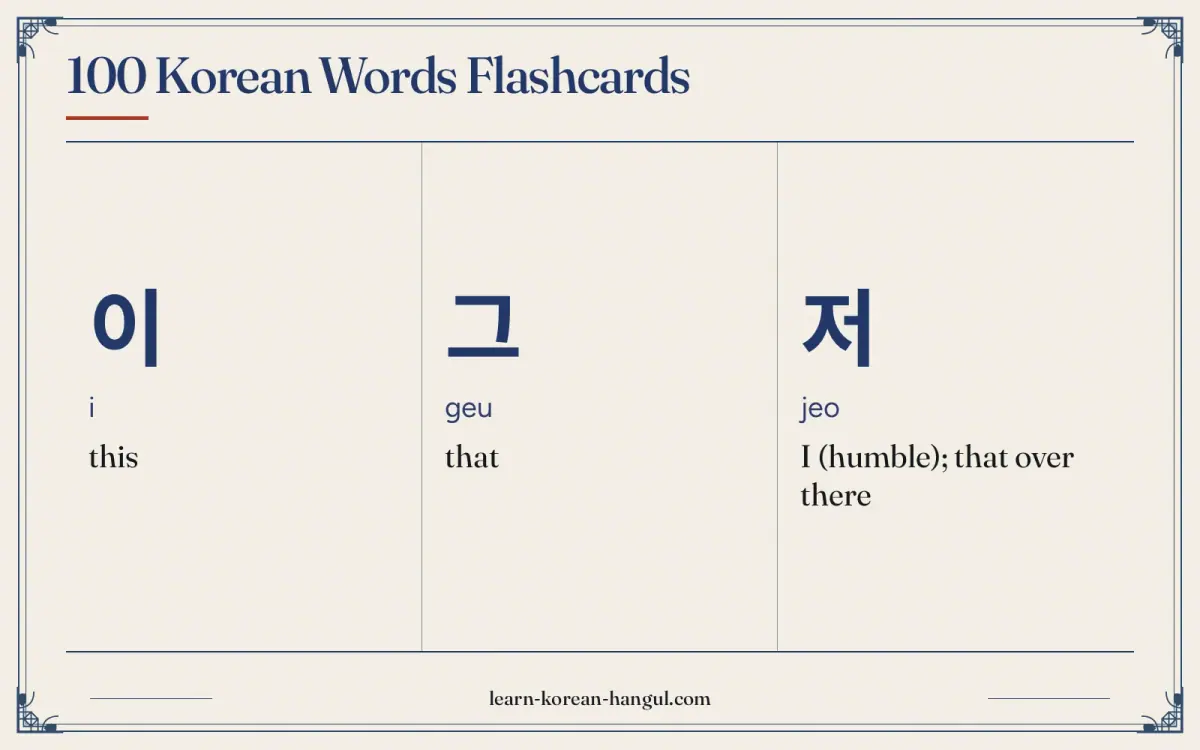
The cards follow the order of the 100 Korean words list: pronouns and demonstratives first (cards 1 to 16), then people and family (17 to 36), time and numbers (37 to 54), places and things (55 to 84), and everyday adverbs and connectors (85 to 100). Each card has the same meaning as the list, and the list gives an example sentence for every word, so open it when a card needs context. Verbs and adjectives are not in the list, so they are not in this deck either.
How Do I Use These Flashcards?
Use the deck above in four steps. It works with tap, click or keyboard, and nothing plays until you press an audio button.
- Choose a mode. Start with recognition (Hangul to meaning). Switch to recall (meaning to Hangul) or listening (audio to meaning) once recognition feels easy.
- Show the answer. Think of the answer first, then press Show answer (or Space). Turn on the romanization toggle only if you need it; the 100-card table below always shows it.
- Grade yourself. Press Got it if you answered correctly without help, or Not yet if you hesitated or guessed.
- Finish the session. A session holds up to 20 cards (you can set 10, 20 or 40). With 100 cards, a first-time learner should expect about ten days at the default limit of 10 new cards a day, with review sessions on top.
The Three Study Modes
Recognition shows the Hangul and asks for the meaning, which trains reading. Recall shows the meaning and asks for the Hangul, which trains remembering; you may type the answer with your Hangul keyboard or just recall it in your head. Listening plays a clip and hides the letters, which trains the ear. Listening mode only uses a card once its audio is approved, and cards without approved audio are skipped in that mode with a note.
Got It and Not Yet
Got it moves the card up one Leitner box, so it comes back later. Not yet sends the card back to box 1, so it returns in the same session or within 10 minutes. The grades are your own judgement; the deck does not score you or claim fluency.
Deck Scope: What Is and Is Not Covered
The deck covers the 100 words of the Top 100 Korean Words list: pronouns and question words, people, time words and a few numbers, everyday places and things, and short adverbs and connectors. Greetings and full number practice are left to their own decks, and the wider core list continues in the 500-word deck. The list is an editorial beginner set, not an official frequency list.
What Is Left out of This Deck?
Greetings are on the Korean greetings page, and numbers are in the Korean numbers flashcards. The next 400 words are in the 500 Korean words flashcards. Verbs and adjectives, and how to conjugate them, are on the common verbs pages, not here.
All 100 Cards in One Table
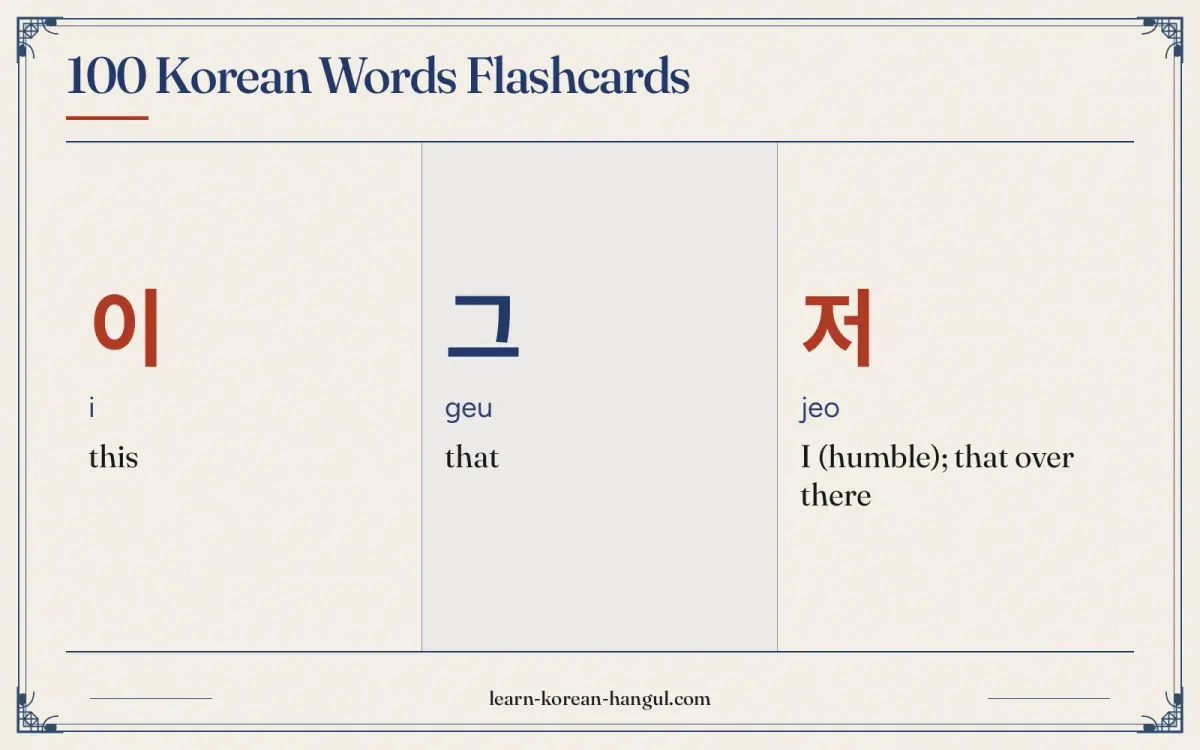
All 100 cards appear below in deck order. The table is plain HTML, so you can use it as a drill without the deck: cover the Meaning column, read each word aloud, then uncover it.
| # | Hangul | Revised Romanization | Meaning | Note | Audio assetId |
|---|---|---|---|---|---|
| 1 | 이 | i | this | Before a noun: 이 책 (this book). Near the speaker. | au-pg-flashcards-top-100-words-1 |
| 2 | 그 | geu | that | Before a noun: 그 사람 (that person). Near the listener. | au-pg-flashcards-top-100-words-2 |
| 3 | 저 | jeo | I (humble); that over there | Humble I for elders and strangers (저는 학생이에요); also that over there (저 사람). | au-pg-flashcards-top-100-words-3 |
| 4 | 나 | na | I (casual) | For friends and juniors. | au-pg-flashcards-top-100-words-4 |
| 5 | 너 | neo | you (casual) | Only for close friends or juniors. | au-pg-flashcards-top-100-words-5 |
| 6 | 우리 | uri | we, our | Also 우리 집 (our house) for your own home. | au-pg-flashcards-top-100-words-6 |
| 7 | 이것 | igeot | this thing | Said [이걷]; spoken form is 이거. | au-pg-flashcards-top-100-words-7; slow: au-pg-flashcards-top-100-words-101 |
| 8 | 그것 | geugeot | that thing | Said [그걷]; spoken form is 그거. | au-pg-flashcards-top-100-words-8 |
| 9 | 저것 | jeogeot | that thing over there | Said [저걷]; spoken form is 저거. | au-pg-flashcards-top-100-words-9 |
| 10 | 여기 | yeogi | here | Near the speaker. | au-pg-flashcards-top-100-words-10 |
| 11 | 거기 | geogi | there | Near the listener. | au-pg-flashcards-top-100-words-11 |
| 12 | 저기 | jeogi | over there | Far from both. | au-pg-flashcards-top-100-words-12 |
| 13 | 누구 | nugu | who | Sits where the answer would sit. | au-pg-flashcards-top-100-words-13 |
| 14 | 무엇 | mueot | what | Said [무얻]; spoken form is 뭐. | au-pg-flashcards-top-100-words-14; slow: au-pg-flashcards-top-100-words-102 |
| 15 | 어디 | eodi | where | 어디예요? means Where is it? | au-pg-flashcards-top-100-words-15 |
| 16 | 언제 | eonje | when | Time question word. | au-pg-flashcards-top-100-words-16 |
| 17 | 사람 | saram | person | Counted with 명. | au-pg-flashcards-top-100-words-17 |
| 18 | 남자 | namja | man | Pairs with 여자 (woman). | au-pg-flashcards-top-100-words-18 |
| 19 | 여자 | yeoja | woman | Pairs with 남자 (man). | au-pg-flashcards-top-100-words-19 |
| 20 | 아이 | ai | child | Spoken form is 애. | au-pg-flashcards-top-100-words-20 |
| 21 | 친구 | chingu | friend | Also used for people your age. | au-pg-flashcards-top-100-words-21 |
| 22 | 선생님 | seonsaengnim | teacher | 님 is a respect suffix; also used to address a teacher. | au-pg-flashcards-top-100-words-22 |
| 23 | 학생 | haksaeng | student | Said [학쌩]. | au-pg-flashcards-top-100-words-23; slow: au-pg-flashcards-top-100-words-103 |
| 24 | 가족 | gajok | family | 우리 가족 means my family. | au-pg-flashcards-top-100-words-24 |
| 25 | 어머니 | eomeoni | mother | Polite word; 엄마 is the casual one. | au-pg-flashcards-top-100-words-25 |
| 26 | 아버지 | abeoji | father | Polite word; 아빠 is the casual one. | au-pg-flashcards-top-100-words-26 |
| 27 | 엄마 | eomma | mom | Casual word for mother. | au-pg-flashcards-top-100-words-27 |
| 28 | 아빠 | appa | dad | Casual word for father. | au-pg-flashcards-top-100-words-28 |
| 29 | 형 | hyeong | older brother (said by a man) | Used by a man for his older brother. | au-pg-flashcards-top-100-words-29 |
| 30 | 누나 | nuna | older sister (said by a man) | Used by a man for his older sister. | au-pg-flashcards-top-100-words-30 |
| 31 | 오빠 | oppa | older brother (said by a woman) | Used by a woman for her older brother. | au-pg-flashcards-top-100-words-31 |
| 32 | 언니 | eonni | older sister (said by a woman) | Used by a woman for her older sister. | au-pg-flashcards-top-100-words-32 |
| 33 | 동생 | dongsaeng | younger sibling | Brother or sister; 남동생 and 여동생 say which. | au-pg-flashcards-top-100-words-33 |
| 34 | 아들 | adeul | son | Pairs with 딸 (daughter). | au-pg-flashcards-top-100-words-34 |
| 35 | 딸 | ttal | daughter | Tense ㄸ, with no puff of air. | au-pg-flashcards-top-100-words-35 |
| 36 | 이름 | ireum | name | 이름이 뭐예요? asks for a name. | au-pg-flashcards-top-100-words-36 |
| 37 | 시간 | sigan | time | 시간 있어요? means Do you have time? | au-pg-flashcards-top-100-words-37 |
| 38 | 오늘 | oneul | today | Time word. | au-pg-flashcards-top-100-words-38 |
| 39 | 내일 | naeil | tomorrow | Time word. | au-pg-flashcards-top-100-words-39 |
| 40 | 어제 | eoje | yesterday | Time word. | au-pg-flashcards-top-100-words-40 |
| 41 | 지금 | jigeum | now | Time word. | au-pg-flashcards-top-100-words-41 |
| 42 | 아침 | achim | morning; breakfast | Also means breakfast. | au-pg-flashcards-top-100-words-42 |
| 43 | 저녁 | jeonyeok | evening; dinner | Also means dinner. | au-pg-flashcards-top-100-words-43 |
| 44 | 밤 | bam | night | 밤에 means at night. | au-pg-flashcards-top-100-words-44 |
| 45 | 주 | ju | week | 이번 주 means this week. | au-pg-flashcards-top-100-words-45 |
| 46 | 달 | dal | month; moon | Also moon; 다음 달 means next month. | au-pg-flashcards-top-100-words-46 |
| 47 | 해 | hae | sun; year | Also year; 해가 떠요 means the sun rises. | au-pg-flashcards-top-100-words-47 |
| 48 | 하루 | haru | one day | 하루에 means per day. | au-pg-flashcards-top-100-words-48 |
| 49 | 하나 | hana | one | Becomes 한 before a counter: 한 명. | au-pg-flashcards-top-100-words-49 |
| 50 | 둘 | dul | two | Becomes 두 before a counter: 두 명. | au-pg-flashcards-top-100-words-50 |
| 51 | 셋 | set | three | Becomes 세 before a counter: 세 명. | au-pg-flashcards-top-100-words-51 |
| 52 | 열 | yeol | ten | Native ten; the Sino-Korean ten is 십. | au-pg-flashcards-top-100-words-52 |
| 53 | 백 | baek | hundred | Sino-Korean; 백 원 means 100 won. | au-pg-flashcards-top-100-words-53 |
| 54 | 몇 | myeot | how many | Said [멷]; needs a counter. | au-pg-flashcards-top-100-words-54; slow: au-pg-flashcards-top-100-words-104 |
| 55 | 집 | jip | house, home | Ends in a closed [p] sound. | au-pg-flashcards-top-100-words-55 |
| 56 | 학교 | hakgyo | school | Said [학꾜]: ㄱ tenses after ㄱ. | au-pg-flashcards-top-100-words-56; slow: au-pg-flashcards-top-100-words-105 |
| 57 | 회사 | hoesa | company | 회사에 다녀요 means I work at a company. | au-pg-flashcards-top-100-words-57 |
| 58 | 나라 | nara | country | Native Korean word for country. | au-pg-flashcards-top-100-words-58 |
| 59 | 한국 | hanguk | Korea | Said [한국]; ends in a closed [k]. | au-pg-flashcards-top-100-words-59 |
| 60 | 서울 | seoul | Seoul | The capital of Korea. | au-pg-flashcards-top-100-words-60 |
| 61 | 방 | bang | room | 제 방 means my room. | au-pg-flashcards-top-100-words-61 |
| 62 | 문 | mun | door | 문을 열어요 means I open the door. | au-pg-flashcards-top-100-words-62 |
| 63 | 길 | gil | road, way | A road, or the way to a place. | au-pg-flashcards-top-100-words-63 |
| 64 | 시장 | sijang | market | 시장에 가요 means I go to the market. | au-pg-flashcards-top-100-words-64 |
| 65 | 식당 | sikdang | restaurant | Said [식땅]. | au-pg-flashcards-top-100-words-65; slow: au-pg-flashcards-top-100-words-106 |
| 66 | 병원 | byeongwon | hospital | 원 means institution, as in 학원. | au-pg-flashcards-top-100-words-66 |
| 67 | 은행 | eunhaeng | bank | In fast speech the ㅎ often sounds weak. | au-pg-flashcards-top-100-words-67 |
| 68 | 역 | yeok | station | 서울역 is Seoul Station. | au-pg-flashcards-top-100-words-68 |
| 69 | 물 | mul | water | Basic drink word. | au-pg-flashcards-top-100-words-69 |
| 70 | 밥 | bap | cooked rice; meal | Also means a meal. | au-pg-flashcards-top-100-words-70 |
| 71 | 음식 | eumsik | food | 한국 음식 means Korean food. | au-pg-flashcards-top-100-words-71 |
| 72 | 차 | cha | tea; car | Tea or car; context decides. | au-pg-flashcards-top-100-words-72 |
| 73 | 책 | chaek | book | Ends in a closed [k] sound. | au-pg-flashcards-top-100-words-73 |
| 74 | 돈 | don | money | Often with 있다 and 없다. | au-pg-flashcards-top-100-words-74 |
| 75 | 전화 | jeonhwa | phone; phone call | In fast speech the ㅎ often sounds weak. | au-pg-flashcards-top-100-words-75 |
| 76 | 옷 | ot | clothes | Said [옫]; 옷이 is said [오시]. | au-pg-flashcards-top-100-words-76; slow: au-pg-flashcards-top-100-words-107 |
| 77 | 신발 | sinbal | shoes | Counted in pairs with 켤레. | au-pg-flashcards-top-100-words-77 |
| 78 | 우산 | usan | umbrella | 우산이 있어요 means I have an umbrella. | au-pg-flashcards-top-100-words-78 |
| 79 | 일 | il | work; thing to do | Different from the number 일 (one). | au-pg-flashcards-top-100-words-79 |
| 80 | 말 | mal | word; speech | 한국말 means the Korean language. | au-pg-flashcards-top-100-words-80 |
| 81 | 눈 | nun | eye; snow | Eye or snow; context decides. | au-pg-flashcards-top-100-words-81 |
| 82 | 배 | bae | pear; belly; ship | Pear, belly or ship; context decides. | au-pg-flashcards-top-100-words-82 |
| 83 | 손 | son | hand | 손을 씻어요 means I wash my hands. | au-pg-flashcards-top-100-words-83 |
| 84 | 것 | geot | thing | Spoken form is 거: 제 거 (mine). | au-pg-flashcards-top-100-words-84 |
| 85 | 아주 | aju | very | Strong degree word. | au-pg-flashcards-top-100-words-85 |
| 86 | 곧 | got | soon | 곧 가요 means I am going soon. | au-pg-flashcards-top-100-words-86 |
| 87 | 너무 | neomu | too much | Often means too much. | au-pg-flashcards-top-100-words-87 |
| 88 | 많이 | mani | a lot | Said [마니]; adverb of 많다. | au-pg-flashcards-top-100-words-88; slow: au-pg-flashcards-top-100-words-108 |
| 89 | 조금 | jogeum | a little | Spoken form is 좀. | au-pg-flashcards-top-100-words-89 |
| 90 | 더 | deo | more | 더 주세요 means Give me more. | au-pg-flashcards-top-100-words-90 |
| 91 | 또 | tto | again | Repeats an action. | au-pg-flashcards-top-100-words-91 |
| 92 | 같이 | gachi | together | Said [가치]: ㅌ becomes ㅊ before 이 (palatalization). | au-pg-flashcards-top-100-words-92; slow: au-pg-flashcards-top-100-words-109 |
| 93 | 다시 | dasi | again, once more | 다시 말해 주세요 means Please say it again. | au-pg-flashcards-top-100-words-93 |
| 94 | 먼저 | meonjeo | first, before | 먼저 가세요 means Please go first. | au-pg-flashcards-top-100-words-94 |
| 95 | 자주 | jaju | often | Goes before the verb: 자주 가요. | au-pg-flashcards-top-100-words-95 |
| 96 | 가끔 | gakkeum | sometimes | Tense ㄲ in the middle. | au-pg-flashcards-top-100-words-96 |
| 97 | 빨리 | ppalli | quickly | Tense ㅃ, then a double [ll]. | au-pg-flashcards-top-100-words-97 |
| 98 | 그리고 | geurigo | and (between sentences) | Joins sentences; between nouns use 하고. | au-pg-flashcards-top-100-words-98 |
| 99 | 그런데 | geureonde | but; by the way | Spoken form is 근데. | au-pg-flashcards-top-100-words-99 |
| 100 | 그래서 | geuraeseo | so, therefore | Gives a result: so. | au-pg-flashcards-top-100-words-100 |
Reading the Table
Hangul is the word. Revised Romanization (RR) is a learning aid, so try to read the Hangul before you look at it. RR follows some sound changes, which is why 같이 is gachi and 많이 is mani, but not tensing, so 학교 is hakgyo although it is said [학꾜]. The Meaning column gives the English gloss, and the Note column gives a use or sound hint. The last column lists the audio assetId; a second ID marks a slow clip. Where people usually say a shorter form, such as 이거 for 이것, the Note column gives it.
Usage Notes for These Cards
저 and 나 are both I. 저 is the humble first-person pronoun used with elders and strangers, while 나 is for friends and juniors: 저는 학생이에요 (I am a student). Learn 저 first, because a polite sentence is always safe. 저 also means "that over there" before a noun, as in 저 사람 (that person over there).
이, 그 and 저 come in sets. The same three distances run through 이것, 그것, 저것 (this, that, that over there) and 여기, 거기, 저기 (here, there, over there). 이 is near the speaker, 그 is near the listener and 저 is far from both, so learn each set of three together.
Family words depend on who is speaking. A man calls his older brother 형 and his older sister 누나, while a woman says 오빠 and 언니. 어머니 and 아버지 are the polite words; 엄마 and 아빠 are used in the family and in casual speech.
Question words sit where the answer would sit. Korean does not move them to the front, so 학교가 어디예요? (Where is the school?) keeps the word order of 학교가 저기예요 (The school is over there).
우리 means our as well as we. It is also used for things that belong to a group, so Koreans say 우리 집 (our house) for their own home, even when speaking only for themselves.
Which Sounds Do Not Match the Spelling?
이것 is said [이걷], and 옷 is said [옫]. At the end of a word, ㅅ is pronounced as a closed [ㄷ]. When a vowel follows, the ㅅ comes back: 이것은 is [이거슨] and 옷이 is [오시].
학교 is said [학꾜], 학생 [학쌩] and 식당 [식땅]. After a final ㄱ sound, a plain ㄱ, ㅅ or ㄷ at the start of the next syllable becomes tense. Revised Romanization does not mark this, so it writes hakgyo, haksaeng and sikdang.
많이 is said [마니], and 같이 is said [가치]. In 많이 the ㅎ is silent before a vowel; in 같이 the ㅌ becomes ㅊ before 이. Revised Romanization follows both changes (mani, gachi). Reviewers should confirm these forms against the 국립국어원 standard pronunciation rules.
What Mistakes Do Learners Make with Top 100 Korean Words?
- Using 나 or 너 with elders or strangers. Use 저 and a polite ending, as in 저는 물을 마셔요, and use the person's name or title instead of 너.
- Mixing up 오빠/언니 and 형/누나. The choice depends on the speaker: a woman says 오빠 and 언니, a man says 형 and 누나.
- Using 그리고 between nouns. 그리고 joins sentences; between two nouns, use 하고, as in 물하고 밥.
- Saying 하나 or 둘 before a counter. These numbers shorten before a counter: 한 명, 두 명, 세 명.
Most of these slips involve register or word form, so say the list's example sentence aloud when you answer a card.
How Does the Review Schedule Work?
The deck uses a simplified Leitner system with five boxes. A new card starts in box 1. Each Got it moves it up one box, and each Not yet returns it to box 1. The box sets how long the card waits before it is due again.
| Box | Wait until the next review |
|---|---|
| 1 | same session or 10 minutes |
| 2 | 1 day |
| 3 | 3 days |
| 4 | 7 days |
| 5 | 21 days |
Each session shows due cards first, oldest due first, and then up to 10 new cards a day by default. A deck of 100 cards is introduced over ten days at the default of 10 new cards a day, and the later boxes bring each card back at longer gaps. Progress is saved only in this browser, so clearing site data deletes it. Use the export button to save a small JSON file with card IDs, boxes and due dates, and import it on another device. No account is needed.
Cultural and Practical Context
Real conversation often drops pronouns entirely, so a sentence like 가요 can mean I go, you go or we go depending on context. That is why the pronoun cards come first but are used less often than learners expect. Family words such as 언니 and 형 are also used for close friends and colleagues who are a little older. Listen for who and what the speakers have already mentioned, and fill in the missing pronoun yourself.
Limits of This Deck
The deck holds 100 words, which is a starting set rather than a complete vocabulary, and it is a hand-chosen beginner set, not an official frequency list. Each card carries its core meanings only, so words such as 배 (pear, belly, ship) and 차 (tea, car) need context. The deck has no verbs or adjectives, because the list has none. All Korean text is generated, and Min-ji Park reviewed and signed off the text and audio on 15 October 2026.
Next Steps after This Deck
When these cards feel easy, move on to the 500 Korean words flashcards to keep the same routine. Write the same words by hand with the 100 Korean words worksheet. If Hangul still feels slow, review reading Hangul. The Korean vocabulary flashcards page lists every themed deck, and the Korean flashcards hub lists all topics.
Frequently Asked Questions
Should I Learn 나 or 저 First?
Learn 저 first for safe polite speech with strangers and elders, then add 나 for friends your age or younger. Both mean I. Using 나 with someone older sounds rude, while using 저 with a close friend only sounds formal. Pair 저 with a polite ending such as 요.
Why Are There No Verbs in This Deck?
The deck matches the Top 100 Korean Words list, which holds nouns, pronouns, determiners, numbers, adverbs and connectors only. Verbs and adjectives change their endings, so they are taught with conjugation on the common verbs pages. Learn these 100 words first, then add verbs such as 가다 and 먹다 to build full sentences.
Why Does the Card Say 이것 When People Say 이거?
이것 is the full dictionary form, and 이거 is the spoken short form. Both mean this thing. The cards show the full form because that is how the list and dictionaries give it, and the Note column gives the short form. In conversation you will hear 이거, 그거 and 저거 far more often.
Why Is 무엇 on the Card When People Say 뭐?
뭐 is the spoken contraction of 무엇, both meaning what. The card shows 무엇 because the list uses the dictionary form. In conversation 뭐 is the usual form, as in 뭐 해요? (What are you doing?), while 무엇 appears in formal or written Korean, so learn to recognise both.
Is My Progress Saved If I Close the Page?
Yes, in the same browser on the same device. Card boxes and due dates are stored locally and nothing is sent to a server. Clearing site data, using a private window or switching browsers removes them, so use the export button to keep a backup file. No account is needed.