
Korean Internet Slang Flashcards: Study the 27 Cards
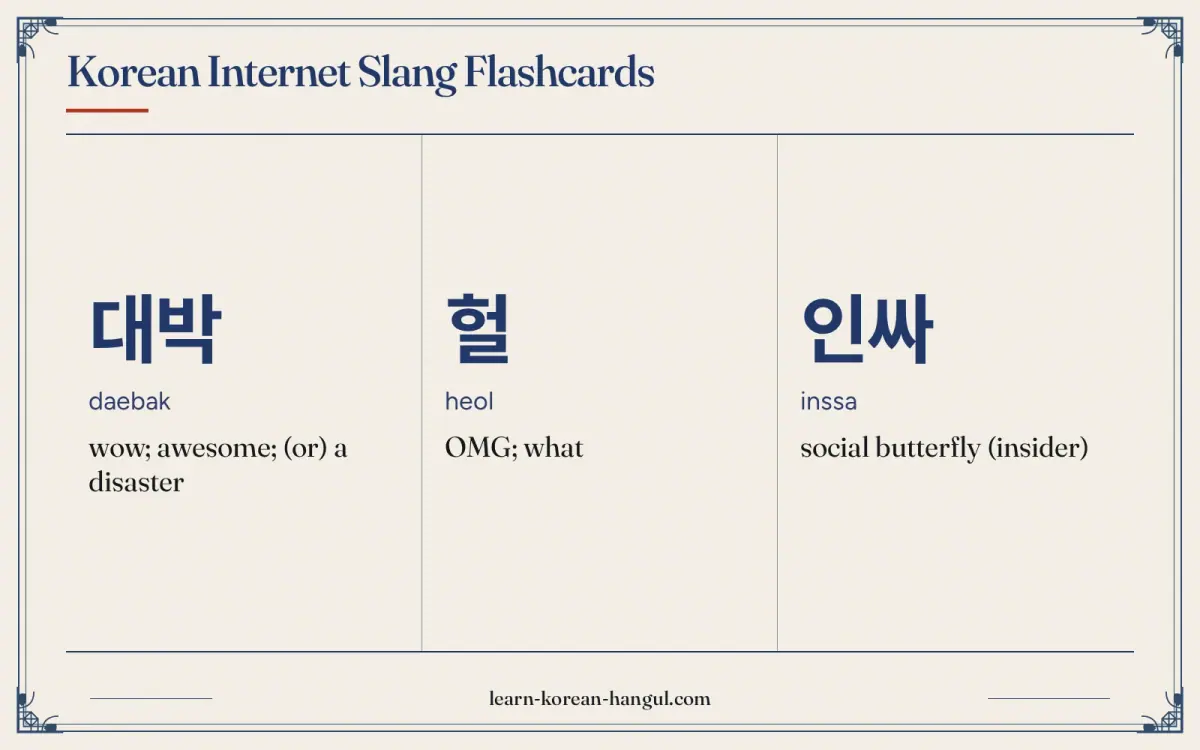
The cards start with typed laughter and reactions (cards 1 to 4), then social labels (5 to 8, with 갓생), then fun and boring (9 and 10), then a perfect person, posts and failure (11 to 14), then reactions and tips (15 to 20), and finish with chat habits, short forms and one English abbreviation (21 to 27).
How Do I Use These Flashcards?
Use the deck above in four steps. It works with tap, click or keyboard, and nothing plays until you press an audio button.
- Choose a mode. Start with recognition (Hangul to meaning). Switch to recall (meaning to Hangul) or listening (audio to meaning) once recognition feels easy.
- Show the answer. Say the word aloud in a friendly tone, as you would to a friend, before you reveal the meaning. Then press Show answer (or Space). Turn on the romanization toggle only if you need it; the table below always shows it.
- Grade yourself. Press Got it if you answered correctly without help, or Not yet if you hesitated or guessed.
- Finish the session. A session holds up to 20 cards (you can set 10, 20 or 40). With 27 cards, a first-time learner should expect about 3 days at the default limit of 10 new cards a day, with review sessions on top.
What Do the Three Modes Do?
Recognition shows the Hangul and asks for the meaning, so with the first card it shows ㅋㅋ and you answer "lol (typed laughter)". Recall reverses this: it shows the meaning and asks for the Hangul, and you may type the answer with your Hangul keyboard or just say it in your head. Listening plays a clip and hides the letters, which trains the ear. Recall mode is hard for slang because the spelling is not obvious, so use it last, after recognition and listening feel easy. The pronunciation audio is generated with text-to-speech and a Korean teacher approves it before it is switched on. Listening mode only uses cards whose audio is approved, and cards without approved audio are skipped in that mode with a note.
What Do Got It and Not yet Do?
Got it moves a card up one Leitner box, so it comes back later. Not yet sends the card back to box 1, so it returns in the same session or within 10 minutes. The grades are your own judgement; the deck does not score you or claim fluency.
Deck Scope: What Is and Is Not Covered
The deck covers 27 slang items of the kind that young Koreans use online: typed laughter (ㅋㅋ, ㅎㅎ), reactions (대박, 헐), social labels (인싸, 아싸), blends (꿀잼, 갓생, 엄친아), and short forms (폭망, 읽씹, 갑분싸, 케바케, 금사빠). They are mostly in the casual register (반말), so check the context before you use them. Consonant-only texting shortcuts are in the texting abbreviations deck.
What Is Left out of This Deck?
Texting shortcuts built only from consonants are in the Korean texting abbreviations flashcards. Slang with a rude or sexual sense is left out on purpose. Older cultural words and sayings are in the Traditional Korean culture words flashcards. The full lesson on this topic is korean internet slang.
All 27 Cards in One Table
All 27 cards appear below in deck order. The table is plain HTML, so you can use it as a drill without the deck: cover the Meaning column, say each item aloud, then uncover it.
| # | Hangul | Revised Romanization | Meaning | Note | Audio assetId |
|---|---|---|---|---|---|
| 1 | ㅋㅋ | keukeu | lol (typed laughter) | Written laughter. More ㅋ means more laughter, as in ㅋㅋㅋㅋ. The reading keukeu is a convention. | au-pg-flashcards-internet-slang-1 |
| 2 | ㅎㅎ | hihi | hehe (typed laughter) | A softer written laugh than ㅋㅋ. The reading hihi is a convention. | au-pg-flashcards-internet-slang-2 |
| 3 | 대박 | daebak | wow; awesome; (or) a disaster | 대박! 합격했어요. (Wow! I passed.) Tone decides the meaning: 대박, 망했어 means Oh no, I failed. | au-pg-flashcards-internet-slang-3; slow: au-pg-flashcards-internet-slang-28 |
| 4 | 헐 | heol | OMG; what | A reaction to surprise or disbelief. Spoken or chat only. | au-pg-flashcards-internet-slang-4 |
| 5 | 인싸 | inssa | social butterfly (insider) | 그 친구는 인싸예요. (That friend is a social butterfly.) From the English insider. | au-pg-flashcards-internet-slang-5 |
| 6 | 아싸 | assa | loner (outsider) | The opposite of 인싸, from the English outsider. It can also be used about oneself with a joking tone. | au-pg-flashcards-internet-slang-6 |
| 7 | 핵인싸 | haeginssa | super social butterfly | 핵 adds the sense of extreme, so it means the most outgoing person in the group. | au-pg-flashcards-internet-slang-7 |
| 8 | 갓생 | gatsaeng | an organised, productive life | From 갓 (god) + 생 (life). 갓생 살고 싶어. (I want to live an organised life.) | au-pg-flashcards-internet-slang-8 |
| 9 | 꿀잼 | kkuljaem | very fun | From 꿀 (honey) + 재미 (fun). 이 영화 꿀잼이야. (This movie is great fun.) | au-pg-flashcards-internet-slang-9 |
| 10 | 노잼 | nojaem | boring; not fun | From the English no + 재미. The opposite of 꿀잼. | au-pg-flashcards-internet-slang-10 |
| 11 | 엄친아 | eomchina | perfect "mom's friend's son" | Short for 엄마 친구 아들. It names someone seen as perfect, often as parents compare. Said [엄치나]. | au-pg-flashcards-internet-slang-11 |
| 12 | 댓글 | daetgeul | comment (online reply) | 댓글을 달아요. (I leave a comment.) Said [댇끌]. | au-pg-flashcards-internet-slang-12; slow: au-pg-flashcards-internet-slang-29 |
| 13 | 폭망 | pongmang | total failure | 시험 폭망했어. (I totally failed the exam.) Said [퐁망]. | au-pg-flashcards-internet-slang-13 |
| 14 | 짤 | jjal | meme image; clipped image | A saved image or a still from a video that is shared as a joke. | au-pg-flashcards-internet-slang-14 |
| 15 | 실화냐 | silhwanya | Is this for real? | 실화냐? (Is this real?) 실화 means a true story. Casual only. | au-pg-flashcards-internet-slang-15 |
| 16 | 레전드 | rejeondeu | legendary | 그 경기 레전드였어. (That match was legendary.) From the English legend. | au-pg-flashcards-internet-slang-16 |
| 17 | 꿀팁 | kkultip | handy tip | From 꿀 + the English tip. 꿀팁 알려 줄게. (I will tell you a handy tip.) | au-pg-flashcards-internet-slang-17 |
| 18 | 멘붕 | menbung | mental breakdown; meltdown | Short for 멘탈 붕괴. 멘붕 왔어. (I am having a meltdown.) | au-pg-flashcards-internet-slang-18 |
| 19 | 득템 | deuktem | scoring a great find | From 득 (gain) + 템 (item). It is used when you get something good, cheaply or by luck. | au-pg-flashcards-internet-slang-19 |
| 20 | 심쿵 | simkung | heart flutter | From 심장이 쿵 (the heart thumps). Used when someone does something charming. | au-pg-flashcards-internet-slang-20 |
| 21 | 먹방 | meokbang | eating broadcast (mukbang) | 먹방을 봐요. (I watch an eating broadcast.) Said [먹빵]. | au-pg-flashcards-internet-slang-21 |
| 22 | 현웃 | hyeonut | real laugh out loud | Short for 현실 웃음 (real-life laugh). Used to say you really laughed, not just typed ㅋㅋ. Said [혀눋]. | au-pg-flashcards-internet-slang-22 |
| 23 | 읽씹 | ikssip | read and ignored (message) | 읽씹 당했어. (My message got read and ignored.) Said [익씹]. | au-pg-flashcards-internet-slang-23 |
| 24 | 갑분싸 | gapbunssa | suddenly awkward mood | Short for 갑자기 분위기 싸해짐. Said [갑뿐싸]. | au-pg-flashcards-internet-slang-24; slow: au-pg-flashcards-internet-slang-30 |
| 25 | 케바케 | kebake | case by case | Short for 케이스 바이 케이스. 사람마다 케바케야. (It depends on the person.) | au-pg-flashcards-internet-slang-25 |
| 26 | TMI (티엠아이) | tiemai | too much information | The English letters T-M-I read in Korean. 너무 TMI야. (That is too much information.) | au-pg-flashcards-internet-slang-26 |
| 27 | 금사빠 | geumsappa | someone who falls in love quickly | Short for 금방 사랑에 빠지는 사람. It is a casual label for oneself or a friend. | au-pg-flashcards-internet-slang-27 |
How Do I Read the Table?
Hangul is the slang item. Revised Romanization (RR) is a learning aid, so try to read the Hangul first. For the typed laughter ㅋㅋ and ㅎㅎ, the reading is a convention. The Meaning column gives the closest English equivalent. The Note column gives the origin, a short example or a use hint, and where the spoken sound differs from the spelling, the sound is shown in brackets. The last column lists the audio assetId, and a second ID marks a slow clip (0.8x).
Usage Notes for These Cards
Most of these are casual only. Slang belongs to casual speech and is mostly used in 반말 (the casual speech style), so avoid it with elders, in work emails and with strangers. 대박 is fine with friends, but not with a teacher or a boss.
대박 can be good or bad. 대박! 합격했어요 means Wow! I passed, and 대박, 망했어 means Oh no, I failed. Listen to the tone of voice and the rest of the sentence, because the word alone does not tell you.
Many are blends. 꿀잼 joins 꿀 (honey) and 재미 (fun), 갓생 joins 갓 (god) and 생 (life), and 엄친아 is the short form of 엄마 친구 아들. Once you see the parts, new slang is easier to guess.
인싸 and 아싸 come from English. They are from insider and outsider. 그 친구는 인싸예요 means that friend is a social butterfly. 핵 in front of a word adds an extreme sense, as in 핵인싸.
Typed laughter has degrees. ㅋㅋ and ㅎㅎ are written laughter: more ㅋ means more laughter, and ㅎㅎ is softer.
Which Sounds Do Not Match the Spelling?
Slang words are spelled in the usual way, so the usual sound changes apply.
댓글 is said [댇끌]. The final ㅅ is read as ㄷ, and the ㄱ after it becomes a tense sound. RR writes the sound as daetgeul.
폭망 is said [퐁망]. The final ㄱ becomes ㅇ before ㅁ. This is nasalization, and RR writes pongmang.
엄친아 is said [엄치나]. The final ㄴ of 친 moves onto the empty ㅇ of 아. This is liaison, and RR writes eomchina.
What Mistakes Do Learners Make with Internet Slang?
- Using slang with seniors or in formal messages. Switch to a polite form with elders and at work.
- Treating 대박 as only positive. It can also mean something went very wrong.
- Using 헐 in a formal report. It is spoken or chat only.
- Expecting slang to last. Many items feel dated within a few years, so check recent examples before you use an item.
The first mistake is about people, not words, so decide whom you are talking to before you pick a word.
How Does the Review Schedule Work?
The deck uses a simplified Leitner system with five boxes. A new card starts in box 1. Each Got it moves it up one box, and each Not yet returns it to box 1. The box sets how long the card waits before it is due again.
| Box | Wait until the next review |
|---|---|
| 1 | same session or 10 minutes |
| 2 | 1 day |
| 3 | 3 days |
| 4 | 7 days |
| 5 | 21 days |
Each session shows due cards first, oldest due first, then up to 10 new cards a day by default. A deck of 27 cards is introduced over 3 days at 10 new cards a day. Slang changes fast, so it helps to review cards in box 1 and 2 more often than the long gaps suggest. Progress is saved only in this browser, so clearing site data deletes it. Use the export button to save a small file with card IDs, boxes and due dates, and import it on another device. No account is needed.
Cultural and Practical Context
Korean youth slang changes quickly and often shortens or blends words, so expressions can feel dated within a few years. Some items spread from games, streams and comment sections before they reach television. This deck gives a snapshot, and its value is to help you understand what you read and hear, more than to push you to use every word yourself.
Limits of This Deck
The deck holds 27 slang items and one note for each, so it shows the common meaning and not every sense. Slang is a moving target, and some items here may sound old to a young speaker. All of it is informal. The deck leaves out items with a strong or rude word. All Korean text is generated and was reviewed and signed off by Min-ji Park on 15 October 2026, and each audio clip is checked by a Korean teacher before publication.
Next Steps after This Deck
After these korean internet slang flashcards, move on to the Korean texting abbreviations flashcards to keep the same routine, or try the Traditional Korean culture words flashcards for the opposite end of the vocabulary: older words that do not go out of date. Read the korean internet slang lesson for the background. The Korean vocabulary flashcards page lists every vocabulary deck, and the Korean flashcards hub lists all topics.
Frequently Asked Questions
Is 존맛 Slang Too?
Yes, it is common online as a word for very tasty. It contains a strong word as its first part, so this deck leaves it out and learners are better off avoiding it. A safer choice is 진짜 맛있어요 (it is really tasty), which works with everyone.
What Does 갓생 Mean?
갓생 means living an organised and productive life, such as keeping a schedule, exercising and studying. It joins 갓 (god) and 생 (life). Young Koreans often use it in a hopeful way, as in 갓생 살고 싶어 (I want to live an organised life).
Is 짤 Only a Meme?
Mostly it means an image that people share for fun, but it also means a still taken from a video. A reaction image in a chat is a 짤, and so is a cut-out of a famous scene. The word is casual and used online.
Can I Use 엄친아 for a Person?
Yes, but it describes someone seen as perfect, usually from the point of view of parents who compare their child with the friend's son. It can sound like a joke or a complaint, so use it with friends and not in front of the person.
Is My Progress Saved If I Close the Page?
Yes, in the same browser on the same device. Card boxes and due dates are stored locally and nothing is sent to a server. Clearing site data, using a private window or switching browsers removes them, so use the export button to keep a backup file. No account is needed.