Traditional Korean Culture Words Flashcards: Study the 29 Cards
Many of these words are Sino-Korean or older native terms, so they appear on museum labels and in history lessons more than in daily talk. The lesson behind this deck is traditional Korean culture words, so read it first if a card is new.
How Do I Use These Flashcards?
Use the deck above in four steps. It works with tap, click or keyboard, and nothing plays until you press an audio button.
- Choose a mode. Start with recognition (Hangul to meaning). Switch to recall (meaning to Hangul) or listening (audio to meaning) once recognition feels easy.
- Show the answer. Think of the answer first, then press Show answer (or Space). Say the word aloud before you reveal it, and for the clothing cards try it with its verb, such as 한복을 입어요. Turn on the romanization toggle only if you need it; the 29-card table below always shows it.
- Grade yourself. Press Got it if you answered correctly without help, or Not yet if you hesitated or guessed.
- Finish the session. A session holds up to 20 cards (you can set 10, 20 or 40). With 29 cards, a first-time learner can split the deck over three days, using the default limit of 10 new cards a day.
The Three Study Modes
Recognition shows the Hangul and asks for the meaning, which trains reading. Recall shows the meaning and asks for the Hangul, which trains remembering; you may type the answer with your Hangul keyboard or just recall it in your head. Listening plays a clip and hides the letters, which trains the ear. Listening mode only uses a card once its audio is approved, and cards without approved audio are skipped in that mode with a note.
Got It and Not Yet
Got it moves a card up one Leitner box, so it comes back later. Not yet sends the card back to box 1, so it returns in the same session or within 10 minutes. The grades are your own judgement; the deck does not score you or claim fluency.
Deck Scope: What Is and Is Not Covered
The deck covers 29 words in five groups: clothing and housing (한복, 저고리, 갓, 한옥, 온돌, 마루, 기와, 한지), food and crafts (김장, 도자기, 청자, 서예, 병풍), music and performance (판소리, 사물놀이, 장구, 꽹과리, 탈춤, 가야금), games and sport (씨름, 윷놀이, 제기차기) and history and language (전통, 조선, 경복궁, 궁궐, 선비, 한글, 한국어). Many cards name something you can see in a museum.
What Is Left out of This Deck?
Holidays and their food and rites are in the Korean holidays flashcards, and drama words are in the K-drama words flashcards. Everyday food is in a separate dishes deck. Online slang is in the Korean internet slang flashcards. The lesson page traditional Korean culture words holds the longer list.
All 29 Cards in One Table
All 29 cards appear below in deck order. The table is plain HTML, so you can use it as a drill without the deck: cover the Meaning column, say each entry aloud, then uncover it.
| # | Hangul | Revised Romanization | Meaning | Note | Audio assetId |
|---|---|---|---|---|---|
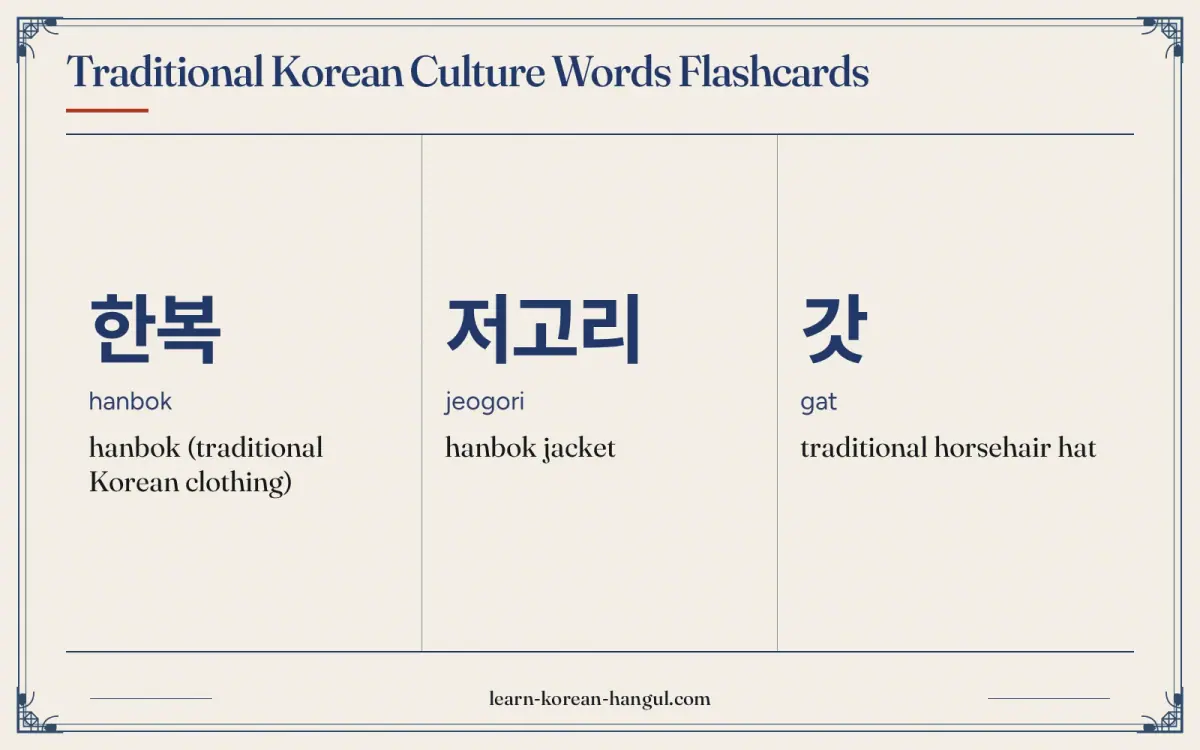
| 1 | 한복 | hanbok | hanbok (traditional Korean clothing) | Traditional Korean clothing. | au-pg-flashcards-traditional-culture-1 |
| 2 | 저고리 | jeogori | hanbok jacket | The upper garment of a hanbok. | au-pg-flashcards-traditional-culture-2 |
| 3 | 갓 | gat | traditional horsehair hat | Worn by men in the Joseon period. | au-pg-flashcards-traditional-culture-3 |
| 4 | 한옥 | hanok | hanok (traditional Korean house) | Said [하녹]; the final ㄴ of 한 links to 옥. | au-pg-flashcards-traditional-culture-4 |
| 5 | 온돌 | ondol | ondol (underfloor heating) | Heated floor; still used as underfloor heating. | au-pg-flashcards-traditional-culture-5 |
| 6 | 마루 | maru | wooden floor (hall) | The raised wooden-floor room of a hanok. | au-pg-flashcards-traditional-culture-6 |
| 7 | 기와 | giwa | roof tile | A hanok roof is covered with 기와. | au-pg-flashcards-traditional-culture-7 |
| 8 | 한지 | hanji | traditional Korean paper | Paper made from mulberry bark. | au-pg-flashcards-traditional-culture-8 |
| 9 | 김장 | gimjang | kimjang (making kimchi for winter) | Late-autumn kimchi making for the winter: 김장을 해요. | au-pg-flashcards-traditional-culture-9 |
| 10 | 판소리 | pansori | pansori (sung storytelling) | One singer tells a story with a drummer. | au-pg-flashcards-traditional-culture-10 |
| 11 | 사물놀이 | samullori | four-instrument percussion music | Said [사물로리]; ㄴ after a ㄹ final is read as ㄹ. | au-pg-flashcards-traditional-culture-11; slow: au-pg-flashcards-traditional-culture-30 |
| 12 | 장구 | janggu | janggu (hourglass drum) | One of the four 사물놀이 instruments. | au-pg-flashcards-traditional-culture-12 |
| 13 | 꽹과리 | kkwaenggwari | small hand gong | Struck with a stick; leads 사물놀이. | au-pg-flashcards-traditional-culture-13 |
| 14 | 탈춤 | talchum | mask dance | A dance drama performed in masks. | au-pg-flashcards-traditional-culture-14 |
| 15 | 씨름 | ssireum | Korean wrestling | Two wrestlers grip a belt and try to throw each other. | au-pg-flashcards-traditional-culture-15 |
| 16 | 윷놀이 | yunnori | yut game (stick-throwing board game) | Said [윤노리]; a New Year game. | au-pg-flashcards-traditional-culture-16; slow: au-pg-flashcards-traditional-culture-31 |
| 17 | 제기차기 | jegichagi | jegi kicking game | Players kick a weighted jegi to keep it in the air. | au-pg-flashcards-traditional-culture-17 |
| 18 | 가야금 | gayageum | gayageum (Korean zither) | A plucked string instrument. | au-pg-flashcards-traditional-culture-18 |
| 19 | 도자기 | dojagi | ceramics | Pottery; 청자 is a famous type. | au-pg-flashcards-traditional-culture-19 |
| 20 | 청자 | cheongja | celadon | Blue-green glazed pottery. | au-pg-flashcards-traditional-culture-20 |
| 21 | 서예 | seoye | calligraphy | Brush writing with ink. | au-pg-flashcards-traditional-culture-21 |
| 22 | 병풍 | byeongpung | folding screen | A screen of joined panels used as a room divider. | au-pg-flashcards-traditional-culture-22 |
| 23 | 전통 | jeontong | tradition | 전통적인 is the adjective traditional. | au-pg-flashcards-traditional-culture-23 |
| 24 | 조선 | joseon | Joseon (dynasty) | The last Korean dynasty, founded in 1392. | au-pg-flashcards-traditional-culture-24 |
| 25 | 경복궁 | gyeongbokgung | Gyeongbokgung Palace | Said [경복꿍]. The main royal palace in Seoul. | au-pg-flashcards-traditional-culture-25 |
| 26 | 궁궐 | gunggwol | palace | A royal palace complex. | au-pg-flashcards-traditional-culture-26 |
| 27 | 한글 | hangeul | Korean alphabet | The script; the language is 한국어. | au-pg-flashcards-traditional-culture-27 |
| 28 | 한국어 | hangugeo | Korean (language) | Said [한구거]; the final ㄱ of 국 links to 어. | au-pg-flashcards-traditional-culture-28; slow: au-pg-flashcards-traditional-culture-32 |
| 29 | 선비 | seonbi | scholar (learned gentleman) | A Joseon-period learned man. | au-pg-flashcards-traditional-culture-29 |
Reading the Table
Hangul is the word. Revised Romanization (RR) is a learning aid, so read the Hangul first and check RR afterwards. RR follows the sound of the word, which is why 사물놀이 is written samullori even though the spelling has ㄴ. The Meaning column gives the English gloss, and the Note column gives a use or sound hint. The last column lists the audio assetId; a second ID marks a slow clip. Cards 11, 16 and 28 have slow clips because their sound changes are easy to miss.
Usage Notes for These Cards
Clothes are worn with 입다. The verb for putting on or wearing clothes is 입다, so you say 한복을 입어요 (I wear hanbok). 하다 does not work here.
Kimchi is made with 담그다, and 김장 is a communal event. The usual verb for making kimchi is 담그다: 김치를 담그다. The late-autumn event where families and neighbours make a winter supply together is 김장, and you say 김장을 해요 (We do kimjang).
판소리 has a singer and a drummer. A singer (소리꾼) tells a story in song and speech while a drummer, the 고수, keeps the beat and calls out encouragement. The art is called 판소리, and you listen to it rather than watch a plot unfold.
사물놀이 uses four instruments. The group plays 꽹과리, 징, 장구 and 북, and the word 사물 means four things. Two of those are cards in this deck, 꽹과리 and 장구.
한글 is the alphabet, and 한국어 is the language. You learn 한국어 and write it in 한글: 한글로 써요 (I write in Hangul). The two words are often mixed up by learners.
Palaces and eras use 조선. 경복궁 is a 궁궐 (palace complex) built in the Joseon period, so a museum label may say 조선 시대 (the Joseon era).
Which Sounds Do Not Match the Spelling?
한옥 is said [하녹]. The final ㄴ of 한 links to the vowel of 옥, so the word sounds like ha-nok.
윷놀이 is said [윤노리]. The final ㅊ of 윷 is pronounced as ㄷ, and the ㄷ turns into ㄴ before the ㄴ of 놀. Then the ㄹ of 놀 links to the vowel of 이.
사물놀이 is said [사물로리]. The ㄴ after a ㄹ final is read as ㄹ (lateralization), so the word sounds like sa-mul-lo-ri.
한국어 is said [한구거]. The final ㄱ of 국 links to the vowel of 어.
경복궁 is said [경복꿍]. The ㄱ of 궁 comes right after the final ㄱ of 복, so it is pronounced tense, like ㄲ.
What Mistakes Do Learners Make with Traditional Culture Words?
- Saying 한복을 하다 for wearing. Say 한복을 입다.
- Calling the language 한글. 한글 is the script, and 한국어 is the language.
- Using 김치를 만들다 where 김치를 담그다 is the usual phrase.
- Treating 궁궐 as one building. It names a whole palace complex, while 경복궁 is one named palace.
The verb pairs cause most of the slips, so give cards 1, 9 and 27 extra passes in recall mode.
How Does the Review Schedule Work?
The deck uses a simplified Leitner system with five boxes. A new card starts in box 1. Each Got it moves it up one box, and each Not yet returns it to box 1. The box sets how long the card waits before it is due again.
| Box | Wait until the next review |
|---|---|
| 1 | same session or 10 minutes |
| 2 | 1 day |
| 3 | 3 days |
| 4 | 7 days |
| 5 | 21 days |
Each session shows due cards first, oldest due first, and then up to 10 new cards a day by default. A deck of 29 cards is introduced over three days at the default of 10 new cards a day, and the later boxes bring each card back at longer gaps. Progress is saved only in this browser, so clearing site data deletes it. Use the export button to save a small JSON file with card IDs, boxes and due dates, and import it on another device. No account is needed.
Cultural and Practical Context
Traditional arts such as 판소리 and the communal making of kimchi, 김장, have been recognised by UNESCO as intangible cultural heritage, and many people still wear 한복 for holidays and weddings. Several games on this deck, such as 윷놀이, are played at family gatherings on New Year.
Limits of This Deck
The deck holds 29 cards and gives each word a short gloss, so it does not explain the history behind them. The UNESCO remark is stated briefly. All Korean text is generated and was reviewed and signed off by Min-ji Park on 15 October 2026. The audio is generated with text-to-speech and is checked by a Korean teacher before publication, and listening mode uses only cards whose clips are approved.
Next Steps after This Deck
After this deck, move on to the Korean internet slang flashcards for a very different register. Go back to the K-drama words flashcards for earlier material, and write the words by hand with the Korean culture vocabulary worksheet. The traditional Korean culture words lesson holds the longer list, the Korean vocabulary flashcards page lists every other deck, and the Korean flashcards hub lists all topics.
Frequently Asked Questions
What Is the Difference between 한복 and 생활한복?
한복 is the traditional dress worn on formal occasions such as weddings and holidays. 생활한복 is a modern everyday version made to be comfortable for daily wear. Both come from the same tradition, but 생활한복 is looser and simpler.
What Is 온돌 in Modern Homes?
온돌 is the traditional system that heats the floor, and the idea survives as underfloor heating in modern Korean homes. In a hanok the heat came from a fire under the floor, while newer homes use pipes with hot water. People still say the floor is 따뜻해요 (warm).
Is 경복궁 in Seoul?
Yes. 경복궁 is one of the main royal palaces in Seoul. It is a 궁궐 from the Joseon period, and visitors can see it in the city centre. Its name is often written as Gyeongbokgung in English.
How Do I Say Traditional as an Adjective?
Use 전통적인 before a noun, as in 전통적인 음식 (traditional food). You can also use the noun 전통 as a modifier with 의: 전통의 맛 (the taste of tradition). The compound 전통 음식 (traditional food) is common in everyday speech.
Is My Progress Saved If I Close the Page?
Yes, in the same browser on the same device. Card boxes and due dates are stored locally and nothing is sent to a server. Clearing site data, using a private window or switching browsers removes them, so use the export button to keep a backup file. No account is needed.