
Korean Internet Slang at a Glance
The list has 45 words in five groups of nine. It starts with reactions that you can type in one syllable, then moves through fun and food, online posts, people and fandom, and the feelings that Koreans compress into short words. It belongs to Korean slang, and four neighbouring pages go further: Gen Z slang, social slang, abbreviations and shortened words and texting shortcuts. For the plain dictionary word, see slang in Korean.
| Group | Words | Use |
|---|---|---|
| Reactions and exclamations | 9 | Surprise, agreement, goosebumps and hopelessness |
| Fun, food and everyday life | 9 | Fun, boring, tips, restaurants and eating alone |
| Online posts and sharing | 9 | Comments, likes, subscribing and memes |
| People and fandom | 9 | Popular and lonely types, fans and best friends |
| Feelings and trends | 9 | Panic, awkward moments, finds and splurging |
This page leaves out vulgar slang on purpose. Vulgar words and the prefixes that make words rude are collected on Korean swear words, with notes on when they offend.
Which Internet Slang Words Should You Learn First?
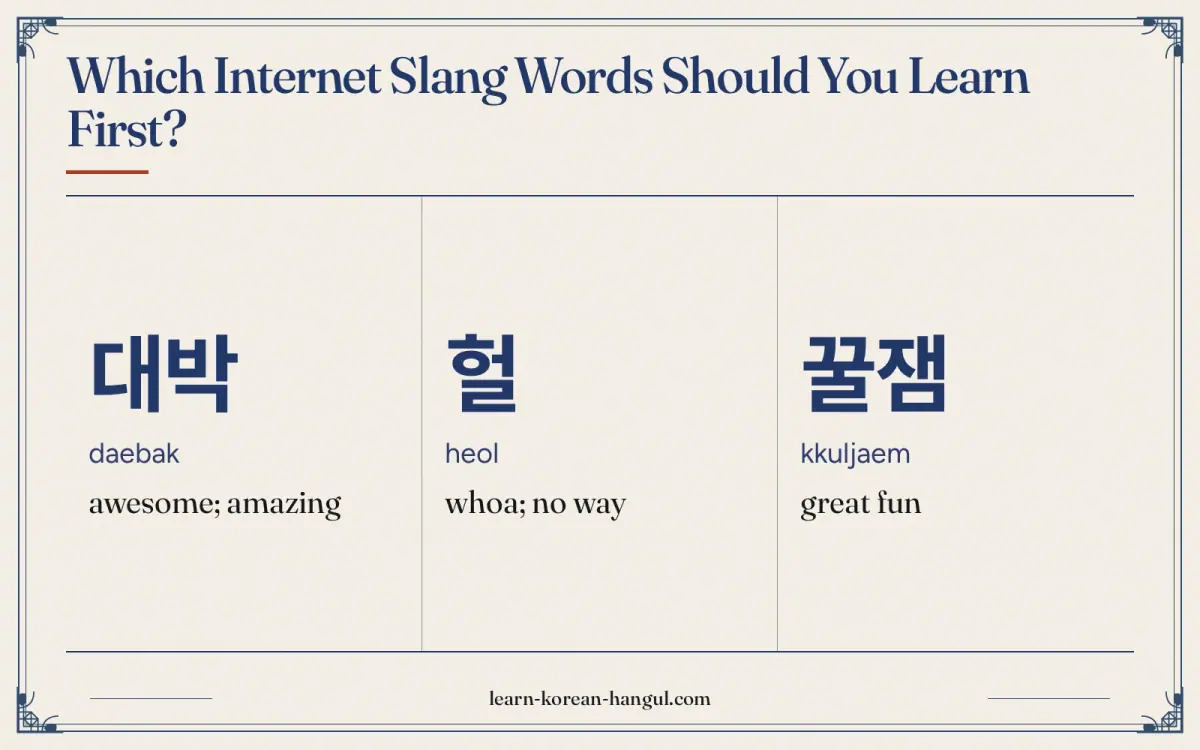
Learn 대박 (awesome), 헐 (whoa), 인정 (agreed), 꿀잼 (great fun) and 좋아요 (like) first. They appear in almost every chat and comment thread, and they are safe among friends. 대박이에요 (That is awesome) is the single most useful slang sentence for a new learner.
- Words to say. 대박, 헐, 인정, 꿀잼, 노잼, 맛집. They are common and low-risk among friends.
- Words to recognise. 갑분싸, 현타, 멘붕, 극혐, 고인물. You will read them more than you say them.
- Words to use with care. 관종, 아싸, 노답. They can sound rude if aimed at another person.
The scene below shows a phone screen with ten numbered slang words and symbols, so that you can tie each word to a picture.
Word · 10
- 1
대박
daebak
awesome; amazing
- 2
헐
heol
whoa; no way
- 3
꿀잼
kkuljaem
great fun
- 4
먹방
meokbang
eating broadcast
- 5
댓글
daetgeul
comment (online)
- 6
좋아요
joayo
like (button)
- 7
구독
gudok
subscription
- 8
인싸
inssa
popular person; insider
- 9
최애
choeae
favourite (most loved)
- 10
현타
hyeonta
reality-check moment
Reactions and Exclamations
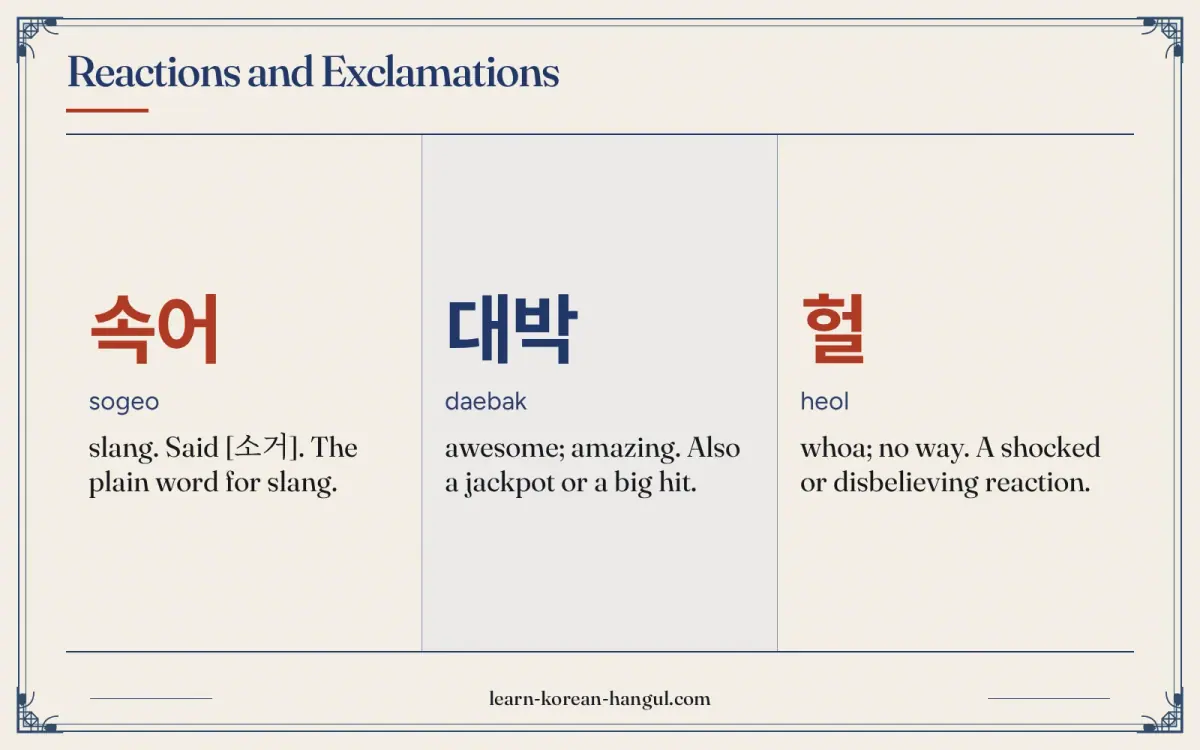
Reaction words are the quickest slang to learn, because they stand alone. A reader sees 헐 under a post, or a friend answers with 인정, and no sentence is needed. This first group also includes 속어, the neutral word for slang, and 핵, a small prefix that raises the volume of any word.
| No. | Hangul | Revised Romanization | Meaning and note | Example sentence | Audio assetId |
|---|---|---|---|---|---|
| 1 | 속어 | sogeo | slang. Said [소거]. The plain word for slang. | 속어를 배워요. (I learn slang.) | au-pg-vocabulary-slang-internet-slang-1; example: au-pg-vocabulary-slang-internet-slang-46 |
| 2 | 대박 | daebak | awesome; amazing. Also a jackpot or a big hit. | 대박이에요. (That is awesome.) | au-pg-vocabulary-slang-internet-slang-2; example: au-pg-vocabulary-slang-internet-slang-47 |
| 3 | 헐 | heol | whoa; no way. A shocked or disbelieving reaction. | 헐, 진짜예요? (Whoa, really?) | au-pg-vocabulary-slang-internet-slang-3; example: au-pg-vocabulary-slang-internet-slang-48 |
| 4 | 레전드 | rejeondeu | legend; legendary. Used for the best of something. | 이 노래는 레전드예요. (This song is legendary.) | au-pg-vocabulary-slang-internet-slang-4; example: au-pg-vocabulary-slang-internet-slang-49 |
| 5 | 실화 | silhwa | true story; for real. Often used as a question of disbelief. | 이게 실화예요? (Is this for real?) | au-pg-vocabulary-slang-internet-slang-5; example: au-pg-vocabulary-slang-internet-slang-50 |
| 6 | 인정 | injeong | agreed; fair point. A short reply to agree with someone. | 인정, 맞아요. (Agreed, you are right.) | au-pg-vocabulary-slang-internet-slang-6; example: au-pg-vocabulary-slang-internet-slang-51 |
| 7 | 소름 | soreum | goosebumps. Goes with the verb 돋다, to rise. | 소름이 돋아요. (I get goosebumps.) | au-pg-vocabulary-slang-internet-slang-7; example: au-pg-vocabulary-slang-internet-slang-52 |
| 8 | 노답 | nodap | hopeless. 노 (no) plus 답 (answer). | 이 게임은 노답이에요. (This game is hopeless.) | au-pg-vocabulary-slang-internet-slang-8; example: au-pg-vocabulary-slang-internet-slang-53 |
| 9 | 핵 | haek | extremely (prefix). Put before a word to mean super. | 핵꿀잼이에요. (It is super fun.) | au-pg-vocabulary-slang-internet-slang-9; example: au-pg-vocabulary-slang-internet-slang-54 |
Example Sentences
Reaction words work as one-word answers, but they also fit the pattern word + 이에요 or 예요. 대박이에요 means that is awesome, and 노답이에요 means it is hopeless. After a vowel, use 예요, as in 레전드예요. Say each sentence aloud after the audio.
대박 is the best-known Korean slang word. It can describe a lucky win, a hit film or a shocking piece of news, and the tone of voice shows whether you are pleased or alarmed. 헐 is only a sound, and it has no standard spelling beyond this one, so you will also see 허얼 with a longer vowel. 핵 literally means nucleus, and as a prefix it works like super: 핵꿀잼 is super fun, and 핵인싸 appears in the people group below.
Fun, Food and Everyday Life
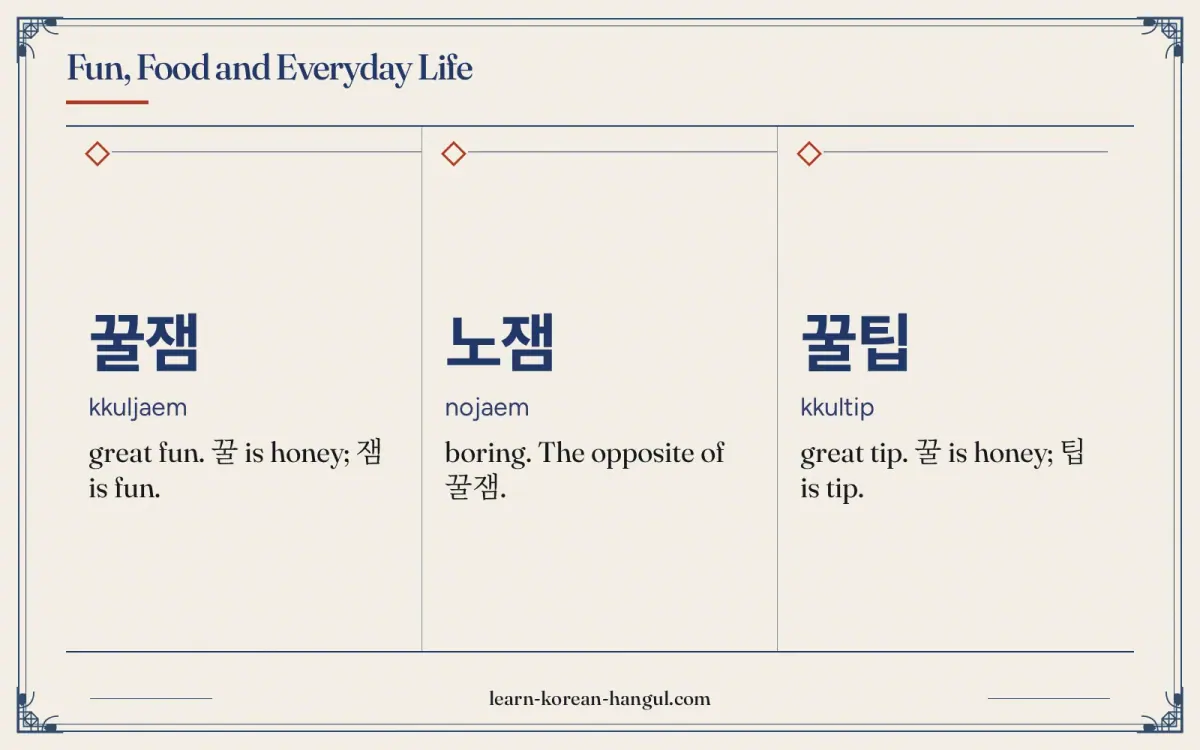
A large part of internet talk is about what is fun, what to eat and how to live. The first four words judge a thing, and the next five describe food and daily habits.
| No. | Hangul | Revised Romanization | Meaning and note | Example sentence | Audio assetId |
|---|---|---|---|---|---|
| 10 | 꿀잼 | kkuljaem | great fun. 꿀 is honey; 잼 is fun. | 이 드라마는 꿀잼이에요. (This drama is great fun.) | au-pg-vocabulary-slang-internet-slang-10; example: au-pg-vocabulary-slang-internet-slang-55 |
| 11 | 노잼 | nojaem | boring. The opposite of 꿀잼. | 이 영화는 노잼이에요. (This movie is boring.) | au-pg-vocabulary-slang-internet-slang-11; example: au-pg-vocabulary-slang-internet-slang-56 |
| 12 | 꿀팁 | kkultip | great tip. 꿀 is honey; 팁 is tip. | 꿀팁을 공유해요. (I share a great tip.) | au-pg-vocabulary-slang-internet-slang-12; example: au-pg-vocabulary-slang-internet-slang-57 |
| 13 | 맛집 | matjip | popular restaurant. 맛 is taste; 집 is house. | 맛집을 찾아요. (I look for a good restaurant.) | au-pg-vocabulary-slang-internet-slang-13; example: au-pg-vocabulary-slang-internet-slang-58 |
| 14 | 먹방 | meokbang | eating broadcast. Said [먹빵]. A video of someone eating. | 먹방을 봐요. (I watch an eating show.) | au-pg-vocabulary-slang-internet-slang-14; example: au-pg-vocabulary-slang-internet-slang-59 |
| 15 | 혼밥 | honbap | eating alone. 혼자 (alone) plus 밥 (rice, a meal). | 오늘은 혼밥이에요. (Today I eat alone.) | au-pg-vocabulary-slang-internet-slang-15; example: au-pg-vocabulary-slang-internet-slang-60 |
| 16 | 혼술 | honsul | drinking alone. 혼자 (alone) plus 술 (alcohol). | 혼술이 편해요. (Drinking alone is comfortable.) | au-pg-vocabulary-slang-internet-slang-16; example: au-pg-vocabulary-slang-internet-slang-61 |
| 17 | 갓생 | gatsaeng | a disciplined, productive life. Said [갇쌩]. 갓 is from English god. | 갓생을 살아요. (I live a disciplined life.) | au-pg-vocabulary-slang-internet-slang-17; example: au-pg-vocabulary-slang-internet-slang-62 |
| 18 | 가성비 | gaseongbi | value for money. Price against quality. | 가성비가 좋아요. (It is good value for money.) | au-pg-vocabulary-slang-internet-slang-18; example: au-pg-vocabulary-slang-internet-slang-63 |
꿀 (honey) is a favourite slang prefix for good things, as in 꿀잼 and 꿀팁. 노 (no) is the opposite, as in 노잼. 먹방 combines 먹다 (to eat) and 방송 (broadcast), and the ㅂ of 방 is said tense after the final ㄱ, so the word sounds like meok-ppang. The prefix 혼 (alone) builds a small family: 혼밥, 혼술 and 혼영 (watching a film alone). 갓생 is a Gen Z word, and the next page in the series, Gen Z slang, covers more of them.
How Do You Say Online Posts and Sharing in Korean?
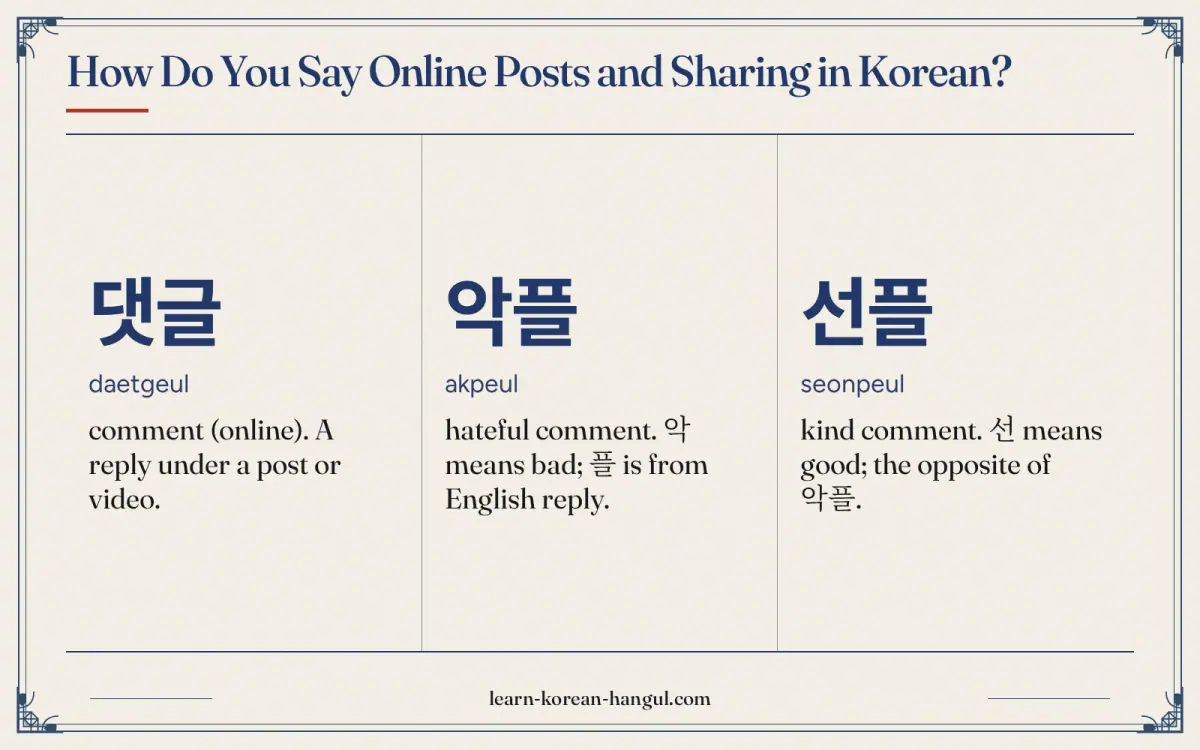
Korean social media has its own vocabulary, and many words are English loanwords. A few are short Korean forms of English words, such as 악플, and a few are real Korean inventions, such as 짤. This group names what you do in a comment thread and on a video channel.
| No. | Hangul | Revised Romanization | Meaning and note | Example sentence | Audio assetId |
|---|---|---|---|---|---|
| 19 | 댓글 | daetgeul | comment (online). A reply under a post or video. | 댓글을 달아요. (I leave a comment.) | au-pg-vocabulary-slang-internet-slang-19; example: au-pg-vocabulary-slang-internet-slang-64 |
| 20 | 악플 | akpeul | hateful comment. 악 means bad; 플 is from English reply. | 악플은 읽지 않아요. (I do not read hateful comments.) | au-pg-vocabulary-slang-internet-slang-20; example: au-pg-vocabulary-slang-internet-slang-65 |
| 21 | 선플 | seonpeul | kind comment. 선 means good; the opposite of 악플. | 선플을 달아요. (I leave a kind comment.) | au-pg-vocabulary-slang-internet-slang-21; example: au-pg-vocabulary-slang-internet-slang-66 |
| 22 | 좋아요 | joayo | like (button). Said [조아요]. The button, and the phrase I like it. | 좋아요를 눌러요. (I press like.) | au-pg-vocabulary-slang-internet-slang-22; example: au-pg-vocabulary-slang-internet-slang-67 |
| 23 | 구독 | gudok | subscription. Follow a channel. | 채널을 구독해요. (I subscribe to the channel.) | au-pg-vocabulary-slang-internet-slang-23; example: au-pg-vocabulary-slang-internet-slang-68 |
| 24 | 팔로우 | pallou | follow (social media). Loanword from English. | 친구를 팔로우해요. (I follow my friend.) | au-pg-vocabulary-slang-internet-slang-24; example: au-pg-vocabulary-slang-internet-slang-69 |
| 25 | 인플루언서 | inpeullueonseo | influencer. Loanword from English. | 인플루언서가 영상을 올려요. (The influencer uploads a video.) | au-pg-vocabulary-slang-internet-slang-25; example: au-pg-vocabulary-slang-internet-slang-70 |
| 26 | 짤 | jjal | meme image; saved picture. A picture or GIF passed around online. | 짤을 저장해요. (I save the meme image.) | au-pg-vocabulary-slang-internet-slang-26; example: au-pg-vocabulary-slang-internet-slang-71 |
| 27 | 밈 | mim | meme. From English meme. | 그 밈이 유명해요. (That meme is famous.) | au-pg-vocabulary-slang-internet-slang-27; example: au-pg-vocabulary-slang-internet-slang-72 |
악플 and 선플 are a neat pair, because both are built from the English word reply and a Korean piece, 악 (bad) or 선 (good). 좋아요 is the like button, and the ㅎ in it is silent, so you say jo-a-yo. The verb 달다 (to attach) is used for a comment, because a comment is stuck to a post. 누르다 (to press) is irregular, and the polite form is 눌러요, so check a table before you write it. Compare these words with the shorter forms on texting shortcuts.
People and Fandom
Korean internet slang sorts people into types. A person can be an 인싸 or an 아싸, a fan can be a 덕후, and a fan's life has stages: joining, loving and leaving. Many of these words are short forms of English words, and 덕후 comes from a Japanese word; all are used among peers.
| No. | Hangul | Revised Romanization | Meaning and note | Example sentence | Audio assetId |
|---|---|---|---|---|---|
| 28 | 인싸 | inssa | popular person; insider. From English insider. | 친구는 인싸예요. (My friend is very sociable.) | au-pg-vocabulary-slang-internet-slang-28; example: au-pg-vocabulary-slang-internet-slang-73 |
| 29 | 아싸 | assa | outsider; loner. From English outsider. Also a cheer, like yay. | 저는 아싸예요. (I am a bit of a loner.) | au-pg-vocabulary-slang-internet-slang-29; example: au-pg-vocabulary-slang-internet-slang-74 |
| 30 | 핵인싸 | haeginssa | super popular person. Said [해긴싸]. 핵 plus 인싸. | 그 사람은 핵인싸예요. (That person is very popular.) | au-pg-vocabulary-slang-internet-slang-30; example: au-pg-vocabulary-slang-internet-slang-75 |
| 31 | 관종 | gwanjong | attention seeker. Short for 관심 종자. Can sound rude. | 저는 관종이 아니에요. (I am not an attention seeker.) | au-pg-vocabulary-slang-internet-slang-31; example: au-pg-vocabulary-slang-internet-slang-76 |
| 32 | 덕후 | deokhu | devoted fan; enthusiast. Said [더쿠]. Short for 오덕후. | 저는 영화 덕후예요. (I am a film enthusiast.) | au-pg-vocabulary-slang-internet-slang-32; example: au-pg-vocabulary-slang-internet-slang-77 |
| 33 | 최애 | choeae | favourite (most loved). The standard allows [최애] and [췌애]. | 이 사람이 제 최애 가수예요. (This is my favourite singer.) | au-pg-vocabulary-slang-internet-slang-33; example: au-pg-vocabulary-slang-internet-slang-78 |
| 34 | 입덕 | ipdeok | becoming a fan. Said [입떡]. 입 means enter. | 이 노래로 입덕했어요. (I became a fan through this song.) | au-pg-vocabulary-slang-internet-slang-34; example: au-pg-vocabulary-slang-internet-slang-79 |
| 35 | 탈덕 | taldeok | leaving a fandom. Said [탈떡]. 탈 means exit. | 작년에 탈덕했어요. (I left the fandom last year.) | au-pg-vocabulary-slang-internet-slang-35; example: au-pg-vocabulary-slang-internet-slang-80 |
| 36 | 베프 | bepeu | best friend. Short for 베스트 프렌드. | 우리는 베프예요. (We are best friends.) | au-pg-vocabulary-slang-internet-slang-36; example: au-pg-vocabulary-slang-internet-slang-81 |
입덕 and 탈덕 are a pair: 입 (enter) and 탈 (leave) are joined to 덕, which is short for 덕후. 관종 is the one word in this group to use with care. It can sound like an insult when you aim it at another person, and people mostly use it about themselves, as a joke. 인싸 and 아싸 are neutral among friends, although 아싸 can sting if said about someone else. More social types are on social slang.
Feelings and Trends
The last group packs complete feelings into two or three syllables. Korean speakers love shortening a long phrase to its first sounds, and each word here is such a short form. Learn them as chunks and not as separate letters.
| No. | Hangul | Revised Romanization | Meaning and note | Example sentence | Audio assetId |
|---|---|---|---|---|---|
| 37 | 현타 | hyeonta | reality-check moment. Short for 현실 자각 타임. | 현타가 와요. (A reality check hits me.) | au-pg-vocabulary-slang-internet-slang-37; example: au-pg-vocabulary-slang-internet-slang-82 |
| 38 | 멘붕 | menbung | mental breakdown; panic. Short for 멘탈 붕괴. | 시험 전에 멘붕이었어요. (I panicked before the exam.) | au-pg-vocabulary-slang-internet-slang-38; example: au-pg-vocabulary-slang-internet-slang-83 |
| 39 | 갑분싸 | gapbunssa | sudden awkward mood. Said [갑뿐싸]. Short for 갑자기 분위기 싸해짐. | 갑분싸가 됐어요. (It suddenly turned awkward.) | au-pg-vocabulary-slang-internet-slang-39; example: au-pg-vocabulary-slang-internet-slang-84 |
| 40 | 극혐 | geukhyeom | disgusting. Said [그켬]. Short for 극도의 혐오. | 벌레는 극혐이에요. (Bugs are disgusting.) | au-pg-vocabulary-slang-internet-slang-40; example: au-pg-vocabulary-slang-internet-slang-85 |
| 41 | 핫플 | hatpeul | trendy spot. Short for 핫플레이스. | 여기가 핫플이에요. (This is a trendy spot.) | au-pg-vocabulary-slang-internet-slang-41; example: au-pg-vocabulary-slang-internet-slang-86 |
| 42 | 득템 | deuktem | landing a great find. 득 means gain; 템 is item. | 오늘 득템했어요. (I got a great find today.) | au-pg-vocabulary-slang-internet-slang-42; example: au-pg-vocabulary-slang-internet-slang-87 |
| 43 | 플렉스 | peullekseu | splurge; flex. From English flex. | 오늘은 플렉스했어요. (I splurged today.) | au-pg-vocabulary-slang-internet-slang-43; example: au-pg-vocabulary-slang-internet-slang-88 |
| 44 | 고인물 | goinmul | long-time veteran. Stagnant water; in games, an expert who stays. | 그는 게임 고인물이에요. (He is a game veteran.) | au-pg-vocabulary-slang-internet-slang-44; example: au-pg-vocabulary-slang-internet-slang-89 |
| 45 | 광클 | gwangkeul | frantic clicking. Used for ticket sales. | 광클했어요. (I clicked like crazy.) | au-pg-vocabulary-slang-internet-slang-45; example: au-pg-vocabulary-slang-internet-slang-90 |
Most of these words are acronyms of a longer phrase, and the pattern is worth learning. 현타 takes the first sound of 현실 and 타임, 멘붕 takes the first of 멘탈 and 붕괴, and 갑분싸 takes one syllable from each word of a sentence. If you learn the long phrase, the short word is easy to remember. The page on abbreviations and shortened words lists more of them. 극혐 and 득템 are heard in speech as well as in text.
When Is It Safe to Use Korean Slang?
Slang fits friends, peers and online spaces, and it does not fit every setting. Use these words with people your age and in chats where others use them. With a boss, a teacher, an older person or a stranger, use the polite -요 or formal -ㅂ니다 style and standard words: 아주 좋아요 (very good) in place of 대박, and 재미있어요 (it is fun) in place of 꿀잼. Compare how a friend writes 꿀잼이야 with how you would write 재미있어요 to a teacher. The same meaning has two registers.
The table below pairs common words from this page with the standard Korean they replace, and gives each a register label: neutral (fine in most settings, including the news), casual (friends and online only) or risky (can offend, even among friends).
| Slang | Standard Korean | Register |
|---|---|---|
| 대박 | 정말 좋아요 (jeongmal joayo, really good) | casual |
| 헐 | 진짜요? (jinjjayo, really?) | casual |
| 인정 | 맞아요 (majayo, that is right) | casual |
| 꿀잼 | 정말 재미있어요 (jeongmal jaemiisseoyo, really fun) | casual |
| 노잼 | 재미없어요 (jaemieopseoyo, it is boring) | casual |
| 멘붕 | 당황했어요 (danghwanghaesseoyo, I panicked) | casual |
| 베프 | 가장 친한 친구 (gajang chinhan chingu, best friend) | casual |
| 맛집 | 유명한 식당 (yumyeonghan sikdang, well-known restaurant) | neutral |
| 먹방 | 먹는 방송 (meongneun bangsong, eating broadcast) | neutral |
| 가성비 | 가격 대비 성능 (gagyeok daebi seongneung, performance for the price) | neutral |
| 노답 | 방법이 없어요 (bangbeobi eopseoyo, there is no way) | risky when said about a person |
| 극혐 | 정말 싫어요 (jeongmal sireoyo, I really hate it) | risky |
| 관종 | 관심을 받고 싶어 하는 사람 (gwansimeul batgo sipeo haneun saram, someone who wants attention) | risky |
Slang also ages quickly. A word that is common one year can sound dated a few years later, and spellings differ from site to site. The words on this page are widely understood, but check a recent source or ask a Korean friend before you use a new one. If a word uses a vulgar prefix, it is not on this page, and you can read about those words on Korean swear words.
Where Does Korean Internet Slang Come From?
Four patterns create most of it. The first is shortening: 현실 자각 타임 becomes 현타. The second is borrowing from English: 레전드 (legend) and 플렉스 (flex) come straight from English. The third is mixing a Korean piece with an English one: 악플 combines 악 (bad) with 플 from reply. The fourth is a playful prefix: 꿀 (honey) means good, 노 (no) means none, 핵 (nucleus) means very, and 혼 (alone) means by oneself. Once you notice these four patterns, you can guess many new words before you look them up. Chat apps add one more: words typed as initial consonants only, such as ㅇㅈ for 인정, which are collected on texting shortcuts.
How Do You Pronounce Korean Internet Slang?
Slang follows the standard sound rules of the National Institute of Korean Language (국립국어원), but its spelling is looser than a dictionary word. The Revised Romanization of Korean writes the tense letters kk, tt, pp and ss, but it does not show tensing caused by a neighbouring sound, and it keeps the h in nouns such as deokhu, so rely on the Hangul and the audio.
| Spelling | Sounds like | What changes |
|---|---|---|
| 속어 | [소거] | The final ㄱ of 속 moves onto the empty ㅇ of 어. |
| 먹방 | [먹빵] | After the final ㄱ, the ㅂ of 방 is said tense; it does not become ㅁ. |
| 갓생 | [갇쌩] | The final ㅅ is said as ㄷ, and the ㅅ of 생 is tense. |
| 좋아요 | [조아요] | The ㅎ of 좋 is silent before a vowel. |
| 입덕 | [입떡] | After the final ㅂ, the ㄷ of 덕 is said tense. |
| 갑분싸 | [갑뿐싸] | After the final ㅂ, the ㅂ of 분 is said tense. |
| 극혐 | [그켬] | The final ㄱ and the ㅎ of 혐 join into a strong ㅋ sound. |
| 덕후 | [더쿠] | The final ㄱ and the ㅎ of 후 join into a strong ㅋ sound. |
Three habits cover most of the list. After a final ㄱ or ㅂ, the next consonant is said tense, as in 먹방, 입덕 and 갑분싸. A ㅎ that meets ㄱ makes a strong ㅋ, as in 극혐 and 덕후. And a final consonant moves forward before ㅇ, as in 속어. Learn the spoken form with the spelling, and do not pause between syllables.
Audio and Slow Playback
Each word and sentence has its own clip. Five clips replay the hardest words slowly: eating show, productive life, becoming a fan, disgusting and devoted fan. Play one, repeat it aloud, then play it again and compare.
What Mistakes Do Learners Make with Korean Internet Slang?
Five confusions come up again and again.
- Using slang with older people. Slang is for peers. To a boss, teacher or elder, 대박이에요 can sound careless. Use polite words such as 아주 좋아요 and the polite -요 style, and keep the slang for friends.
- Reading 대박 as only good news. 대박 can also react to shocking bad news, with a different tone. A hit film is 대박, and so is a surprise accident. The tone of voice and the next sentence tell you which.
- Treating 관종 as a compliment. 관종 means someone who wants attention, and it often sounds like an insult. People use it about themselves as a joke. Do not use it for another person.
- Saying the ㅎ in 좋아요. The ㅎ of 좋 is silent before a vowel, so the word is [조아요]. If you pronounce it as joh-a-yo, it will sound unnatural.
- Assuming slang spellings are fixed. Online spelling varies: 헐 and 허얼, 꿀잼 and 꿀 잼. Choose the form in the dictionary or the one most people use, and expect to see variants.
In each case the word is right, but the setting, the tone or the sound is wrong. Keep the pairs together, such as 대박 and 아주 좋아요, 인싸 and 관종, and 좋아요 and joh-a-yo, and the rest of the 45 words stay in place.
Practice: Flashcards and Worksheet
Study in three steps. First, run the deck in recognition mode and take one group of nine words at a time. Second, switch to listening mode and play the clip before you flip each card. Third, take the five-question quiz. Progress stays in your browser, and the vocabulary flashcard decks page lists the other decks.
Practice · 45
- 01속어
Show answer
sogeo
slang
- 02대박
Show answer
daebak
awesome; amazing
- 03헐
Show answer
heol
whoa; no way
- 04레전드
Show answer
rejeondeu
legend; legendary
- 05실화
Show answer
silhwa
true story; for real
- 06인정
Show answer
injeong
agreed; fair point
- 07소름
Show answer
soreum
goosebumps
- 08노답
Show answer
nodap
hopeless
- 09핵
Show answer
haek
extremely (prefix)
- 10꿀잼
Show answer
kkuljaem
great fun
- 11노잼
Show answer
nojaem
boring
- 12꿀팁
Show answer
kkultip
great tip
- 13맛집
Show answer
matjip
popular restaurant
- 14먹방
Show answer
meokbang
eating broadcast
- 15혼밥
Show answer
honbap
eating alone
- 16혼술
Show answer
honsul
drinking alone
- 17갓생
Show answer
gatsaeng
a disciplined, productive life
- 18가성비
Show answer
gaseongbi
value for money
- 19댓글
Show answer
daetgeul
comment (online)
- 20악플
Show answer
akpeul
hateful comment
- 21선플
Show answer
seonpeul
kind comment
- 22좋아요
Show answer
joayo
like (button)
- 23구독
Show answer
gudok
subscription
- 24팔로우
Show answer
pallou
follow (social media)
- 25인플루언서
Show answer
inpeullueonseo
influencer
- 26짤
Show answer
jjal
meme image; saved picture
- 27밈
Show answer
mim
meme
- 28인싸
Show answer
inssa
popular person; insider
- 29아싸
Show answer
assa
outsider; loner
- 30핵인싸
Show answer
haeginssa
super popular person
- 31관종
Show answer
gwanjong
attention seeker
- 32덕후
Show answer
deokhu
devoted fan; enthusiast
- 33최애
Show answer
choeae
favourite (most loved)
- 34입덕
Show answer
ipdeok
becoming a fan
- 35탈덕
Show answer
taldeok
leaving a fandom
- 36베프
Show answer
bepeu
best friend
- 37현타
Show answer
hyeonta
reality-check moment
- 38멘붕
Show answer
menbung
mental breakdown; panic
- 39갑분싸
Show answer
gapbunssa
sudden awkward mood
- 40극혐
Show answer
geukhyeom
disgusting
- 41핫플
Show answer
hatpeul
trendy spot
- 42득템
Show answer
deuktem
landing a great find
- 43플렉스
Show answer
peullekseu
splurge; flex
- 44고인물
Show answer
goinmul
long-time veteran
- 45광클
Show answer
gwangkeul
frantic clicking
Practice · 5
What does 대박 (daebak) mean?
Show answer
awesome; amazing
대박 means awesome; amazing. Example: 대박이에요. (That is awesome.)
What does 꿀잼 (kkuljaem) mean?
Show answer
great fun
꿀잼 means great fun. Example: 이 드라마는 꿀잼이에요. (This drama is great fun.)
What does 먹방 (meokbang) mean?
Show answer
eating broadcast
먹방 means eating broadcast. Example: 먹방을 봐요. (I watch an eating show.)
What does 인싸 (inssa) mean?
Show answer
popular person; insider
인싸 means popular person; insider. Example: 친구는 인싸예요. (My friend is very sociable.)
What does 멘붕 (menbung) mean?
Show answer
mental breakdown; panic
멘붕 means mental breakdown; panic. Example: 시험 전에 멘붕이었어요. (I panicked before the exam.)
Korean Internet Slang Worksheet (PDF)
A printable worksheet for these words (word list, matching, writing practice, fill-in-the-blank exercises and answer key) is available in A4 and US Letter from the download card on this page. For additional practice, write three chat lines to a friend that use 대박, 꿀잼 and 인정.
Where to Go Next
After this page, continue with Gen Z slang for newer words, abbreviations and shortened words for more short forms, or texting shortcuts for typed symbols. For rude words and their risks, read Korean swear words. To move up a level, return to Korean slang.
Frequently Asked Questions
What Does 대박 (daebak) Mean?
대박 means awesome, amazing or a big hit. It can also be a jackpot. Say 대박이에요 for that is awesome. It is casual slang, so use it with friends. With a boss or an elder, choose a polite phrase such as 아주 좋아요. The tone of voice shows whether you are happy or shocked.
How Do You Pronounce 먹방 (meokbang)?
Say meok-ppang in two beats. The ㅂ of 방 is said tense after the final ㄱ, so the word sounds like [먹빵] and not [멍방]. The vowel ㅓ is a relaxed, unrounded sound. Press the audio button on this page to hear the word and the slow clip.
How Many Internet Slang Words Should I Learn First?
Start with five: 대박, 헐, 인정, 꿀잼 and 좋아요. They appear in most chats and comment threads. The whole list of 45 takes about nine days at five new words a day, with a short review of earlier words each day.
Is It Safe to Use Korean Slang with Everyone?
No. Slang suits friends and peers. With a boss, a teacher or an older person, use the polite style and standard words. Some words, such as 관종, can sound rude when you aim them at another person.
Where Can I Practise Internet Slang with Flashcards?
Use the deck on this page, which holds all 45 words with Hangul, romanization and audio, in recognition and listening modes. The vocabulary flashcard decks page lists the decks for other topics. Progress is saved only in your browser.
Is the Romanization on This Page Official?
It follows the Revised Romanization of Korean, which South Korea adopted in 2000 and whose rules the National Institute of Korean Language (국립국어원) publishes. It is a learning aid, and it does not show tensing caused by a neighbouring sound, so rely on the Hangul and the audio.