Key facts
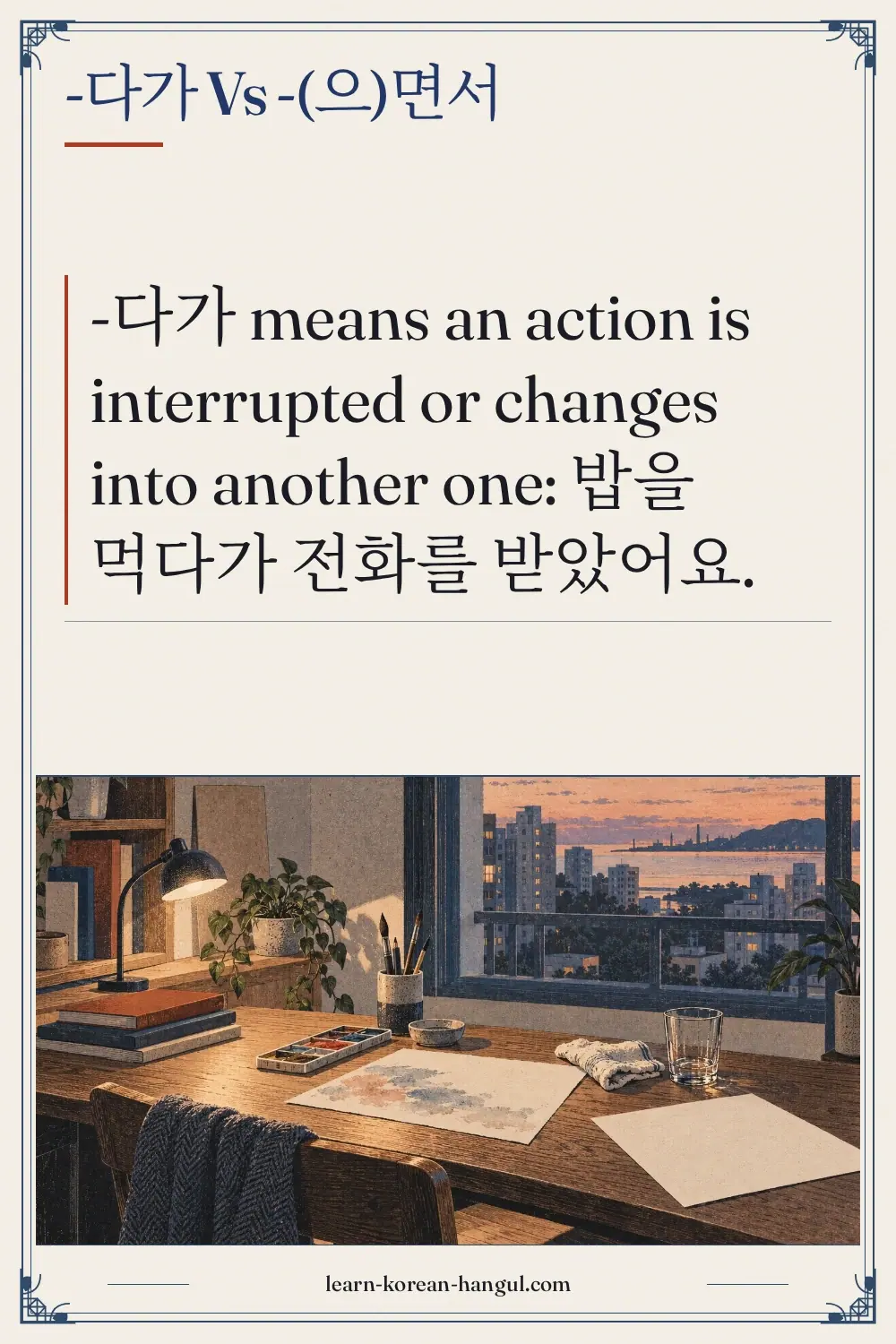
- -다가 means that an action is interrupted or changes into another one.
- -(으)면서 means that two actions overlap in time.
What you'll learn
- Say which pattern marks a switch and which one marks an overlap.
- Build both patterns for regular, ㄹ-stem and common irregular verbs.
- Choose the right pattern for five sentences and give the reason.
- Avoid the "different subject" and "tense" mistakes with -(으)면서.
Before you start: you should know the polite ending -아요/어요 and how to find the verb stem (the dictionary form without 다). The full rules for each pattern are on their own lesson pages, linked below. Audio plays only when you press a button.
What Is the Difference between -다가 and -(으)면서?
The difference is what happens to the first action. With -다가 the first action stops, changes or is interrupted, and something else begins. With -(으)면서 the first action keeps going while the second one happens. English says "while" for both, but the Korean pair describes two different timelines.
Here is the contrast in two sentences.
밥을 먹다가 전화를 받았어요. (babeul meokdaga jeonhwareul badasseoyo) "I was eating, and I stopped to take a call." Pronunciation: [바블 먹따가 전화를 바다써요]. Eating stops when the call starts.
밥을 먹으면서 전화를 받았어요. (babeul meogeumyeonseo jeonhwareul badasseoyo) "I took a call while eating." Pronunciation: [바블 머그면서]. Eating goes on during the call. Both actions are happening at once.
The only difference is the ending, yet one sentence describes two steps and the other describes one block of time. The next section puts the two patterns side by side.
-다가 vs -(으)면서: Side-by-Side Table
The table compares the two patterns on the points that decide the choice.
| Point | -다가 | -(으)면서 |
|---|---|---|
| Core meaning | in the middle of A, then B; A turns into B | while doing A, also B |
| Timeline | A stops, B starts | A and B run together |
| How it is built | stem + 다가 (no 으) | stem + 면서 (vowel or ㄹ stem), stem + 으면서 (consonant stem) |
| Subject | usually the same in both clauses | the same in both clauses |
| Tense before the ending | -았/었다가 has a special meaning (finished, then reversed) | none; the main verb shows the tense |
| With adjectives | for a change of state (덥다가 추워지다) | "and also" (싸면서 맛있다) |
| Different subjects | allowed only for natural changes, such as the weather | not allowed; use -는 동안 |
| Example | 길을 걷다가 친구를 만났어요. | 음악을 들으면서 공부해요. |
Two notes sit behind the table. First, -다가 is attached directly to the stem. A vowel stem and a consonant stem take the same 다가: 가다가, 먹다가. Second, -(으)면서 follows the usual 으 rule: 먹으면서 for a consonant stem and 가면서 for a vowel stem. The ㄹ stem keeps its ㄹ and takes 면서, as in 놀면서.
When Do You Use -다가?
Use -다가 when one action or state is stopped, replaced or interrupted by another. The pattern often tells a story: "I was doing A, and then B happened". Do not add 으 before 다가.
| Dictionary form | Meaning | -다가 form | Spoken |
|---|---|---|---|
| 가다 | to go | 가다가 | [가다가] |
| 먹다 | to eat | 먹다가 | [먹따가] |
| 보다 | to watch | 보다가 | [보다가] |
| 걷다 | to walk | 걷다가 | [걷따가] |
| 놀다 | to play | 놀다가 | [놀다가] |
| 덥다 | to be hot | 덥다가 | [덥따가] |
The irregular verbs keep their stems, because 다가 begins with a consonant: 걷다가, 덥다가, 듣다가. Compare this with 걸으면서 and 들으면서 in the next part, where the vowel 으 triggers the change.
Four typical uses follow.
- An event in the middle of something. 길을 걷다가 친구를 만났어요. (gireul geotdaga chingureul mannasseoyo) "I was walking along the street and met a friend." Pronunciation: [기를 걷따가 친구를 만나써요].
- An event on the way. 학교에 가다가 지갑을 잃어버렸어요. (hakgyoe gadaga jigabeul ireobeoryeosseoyo) "On my way to school, I lost my wallet." Pronunciation: [학꾜에 가다가 지가블 이러버려써요].
- One activity turning into another. 텔레비전을 보다가 잠이 들었어요. (tellebijeoneul bodaga jami deureosseoyo) "I fell asleep watching TV."
- A change of state. 날씨가 덥다가 추워졌어요. (nalssiga deopdaga chuwojyeosseoyo) "The weather was hot, and then it turned cold." The weather is the subject in both clauses, so the same-subject idea holds.
There is a past form, -았/었다가, with a different meaning: the first action is finished, and then the next one reverses it or follows in the other direction. 서울에 갔다가 왔어요 (seoure gatdaga wasseoyo) means "I went to Seoul and came back". Pronunciation: [서우레 갇따가 와써요]. For the full rules, read the lesson on -다가.
When Do You Use -(으)면서?
Use -(으)면서 when two actions, or an action and a state, are true at the same time for the same subject. A vowel stem takes 면서, a consonant stem takes 으면서, and a ㄹ stem takes 면서 with the ㄹ kept.
| Dictionary form | Meaning | -(으)면서 form |
|---|---|---|
| 가다 | to go | 가면서 |
| 먹다 | to eat | 먹으면서 |
| 듣다 | to listen | 들으면서 |
| 걷다 | to walk | 걸으면서 |
| 놀다 | to play | 놀면서 |
| 돕다 | to help | 도우면서 |
The ㄷ and ㅂ irregular verbs change in front of the vowel in 으: 걷다 becomes 걸으면서, and 돕다 becomes 도우면서.
Four typical uses follow.
- Two actions at once. 음악을 들으면서 공부해요. (eumageul deureumyeonseo gongbuhaeyo) "I study while listening to music."
- Talking while moving. 걸으면서 이야기해요. (georeumyeonseo iyagihaeyo) "We talk while walking."
- Two skills together. 노래하면서 춤을 춰요. (noraehamyeonseo chumeul chwoyo) "He sings while dancing."
- "And also" with adjectives. 이 식당은 싸면서 맛있어요. (i sikdangeun ssamyeonseo masisseoyo) "This restaurant is cheap and also tasty."
Two limits matter. The subject must be the same in both clauses. For different subjects, use -는 동안 (during the time that): 제가 요리하는 동안 동생이 청소했어요 ("While I cooked, my younger sibling cleaned"). And the verb before -(으)면서 never takes a tense marker. The main verb shows the tense: 먹으면서 전화를 받았어요 is correct even though the event is in the past. For the full rules, read the lesson on -(으)면서.
Can You Use Both in the Same Sentence?
You can use either pattern with the same verbs, but you describe a different story. Look at one activity.
- 텔레비전을 보다가 밥을 먹었어요. "I watched TV, and then I ate." The TV stops when the meal starts.
- 텔레비전을 보면서 밥을 먹었어요. "I ate while watching TV." Both go on together.
Some sentences use both patterns in turn. 운전하다가 졸리면 쉬세요. 운전하면서 전화하지 마세요. "If you get sleepy while driving, take a rest. Don't talk on the phone while driving." The first sentence describes a possible change during driving. The second sentence prohibits a pair of simultaneous actions.
Each sentence uses the pattern that matches its timeline. A good test is to draw the timeline in your mind. A line that stops and starts again belongs to -다가. Two lines that run side by side belong to -(으)면서.
How Does a Conversation Use Both Patterns?
A short dialogue shows how a speaker moves from the switch to the overlap. Two friends talk about a bad morning.
A: 왜 늦었어요? (wae neujeosseoyo?) "Why were you late?"
B: 학교에 가다가 지갑을 잃어버렸어요. 그래서 걸으면서 계속 찾았어요. (hakgyoe gadaga jigabeul ireobeoryeosseoyo. geuraeseo georeumyeonseo gyesok chajasseoyo.) "On my way to school I lost my wallet. So I kept looking for it as I walked."
Speaker B uses -다가 for the event that interrupted the trip, and then uses -(으)면서 for the two actions that went on together: walking and searching. The choice does not depend on the verb. It depends on the timeline.
Which One Should You Pick? a Simple Rule of Thumb
Ask three questions in order.
- Does the first action stop or change into something else? If yes, use -다가. Example: 밥을 먹다가 전화를 받았어요.
- Do both actions go on together? If yes, use -(으)면서. Example: 밥을 먹으면서 전화를 받았어요.
- Do the clauses have different subjects? If yes, do not use -(으)면서. Use -는 동안 for "while", or -고 for a simple sequence.
If the first clause is an adjective, ask what you want to say. A change over time uses -다가: 덥다가 추워졌어요. An "and also" idea uses -(으)면서: 싸면서 맛있어요.
What Mistakes Do Learners Make with These Two?
Most mistakes come from using "while" in English as a guide. Five of them appear again and again.
- Using -다가 for two things that happen together. 노래하다가 춤을 춰요 means "I sing, then I switch to dancing". Say 노래하면서 춤을 춰요.
- Using -(으)면서 for an interruption. 걸으면서 친구를 만났어요 means that you were walking while meeting a friend, as if the meeting was an activity. For an event that happened in the middle, say 걷다가 친구를 만났어요.
- Using different subjects with -(으)면서. 제가 요리하면서 동생이 청소했어요 is wrong. Say 제가 요리하는 동안 동생이 청소했어요.
- Adding a tense before -(으)면서. 먹었으면서 전화를 받았어요 is wrong. Say 먹으면서, and let the main verb show the tense.
- Using the wrong linking vowel. 가으면서 and 먹으다가 are both wrong. A vowel stem takes 면서, and 다가 never takes 으.
A quick self-check: say the second verb first and ask yourself "Did the first action stop?" If yes, -다가. If no, -(으)면서.
Practice: Choose the Right Pattern
Try the five questions, then read the answers below.
Practice · 5
Choose the best ending. 길을 ___ 친구를 만났어요. (I was walking and I met a friend.)
Show answer
걷다가
An event happened in the middle of walking, so -다가 fits. The verb 걷다 keeps its stem before 다가.
Choose the best ending. 음악을 ___ 공부해요. (I study while listening to music.)
Show answer
들으면서
Both actions go on together, so -(으)면서 fits. The verb 듣다 changes to 들 before 으.
Which sentence is correct?
Show answer
제가 요리하는 동안 동생이 청소했어요.
The two clauses have different subjects, so -는 동안 is the right pattern.
What is the difference between 노래하다가 춤을 춰요 and 노래하면서 춤을 춰요?
Show answer
The first switches from singing to dancing; the second does both together.
-다가 marks a switch, and -(으)면서 marks an overlap.
Which sentence means "This restaurant is cheap and also tasty"?
Show answer
이 식당은 싸면서 맛있어요.
With an adjective that ends in a vowel, -(으)면서 means "and also" and takes 면서.
Answer key
- 걷다가. The sentence is 길을 걷다가 친구를 만났어요.
- 들으면서. The sentence is 음악을 들으면서 공부해요.
- 제가 요리하는 동안 동생이 청소했어요.
- The first switches from singing to dancing; the second does both together.
- 이 식당은 싸면서 맛있어요.
Now write your own pair: one sentence about an event that happened while you were doing something (with -다가), and one sentence about two things you do together (with -(으)면서).
What Should You Learn Next?
After this comparison, study each pattern on its own lesson page, then look at the other pairs on the list.
- Learn the full rules for -다가, including -았/었다가.
- Learn the full rules for -(으)면서, including -(으)면서도.
- Compare other confusable pairs on Confusing Grammar Compared.
- See where both patterns sit on the Intermediate Grammar list.
Frequently Asked Questions
What Is the Difference between -다가 and -(으)면서?
-다가 means the first action stops or turns into another one, so there is a switch. -(으)면서 means the two actions continue together, so there is overlap. Compare 밥을 먹다가 전화를 받았어요 (I stopped eating to take a call) with 밥을 먹으면서 전화를 받았어요 (I took a call while eating).
Can I Always Replace -다가 with -(으)면서?
No. If the first action is interrupted or replaced, only -다가 works, as in 길을 걷다가 친구를 만났어요. If two actions truly happen together, as in 음악을 들으면서 공부해요, use -(으)면서. Swapping them changes the meaning, and sometimes it makes the sentence odd.
Which One Sounds More Natural in Speech?
Both are common in speech and in writing. -다가 is natural for stories about something that happened on the way or in the middle of an activity. -(으)면서 is natural for habits, advice and descriptions of two things done together.
Which One Appears More Often on TOPIK?
This site does not publish exam statistics. Both patterns are taught at the intermediate stage and are common in reading passages. For current exam content, check the level descriptions and past papers on the official TOPIK site, topik.go.kr.
What Is the Quickest Rule to Remember?
Ask whether the first action keeps going. If it stops, changes or gets interrupted, use -다가. If it keeps going while the second action happens, use -(으)면서.