What you'll learn
- Attach -다가 to any verb stem, including irregular verbs.
- Tell the difference between 먹다가 ("while eating") and 갔다가 ("went and then came back").
- Use -다가 with adjectives to show a change of state.
- Choose between -다가, -(으)면서 and -고.
Prerequisites: the polite ending -아요/어요 and the past tense -았/었-. Time: about 15 minutes.
Key facts
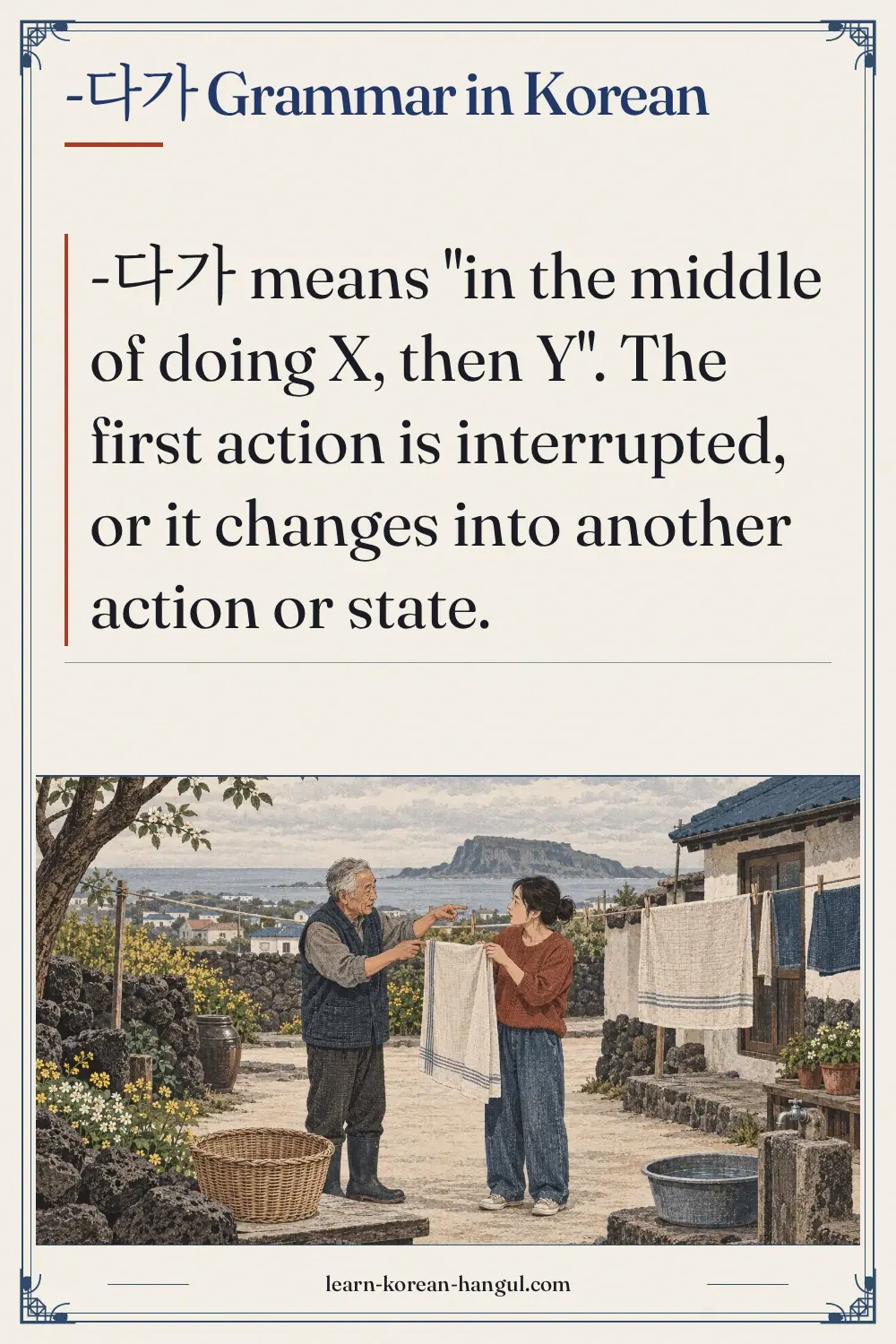
- -다가 means "in the middle of doing X, then Y".
- The first action is interrupted, or it switches into another action or state.
- The form is the plain stem + 다가. Nothing changes for irregular stems.
- The actor is normally the same in both clauses.
- The two parts do not happen at the same moment.
Listen to two model sentences.
The next section defines the pattern.
What Does -다가 Grammar Mean?
-다가 means "in the middle of doing X, then Y". A connective ending is a word ending that joins one clause to the next. -다가 is a connective ending that tells the listener, "The first action was going on, and then something else took its place."
Picture a line with a break in it. The first action runs along the line, then it stops or turns, and the second action starts at the break. In 길을 가다가 친구를 만났어요, the walking was under way. At one point the speaker met a friend. The walk did not need to be finished.
Here are two glossed examples.
| Part | 공부하다가 잠이 들었어요. | 길을 가다가 친구를 만났어요. |
|---|---|---|
| First clause | 공부하다가 (while studying, I...) | 길을 가다가 (while walking along the road, I...) |
| Main clause | 잠이 들었어요 (fell asleep) | 친구를 만났어요 (met a friend) |
| Spoken | [공부하다가 자미 드러써요] | [기를 가다가 친구를 만나써요] |
| RR (aid) | gongbuhadaga jami deureosseoyo | gireul gadaga chingureul mannasseoyo |
| English | I fell asleep while studying. | I met a friend while walking down the road. |
Revised Romanization (RR) is the national system for writing Korean in the Latin alphabet. It is shown here only as a learning aid.
The next section shows how to build the form.
How Do You Form -다가?
The rule is the simplest in this group of connectors. Remove 다 from the dictionary form to get the stem, and add 다가. The stem is the verb without its dictionary ending -다. For 먹다 the stem is 먹.
| Dictionary form | Stem | Stem + 다가 | Spoken | RR (aid) |
|---|---|---|---|---|
| 가다 (go) | 가 | 가다가 | [가다가] | gadaga |
| 하다 (do) | 하 | 하다가 | [하다가] | hadaga |
| 공부하다 (study) | 공부하 | 공부하다가 | [공부하다가] | gongbuhadaga |
| 보다 (watch) | 보 | 보다가 | [보다가] | bodaga |
| 먹다 (eat) | 먹 | 먹다가 | [먹따가] | meokdaga |
| 읽다 (read) | 읽 | 읽다가 | [익따가] | ikdaga |
| 앉다 (sit) | 앉 | 앉다가 | [안따가] | andaga |
| 있다 (be, stay) | 있 | 있다가 | [읻따가] | itdaga |
After a final consonant, the ㄷ of 다 is said as a tense ㄸ, so 먹다가 sounds like [먹따가]. This tensing happens in speech only. The spelling does not change. RR does not mark tensing that comes from a neighbouring sound, so it writes meokdaga.
Stems Ending in a Vowel
Vowel stems take 다가 directly: 가다가, 보다가, 자다가. There is no contraction. Compare this with -아/어서, where 가 + 아서 becomes 가서. For verbs made with 하다, add 다가 to 하: 공부하다가, 일하다가.
Stems Ending in a Consonant
Consonant stems also take 다가 directly. There is no 으 to insert. This is a big difference from -(으)면서, which adds 으 after a consonant.
Irregular Stems
Irregular stems do not change before 다가. An irregular stem is one that changes its shape before an ending that begins with a vowel. 다가 begins with a consonant, so the change never happens.
| Type | Dictionary form | With 다가 | Note |
|---|---|---|---|
| ㄷ-irregular | 듣다 (listen) | 듣다가 | ㄷ stays; compare 들어요 |
| ㅂ-irregular | 덥다 (be hot) | 덥다가 | ㅂ stays; compare 더워요 |
| 르-irregular | 모르다 (not know) | 모르다가 | 르 stays; compare 몰라요 |
| ㄹ stem | 만들다 (make) | 만들다가 | ㄹ stays; it drops only before ㄴ, ㅂ and ㅅ |
| ㅡ stem | 쓰다 (write) | 쓰다가 | ㅡ stays; compare 써요 |
Spoken, 듣다가 is [듣따가] and 덥다가 is [덥따가].
A noun cannot take -다가 on its own. It joins verbs, and with adjectives it describes a change of state. The next section builds a full sentence.
Worked Example: Building 길을 가다가 친구를 만났어요
Say that you met a friend while you were walking. Follow five steps.
- Write the first action. "I walk down the road" is 길을 가요 in the polite style.
- Find the stem. The dictionary form is 가다, so the stem is 가.
- Add 다가. 가 + 다가 = 가다가. Take away the polite ending 요, because the ending belongs to the last verb only.
- Write the second action. "I met a friend" is 친구를 만났어요. The past form of 만나다 is 만났어요.
- Join the two parts. 길을 가다가 친구를 만났어요.
You'll know it worked when the first verb ends in 다가 with nothing after it, and the polite ending 요 appears only once, at the end. Try the same steps with "I fell asleep while watching TV": 보다 gives 보다가, and 잠들었어요 follows.
Sentence
I met a friend while walking down the road.
Show answer
길을 가다가 친구를 만났어요
The next section covers tense and sentence types.
Which Tenses and Sentence Types Work with -다가?
The final verb of the sentence carries the tense. The first clause does not take 겠 or the present modifier 는. But it can take a past marker 았/었, and when it does, the meaning changes in a clear way.
| Form | Example | What it means |
|---|---|---|
| stem + 다가 | 밥을 먹다가 전화를 받았어요. | I was eating when I took a call. The meal was interrupted. |
| stem + 았/었 + 다가 | 학교에 갔다가 집에 왔어요. | I went to school and then came home. The first action was finished and then reversed. |
| stem + 았/었 + 다가 | 옷을 입었다가 벗었어요. | I put the clothes on and then took them off. |
With 갔다가, spoken [갇따가], and 입었다가, spoken [이벋따가], the first action is complete. Then the second action turns back, as in going and coming back, opening and closing, or putting on and taking off. This is a separate use that Korean textbooks often teach as a different pattern.
Adjectives take -다가 too, but then it describes a change of state, as in a changing condition.
| Example | Spoken | English |
|---|---|---|
| 날씨가 덥다가 추워졌어요. | [날씨가 덥따가 추워저써요] | The weather was hot, and then it got cold. |
| 아프다가 나았어요. | [아프다가 나아써요] | I was sick, and then I got better. |
The main clause can be any sentence type.
| Sentence type | Example | English |
|---|---|---|
| statement | 걷다가 넘어졌어요. | I fell while walking. |
| yes/no question | 공부하다가 잤어요? | Did you fall asleep while studying? |
| wh-question | 길을 가다가 누구를 만났어요? | Who did you meet while walking? |
| command | 공부하다가 좀 쉬세요. | Please take a rest in the middle of studying. |
| suggestion | 일하다가 같이 커피 마셔요. | Let's have coffee in the middle of work. |
Yes/no questions usually end with a rise. A wh-question puts the stress on the question word and often ends with a fall or a rise-fall.
The two clauses normally share the same actor. In 길을 가다가 친구를 만났어요, the walker and the person who met the friend are the same person. The next section compares -다가 with its neighbours.
How Is -다가 Different from -(으)면서 and -고?
The three patterns all join two actions, but they place them differently in time.
| Pattern | Core idea | Example | Feeling |
|---|---|---|---|
| -다가 | a break or a switch | 걷다가 전화했어요. | I was walking, then stopped (or switched) and called. |
| -(으)면서 | two actions together | 걸으면서 전화했어요. | I called while walking, with both going on at once. |
| -고 | one thing, and then another | 걷고 전화했어요. | I walked, and (after that) I called. |
Look at 공부하다가 잤어요 and 공부하고 잤어요. The first means "I fell asleep while studying", so the studying was not finished. The second means "I studied and then slept", so the studying was done. Use -다가 when the first action never reached its end.
Now compare -다가 with -(으)면서. If both actions can run at the same time, as in singing while cooking, use -(으)면서. If the second action takes the place of the first, use -다가. A quick test is to ask, "Could someone watch both actions in the same second?" If so, the answer is -(으)면서.
For a full side-by-side with practice, see -다가 vs -(으)면서.
The next section covers variations and edge cases.
Variations and Edge Cases of -다가
Shortened -다
In speech, 다가 is often shortened to 다. 길을 가다 친구를 만났어요 means the same as the long form. The short form is common in conversation. In essays and formal writing, keep the long form.
-다가는: If You Keep Doing, a Warning
Add 는 to the end for a warning about a bad result. 그렇게 먹다가는 배탈 나요 means "If you keep eating like that, you will get a stomachache." It is a separate pattern that builds on -다가.
-다가도: Even While Doing
Add 도 for "even while". 자다가도 그 생각이 나요 means "I think of it even while I'm sleeping." It stresses that the second thing happens even in the middle of the first.
Stopping Partway: 하다가 말다
You can use -다가 with 말다 ("stop") to say that you quit in the middle. 공부하다가 말았어요 means "I started studying but stopped halfway."
Not the Same as -다 보니
The pattern -다 보니(까) looks like a cousin, but it describes a gradual result: "as I kept doing it, I realised." See -다 보니(까).
The next section lists the mistakes that appear most often.
What Mistakes Do Learners Make with -다가?
Learners make six predictable mistakes. Each has a reason and a fix.
Learners often use -다가 for actions at the same time. Wrong: 음악을 듣다가 공부해요 when you mean "I study while listening to music". Right: 음악을 들으면서 공부해요. Fix: if both actions go on together, use -(으)면서.
Learners often mix up 먹다가 and 먹었다가. 문을 열다가 멈췄어요 means "I stopped in the middle of opening the door". 문을 열었다가 닫았어요 means "I opened the door and then closed it." Fix: leave out 았/었 for an interrupted action, and add it for a finished action that is then followed by a turn.
Learners often use different actors. Wrong: 제가 공부하다가 동생이 잤어요. Right: 제가 공부하다가 잤어요, or 제가 공부할 때 동생이 잤어요. Fix: for two different people, use a time pattern such as -(으)ㄹ 때 or a plain linker.
Learners often use -다가 for a plain sequence. Wrong: 아침에 일어나다가 샤워했어요 when you mean "I got up and then showered". Right: 아침에 일어나서 샤워했어요. Fix: -다가 means a break. For simple order, use -고 or -아/어서.
Learners often change the stem. Wrong: 들으다가 and 더우다가. Right: 듣다가 and 덥다가. Fix: do not apply the -아/어 rules here.
Learners often put the polite ending inside. Wrong: 먹어요다가 전화를 받았어요. Right: 먹다가 전화를 받았어요. Fix: attach 다가 to the bare stem, and put 요 only on the last verb.
The next section gives you practice.
Practice and Answers
Do the four tasks, then compare with the key.
Task 1: join the sentences with -다가. Write one sentence for each pair.
- 저는 책을 읽어요. / 잠이 들었어요.
- 저는 길을 걸어요. / 친구를 만났어요.
- 저는 밥을 먹어요. / 전화를 받았어요.
Task 2: add -다가. Write the -다가 form of each verb.
- 듣다 (listen)
- 만들다 (make)
- 모르다 (not know)
- 덥다 (be hot)
Task 3: fix the error. Each sentence has one mistake. Rewrite it correctly.
- 들으다가 잠이 들었어요.
- 음악을 듣다가 공부해요. (meaning: I study while listening to music.)
- 먹어요다가 전화를 받았어요.
Task 4: write your own. Write one sentence about something that interrupted you, and one about the weather that changed.
Practice · 5
Which form of 먹다 means "in the middle of eating"?
Show answer
먹다가
다가 attaches straight to the stem 먹. No 으 and no polite ending is added.
How do you say "in the middle of listening" with 듣다?
Show answer
듣다가
다가 begins with a consonant, so the ㄷ-irregular change does not happen. The stem stays 듣.
Which sentence means "I went to school and then came home"?
Show answer
학교에 갔다가 집에 왔어요.
With 았/었 inside, -다가 means that the first action was finished and then reversed.
Which pattern fits "I talk on the phone while walking"?
Show answer
걸으면서 전화해요
Both actions go on together, so -(으)면서 is correct. ㄷ-irregular 걷다 becomes 걸으면서.
Which sentence is correct?
Show answer
날씨가 덥다가 추워졌어요.
The ㅂ-irregular stem stays whole before 다가. The sentence shows a change of state.
Answer key
- (1) 저는 책을 읽다가 잠이 들었어요. (2) 저는 길을 걷다가 친구를 만났어요. (3) 저는 밥을 먹다가 전화를 받았어요.
- (1) 듣다가 (2) 만들다가 (3) 모르다가 (4) 덥다가
- (1) 듣다가 잠이 들었어요. (2) 음악을 들으면서 공부해요. (3) 먹다가 전화를 받았어요.
- Sample answers: 숙제를 하다가 친구한테 전화가 왔어요. 아침에는 맑다가 오후에 비가 왔어요. Any pair is correct if the first verb ends in 다가 and the second part shows a break or a change.
If task 1 was correct, you have the formation rule. If task 3 was hard, check whether you changed a stem or put 요 inside. The next section points you to what comes after this lesson.
What Should You Learn after -다가 Grammar?
After -다가, learn -(으)면서 for two actions at once, and -고 for a plain "and". To see how -다가 and -(으)면서 compare, read -다가 vs -(으)면서. Then look at -다 보니(까) for a result that appears as you keep doing something.
For a wider view, the parent page Time and Sequence lists every time connector in this group. To plan by level, use Intermediate Grammar.
This lesson shows -다가 with polite-style endings; the connector itself is the same in every speech style, because the style comes from the last verb. It does not cover every written variation. About this page. Last updated 2026-10-09. Revised Romanization follows the national rules and is shown only as a learning aid.
Frequently Asked Questions
What Does -다가 Mean?
-다가 means "in the middle of doing X, then Y". The first action was going on and then stopped, or it switched to something else. 공부하다가 잠이 들었어요 means "I fell asleep while studying." The first action was not finished. A new event took over before it ended.
How Do I Attach -다가 to a Verb or Adjective?
Take the stem, which is the dictionary form without 다, and add 다가. 가다 becomes 가다가, 먹다 becomes 먹다가 and 공부하다 becomes 공부하다가. Nothing changes for final consonants or irregular verbs: 듣다 becomes 듣다가. With adjectives it describes a change of state, as in 덥다가 추워졌어요.
Can -다가 Be Used in the past Tense?
You can put 았/었 before it, but the meaning changes. 먹다가 means an interrupted action. 갔다가 means the action was finished and then reversed: 학교에 갔다가 집에 왔어요 is "I went to school and then came home." The sentence tense is shown by the last verb, and 겠 is not used inside.
Is -다가 Used in Speech or Only in Writing?
Both. It is natural in conversation, stories, messages and news. In speech, 다가 is often shortened to 다, as in 길을 가다 친구를 만났어요. The long form is safer in writing. The endings -다가는 and -다가도 are separate patterns that build on it.
What Is the Most Common Mistake with -다가?
Learners use -다가 for two actions at the same moment, such as 음악을 듣다가 공부해요. For actions that happen together, use -(으)면서. -다가 needs a break or a switch. A second slip is using different subjects in the two clauses, when the same person normally does both.
What Is the Difference between -다가 and -(으)면서?
-(으)면서 joins two actions that happen together, so 걸으면서 전화해요 is "I talk on the phone while walking". -다가 describes a break, so 걷다가 전화했어요 is "I was walking, then stopped and called". If one action replaces the other, use -다가. If both go on together, use -(으)면서.