Before you start: you should know the connector -고 ("and") and how to make polite present and past sentences. You should also know how to find a stem (the dictionary form without its final 다, such as 듣 in 듣다). Estimated time: 15 minutes.
What Does -(으)면서 Grammar Mean?

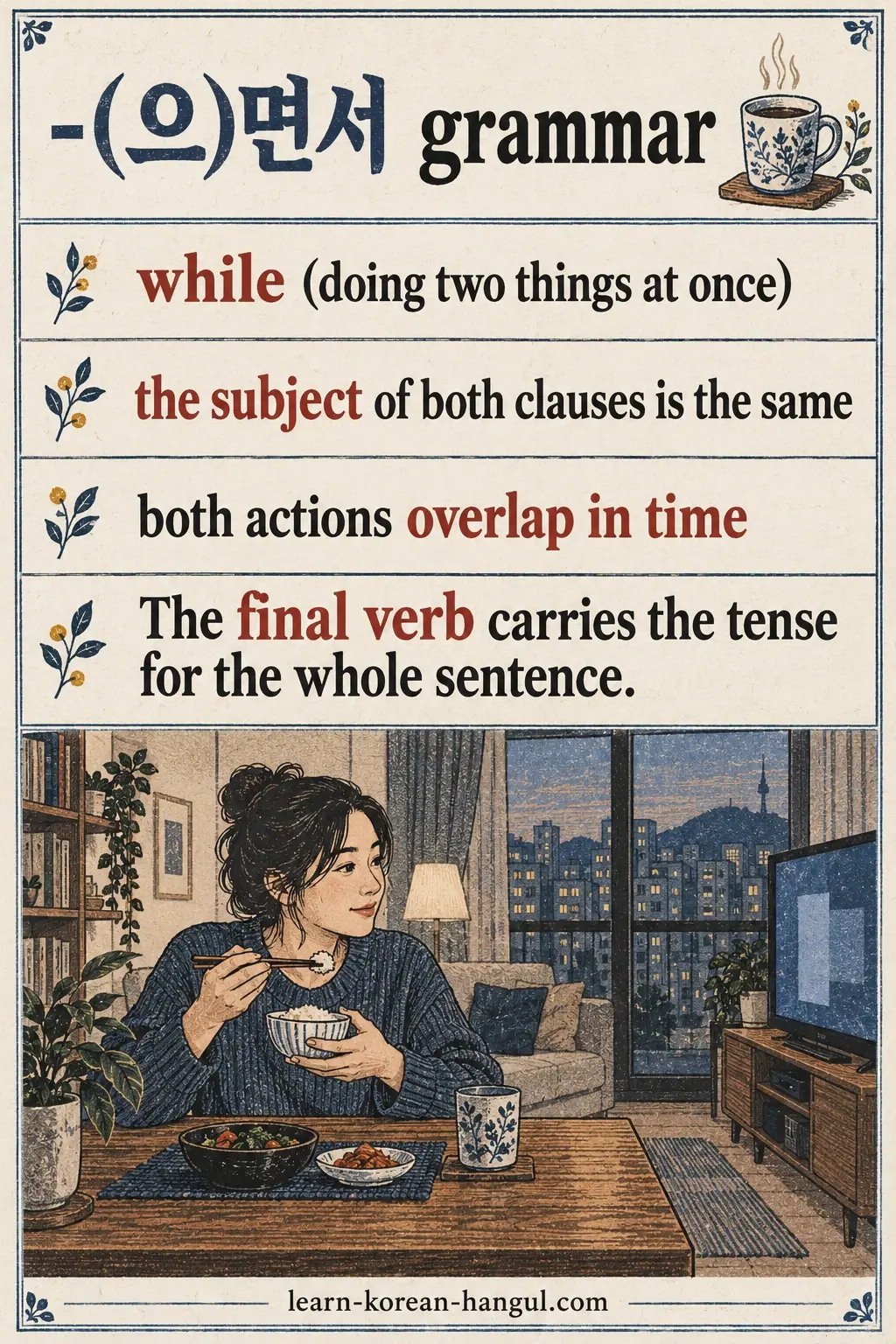
-(으)면서 grammar means "while": two actions run at the same time, and one person does both. In 음악을 들으면서 운전해요, the listening and the driving overlap. The ending is a connective ending (연결 어미, yeongyeol eomi): a form that links one clause to the next. The final verb 운전해요 is the main action, and the -(으)면서 clause adds a second action alongside it.
The ending has two common jobs.
- Two overlapping actions. 밥을 먹으면서 TV를 봐요. = "I watch TV while I eat."
- Two descriptions of one thing. 이 식당은 싸면서 맛있어요. = "This restaurant is cheap and also tasty." With adjectives and 이다, no action overlaps. The pattern simply adds a second quality to the first, often with a feeling of contrast or surprise.
음악을 들으면서 운전해요.
eumageul deureumyeonseo unjeonhaeyo.
I drive while listening to music.
그는 학생이면서 가수예요.
geuneun haksaengimyeonseo gasuyeyo.
He is both a student and a singer.
이 식당은 싸면서 맛있어요.
i sikdangeun ssamyeonseo masisseoyo.
This restaurant is cheap and also tasty.
In the second sentence, 가수예요 is said [가수예요], and many speakers say [가수에요] in everyday talk. The next section shows how to build the form on every kind of stem.
How Do You Form -(으)면서?
You form -(으)면서 with two versions that depend on the last sound of the stem. After a vowel or ㄹ, add -면서. After any other final consonant, add -으면서. The 으 is a linking vowel that makes the consonant easier to say.
| Stem type | Dictionary form | With -(으)면서 | Revised Romanization |
|---|---|---|---|
| Vowel | 마시다 | 마시면서 | masimyeonseo |
| Vowel | 보다 | 보면서 | bomyeonseo |
| Consonant | 먹다 | 먹으면서 [머그면서] | meogeumyeonseo |
| Consonant | 읽다 | 읽으면서 [일그면서] | ilgeumyeonseo |
| Consonant | 앉다 | 앉으면서 [안즈면서] | anjeumyeonseo |
| ㄹ stem | 만들다 | 만들면서 | mandeulmyeonseo |
| ㄷ stem | 듣다 | 들으면서 [드르면서] | deureumyeonseo |
| ㄷ stem | 걷다 | 걸으면서 [거르면서] | georeumyeonseo |
| ㅂ stem | 돕다 | 도우면서 | doumyeonseo |
| 르 stem | 부르다 | 부르면서 | bureumyeonseo |
| ㅡ stem | 쓰다 | 쓰면서 | sseumyeonseo |
| 하다 verb | 운전하다 | 운전하면서 | unjeonhamyeonseo |
| 이다 | 학생이다 | 학생이면서 [학쌩이면서] | haksaengimyeonseo |
Revised Romanization (RR, the official Latin spelling) is only an aid. It follows the sounds of the words, so linking is shown (먹으면서 is meogeumyeonseo), but it does not show tensing caused by a neighbouring sound.
Stems Ending in a Vowel
Add -면서 straight after the vowel and say it as written: 마시면서, 보면서, 가면서, 쓰면서. There is no sound change.
Stems Ending in a Consonant
Add -으면서 after the final consonant. In speech, the final consonant moves onto the vowel 으 and you hear a smooth link, not a stop. So 먹으면서 is said [머그면서], 읽으면서 is said [일그면서], and 앉으면서 is said [안즈면서]. This linking follows the Standard Pronunciation Rules (표준 발음법, Articles 13 and 14).
- 먹으면서 [머그면서], with final ㄱ.
- 읽으면서 [일그면서], where the cluster ㄺ splits: ㄹ stays and ㄱ moves.
- 앉으면서 [안즈면서], where the cluster ㄵ splits: ㄴ stays and ㅈ moves.
Irregular Stems and Nouns
ㄹ stems are the main exception, and they behave differently from other consonant stems. A ㄹ stem keeps its ㄹ and takes -면서 with no 으: 만들다 becomes 만들면서, and 놀다 becomes 놀면서. Many learners add 으 by mistake, as they would after other final consonants. With -(으)면서, the ㄹ stays and no 으 is added.
The other irregular stems change as they do before -(으)면. A ㄷ stem changes ㄷ to ㄹ: 듣다 becomes 들으면서, and 걷다 becomes 걸으면서. A ㅂ stem drops ㅂ and adds 우: 돕다 becomes 도우면서, and 춥다 becomes 추우면서. 르 stems and ㅡ stems end in a vowel, so they take plain -면서: 부르면서 and 쓰면서.
For 이다 ("to be"), use -(이)면서: 학생이면서 가수예요 means "He is both a student and a singer". After a noun that ends in a vowel, the 이 is often dropped in speech: 가수이면서 or 가수면서.
Next, here is one full sentence built step by step.
Worked Example: Building a Sentence with -(으)면서

You build it in five steps, working from the two actions that overlap. This example makes "I drive while listening to music".
- Write both actions with their dictionary verbs. 음악을 듣다 and 운전하다.
- Check the subject. The same person (I) does both, so -(으)면서 is possible.
- Find the stem of the side action and its type. Remove 다 from 듣다. The stem is 듣, a ㄷ-irregular stem.
- Change the stem and add the ending. ㄷ becomes ㄹ before a vowel: 듣 → 들으. Then add -면서: 들으면서, said [드르면서].
- Give the main verb its tense and politeness. 운전하다 becomes the polite present 운전해요. Put the clause first: 음악을 들으면서 운전해요.
Sentence
I drive while listening to music.
Show answer
음악을 들으면서 운전해요
Checkpoint. You have it when you can put the sentence into the past without touching 들으면서. The answer is 음악을 들으면서 운전했어요 [으마글 드르면서 운전해써요]. Only the last verb changes.
The sentence built here is a statement. The next section shows which tenses and sentence types can follow -(으)면서.
Which Tenses and Sentence Types Work with -(으)면서?

The main verb can have any tense or sentence type, and the first verb normally stays bare. The ending carries no tense of its own, because "while" already means that both actions happen together. The time is read from the final verb.
| Feature | Where it goes | Example |
|---|---|---|
| Present habit | final verb | 밥을 먹으면서 TV를 봐요. |
| Past | final verb | 커피를 마시면서 이야기했어요. |
| Command or request | final verb | 걸으면서 전화하지 마세요. = "Do not phone while walking." |
| Suggestion | final verb | 걸으면서 이야기해요. = "Let's talk while we walk." |
| Question with a question word | final verb | 운전하면서 뭐 들어요? = "What do you listen to while driving?" |
| Honorific -(으)시- | on the first verb too | 선생님은 웃으시면서 말씀하셨어요. |
| Different subjects | not allowed | 제가 요리하면서 아이는 숙제를 했어요 is wrong |
| Tense in the first clause | normally not used | 먹었으면서 is not the "while" form |
The honorific -(으)시- is the ending that shows respect for the subject. Because the subject is shared, it is usually repeated: 웃으시면서 말씀하셨어요 means "The teacher spoke while smiling" [우스시면서 말씀하셔써요]. See honorific -(으)시- for the ending itself. A question that uses a question word such as 뭐 ("what") puts the stress on that word and does not end with a sharp rise.
Next comes the pattern that learners confuse with -(으)면서 most often.
How Is -(으)면서 Different from -는 동안(에)?

-(으)면서 joins two actions of the same person, while -는 동안(에) names a period during which something else happens. Both can be translated as "while". But 동안 describes a stretch of time, and the two clauses may have different subjects. The lesson on -는 동안(에) gives the full rules.
Compare two sentences. 커피를 마시면서 이야기했어요 means "I talked while drinking coffee". One person does both. 제가 요리하는 동안 아이는 숙제를 했어요 means "While I cooked, the child did homework". Two people are involved, so -(으)면서 is not possible.
-(으)면서
while: one subject, two overlapping actions
-는 동안(에)
while, during: a period, subjects may differ
| Comparison | -(으)면서 | -는 동안(에) |
|---|---|---|
| Subjects | the same | same or different |
| After a noun | only with 이다 (학생이면서) | noun + 동안 (방학 동안) |
| Example | 걸으면서 이야기해요. | 제가 요리하는 동안 아이는 숙제를 했어요. |
| Level | A2 | A2 |
Use -(으)면서 for one person doing two things together; use -는 동안(에) for a period or for two different subjects.
The other neighbour is -고. -고 links actions or descriptions, and for two actions in order it also reads as "and then". 밥을 먹고 TV를 봐요 means "I eat and then watch TV", while 밥을 먹으면서 TV를 봐요 means "I watch TV while I eat". For a side-by-side rule, see -(으)면서 vs -고. A related pattern, -다가, means "stop doing one thing and switch to another"; see -다가 vs -(으)면서.
A quick test: if one person is doing both things at the same moment, -(으)면서 fits. If a second person appears, switch to -는 동안. Next are the useful variations of the pattern.
Variations and Edge Cases of -(으)면서

-(으)면서 has three useful variations: -(으)면서도, 그러면서 and the noun form with 이다.
- -(으)면서도 (even though). Adding 도 shifts the meaning from "while" to "even though". 그는 알면서도 말하지 않았어요 means "Even though he knew, he did not say" [그는 알면서도 말하지 아나써요]. The ㄹ stem 알 keeps its ㄹ.
- 그러면서 (and at the same time). This word starts a new sentence and means "doing that, ...". 그는 웃었어요. 그러면서 손을 흔들었어요 means "He smiled. At the same time, he waved".
- 이면서 with nouns. Two nouns can describe one person: 그는 학생이면서 가수예요. Both are true of the same person, so no action overlaps.
Adjectives follow the same rules as verbs: 이 식당은 싸면서 맛있어요 joins two qualities. When both qualities are bad, or the second is unexpected, the pattern often carries a tone of complaint or surprise: 비싸면서 맛없어요 means "It is expensive and not even tasty".
For more neighbours of this pattern, see Time and Sequence. Next are the errors that appear most often.
What Mistakes Do Learners Make with -(으)면서?
Learners make five common mistakes with -(으)면서.
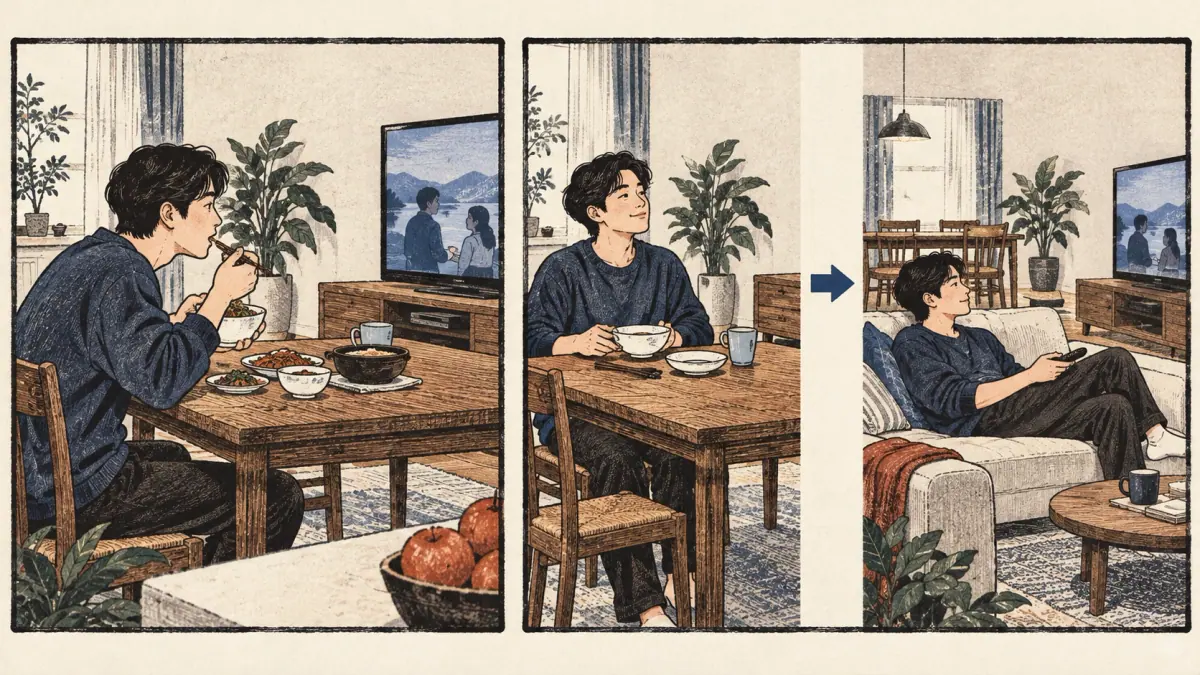
- Using two different subjects. Learners write 제가 요리하면서 아이는 숙제를 했어요. Actually -(으)면서 needs one subject doing both actions. Use -는 동안 for two subjects.
- Putting a past ending in the first clause. Learners write 먹었으면서 TV를 봤어요. Actually the first verb stays bare, because the final verb already shows the tense.
- Adding 으 after a ㄹ stem. Learners write 만들으면서. Actually ㄹ stems keep ㄹ and take -면서: 만들면서.
- Forgetting the ㄷ change. Learners write 걷으면서. Actually 걷다 is ㄷ-irregular, so the form is 걸으면서.
- Using it for "and then". Learners write 샤워하면서 자요 to mean "I shower and then sleep". Actually -(으)면서 means the actions overlap. Use -고 or -고 나서 for order.
Whenever you reach for "while", check who is doing each action. Now test yourself.
Practice and Answers
These four exercises check the main skills: joining actions, repairing a mistake and choosing the right word. Try each one before you read the answers.
Practice · 5
How do you say "while making" with 만들다?
Show answer
만들면서
A ㄹ stem keeps its ㄹ and takes -면서. Never add 으 after ㄹ.
How do you say "while walking" with 걷다?
Show answer
걸으면서
걷다 is a ㄷ-irregular verb. The ㄷ changes to ㄹ before a vowel, so 걷 + 으면서 becomes 걸으면서.
Which sentence is correct?
Show answer
저는 음악을 들으면서 운전해요.
Both actions belong to one subject (저는). 듣다 is a ㄷ-irregular verb, so it becomes 들으면서, and the first verb takes no tense.
Which sentence means "He is both a student and a singer"?
Show answer
그는 학생이면서 가수예요.
이다 takes -(이)면서 for "and also". The pattern joins two descriptions of the same person.
Which sentence means "While I cooked, the child did homework"?
Show answer
제가 요리하는 동안 아이는 숙제를 했어요.
There are two subjects, so -(으)면서 does not work. -는 동안 names a period and allows different subjects.
Exercise 1: Join the actions. Make one sentence with -(으)면서: 커피를 마시다 + 이야기하다. ("I drink coffee" and "I talk".) Use the polite present.
Exercise 2: Fix the error. A learner writes 노래를 만들으면서 춤을 춰요. Correct the stem.
Exercise 3: Choose the right word. You want to say "While I was cooking, my child did homework". Is -(으)면서 right, or -는 동안?
Exercise 4: Translate. "I eat while I watch TV." (eat = 먹다, watch = 보다)
Answer Key
- Exercise 1: 커피를 마시면서 이야기해요. The vowel stem 마시 takes -면서, and 이야기해요 carries the tense.
- Exercise 2: The ㄹ stem 만들 keeps its ㄹ: 노래를 만들면서 춤을 춰요. Never add 으 after ㄹ.
- Exercise 3: -는 동안. There are two subjects, the cook and the child, so the sentence is 제가 요리하는 동안 아이는 숙제를 했어요.
- Exercise 4: TV를 보면서 먹어요. [티브이를 보면서 머거요] Either order is possible, because both actions belong to the same person. The vowel stem 보 takes -면서.
If you missed Exercise 1 or 2, return to the five building steps. If you missed Exercise 3, reread the section on -는 동안(에). Next, plan where to go from here.
What Should You Learn Next after -(으)면서 Grammar?
The best next lesson is -는 동안(에), the "during" pattern that allows two subjects, because it covers the cases where -(으)면서 does not work. Then review -고 to keep "and then" and "while" apart. The full set of timing patterns is on Time and Sequence. To see where -(으)면서 sits in a study plan, use the Beginner Grammar list. The modifier forms behind related patterns are explained in Noun-Modifying Forms.
What this lesson does not cover. It does not cover the reproachful use of -았/었으면서 (as in "you did it, and yet..."), the written style, or -(으)면서 with passive verbs. The level given here, A2, is an editorial estimate based on common textbook order and TOPIK I, not an official grading.
In short, -(으)면서 grammar attaches to a stem with -면서 or -으면서, joins two overlapping actions of one subject, and puts the tense on the last verb.
Frequently Asked Questions
What does -(으)면서 mean? -(으)면서 means "while". It joins two actions that one person does at the same time. 음악을 들으면서 운전해요 means "I drive while listening to music". With adjectives and 이다 it means "and also", as in 그는 학생이면서 가수예요, "He is both a student and a singer". The subject stays the same.
How do I attach -(으)면서 to a verb or adjective? After a vowel stem or a ㄹ stem, add -면서: 마시다 becomes 마시면서, 만들다 becomes 만들면서. After any other consonant, add -으면서: 먹다 becomes 먹으면서. ㄹ stems keep their ㄹ and take no 으. Irregular stems change as they do before -(으)면: 듣다 becomes 들으면서, and 돕다 becomes 도우면서.
Can -(으)면서 be used in the past tense? The main verb can be past, present or future, but the verb before -(으)면서 normally stays bare. Say 커피를 마시면서 이야기했어요, "I talked while drinking coffee". The first verb takes no -았/었-, because "while" already means the two actions overlap. The final verb carries the tense for the whole sentence.
Is -(으)면서 used in speech or only in writing? -(으)면서 is common in both speech and writing and is neutral in tone. It does not mark politeness itself, so it fits with casual, polite and formal endings on the final verb. The sound to watch is linking: 먹으면서 is said [머그면서], and 읽으면서 is said [일그면서].
What is the most common mistake with -(으)면서? Learners use it for two different subjects, as in 제가 요리하면서 아이는 숙제를 했어요. This is wrong because -(으)면서 needs one subject doing both things. Use -는 동안 for two subjects. Another frequent error is adding 으 after a ㄹ stem, as in 만들으면서, where 만들면서 is correct.
What is the difference between -(으)면서 and -는 동안(에)? -(으)면서 joins two actions of the same person and does not name a period. -는 동안(에) names a stretch of time, and the two clauses may have different subjects. 제가 요리하는 동안 아이는 숙제를 했어요 uses 동안 because the cook and the child are different people. Use -(으)면서 for one person.