What you'll learn
- Choose between an undecided plan and an intention in one sentence.
- Build both patterns from a verb stem and conjugate 하다 in the present and the past.
- Use 갈까 했는데 and 가려고 했는데 for plans that did not happen.
- Recognise -(으)려고 하다 as "be about to" for events such as rain.
Before you start: you should know the polite ending -아요/-어요, the verb 하다 and the purpose ending in -(으)려고. The full rules for each pattern are in the lessons on -(으)ㄹ까 하다 and -(으)려고 하다. It plays only when you press a button.
What Is the Difference between -(으)ㄹ까 하다 and -(으)려고 하다?
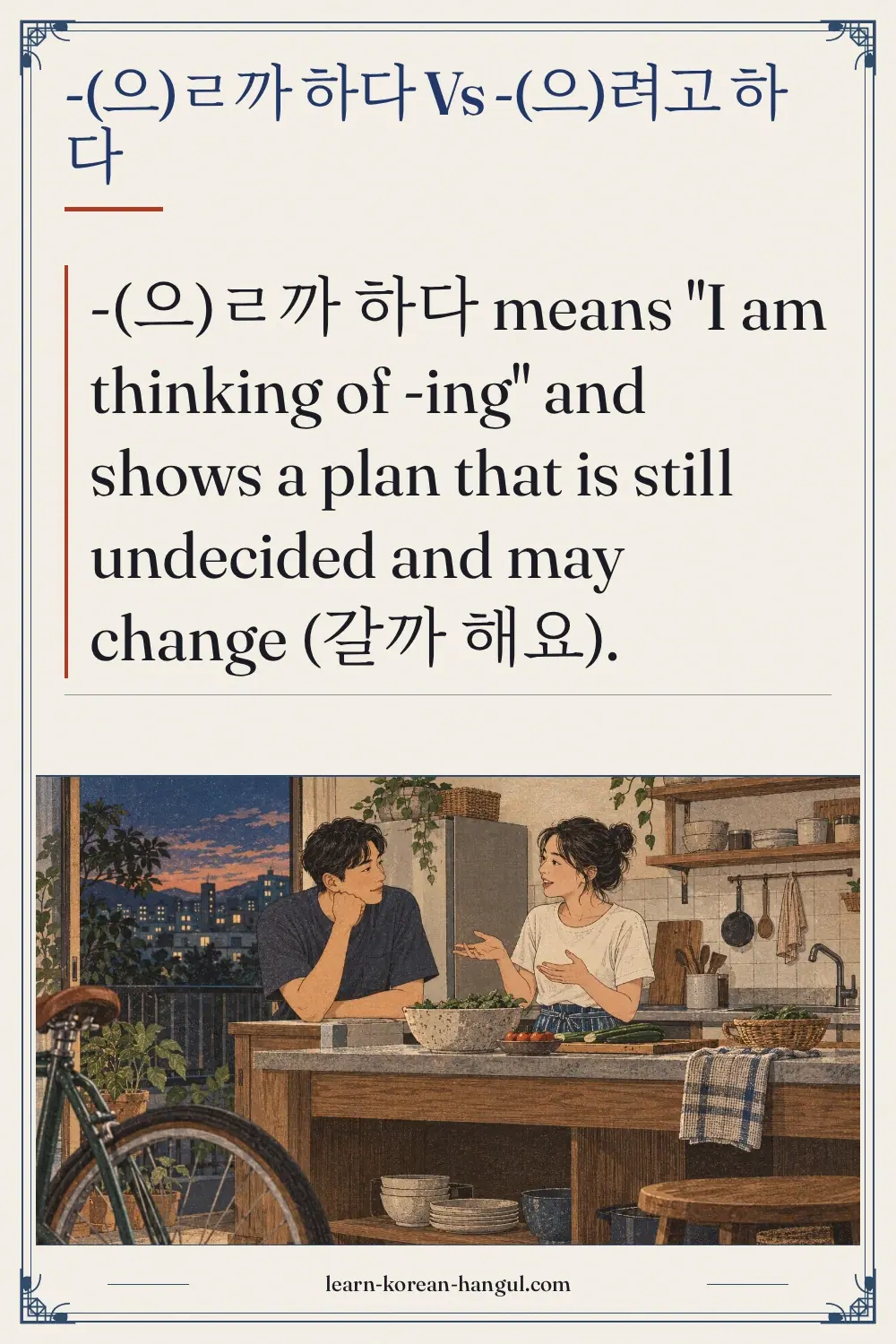
The difference is how firm the plan is. -(으)ㄹ까 하다 opens a possibility: you are considering an option, and the decision may still change. -(으)려고 하다 closes it: you have decided, or the event is already starting. The first is a thought, and the second is an intention.
One verb shows the contrast:
- 갈까 해요. (galkka haeyo.) = "I'm thinking of going." You are weighing the option.
- 가려고 해요. (garyeogo haeyo.) = "I intend to go" or "I'm planning to go." You have decided.
The verb 가다 is the same in both sentences. The change in firmness comes only from the pattern before 해요. The next sections turn this into a rule you can apply in a few seconds.
The One-Line Rule
Use -(으)ㄹ까 하다 when you can say "maybe" and may still change your mind. Use -(으)려고 하다 when you can say "I plan to" and the event is likely to happen. If you are unsure, -(으)ㄹ까 하다 is the safer choice, because it does not promise anything to the listener.
-(으)ㄹ까 하다 vs -(으)려고 하다: Side-by-Side Table
The table compares the two patterns on the points learners need most. Each row has one specific answer for each pattern.
| Point | -(으)ㄹ까 하다 | -(으)려고 하다 |
|---|---|---|
| Core meaning | thinking of, considering | intend to, be about to |
| English cue | "I'm thinking of...", "I might...", "I wonder whether to..." | "I'm planning to...", "I intend to...", "be about to..." |
| Firmness | low: the decision may change | medium to high |
| Typical subject | "I" (or "we") | any person, or a thing such as weather |
| Past form | 갈까 했어요: "I was thinking of going" | 가려고 했어요: "I was going to / I meant to" |
| "Be about to" | no | yes: 비가 오려고 해요 |
| Fits with adverb | 아마, 아직, 어쩌면 | 꼭, 곧, 막 |
| Negative | 안 갈까 해요: "I'm thinking of not going" | 안 가려고 해요: "I intend not to go" |
| After a vowel | 갈까 하다 | 가려고 하다 |
| After a consonant | 먹을까 하다 | 먹으려고 하다 |
| After ㄹ | 만들까 하다 | 만들려고 하다 |
| Example | 주말에 영화를 볼까 해요. | 내년에 한국에 유학 가려고 해요. |
The table shows that -(으)ㄹ까 하다 describes the speaker's own thinking and -(으)려고 하다 describes a plan or an event. Each pattern has a cluster of typical situations.
When Do You Use -(으)ㄹ까 하다?
Use -(으)ㄹ까 하다 when you are still deciding. It has three typical jobs:
- A loose plan. 주말에 영화를 볼까 해요. (jumare yeonghwareul bolkka haeyo.) = "I'm thinking of seeing a movie this weekend."
- An idea you want to try. 한번 먹어 볼까 해서 주문했어요. (hanbeon meogeo bolkka haeseo jumunhaesseoyo.) = "I thought I might try it, so I ordered." The ending -(으)ㄹ까 해서 gives a reason for an action.
- A thought you share to get a reaction. 같이 갈까 하는데 시간 있어요? (gachi galkka haneunde sigan isseoyo?) [가치 갈까 하는데 시간 이써요] = "I'm thinking of going together; do you have time?" The ending -는데 invites the listener to respond.
You can also stretch the thought over time with -고 있어요: 요즘 이사할까 하고 있어요. (yojeum isahalkka hago isseoyo.) = "I've been thinking about moving lately."
To build the pattern, take the stem and add the right form of -(으)ㄹ. A stem that ends in a vowel adds ㄹ to the last block (가 + ㄹ = 갈). A stem that ends in a consonant adds 을 (먹 + 을 = 먹을). A stem that ends in ㄹ keeps it (만들). Then add 까 하다 and conjugate 하다 as usual: 갈까 해요, 갈까 했어요, 갈까 하는데.
The sentence 한번 먹어 볼까 해서 주문했어요 also shows a common pairing. The auxiliary 보다 ("try") combines with -(으)ㄹ까 하다 to say "I thought I would try". Speakers rarely use this pattern for other people, because it reports your own thinking.
When Do You Use -(으)려고 하다?
Use -(으)려고 하다 when the plan is settled or the event is near. It has three typical jobs:
- A settled plan. 내년에 한국에 유학 가려고 해요. (naenyeone hanguge yuhak garyeogo haeyo.) = "I plan to study abroad in Korea next year."
- An event that is about to start. 비가 오려고 해요. (biga oryeogo haeyo.) = "It's about to rain." Here the subject is the weather. A speaker cannot use -(으)ㄹ까 하다 this way.
- A plan that did not happen. 전화하려고 했는데 잊어버렸어요. (jeonhwaharyeogo haenneunde ijeobeoryeosseoyo.) = "I meant to call, but I forgot." The past form 가려고 했는데 means "I was going to".
The same ending also works in questions: 주말에 뭐 하려고 해요? (jumare mwo haryeogo haeyo?) = "What are you planning to do this weekend?" This is a wh-question, so the stress sits on 뭐 and the sentence often ends with a fall or a rise-fall. A sharp final rise can turn 뭐 into "something".
To build the pattern, take the stem and add 려고 after a vowel (가려고) and 으려고 after a consonant (먹으려고). A stem that ends in ㄹ takes 려고 directly (만들려고). Then add 하다: 가려고 해요, 가려고 했어요, 가려고 하는데.
The pattern -(으)려고 하다 is the sentence-final version of the purpose ending -(으)려고. When the speaker uses 하다 afterwards, the meaning shifts from "in order to" to "intend to". The comparison page -(으)려고 vs -(으)러 explains the purpose ending itself.
Worked Example: One Plan, Three Levels of Firmness
Follow the steps with the idea "go to the mountains this weekend."
- Decide how firm the plan is. Suppose you have not looked at the weather. The plan is loose.
- Choose the pattern. A loose plan uses -(으)ㄹ까 하다: 주말에 등산 갈까 해요. Add 아마 ("probably") if you want to stress the doubt.
- Raise the firmness. You check the weather, call a friend and book a bus. The plan is now settled: 주말에 등산 가려고 해요. Add 꼭 ("definitely") if you want to stress the commitment.
- Check the past. If the trip did not happen, say 등산 갈까 했는데 안 갔어요 (you only considered it) or 등산 가려고 했는데 비가 왔어요 (you planned it, then rain stopped you).
You will know it worked when the two sentences in steps 2 and 3 carry different promises to the listener. The usual slip at this stage is to use -(으)려고 하다 when you are still undecided, which makes you sound committed to a plan you have not made.
Can You Use Both in the Same Situation?
Yes, in everyday talk the two patterns overlap when a plan is somewhat firm. 내년에 이사할까 해요 and 내년에 이사하려고 해요 both talk about next year. The first says "maybe", and the second says "I plan to". Two further facts help.
- Inviting. 같이 갈까 하는데 시간 있어요? tests the listener's availability before you decide. 같이 가려고 하는데 시간 있어요? sounds as if the decision is made and only the time must fit.
- Asking. You ask about someone's plan with -(으)려고 하다: 뭐 하려고 해요? You rarely ask with -(으)ㄹ까 하다, because you cannot know what another person is considering.
Some limits are firm. Only -(으)려고 하다 can describe weather or things about to happen. Only -(으)ㄹ까 하다 reports a thought you have not decided on. An honest limit: this page treats the textbook contrast between two adjacent levels of firmness. Korean also has stronger patterns for a final decision, and those are outside this lesson.
Which Should You Pick? a Simple Rule of Thumb
Follow these four steps in order. The first step that applies gives the answer.
- Is the subject weather or a thing that is about to start? Use -(으)려고 하다: 곧 시작하려고 해요.
- Is the plan still open, and could you change your mind? Use -(으)ㄹ까 하다: 갈까 해요.
- Have you decided, or do you want to commit? Use -(으)려고 하다: 가려고 해요.
- Are you asking about another person's plan? Use -(으)려고 하다: 뭐 하려고 해요?
Checkpoint: add 아직 정하지 않았지만 ("I haven't decided yet, but") in front of your sentence. If it still sounds natural, -(으)ㄹ까 하다 is right. If it sounds strange, choose -(으)려고 하다.
What Mistakes Do Learners Make with These Two?
Learners most often mix up firmness. Five mistakes appear again and again, and each has a quick repair.
- Using -(으)려고 하다 for an undecided idea. Learners often assume that the two patterns are both "plan to". Actually, 가려고 해요 sounds decided. If you are still thinking, say 갈까 해요.
- Using -(으)ㄹ까 하다 for weather. 비가 올까 해요 does not mean "It's about to rain". It means "I'm thinking of raining", which is nonsense. Say 비가 오려고 해요.
- Using -(으)ㄹ까 하다 for another person. 민수 씨는 갈까 해요 describes your own thinking. Say 민수 씨는 가려고 해요 if Minsu told you his plan.
- Mixing up the two past forms. 가려고 했는데 means you meant to go. 갈까 했는데 means you were only thinking about it. The two sentences give very different impressions of how much effort you made.
- Forgetting the spacing. Both patterns are written with a space before 하다: 갈까 하다, 가려고 하다. Attached forms such as 갈까해요 and 가려고해요 are common in casual messages, but they are not the standard spelling.
An honest limit: the line between the two patterns is blurry in casual speech, and some speakers use 갈까 해요 for a plan that is fairly firm. Use the "maybe" test above when you write, and copy the context when you listen.
Practice: Choose the Right Pattern
Try the five items before you read the answer key. Cover the answers with your hand.
- Choose. You have not decided yet. Complete: 주말에 등산을 ___ 해요. (갈까 / 가려고)
- Choose. The sky is dark and the first drops are falling. Complete: 비가 ___ 해요. (올까 / 오려고)
- Choose. You meant to call, but forgot. Complete: 전화하___ 했는데 잊어버렸어요. (려고 / ㄹ까)
- Choose. You have been thinking about moving. Complete: 요즘 이사___ 하고 있어요. (할까 / 하려고)
- Fix the error. Correct 아직 못 정했는데 내일 가려고 해요.
Practice · 5
You have not decided yet. 주말에 등산을 ___ 해요.
Show answer
갈까
The plan is still open, so -(으)ㄹ까 하다 fits.
The sky is dark and the first drops are falling. 비가 ___ 해요.
Show answer
오려고
Only -(으)려고 하다 can say that an event is about to start.
You meant to call, but forgot. 전화하___ 했는데 잊어버렸어요.
Show answer
려고
A plan that did not happen uses -(으)려고 했는데.
You have been thinking about moving. 요즘 이사___ 하고 있어요.
Show answer
할까
The plan is still a thought, so -(으)ㄹ까 하다 fits with 하고 있어요.
Which sentence is consistent? "I haven't decided yet, but I'm thinking of going tomorrow."
Show answer
아직 못 정했는데 내일 갈까 해요.
An undecided plan clashes with -(으)려고 하다 and fits -(으)ㄹ까 하다.
Answer key
- 갈까. The plan is still open.
- 오려고. The event is about to start, and only -(으)려고 하다 can say that.
- 려고. A plan that did not happen uses 려고 했는데.
- 할까. The plan is still a thought, and the sentence continues with 하고 있어요.
- 아직 못 정했는데 내일 갈까 해요. The first clause says the plan is undecided, so -(으)려고 하다 clashes with it.
If you got four or five right, you can handle most real sentences. If you missed item 2, review the "about to" use of -(으)려고 하다.
What Should You Learn Next?
After -(으)ㄹ까 하다 vs -(으)려고 하다, study each pattern on its own, then the neighbouring contrasts. This page compares the two patterns but does not teach every use of either one.
- Read the full lessons: -(으)ㄹ까 하다 and -(으)려고 하다.
- Compare the purpose ending with the "to a place" ending in -(으)려고 vs -(으)러.
- Compare the intention ending with the "so that" ending in -(으)려고 vs -도록.
- See every pair on Confusing Grammar Compared, or browse Intermediate Grammar for the patterns around level B1.
With these steps, the choice in -(으)ㄹ까 하다 vs -(으)려고 하다 becomes automatic: decide how firm the plan is, then add the pattern to the verb stem.
Frequently Asked Questions
Can I always replace -(으)ㄹ까 하다 with -(으)려고 하다?
No. The sentence changes from "I am thinking of going" to "I intend to go". That is fine when you have decided. You cannot replace it when you are still undecided, and you cannot replace -(으)려고 하다 with -(으)ㄹ까 하다 for events that are about to start, such as 비가 오려고 해요.
Which one sounds more natural in speech?
Both are natural. -(으)ㄹ까 하다 is typical when you share a loose plan with a friend or ask for advice, often as 갈까 하는데 어때요?. -(으)려고 하다 is typical when you state a plan to a colleague, teacher or family. Use 아마 with the first and 꼭 with the second to make the firmness clear.
How firm is each pattern compared with -(으)ㄹ 거예요?
Think of a scale of firmness. -(으)ㄹ까 하다 is a maybe, -(으)려고 하다 is an intention, and -(으)ㄹ 거예요 is a plain statement of what will happen. A final decision or agreement uses a different pattern again. The three patterns are not interchangeable, because each tells the listener how much to rely on your plan.
Can I use -(으)ㄹ까 하다 for another person?
Mainly no. -(으)ㄹ까 하다 reports your own thinking, so the subject is usually "I" (or "we"). For a third person, say what you know: 민수 씨는 갈 것 같아요 ("It looks like Minsu will go") or use -(으)려고 하다 when the person told you their plan: 민수 씨는 가려고 해요.
What is the quickest rule to remember?
Ask how firm the plan is. If you are still deciding and might change your mind, use -(으)ㄹ까 하다. If you have decided, or if the event is about to happen, use -(으)려고 하다. A good test is to add 아직 정하지 않았지만 ("I have not decided yet, but"), which fits only the first pattern.