What you'll learn
- Choose between an intention (-(으)려고) and a "so that" goal (-도록) by checking the subjects.
- Attach both endings to verb stems, including the negative -지 않으려고 and -지 않도록.
- Recognise the "until" and "to the point that" meanings of -도록.
- Replace -도록 with -게 in casual speech.
Before you start: you should know the polite ending -아요/-어요 and the purpose endings in -(으)려고 vs -(으)러. The full rules for each ending are in the lessons on -(으)려고 and -도록. It plays only when you press a button.
What Is the Difference between -(으)려고 and -도록?
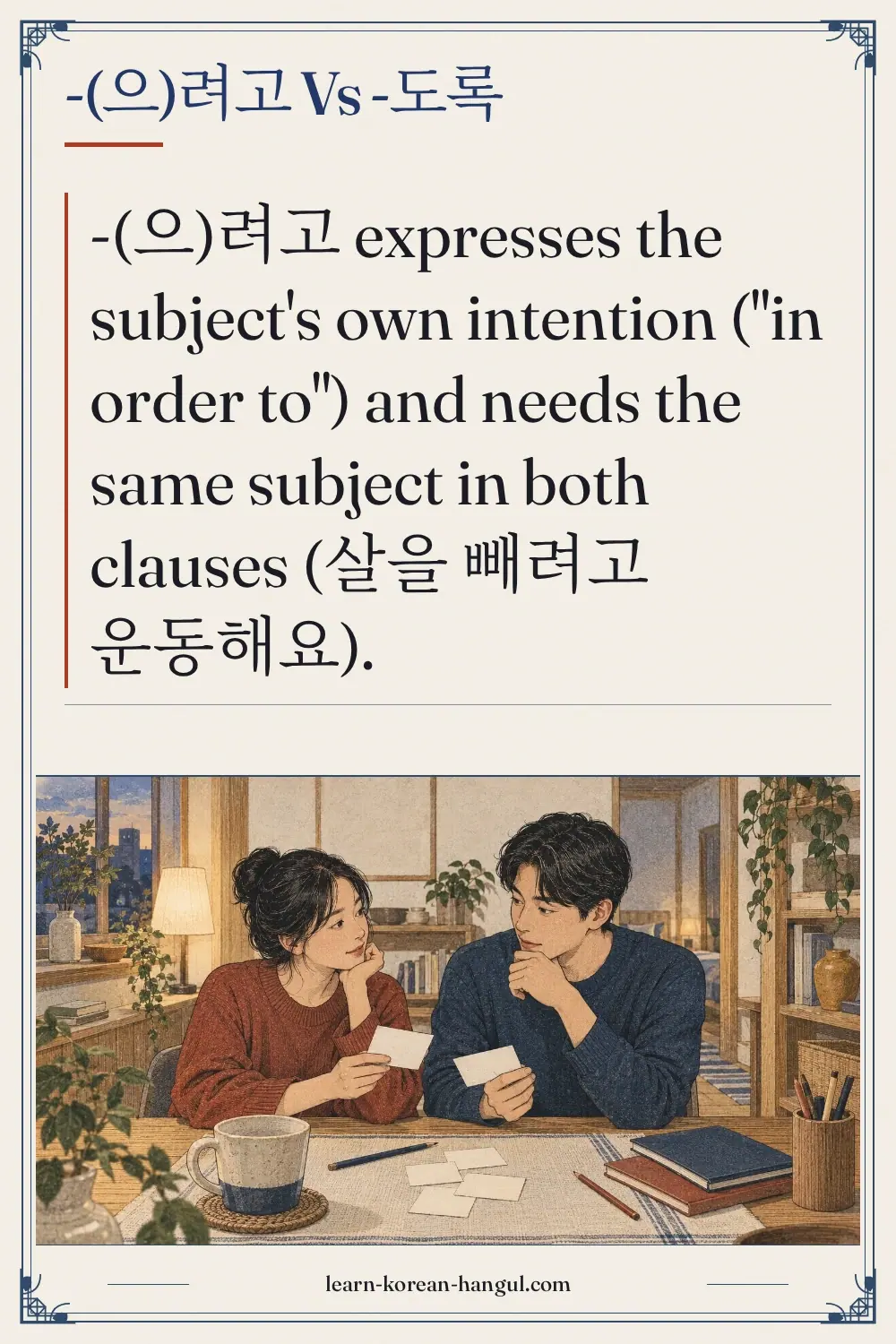
The difference is who wants the result. -(으)려고 belongs to the doer: the person who acts is the person who intends. -도록 describes a result that the action should produce, and that result can be about someone else. The first is a plan, and the second is a target.
Two sentences show the contrast:
- 살을 빼려고 운동해요. (sareul ppaeryeogo undonghaeyo.) = "I exercise to lose weight." The same person exercises and wants to lose weight.
- 아이가 자도록 불을 껐어요. (aiga jadorok bureul kkeosseoyo.) [부를 꺼써요] = "I turned off the light so the child could sleep." The person who turned off the light is not the child.
In the first sentence the subject is one person for both verbs. In the second, 아이가 is the subject of 자도록, and the speaker is the subject of 껐어요. The next sections turn this into a rule you can apply in a few seconds.
The One-Line Rule
Use -(으)려고 when one person does the action and has the goal. Use -도록 when the goal involves someone or something else, when you give a command, or when you mean "until" or "to the point that". If you can add "so that [someone else]" in English, choose -도록.
-(으)려고 vs -도록: Side-by-Side Table
The table compares the two endings on the points learners need most. Each row has one specific answer for each ending.
| Point | -(으)려고 | -도록 |
|---|---|---|
| Core meaning | in order to, intending to | so that, in such a way that |
| English cue | "to", "in order to", "so as to" | "so that", "so (someone) can", "until", "to the point that" |
| Subject | the same in both clauses | may differ |
| Main clause as a command or suggestion | usually not allowed | allowed: 일찍 출발하세요 |
| Tense inside the clause | not allowed | not allowed |
| Negative | 늦지 않으려고 | 늦지 않도록 |
| Other meanings | intention with 하다: 가려고 해요 | degree: 목이 쉬도록; time: 밤새도록 |
| Register | neutral | slightly formal or written; casual -게 |
| After a vowel | 가려고 | 가도록 |
| After a consonant | 먹으려고 | 먹도록 |
| After ㄹ | 만들려고 | 만들도록 |
| Example | 늦지 않으려고 일찍 출발했어요. | 늦지 않도록 일찍 출발하세요. |
The table shows that -(으)려고 is the narrower ending, tied to one subject. -도록 is wider: it works with commands, with other subjects and with degree meanings. Each ending has a cluster of typical situations.
When Do You Use -(으)려고?
Use -(으)려고 when you explain why you do something yourself. Three situations cover most uses:
- A personal goal. 살을 빼려고 운동해요. = "I exercise to lose weight."
- A negative goal. 늦지 않으려고 일찍 출발했어요. (neutji aneuryeogo iljjik chulbalhaesseoyo.) [늗찌 아느려고] = "I left early so as not to be late."
- A trip with an intention. 한국어를 배우려고 한국에 왔어요 = "I came to Korea in order to learn Korean."
To build the ending, take the stem and add 려고 after a vowel (가려고) and 으려고 after a consonant (먹으려고). A stem that ends in ㄹ takes 려고 directly (만들려고). The ending cannot take a tense marker, so say 먹으려고, not 먹었으려고, and put the past tense on the main verb.
An important shade of meaning is the identity of the subject. 아이가 자려고 불을 껐어요 (aiga jaryeogo bureul kkeosseoyo.) means "The child turned off the light to sleep". Here 아이가 is the subject of both verbs, so -(으)려고 is correct. It is not a variant of the "so the child could sleep" sentence above.
When Do You Use -도록?
Use -도록 when a goal is meant for someone else, when you give a command about a goal, or when you describe an extent. Four situations cover most uses:
- A goal for another person. 가족이 잘 먹도록 엄마가 요리했어요. (gajogi jal meokdorok eommaga yorihaesseoyo.) = "Mother cooked so that the family could eat well."
- A command or advice. 늦지 않도록 일찍 출발하세요. (neutji antorok iljjik chulbalhaseyo.) [늗찌 안토록] = "Leave early so that you won't be late."
- An extent. 목이 쉬도록 노래했어요. (mogi swidorok noraehaesseoyo.) = "I sang until my voice went hoarse."
- A stretch of time. 밤새도록 이야기했어요. (bamsaedorok iyagihaesseoyo.) = "We talked all night long."
To build the ending, add 도록 directly to the stem, with no 으: 가도록, 먹도록, 만들도록. The negative is -지 않도록, as in 감기에 걸리지 않도록 하세요 ("Make sure you don't catch a cold"). The Revised Romanization of 않도록 is antorok, because ㅎ joins the next consonant: ㅎ + ㄷ gives ㅌ.
The pattern -도록 하다 is a common way to give gentle advice or to say "make sure that": 잊지 않도록 하세요 ("Please make sure you don't forget"). The meaning of the whole sentence comes from -도록, not from 하다 alone.
Worked Example: Choosing the Ending for One Idea
Follow the steps with the idea "turn off the light so that sleep comes."
- Find the doer. Who turns off the light? In 아이가 자려고 불을 껐어요 the child does. In 아이가 자도록 불을 껐어요 the speaker does.
- Find who wants the result. In the first sentence the doer wants to sleep, so the subject is the same. In the second sentence the doer wants the child to sleep, so the subjects differ.
- Choose the ending. Same subject: -(으)려고. Different subject: -도록.
- Put the verbs in order. The goal verb comes first, and the main action comes last: 가족이 잘 먹도록 엄마가 요리했어요.
You will know it worked when you can name the subject of each verb in one second. The usual slip at this stage is to attach -(으)려고 to a verb whose subject is another person, such as 가족이 잘 먹으려고 엄마가 요리했어요. That sentence suggests that the family intends to eat while the mother cooks, which is not what you want to say.
Can You Use Both in the Same Situation?
Yes, in a few situations either ending is grammatical, but the meaning shifts.
- Own goal, formal tone. 합격하도록 열심히 공부하겠습니다 ("I will study hard so that I pass") is possible in a formal speech. 합격하려고 열심히 공부해요 is the natural everyday version.
- Negative goal. 늦지 않으려고 일찍 출발했어요 shows your own intention. 늦지 않도록 일찍 출발했어요 can be read as "I left early so that we/they would not be late", which includes other people.
- Spoken Korean. Speakers often replace -도록 with -게: 아이가 잘 수 있게 불을 껐어요. (aiga jal su itge bureul kkeosseoyo.) The meaning is nearly the same, and -게 sounds less formal.
Some limits are firm. Only -도록 can follow a command. Only -(으)려고 shows plain personal intention in everyday speech. Neither ending takes a past marker inside its own clause. An honest limit: this page treats the textbook contrast, and some grammar books treat -게 as a separate pattern from -도록. Check the lesson for each ending when you need the full set of uses.
Which Should You Pick? a Simple Rule of Thumb
Follow these four steps in order. The first step that applies gives the answer.
- Are you giving a command, advice or a rule? Use -도록: 잊지 않도록 메모하세요.
- Do the two clauses have different subjects? Use -도록: 아이가 자도록 불을 껐어요.
- Do you mean "until" or "to the point that"? Use -도록: 밤새도록, 목이 쉬도록.
- Is it your own plan, with one subject? Use -(으)려고: 살을 빼려고 운동해요.
Checkpoint: read the sentence with "so that" and a new subject in English. If the new subject fits, -도록 is right. If the sentence is just "I do this to get that", choose -(으)려고.
What Mistakes Do Learners Make with These Two?
Learners most often forget to check the subject. Five mistakes appear again and again, and each has a quick repair.
- Using -(으)려고 with two different subjects. Learners often assume that -(으)려고 is a general "so that". Actually, 가족이 잘 먹으려고 엄마가 요리했어요 is wrong. Say 가족이 잘 먹도록 엄마가 요리했어요.
- Using -(으)려고 before a command. 늦지 않으려고 일찍 출발하세요 is generally avoided. Say 늦지 않도록 일찍 출발하세요.
- Adding 으 before 도록. 먹으도록 is wrong. Say 먹도록, because -도록 attaches directly to the stem.
- Adding a past marker. 갔도록 and 갔으려고 are wrong inside a purpose clause. Keep the stem plain and put the tense on the main verb.
- Reading -도록 only as "so that". In 밤새도록 and 목이 쉬도록, -도록 means "all through" and "to the point that". Translating with "so that" gives nonsense.
An honest limit: -도록 sounds a little formal when you say it about your own plan, so 살을 빼도록 운동해요 can sound stiff. Choose -(으)려고 in that case.
Practice: Choose the Right Pattern
Try the five items before you read the answer key. Cover the answers with your hand.
- Choose. You study to pass the exam yourself. Complete: 시험에 합격하___ 열심히 공부해요. (려고 / 도록)
- Choose. You ask a helper to speak slowly so that the child can understand. Complete: 아이가 이해할 수 있___ 천천히 말해 주세요. (으려고 / 도록)
- Fix the error. Correct 늦지 않으려고 일찍 오세요.
- Choose. You talked until morning. Complete: 밤새___ 이야기했어요. (려고 / 도록)
- Choose. Mother cooks and the family eats well. Complete: 가족이 잘 먹___ 엄마가 요리했어요. (으려고 / 도록)
Practice · 5
You study so that you yourself pass the exam. 시험에 합격하___ 열심히 공부해요.
Show answer
려고
The same person studies and wants to pass, so -(으)려고 is the natural choice.
You ask someone to speak slowly so that the child can understand. 아이가 이해할 수 있___ 천천히 말해 주세요.
Show answer
도록
The child is a different subject, and the main clause is a request, so -도록 fits.
Which sentence is correct?
Show answer
늦지 않도록 일찍 오세요.
A command after a purpose clause needs -도록, which attaches with no 으.
You talked until morning. 밤새___ 이야기했어요.
Show answer
도록
밤새도록 means "all night long", a meaning only -도록 has.
Mother cooks so that the family eats well. 가족이 잘 먹___ 엄마가 요리했어요.
Show answer
도록
The doer (mother) and the eaters (the family) are different people.
Answer key
- 려고. The same person studies and wants to pass.
- 도록. The subject of the goal (the child) differs from the speaker, and the sentence asks for action.
- 늦지 않도록 일찍 오세요. A command needs -도록.
- 도록. The meaning is "all night long", not a purpose.
- 도록. The doer (mother) and the eaters (the family) are different people.
If you got four or five right, you can handle most real sentences. If you missed item 3, review the command rule in the table.
What Should You Learn Next?
After -(으)려고 vs -도록, study each ending on its own, then the other purpose patterns. This page compares the two endings but does not teach every use of either one.
- Read the full lessons: -(으)려고 and -도록.
- Compare the intention ending with the movement ending in -(으)려고 vs -(으)러.
- Study the formal purpose pattern in -기 위해(서).
- See every pair on Confusing Grammar Compared, or browse Intermediate Grammar for the patterns around level B1.
With these steps, the choice in -(으)려고 vs -도록 becomes automatic: check the subjects, then add the ending to the verb stem.
Frequently Asked Questions
Can I always replace -(으)려고 with -도록?
No. 살을 빼도록 운동해요 is grammatical but sounds stiff when you are talking about your own plan. Use -(으)려고 for a personal intention. In the other direction, -(으)려고 cannot replace -도록 when the subjects differ or when the main clause is a command: 늦지 않도록 일찍 출발하세요 has no -(으)려고 version.
Which one sounds more natural in speech?
-(으)려고 is the natural choice for your own purpose, so it is very frequent. -도록 is common in announcements, instructions, written Korean and formal speech, such as 잊지 않도록 메모하세요. In casual conversation, speakers often replace -도록 with -게: 아이가 잘 수 있게 불을 껐어요.
How do I attach them to verb stems?
-도록 attaches directly to the stem with no 으: 먹도록, 가도록, 만들도록. -(으)려고 adds 으 after a consonant stem: 먹으려고, but 가려고 and 만들려고 take none. Neither takes a tense marker, so say 먹도록 and 먹으려고, not 먹었도록. Tense goes on the main verb.
Can the purpose be negative with both?
Yes. 늦지 않으려고 일찍 출발했어요 means "I left early so as not to be late" and shows your own intention. 늦지 않도록 일찍 출발하세요 means "Leave early so that you will not be late" and can address another person. Negative -도록 is especially common in warnings, rules and advice.
What is the quickest rule to remember?
Ask who wants the result. If the subject of the whole sentence wants it, use -(으)려고. If the result concerns another person, a situation or a general rule, or if you are giving a command, use -도록. A test sentence with a different subject in each clause is a strong signal for -도록.