What you'll learn
- Choose -(으)러 or -(으)려고 by looking at the verb that follows.
- Attach both endings to verbs that end in a vowel, a consonant or ㄹ.
- Explain why 책을 사러 돈을 모아요 is wrong and how to repair it.
- Say "so as not to" with -(으)려고.
Before you start: you should know the polite ending -아요/-어요 and verbs such as 가다, 오다, 사다 and 먹다. The full rules for each ending are in the lessons on -(으)려고 and -(으)러. It plays only when you press a button.
What Is the Difference between -(으)려고 and -(으)러?
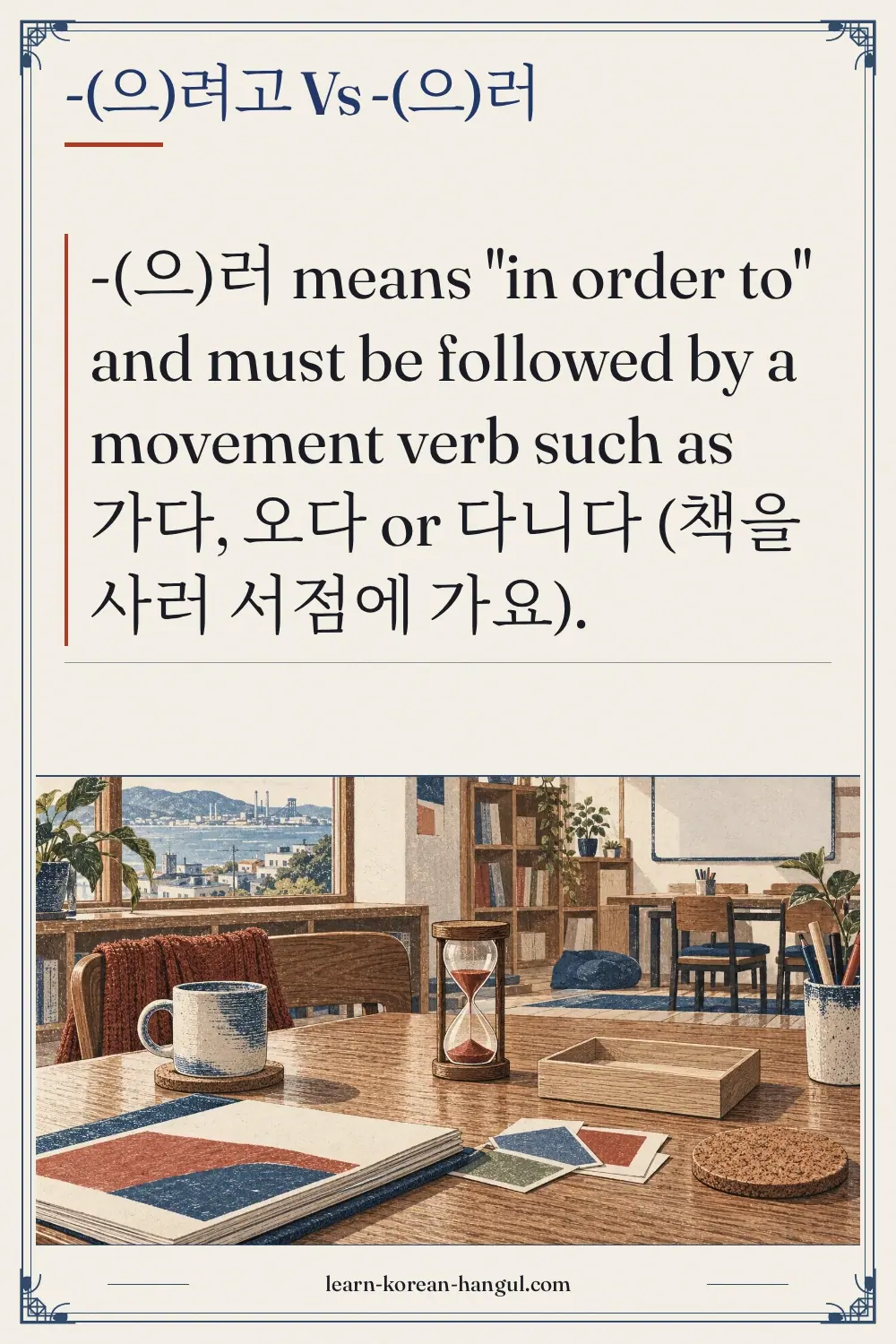
The difference is the verb that comes next. -(으)러 gives the purpose of a movement, so the main verb must be a movement verb (go, come, go out). -(으)려고 gives the purpose or intention behind any action, so the main verb can be anything.
Two sentences built on the same verb 사다 show the contrast:
- 책을 사러 서점에 가요. (chaegeul sareo seojeome gayo.) [채글 사러 서저메 가요] = "I go to the bookstore to buy a book." The main verb 가요 is a movement verb, so -(으)러 is natural.
- 책을 사려고 돈을 모아요. (chaegeul saryeogo doneul moayo.) [채글 사려고 도늘 모아요] = "I am saving money to buy a book." The main verb 모아요 is not a movement verb, so only -(으)려고 works.
Both sentences name a goal ("buy a book") and a purpose ending. The only thing that changes the ending is the next verb. The sections below turn this into a rule you can apply in a few seconds.
The One-Line Rule
Look at the main verb. If it is 가다, 오다, 다니다 or another movement verb, use -(으)러. If it is any other action verb, use -(으)려고. When the main verb is a movement verb, -(으)려고 is also grammatical, but -(으)러 is the more natural choice.
-(으)려고 vs -(으)러: Side-by-Side Table
The table compares the two endings on the points learners need most. Each row has one specific answer for each ending.
| Point | -(으)러 | -(으)려고 |
|---|---|---|
| Core meaning | purpose of going or coming | purpose or intention of any action |
| English cue | "to" after go/come: "go to buy" | "in order to", "so as to", "intending to" |
| Main verb | must be a movement verb: 가다, 오다, 다니다, 나가다, 들어가다 | any action verb; movement verbs are possible |
| Subject | same in both clauses | same in both clauses |
| Tense inside the clause | not allowed: no 았/었, no 겠 | not allowed: no 았/었, no 겠 |
| Command or suggestion in the main clause | allowed: 먹으러 가세요, 먹으러 갑시다 | usually not allowed |
| Negative purpose | rare | yes: 늦지 않으려고 |
| After a vowel | 사러 | 사려고 |
| After a consonant | 먹으러 | 먹으려고 |
| After ㄹ | 만들러 | 만들려고 |
| Example | 친구를 만나러 왔어요. | 한국어를 배우려고 한국에 왔어요. |
The table shows that the two endings share their form rules and their same-subject condition. They split on the main verb, on commands and on negative purposes. Each ending has a few typical situations.
When Do You Use -(으)러?
Use -(으)러 when the purpose of a trip is the sentence's point. The structure is: purpose + -(으)러 + a movement verb. Three situations are the most common:
- Going for an errand or an activity. 영화를 보러 극장에 가요. (yeonghwareul boreo geukjange gayo.) [극짱에] = "I go to the cinema to watch a movie."
- Coming for a reason. 친구를 만나러 왔어요. (chingureul mannareo wasseoyo.) = "I came to meet a friend." The past tense is on the main verb 왔어요, not on -(으)러.
- Inviting or telling someone to go. 점심 먹으러 가세요. (jeomsim meogeureo gaseyo.) = "Please go and eat lunch." The main clause can take a command or a suggestion, such as 점심 먹으러 갑시다 (Let's go eat lunch).
To build the ending, take the stem and add 러 after a vowel (사러), 으러 after a consonant (먹으러), and 러 directly after a stem that ends in ㄹ (만들러). For verbs with a ㄷ final such as 듣다, the ㄷ changes to ㄹ before 으: 들으러. For verbs with a ㅂ final such as 돕다, the ending becomes 도우러.
A stem that ends in ㄹ looks like this in a full sentence: 한국 요리를 만들러 친구 집에 가요. (hanguk yorireul mandeulleo chingu jibe gayo.) = "I go to a friend's house to cook Korean food."
Only the main verb takes tense. If you want the past, put it on 가요 or 왔어요, as in 책을 사러 갔어요 ("I went to buy a book"). Putting a past marker on the first verb, as in 샀으러 갔어요, is wrong.
When Do You Use -(으)려고?
Use -(으)려고 when you explain why you do something, and the main verb is not necessarily a movement verb. It has three typical jobs:
- Purpose behind an ongoing action. 책을 사려고 돈을 모아요. (chaegeul saryeogo doneul moayo.) = "I am saving money to buy a book."
- Purpose of a trip, with the emphasis on intention. 한국어를 배우려고 한국에 왔어요. (hangugeoreul baeuryeogo hanguge wasseoyo.) = "I came to Korea in order to learn Korean." The main verb 왔어요 is a movement verb, so -(으)러 is also possible (배우러 왔어요).
- A negative purpose. 늦지 않으려고 일찍 일어났어요. (neutji aneuryeogo iljjik ireonasseoyo.) [아느려고] = "I got up early so as not to be late." The pattern -지 않으려고 means "so as not to".
The sentence 늦지 않으려고 일찍 일어났어요 also shows a real rule: the subject of both clauses must be the same. The person who got up early is the person who did not want to be late. A sentence such as "I cooked so that my mother could eat" needs a different pattern, which -(으)려고 vs -도록 explains.
Textbooks also list a restriction on the main clause. A command or a suggestion after -(으)려고, as in 살을 빼려고 운동하세요, is generally avoided. A reasonable alternative is to name the goal in a separate sentence.
Worked Example: Choosing between the Two
Follow the steps with the idea "I want to see a movie, so I go to the cinema."
- Find the goal. The goal is "watch a movie": 영화를 보다.
- Look at the main verb. The main verb is "go to the cinema": 극장에 가요. 가다 is a movement verb.
- Choose and attach. For a movement verb, use -(으)러. The stem 보 ends in a vowel, so add 러: 보러.
- Build the sentence. Put the purpose before the movement: 영화를 보러 극장에 가요.
You will know it worked when the purpose clause has no tense marker and the main verb is 가다 or 오다. The most common slip at this stage is to attach the ending to the wrong verb. In 극장에 가러 영화를 봐요, the order is reversed. Another slip is to add the past tense to the first verb. Always keep the first verb in its plain stem form.
Now try the other direction: "I save money, in order to buy a book." The main verb is 모으다 ("to save up"), which is not a movement verb. So use -(으)려고, and the stem 사 ends in a vowel: 사려고. The sentence becomes 책을 사려고 돈을 모아요.
Can You Use Both in the Same Sentence?
Yes, when the main verb is a movement verb, the two endings overlap. 한국어를 배우러 왔어요 and 한국어를 배우려고 왔어요 are both correct and mean "I came to learn Korean". Two small differences remain.
- Emphasis. 배우러 왔어요 treats learning as the reason for the trip. 배우려고 왔어요 stresses your intention.
- Frequency. Everyday speech prefers -(으)러 when the next verb is 가다 or 오다. You will hear -(으)려고 more when a longer explanation comes before the main verb.
Some limits are firm. -(으)러 cannot be used before 모으다, 일하다, 공부하다 or any other verb that is not about moving. The purpose clause also needs the same subject as the main clause, so neither ending can connect "I cook" with "mother eats". An honest limit: this page treats the standard contrast, and spoken Korean sometimes drops the movement verb after 러, as in a short answer 사러요 ("To buy something"). That is an elliptical answer, not a separate pattern.
Which Should You Pick? a Simple Rule of Thumb
Follow these four steps in order. The first step that applies gives the answer.
- Is the main verb 가다, 오다, 다니다, 나가다, 들어가다 or another movement verb? Use -(으)러: 보러 가요.
- Are you giving a command or a suggestion? Use -(으)러 (and a movement verb): 먹으러 가세요.
- Is the purpose negative ("so as not to")? Use -(으)려고: 늦지 않으려고.
- Is the main verb anything else? Use -(으)려고: 사려고 모아요.
Checkpoint: if the English can be "go to ...", you chose well with -(으)러. If the English is "in order to ..." with a non-movement verb, you chose well with -(으)려고.
What Mistakes Do Learners Make with These Two?
Learners most often forget that -(으)러 needs a movement verb. Five mistakes appear again and again, and each has a quick repair.
- Using -(으)러 with a non-movement verb. Learners often assume that the two endings are the same. Actually, 책을 사러 돈을 모아요 is wrong, because 모아요 is not a movement verb. Say 책을 사려고 돈을 모아요.
- Adding a past marker inside the purpose clause. 샀으러 갔어요 and 샀으려고 돈을 모았어요 are wrong. Keep the first verb in the stem form: 사러 갔어요.
- Changing the subject. 내가 먹으려고 엄마가 요리했어요 is wrong, because the subjects differ. Use a different pattern, such as -도록, or restate the sentence.
- Using a command after -(으)려고. 살을 빼려고 운동하세요 is generally avoided. Use 살을 빼고 싶으면 운동하세요 ("If you want to lose weight, exercise") instead.
- Using 가다 inside the purpose clause. A sentence such as 가러 가요 is awkward. Say what you will do there: 쇼핑하러 가요 ("I go shopping").
An honest limit: -(으)러 and -(으)려고 are the learner-friendly pair, but Korean also has -기 위해(서) for formal writing. This page does not cover that pattern.
Practice: Choose the Right Pattern
Try the five items before you read the answer key. Cover the answers with your hand.
- Choose. Complete: 친구를 ___ 카페에 가요. (만나러 / 만나려고)
- Choose. Complete: 여행을 ___ 돈을 모아요. (가러 / 가려고)
- Choose. You want to tell someone to go and eat. Complete: ___ 가세요. (먹으러 / 먹으려고)
- Fix the error. Correct 책을 사러 열심히 일해요.
- Translate. "I came to Korea to study Korean." Use 공부하다.
Practice · 5
친구를 ___ 카페에 가요.
Show answer
만나러
The main verb 가요 is a movement verb, so -(으)러 is the natural choice.
여행을 ___ 돈을 모아요.
Show answer
가려고
The main verb 모아요 is not a movement verb, so only -(으)려고 works.
You tell someone to go and eat. ___ 가세요.
Show answer
먹으러
A command with a movement verb after it takes -(으)러.
Which sentence is correct?
Show answer
책을 사려고 열심히 일해요.
일해요 is not a movement verb, so -(으)러 cannot be used.
You want to say "I came to Korea to study Korean." Which sentence is NOT correct?
Show answer
한국어를 공부했으러 한국에 왔어요.
The purpose clause takes no past marker. Both 공부하러 and 공부하려고 work before the movement verb 왔어요.
Answer key
- 만나러. The main verb 가요 is a movement verb.
- 가려고. The main verb 모아요 is not a movement verb, and 가러 is not used with it.
- 먹으러. A command with a movement verb after it takes -(으)러.
- 책을 사려고 열심히 일해요. The verb 일해요 is not a movement verb.
- 한국어를 공부하러 한국에 왔어요. Both 공부하러 and 공부하려고 are correct here, because the main verb 왔어요 is a movement verb.
If you got four or five right, you can handle most real sentences. If you missed item 4, reread the section on mistakes and look at the main verb first.
What Should You Learn Next?
After -(으)려고 vs -(으)러, study each ending on its own, then the other purpose patterns. This page compares the two endings but does not teach every use of either one.
- Read the full lessons: -(으)려고 and -(으)러.
- Compare the intention ending with the "so that" ending in -(으)려고 vs -도록.
- Learn the sentence-final form of the same idea in -(으)려고 하다.
- See every pair on Confusing Grammar Compared, or browse Beginner Grammar for the patterns around level A2.
With these steps, the choice in -(으)려고 vs -(으)러 becomes automatic: look at the main verb, then add the ending to the verb stem.
Frequently Asked Questions
Can I always replace -(으)려고 with -(으)러?
No. -(으)러 needs a movement verb after it, so 책을 사려고 돈을 모아요 cannot become 사러 돈을 모아요. In the other direction, -(으)려고 usually works before 가다 and 오다 too: 책을 사려고 서점에 가요 is grammatical, though -(으)러 is the more common choice for "go to do".
Is there a difference in meaning between 먹으러 가요 and 먹으려고 가요?
The difference is small. 먹으러 가요 says that going and eating belong together as one errand. 먹으려고 가요 puts the weight on the intention behind going. Native speakers use 먹으러 가요 far more often, and it is the safe default whenever the next verb is 가다 or 오다.
How do I attach them to verbs that end in ㄹ?
Keep the ㄹ and add no 으: 만들다 becomes 만들러 and 만들려고. Verbs with other final consonants add 으 first, as in 먹으러 and 먹으려고. Verbs that end in a vowel add the ending directly: 사러, 사려고. -(으)면 follows the same rule (만들면).
Can the purpose be negative?
Yes, with -(으)려고. 늦지 않으려고 일찍 일어났어요 means "I got up early so as not to be late". -(으)러 is rarely used with a negative, because it names an errand you travel to do. For "so that you will not", use -(으)려고 or a different pattern such as -도록.
What is the quickest rule to remember?
Look at the verb that follows. If it is a movement verb such as 가다, 오다 or 다니다, use -(으)러. If it is any other action verb, use -(으)려고. When the next verb is a movement verb and you hesitate, -(으)러 is almost always correct.