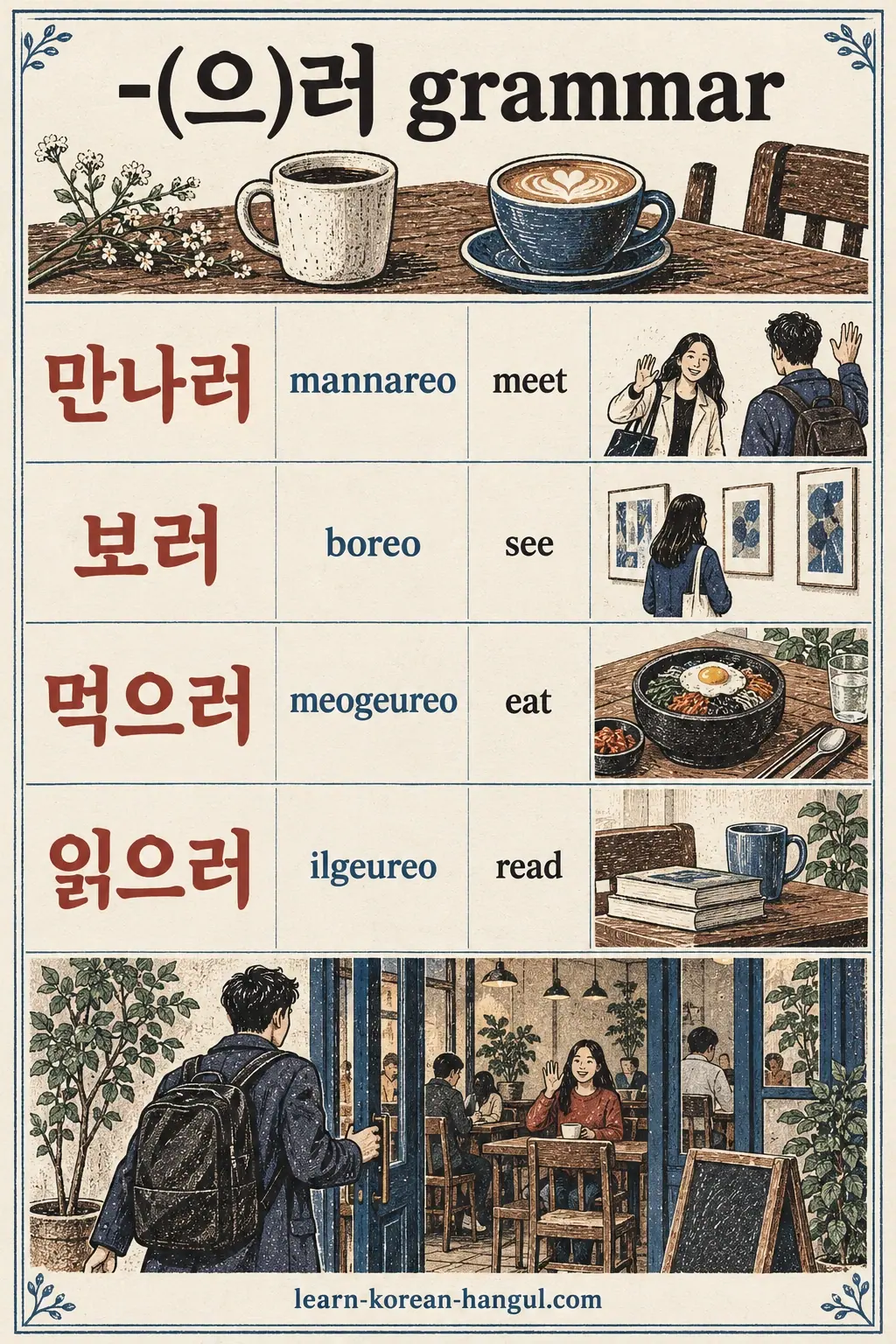
What you'll learn
- Attach -(으)러 to any verb stem, including ㄹ stems and irregular verbs.
- Choose the right main verb to follow it.
- Put the tense on the main verb, not before 러.
- Choose between -(으)러, -(으)려고 and -기 위해(서).
Prerequisites: the polite ending -아요/어요, the verbs 가다 and 오다, and the place particle 에. Time: about 15 minutes.
Key facts
- -(으)러 means "in order to" after you go or come: you travel for a purpose.
- Verb stem + 러 after a vowel or ㄹ, and + 으러 after a final consonant.
- The main verb must be a movement verb: 가다, 오다, 다니다 and similar.
- No tense marker goes before 러. The main verb carries the tense.
- It is common in daily speech and in every politeness style.
Listen to two model sentences.
The next section defines the pattern.
What Does -(으)러 Grammar Mean?
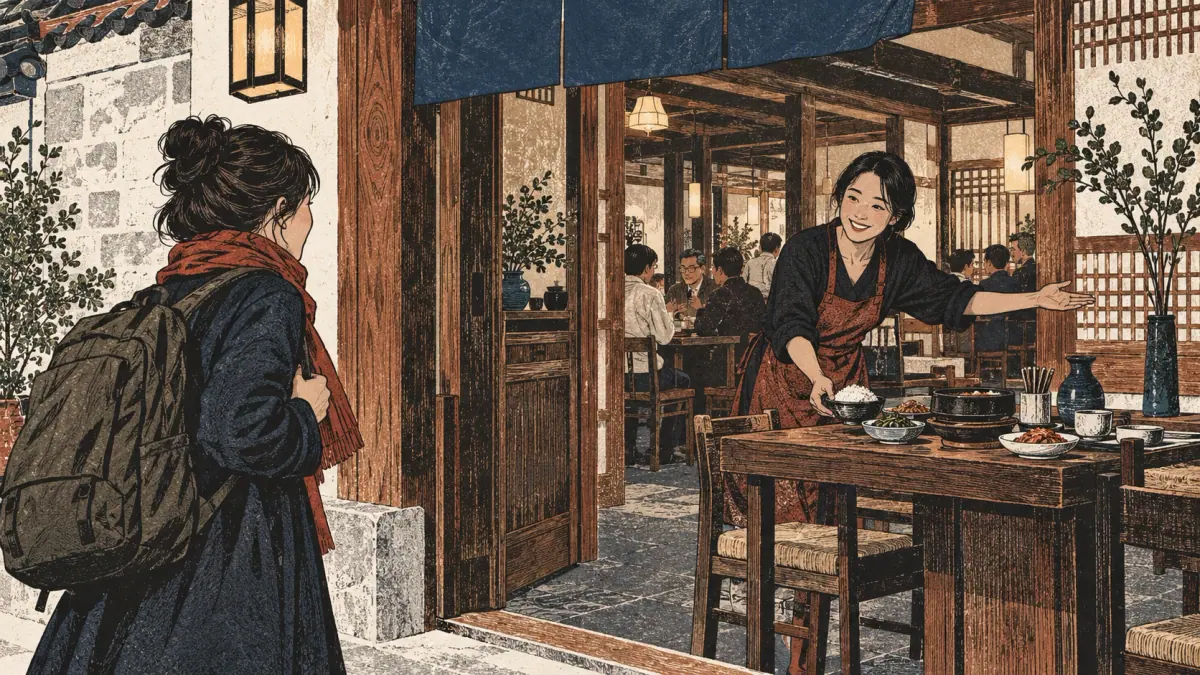
-(으)러 means "in order to", but only in one situation: the speaker goes or comes somewhere for a purpose. A connective ending is a word ending that joins one clause to the next. This one tells the listener why the trip happens.
Think of the sentence as a trip with a reason. The main verb says how you move: 가요 ("go"), 왔어요 ("came"). The -(으)러 clause says what for. In English you can say "I go to meet a friend", and the "to" is the job of 러.
| Part | 친구를 만나러 카페에 가요. | 밥을 먹으러 왔어요. |
|---|---|---|
| Purpose clause | 친구를 만나러 (to meet a friend) | 밥을 먹으러 (to eat) |
| Movement | 카페에 가요 (go to a cafe) | 왔어요 (came) |
| Spoken | [친구를 만나러 카페에 가요] | [바블 머그러 와써요] |
| RR (aid) | chingureul mannareo kapee gayo | babeul meogeureo wasseoyo |
| English | I go to a cafe to meet a friend. | I came to eat. |
The place can be left out when the listener already knows it. 밥을 먹으러 왔어요 does not say where; "here" is understood.
The next section shows how to build the form.
How Do You Form -(으)러?
Remove 다 from the dictionary form to get the stem, then add 러 or 으러. The stem is the verb without its dictionary ending -다. For 먹다 the stem is 먹. The choice depends on the last sound of the stem.
| Dictionary form | Stem | Stem + (으)러 | Spoken | RR (aid) |
|---|---|---|---|---|
| 만나다 (meet) | 만나 | 만나러 | [만나러] | mannareo |
| 보다 (see) | 보 | 보러 | [보러] | boreo |
| 사다 (buy) | 사 | 사러 | [사러] | sareo |
| 공부하다 (study) | 공부하 | 공부하러 | [공부하러] | gongbuhareo |
| 놀다 (play) | 놀 | 놀러 | [놀러] | nolleo |
| 먹다 (eat) | 먹 | 먹으러 | [머그러] | meogeureo |
| 읽다 (read) | 읽 | 읽으러 | [일그러] | ilgeureo |
| 찾다 (look for) | 찾 | 찾으러 | [차즈러] | chajeureo |
| 씻다 (wash) | 씻 | 씻으러 | [씨스러] | ssiseureo |
In the table, the final consonant of a stem moves to the next syllable in speech. 먹으러 is said [머그러], not [먹으러]. This is normal linking between a final consonant and a vowel.
Stems Ending in a Vowel
Vowel stems take 러 directly: 만나러, 보러, 사러. For verbs made with 하다, add 러 to 하: 공부하러, 운동하러, 쇼핑하러. You do not need to change 하 to 해.
Stems Ending in a Consonant
Consonant stems take 으러: 먹으러, 읽으러, 찾으러. The 으 is a helping vowel that makes the sound easy to say.
Stems Ending in ㄹ
A stem that ends in ㄹ takes 러 with no 으. 놀다 gives 놀러, 만들다 gives 만들러, and 팔다 gives 팔러. Writing 놀으러 is a common error.
Irregular Stems and Nouns
Irregular stems follow the same rules as before -(으)면 or -(으)세요. A stem that ends in a consonant gets the helping vowel 으, and the irregular change happens in front of that vowel. A stem that ends in a vowel takes 러 and does not change.
| Type | Dictionary form | With (으)러 | Note |
|---|---|---|---|
| ㄷ-irregular | 듣다 (listen) | 들으러 | ㄷ becomes ㄹ before 으 |
| ㄷ-irregular | 걷다 (walk) | 걸으러 | same rule |
| ㅂ-irregular | 돕다 (help) | 도우러 | ㅂ becomes 우 before 으 |
| ㅅ-irregular | 짓다 (build) | 지으러 | ㅅ drops before 으 |
| 르 stem | 부르다 (call) | 부르러 | vowel stem, so 러 only |
| ㅡ stem | 쓰다 (write) | 쓰러 | vowel stem, so 러 only |
-(으)러 attaches only to verbs. Adjectives and 이다 cannot take it, because you cannot "go in order to be pretty". For nouns, use a verb: 운동 ("exercise") becomes 운동하러 ("to exercise").
The next section builds a full sentence.
Worked Example: Building 책을 빌리러 도서관에 가요

Say that you go to the library to borrow a book. Follow five steps.
- Write the purpose. "I borrow a book" is 책을 빌려요. The verb is 빌리다, "borrow".
- Find the stem. The stem is 빌리. It ends in a vowel, so it takes 러.
- Add 러. 빌리 + 러 gives 빌리러. Remove the polite ending 어요, because it belongs to the main verb.
- Choose the movement verb. You go to the library, so the verb is 가다. Add the place 도서관에, with the particle 에.
- Join the two parts. 책을 빌리러 도서관에 가요.
You'll know it worked when the purpose clause ends in 러 with nothing after it, the main verb is a movement verb, and the polite ending 요 appears once, at the end. Try the same steps with "I came to Korea to learn Korean": 한국어를 배우러 한국에 왔어요.
Sentence
I go to a cafe to meet a friend.
Show answer
친구를 만나러 카페에 가요
카페에 친구를 만나러 가요
The next section covers tense and sentence types.
Which Tenses and Sentence Types Work with -(으)러?

Tense in Korean is shown on the verb. For -(으)러, put the tense on the main verb at the end, not in the purpose clause.
| Slot | Form | Example | English |
|---|---|---|---|
| Present | stem + (으)러 + 가요/와요 | 밥을 먹으러 가요. | I go to eat. |
| Past | stem + (으)러 + 갔어요/왔어요 | 밥을 먹으러 갔어요. | I went to eat. |
| Future | stem + (으)러 + 갈 거예요 | 밥을 먹으러 갈 거예요. | I will go to eat. |
| Tense inside 러 | not possible | 먹었으러 | Wrong. |
| Statement after | any style | 사러 갔어요. | I went to buy it. |
| Question after | rising for yes/no | 같이 먹으러 갈까요? | Shall we go to eat together? |
| Wh-question after | falling or rise-fall | 뭐 하러 왔어요? | What did you come to do? |
| Command after | 세요 | 놀러 오세요. | Please come over. |
| Suggestion after | -ㅂ시다, -아요/어요, -ㄹ까요 | 쇼핑하러 가요. | Let's go shopping. |
Unlike -아/어서, -(으)러 allows every sentence type after it. You can follow it with a statement, a question, a command or a suggestion. That is because the main verb tells where you go, not why.
Yes/no questions end with a rise: 같이 먹으러 갈까요? A wh-question puts the stress on the question word and often ends with a fall or a rise-fall rather than a sharp rise: 뭐 하러 왔어요?
The next section compares -(으)러 with its neighbours.
How Is -(으)러 Different from -(으)려고?

Both can be translated as "to" or "in order to". The difference is the main verb. -(으)러 needs a movement verb. -(으)려고 can be followed by any action.
| Pattern | Main verb | Example | Feeling |
|---|---|---|---|
| -(으)러 | movement verb only | 책을 사러 가요. | "I go to buy a book." The trip is the point. |
| -(으)려고 | any action | 책을 사려고 돈을 모아요. | "I save money to buy a book." Any action. |
| -기 위해(서) | any action | 책을 사기 위해 돈을 모아요. | Formal. Works in commands. |
Tell the same trip with each ending. The facts are "I go to the market" and "I buy fruit".
- 과일을 사러 시장에 가요. The purpose is buying, and the verb is 가요.
- 과일을 사려고 시장에 가요. Also possible, with a slightly stronger sense of intention.
- 과일을 사기 위해서 시장에 가요. Correct but formal, for writing or an announcement.
When the main verb is 가다 or 오다, learners can usually pick either -(으)러 or -(으)려고. When it is anything else, only -(으)려고 or -기 위해(서) works. The deciding question is simple: could the main verb be replaced by "go" or "come"? If yes, -(으)러 is the natural choice. If not, use -(으)려고.
For a detailed side-by-side with practice, see -(으)려고 vs -(으)러.
The next section covers set phrases and edge cases.
Variations and Edge Cases of -(으)러

Invitations with 놀러 오세요
놀러 가다 and 놀러 오다 mean "to go or come for fun" or "to visit". 놀다 alone means "to play" or "to hang out". 놀러 오세요 is the usual way to invite someone: "Please come over." The sentence does not mean you want the guest to play games.
-(으)러 다니다
다니다 means "to go regularly". 학원에 한국어를 배우러 다녀요 means "I go to an academy to learn Korean" and suggests a habit, not a single trip. The same sentence with 가요 would describe one trip.
The Question 뭐 하러
뭐 하러 asks "what for?". 뭐 하러 왔어요? means "What did you come to do?" It can also be a rhetorical question that means "Why would you bother?" Compare 뭐 하러 거기까지 가요? ("Why go all that way?"). The tone of the voice shows which meaning is meant.
Word Order
The purpose clause usually comes first, but the place can come first too: 도서관에 책을 빌리러 가요 means the same as 책을 빌리러 도서관에 가요. Both are natural.
Other Movement Verbs
Besides 가다 and 오다, the main verb can be 나가다 ("go out"), 들어가다 ("go in"), 올라가다 ("go up"), 돌아가다 ("go back") or 내려가다 ("go down"). 점심을 먹으러 나갔어요 means "I went out to eat lunch."
Honorific and Polite Speech
Politeness is set by the last verb. 선생님을 뵈러 갔어요 uses 뵈다, the humble form of 보다, because the person you will meet deserves respect. This lesson does not cover the humble verbs in detail.
The next section lists the mistakes that appear most often.
What Mistakes Do Learners Make with -(으)러?
Learners make six predictable mistakes. Each has a reason and a fix.
Learners often use -(으)러 with a main verb that is not a movement verb. Actually it needs 가다, 오다 or a similar verb. Wrong: 책을 읽으러 해요. Right: 책을 읽으려고 해요 ("I intend to read a book"). Fix: replace the main verb with "go". If the sentence breaks, use -(으)려고.
Learners often put a tense before 러. Wrong: 먹었으러 갔어요. Right: 먹으러 갔어요. Fix: the tense belongs on the main verb only.
Learners often forget 으 after a consonant. Wrong: 먹러 가요. Right: 먹으러 가요. Fix: say the stem, check the last sound, and add 으 if it is a consonant.
Learners often add 으 after ㄹ. Wrong: 놀으러 가요. Right: 놀러 가요. Fix: ㄹ counts as a vowel-like ending here, so no 으.
Learners often write 려 for 러. Wrong: 먹으려 가요. Right: 먹으러 가요. Fix: 러 pairs with movement verbs, and 려고 is a different ending with a different meaning.
Learners often attach it to an adjective. Wrong: 예쁘러 가요. Right: 예뻐지려고 운동해요 ("I exercise to become pretty"). Fix: only action verbs can take -(으)러. For a change of state, use 아/어지다 and -(으)려고.
The next section gives you practice.
Practice and Answers
Do the four tasks, then compare with the key.
Task 1: join the sentences with -(으)러. Write one sentence for each pair.
- 친구를 만나요. / 카페에 가요.
- 영화를 봐요. / 극장에 가요.
- 옷을 사요. / 시장에 갔어요.
- 한국어를 배워요. / 서울에 왔어요.
Task 2: fix the error. Each sentence has one mistake. Rewrite it correctly.
- 점심을 먹러 가요.
- 친구하고 놀으러 갔어요.
- 커피를 마셨으러 왔어요.
Task 3: translate. Write in Korean: "I went to the library to read a book." and "Please come to visit me."
Task 4: write your own. Write one sentence about where you go on the weekend and why, and one sentence about why you came to this city.
Practice · 5
Which form of 먹다 means "in order to eat" before 가다?
Show answer
먹으러
먹 ends in a consonant, so it takes 으러. A tense marker never goes before 러.
Which -(으)러 form is correct for 놀다 (to play, hang out)?
Show answer
놀러
A stem ending in ㄹ takes 러 with no 으: 놀러.
Which sentence is correct?
Show answer
책을 읽으러 도서관에 가요.
The main verb must be a movement verb. 가요 is one; 해요, 좋아해요 and 예뻐요 are not.
How do you say "I came to learn Korean"?
Show answer
한국어를 배우러 왔어요.
The tense is on the main verb: 왔어요. 러 stays unchanged.
Which form of 듣다 (listen) is correct before 가다?
Show answer
들으러
듣다 is ㄷ-irregular. ㄷ becomes ㄹ before a vowel, and 으 is needed after a consonant: 들으러.
Answer key
- (1) 친구를 만나러 카페에 가요. (2) 영화를 보러 극장에 가요. (3) 옷을 사러 시장에 갔어요. (4) 한국어를 배우러 서울에 왔어요.
- (1) 점심을 먹으러 가요. (2) 친구하고 놀러 갔어요. (3) 커피를 마시러 왔어요.
- 책을 읽으러 도서관에 갔어요. 놀러 오세요 (or 저희 집에 놀러 오세요). Other correct versions exist.
- Sample answers: 주말에는 운동하러 공원에 가요. 한국어를 배우러 이 도시에 왔어요. Any sentence is correct if 러 or 으러 sits on the verb stem and a movement verb follows.
If task 1 was correct, you have the formation rule. If task 2 was hard, check each stem for its final sound and whether you put a tense before 러. The next section points you to what comes after this lesson.
What Should You Learn after -(으)러 Grammar?
After -(으)러, learn -(으)려고, which works with any action. Then read -기 위해(서) for the formal "in order to". The comparison page -(으)려고 vs -(으)러 gives a decision rule.
For a wider view, the parent page Purpose and Intention lists every connector in this group. To plan by level, use Beginner Grammar. The ending 기 in -기 위해(서) is explained on the page for the -기 nominalizer.
This lesson covers -(으)러 in the polite, casual and formal styles. It does not cover every humble verb or written variation. About this page. Last updated 2026-10-09. Revised Romanization follows the national rules and is shown only as a learning aid.
Frequently Asked Questions
What Does -(으)러 Mean?
-(으)러 means "in order to" when you go or come somewhere to do something. It names the purpose of the trip. 친구를 만나러 카페에 가요 means "I go to a cafe to meet a friend." The second part of the sentence must be a movement verb, such as 가다 (go) or 오다 (come).
How Do I Attach -(으)러 to a Verb?
Take the stem, which is the dictionary form without 다. After a vowel or ㄹ, add 러: 만나러, 보러, 놀러. After a consonant, add 으러: 먹으러, 읽으러. Irregular stems change as usual before a vowel: 듣다 gives 들으러, and 돕다 gives 도우러. Only verbs can take this ending.
Can -(으)러 Be Used in the past Tense?
Not inside the -(으)러 clause. Never write 먹었으러. Put the tense on the main verb instead: 밥을 먹으러 갔어요 means "I went to eat", and 밥을 먹으러 갈 거예요 means "I will go to eat". The ending 러 itself is the same in the past, present and future.
Is -(으)러 Used in Speech or Only in Writing?
It is very common in everyday speech, and it is one of the first purpose patterns learners meet. You will hear 놀러 오세요, 뭐 하러 왔어요? and 사러 갔어요 daily. It also appears in writing, in every politeness style. In formal writing, -기 위해(서) is more usual for non-movement purposes.
What Is the Most Common Mistake with -(으)러?
The most common mistake is using it with a main verb that is not a movement verb. 먹으러 해요 is wrong, because 하다 does not mean going or coming. Use -(으)려고 there: 먹으려고 해요. Other frequent mistakes are adding a tense, such as 먹었으러, and writing 놀으러 instead of 놀러.
What Is the Difference between -(으)러 and -(으)려고?
-(으)러 only works before movement verbs such as 가다, 오다 and 다니다. -(으)려고 works before any action and means "in order to" or "intending to". 책을 사러 가요 uses the movement verb 가다. 책을 사려고 돈을 모아요 saves money, which is not movement, so only -(으)려고 fits.