Before you start: you should know how to make the polite past (먹었어요, 갔어요) and how to find the past stem (the polite past without 어요, such as 먹었 in 먹었어요). It also helps to know -(으)니까, because this lesson compares the two. Estimated time: 15 minutes.
What Does -았/었더니 Grammar Mean?
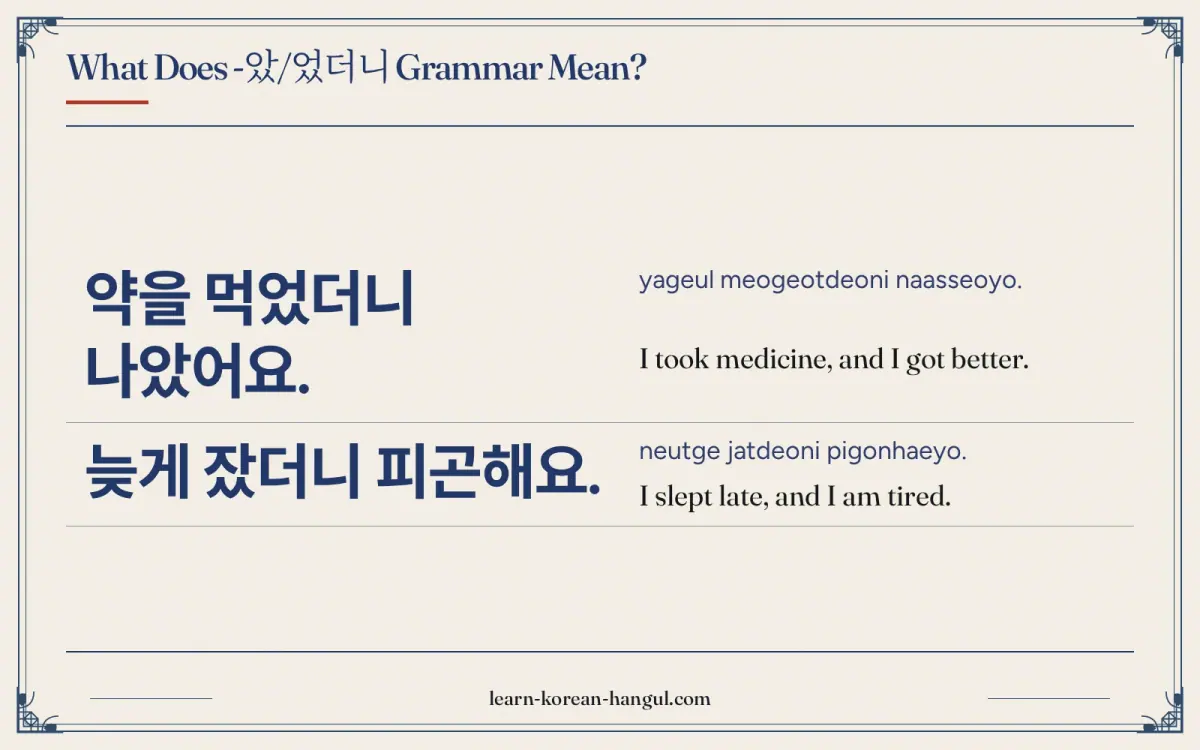
-았/었더니 grammar means "I did X, and then I noticed (or felt) Y". It links something the speaker did in the past to a result that followed. In 운동했더니 기분이 좋아졌어요, the speaker exercised and then found that their mood had improved. -더니 is a connective ending (연결 어미, yeongyeol eomi): a form that links one clause to the next.
The ending is built from two parts. The first is -았/었-, the past tense marker. The second is -더니, an ending that carries the idea of "I observed this myself". So the pattern says: "In the past I did this, and I saw what came next". The result is usually something new that the speaker found out or felt: a cure, a change, an empty room, a reaction.
Two ideas make this pattern different from other connectors. The first is the speaker's own action: the person who did the first thing is "I". The second is that the result comes as a discovery, not as a plan. That is why the second clause is usually in the past or describes a state, and why it does not take commands or suggestions.
약을 먹었더니 나았어요.
yageul meogeotdeoni naasseoyo.
I took medicine, and I got better.
운동했더니 기분이 좋아졌어요.
undonghaetdeoni gibuni joajyeosseoyo.
I exercised, and my mood got better.
늦게 잤더니 피곤해요.
neutge jatdeoni pigonhaeyo.
I slept late, and I am tired.
The first verb in each example already carries the past, and the second clause reports what the speaker found. The next section shows how to build the form on every kind of verb.
How Do You Form -았/었더니?
You form -았/었더니 by adding -더니 to the past stem, which is the stem plus -았/었-. This means you first make the past, then add 더니. Use -았- after a stem whose last vowel is ㅏ or ㅗ, and -었- after any other vowel. 하다 verbs give 했-.
| Verb | Past stem | With -더니 | Sound | Revised Romanization |
|---|---|---|---|---|
| 가다 | 갔 | 갔더니 | [갇떠니] | gatdeoni |
| 보다 | 봤 | 봤더니 | [봗떠니] | bwatdeoni |
| 오다 | 왔 | 왔더니 | [왇떠니] | watdeoni |
| 하다 | 했 | 했더니 | [핻떠니] | haetdeoni |
| 먹다 | 먹었 | 먹었더니 | [머걷떠니] | meogeotdeoni |
| 읽다 | 읽었 | 읽었더니 | [일걷떠니] | ilgeotdeoni |
| 마시다 | 마셨 | 마셨더니 | [마셛떠니] | masyeotdeoni |
| 듣다 (ㄷ) | 들었 | 들었더니 | [드럳떠니] | deureotdeoni |
| 돕다 (ㅂ) | 도왔 | 도왔더니 | [도왇떠니] | dowatdeoni |
| 쓰다 (ㅡ) | 썼 | 썼더니 | [썯떠니] | sseotdeoni |
| 부르다 (르) | 불렀 | 불렀더니 | [불럳떠니] | bulleotdeoni |
| 짓다 (ㅅ) | 지었 | 지었더니 | [지얻떠니] | jieotdeoni |
Revised Romanization (RR, the official Latin spelling) follows the sounds of the words but does not show tensing caused by a neighbouring sound. So 갔더니 is written gatdeoni even though it is said [갇떠니]. The final ㅆ of the past marker is written t in RR before another consonant.
Stems Ending in a Vowel
Make the past first, then add 더니. 가다 becomes 갔 and then 갔더니. 보다 becomes 봤 and then 봤더니. The final ㅆ of the past marker is pronounced as ㄷ, and the ㄷ of 더니 becomes tense after it. A tense consonant is a sharper, tighter sound, written ㄲ, ㄸ, ㅃ, ㅆ or ㅉ when it has its own letter. The Standard Pronunciation Rules (표준 발음법, Articles 9 and 23) cover both changes. So 갔더니 is said [갇떠니], not [가써더니].
Stems Ending in a Consonant
Add 었 after the stem, then 더니: 먹었더니, 읽었더니. The sound follows the same pattern. The ㅆ of 었 becomes ㄷ, and the next ㄷ is tense: 먹었더니 is said [머걷떠니]. A double final consonant keeps one sound before the vowel of 었: 읽었 is said [일걷], with the ㄹ staying and the ㄱ moving across. So 읽었더니 is [일걷떠니].
- 약을 먹었더니 나았어요. ("I took medicine, and I got better.")
- 책을 읽었더니 졸렸어요. ("I read a book, and I got sleepy.")
Irregular Stems and Nouns
Irregular verbs change their stem before the past marker, because -었- starts with a vowel. ㄷ stems turn ㄷ into ㄹ: 듣다 gives 들었더니. ㅂ stems change ㅂ to 우, and then -었- becomes -왔- after ㅗ: 돕다 gives 도왔더니. ㅅ stems drop the ㅅ: 짓다 gives 지었더니. 르 stems double the ㄹ: 부르다 gives 불렀더니. ㅡ stems drop the ㅡ: 쓰다 gives 썼더니.
The pattern also attaches to 이다 in the past (학생이었더니, 의사였더니), but this is uncommon, and the main use is with verbs. Adjectives mostly use -더니 without 았/었, as in 날씨가 덥더니 비가 왔어요. Next, here is one full sentence built step by step.
Worked Example: Building a Sentence with -았/었더니
You build the sentence in five steps, working from what you did and what you found. This example makes "I drank coffee, and I woke up".
- Write both events with their dictionary verbs. 커피를 마시다 and 잠이 깨다.
- Make sure the first event is yours. The speaker drank the coffee, and sleep left the speaker. The first subject is "I".
- Make the past of the first verb. 마시다 becomes 마셨 (마시 + 었 = 마셨).
- Add 더니. 마셨 + 더니 = 마셨더니, said [마셛떠니]. Add the object: 커피를 마셨더니.
- Give the last verb its tense and politeness. 깨다 becomes the polite past 깼어요. Put the clause first: 커피를 마셨더니 잠이 깼어요.
Sentence
I drank coffee, and I woke up.
Show answer
커피를 마셨더니 잠이 깼어요
Checkpoint. You have it when you can name who did the first action. In this sentence it is the speaker, even though the word "I" is missing. If you want to talk about someone else, the form changes to -더니. The next section shows more.
The sentence built here is a statement about a past result. The next section shows which tenses and sentence types can follow -았/었더니.
Which Tenses and Sentence Types Work with -았/었더니?
The first clause is always past, because the marker is built in. The second clause is a past result or a present state that the speaker found. It cannot be a command, a suggestion or a promise.
| Feature | Where it goes | Example |
|---|---|---|
| Past result | final verb | 약을 먹었더니 나았어요. |
| Present state | final verb | 늦게 잤더니 피곤해요. |
| Result about another person | final verb | 동생에게 용돈을 줬더니 좋아했어요. |
| Command, request or suggestion | not allowed | 약을 먹었더니 쉬세요 is wrong |
| Future or promise | not natural | 약을 먹었더니 나을 거예요 is unnatural |
| Another person doing the first action | use -더니 | 동생이 공부하더니 합격했어요. |
| A second 았/었 in the first clause | not allowed | 먹었었더니 is not used for this meaning |
The doer of the first clause is the speaker, but the subject of the second clause can be anyone or anything. In 동생에게 용돈을 줬더니 좋아했어요, the speaker gave the money, and the sibling was happy. The result is something the speaker could see.
집에 갔더니 아무도 없었어요.
jibe gatdeoni amudo eopseosseoyo.
I went home, and nobody was there.
동생에게 용돈을 줬더니 좋아했어요.
dongsaengege yongdoneul jwotdeoni joahaesseoyo.
I gave my sibling pocket money, and he was happy.
Next comes the pattern that learners confuse with -았/었더니 most often.
How Is -았/었더니 Different from -(으)니까?
-았/었더니 reports a result the speaker experienced, while -(으)니까 gives a reason the listener can accept, or reports a discovery. The lesson on -(으)니까 gives its full rules. The big difference is what can come after. -(으)니까 can lead into a command or a suggestion, because the reason is known to both speakers: 비가 오니까 우산을 가져가세요 ("It is raining, so take an umbrella"). -았/었더니 cannot, because it only reports what happened to the speaker.
There is one overlap. -(으)니까 also has a discovery meaning: 집에 가니까 아무도 없었어요 means "When I went home, nobody was there". Here the two patterns are close. With -았/었더니, the speaker's own action is in the past: 집에 갔더니 아무도 없었어요. With -(으)니까, the action can be seen as a step into the discovery.
-았/었더니
I did X and noticed Y: past discovery
-(으)니까
because, since; also a discovery marker
| Comparison | -았/었더니 | -(으)니까 |
|---|---|---|
| Main idea | a result I found | a reason both people accept |
| Example | 약을 먹었더니 나았어요. | 비가 오니까 우산을 가져가세요. |
| Followed by a command | no | yes |
| Level | B2 | B1 |
Use -았/었더니 to report a result you found after your own action; use -(으)니까 for a reason that can lead to a request or a suggestion.
A quick test: if the second clause could be a command, use -(으)니까. If it is a past result that surprised you, -았/었더니 fits. The related pattern -아/어 보니까 also reports a discovery after trying something. Next are the useful variations of the pattern.
Variations and Edge Cases of -았/었더니
-았/었더니 has three useful variations: the form for other people, the discovery use and the form with a present state.
- Other people: -더니. When someone else did the first action and the speaker watched it, Korean uses -더니 on the plain stem, with no 았/었: 동생이 열심히 공부하더니 합격했어요 means "My sibling studied hard and then passed". Using -았/었더니 for that sentence is a common mistake.
- Discovery. After a verb of going, waking or opening, -았/었더니 often introduces something the speaker found: 아침에 일어났더니 눈이 와 있었어요 ("I woke up in the morning, and snow had fallen").
- A present state. The second clause can describe how things are now: 한국어를 공부했더니 드라마가 이해돼요 ("I studied Korean, and now I understand dramas"). The reasoning is the same: a result the speaker can feel.
동생이 열심히 공부하더니 합격했어요.
dongsaengi yeolsimhi gongbuhadeoni hapgyeokaesseoyo.
My sibling studied hard and then passed.
아침에 일어났더니 눈이 와 있었어요.
achime ireonatdeoni nuni wa isseosseoyo.
I woke up in the morning, and snow had fallen.
For more neighbours of this pattern, see Time and Sequence. A pattern with a different "while" idea is -는 사이(에). Next are the errors that appear most often.
What Mistakes Do Learners Make with -았/었더니?
Learners make five common mistakes with -았/었더니.
- Using it for another person's action. Learners write 동생이 공부했더니 합격했어요 about a sibling they watched. Actually the first clause needs "I". For someone else, use -더니: 동생이 공부하더니 합격했어요.
- Following it with a command or a suggestion. Learners write 약을 먹었더니 쉬세요. Actually the pattern reports what already happened. For a request, use -(으)니까: 약을 먹었으니까 쉬세요.
- Using it for a reason both people already know. Learners write 비가 왔더니 우산을 가져가세요. Actually it gives a result, not a shared reason. Say 비가 오니까 우산을 가져가세요.
- Leaving out 았/었. Learners write 약을 먹더니 나았어요 about themselves. Actually 먹더니 points to another person or an earlier observation. For your own past action, use 먹었더니.
- Saying the ㄷ of 더니 as plain. Learners follow the spelling and say [머거더니]. Actually the sound is [머걷떠니]: the ㅆ becomes ㄷ, and the next ㄷ is tense.
Whenever you reach for "and then I noticed", check who did the first action and what the second clause is. Now test yourself.
Practice and Answers
These four exercises check the main skills: joining events, repairing a mistake and choosing the right pattern. Try each one before you read the answers.
Practice · 5
Which completes "I exercised, and then my mood got better" with -았/었더니?
Show answer
운동했더니
하다 gives 했 in the past, and then 더니 is added: 운동했더니.
Which sentence is wrong?
Show answer
약을 먹었더니 쉬세요.
-았/었더니 reports a result and cannot be followed by a command. A command needs -(으)니까.
How is 먹었더니 pronounced?
Show answer
[머걷떠니]
The ㅆ of 었 becomes ㄷ, and the ㄷ of 더니 becomes tense after it: [머걷떠니].
Which sentence means "I took medicine, and I got better"?
Show answer
약을 먹었더니 나았어요.
The past stem 먹었 takes 더니. The other options use endings that cannot come before 더니.
Which kind of sentence can NOT follow -았/었더니?
Show answer
a request: 쉬세요
-았/었더니 reports what the speaker found. A request or command cannot follow it.
Exercise 1: Join the events. Make one sentence with -았/었더니: 늦게 자다 + 피곤하다. ("I slept late" and "I was tired".) Use the polite past.
Exercise 2: Fix the error. A learner writes 동생이 공부했더니 합격했어요 about a sibling they watched. Correct it.
Exercise 3: Choose the right pattern. You want to say "It is raining, so take an umbrella". Is -았/었더니 right, or -(으)니까?
Exercise 4: Translate. "I went to the shop, and it was closed." (shop = 가게, "was shut" = 문이 닫혀 있었어요)
Answer Key
- Exercise 1: 늦게 잤더니 피곤했어요. [늗께 잗떠니 피곤해써요] The past stem 잤 takes 더니, and 피곤했어요 gives the past result.
- Exercise 2: 동생이 공부하더니 합격했어요. [동생이 공부하더니 합껴캐써요] For another person's action, use the plain stem with -더니.
- Exercise 3: -(으)니까. The sentence is 비가 오니까 우산을 가져가세요 [비가 오니까 우사늘 가저가세요]. A request needs -(으)니까.
- Exercise 4: 가게에 갔더니 문이 닫혀 있었어요. [가게에 갇떠니 무니 다처 이써써요] The speaker went, and the shut shop is the discovery.
If you missed Exercise 1 or 2, return to the five building steps. If you missed Exercise 3, reread the section on -(으)니까. Next, plan where to go from here.
What Should You Learn Next after -았/었더니 Grammar?
The best next lesson is -(으)니까, which has a discovery meaning and also gives reasons that lead to commands. Then try -아/어 보니까 for "I tried it and found out". The full set of timing patterns is on Time and Sequence. To see where -았/었더니 sits in a study plan, use the Advanced Grammar list. The modifier forms used by neighbouring patterns are explained in Noun-Modifying Forms.
What this lesson does not cover. It does not cover -더니 on its own in depth, the contrast use of -더니 (덥더니 춥다), or the form -었었더니. The level given here, B2, is an editorial estimate based on common textbook order and TOPIK II, not an official grading.
In short, -았/었더니 grammar attaches to the past stem, needs the speaker as the doer of the first clause, and reports a result that the speaker found.
Frequently Asked Questions
What does -았/었더니 mean? -았/었더니 means "I did X, and then I noticed or felt Y". It links something the speaker did in the past to the result the speaker experienced. 약을 먹었더니 나았어요 means "I took medicine, and I got better". The speaker is the doer of the first clause, and the second clause is a result or a discovery.
How do I attach -았/었더니 to a verb? Make the past stem of the verb, then add 더니: 가다 becomes 갔더니, 먹다 becomes 먹었더니, 하다 becomes 했더니. Irregular verbs change the stem first: 듣다 gives 들었더니, 돕다 gives 도왔더니, 쓰다 gives 썼더니. The most common use is with verbs, and adjectives rarely take it.
Can -았/었더니 be used with the future tense? The first clause is always past, because 았/었 is built in. The second clause reports a result the speaker found, so it is past or a present state. A future, a promise, a command or a suggestion does not fit. For a reason that leads to a request, use -(으)니까, as in 비가 오니까 우산을 가져가세요.
Is -았/었더니 used in speech or only in writing? -았/었더니 is common in both. It is conversational and friendly, especially for personal stories: 늦게 잤더니 피곤해요 is natural at work or with friends. In writing it appears in diaries, blogs and narration. Remember the sound: the ㅆ of 었 becomes ㄷ and the next ㄷ is tense, so 먹었더니 is [머걷떠니].
What is the most common mistake with -았/었더니? Learners use it when someone else did the first action, or follow it with a command. The first clause needs "I". For another person you watched, use -더니 without 았/었, as in 동생이 열심히 공부하더니 합격했어요. For a command, use -(으)니까. Leaving out 았/었 for your own action is also wrong.
What is the difference between -았/었더니 and -(으)니까? -았/었더니 reports a result you found after your own past action. -(으)니까 gives a reason that both speakers accept, so it can lead into a command or a suggestion. 약을 먹었더니 나았어요 is a personal report, while 비가 오니까 우산을 가져가세요 is a reason for a request. -(으)니까 also has a discovery use.