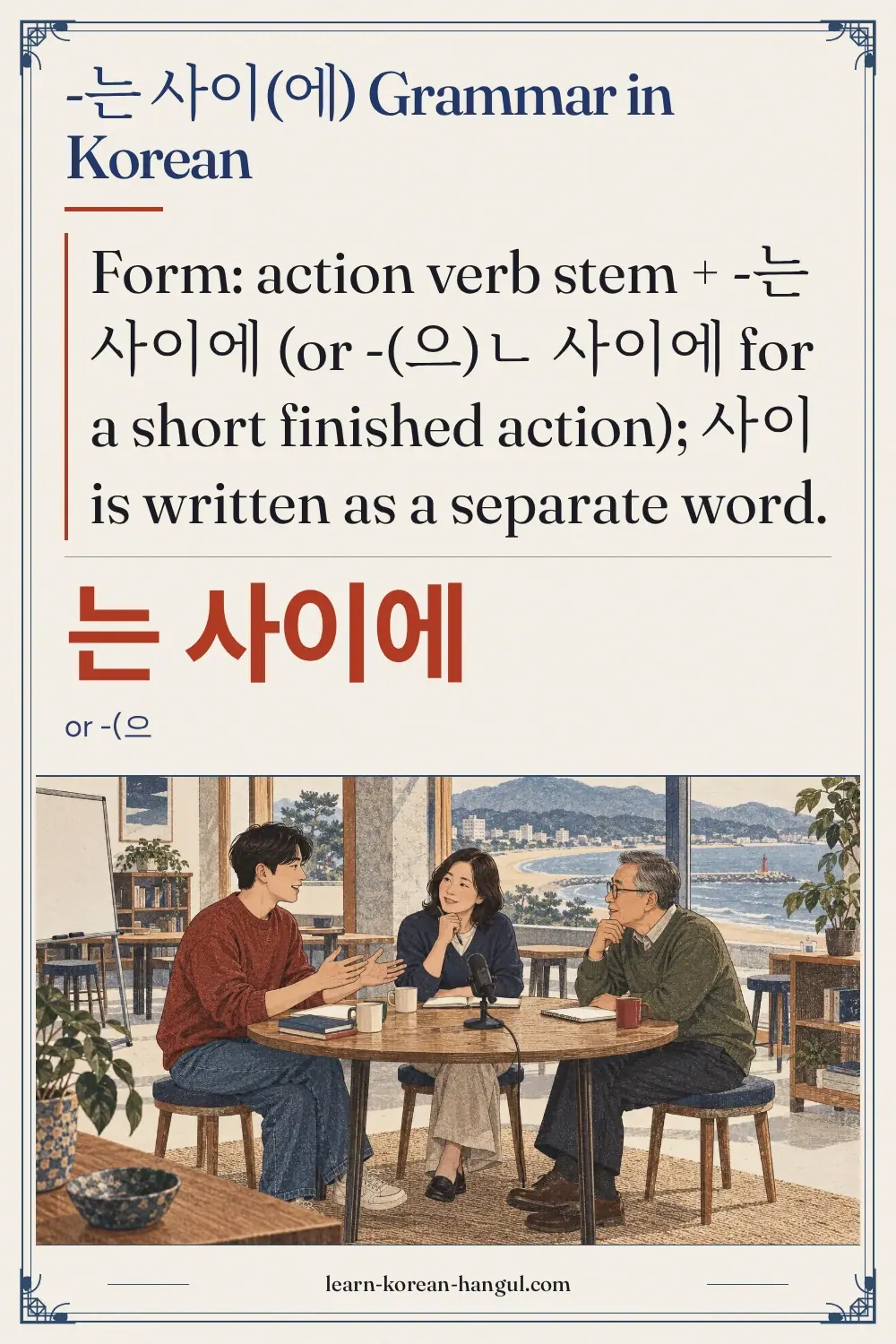
Before you start: you should know how to find a verb stem (the dictionary form without its final 다, such as 자 in 자다) and the noun-modifying ending -는. If you do not know it, read Noun-Modifying Forms first. It also helps to know -는 동안(에), the pattern for "during", because this lesson compares the two. Estimated time: 15 minutes.
What Does -는 사이(에) Grammar Mean?
-는 사이(에) grammar means "while" or "in the meantime", with the idea of a gap. It tells the listener that something happened in the interval while another action was going on. In 내가 자는 사이에 비가 왔어요, the speaker was asleep and so did not see the rain start. The pattern works like a connective ending (연결 어미, yeongyeol eomi), a form that links one clause to the next, although it is built from the modifier -는 plus the noun 사이.
The word 사이 (sai) is a noun meaning "gap, interval, space between". The phrase -는 사이에 literally says "in the gap of the doing". The particle 에 marks the point in time, and in speech it is often dropped: 내가 자는 사이 비가 왔어요. Both versions are fine.
Two ideas make this pattern different from other "while" patterns. The first is the gap: the first clause names an activity that took up some time, and the second clause names an event that slipped into it. The second is the usual feeling of surprise: the speaker did not control or even notice the second event. The two subjects are usually different, as in "I slept, and the rain came".
내가 자는 사이에 비가 왔어요.
naega janeun saie biga wasseoyo.
It rained while I slept.
잠깐 자리를 비운 사이에 일이 생겼어요.
jamkkan jarireul biun saie iri saenggyeosseoyo.
Something happened while I stepped away for a moment.
아이가 자는 사이에 청소했어요.
aiga janeun saie cheongsohaesseoyo.
I cleaned while the child slept.
The first verb in the first and third examples ends in the modifier -는. The second example uses -ㄴ, because the speaker's step away was a short, finished action. The next section shows how to build the form on every kind of verb.
How Do You Form -는 사이(에)?
You form -는 사이(에) by adding the modifier -는 to the verb stem and then writing 사이에 as a separate word. The ending is the same for every stem, so you never choose between -는 and -은. For a short, finished action, use -(으)ㄴ instead.
| Verb | Dictionary form | With -는 사이에 | Sound | Revised Romanization |
|---|---|---|---|---|
| Vowel stem | 가다 | 가는 사이에 | [가는 사이에] | ganeun saie |
| Vowel stem | 자다 | 자는 사이에 | [자는 사이에] | janeun saie |
| Vowel stem | 하다 | 하는 사이에 | [하는 사이에] | haneun saie |
| Consonant stem | 먹다 | 먹는 사이에 | [멍는 사이에] | meongneun saie |
| Consonant stem | 읽다 | 읽는 사이에 | [잉는 사이에] | ingneun saie |
| ㄹ stem | 놀다 | 노는 사이에 | [노는 사이에] | noneun saie |
| ㄷ stem | 듣다 | 듣는 사이에 | [든는 사이에] | deunneun saie |
| ㅂ stem | 돕다 | 돕는 사이에 | [돔는 사이에] | domneun saie |
| 있다 / 없다 | 없다 | 없는 사이에 | [엄는 사이에] | eomneun saie |
| Finished action | 비우다 | 비운 사이에 | [비운 사이에] | biun saie |
Revised Romanization (RR, the official Latin spelling) follows the sounds of the words and writes sound changes between letters, such as meongneun for 먹는. It does not show tensing caused by a neighbouring sound. Words separated by a space are romanized separately, so 사이에 is always saie.
Stems Ending in a Vowel
Add 는 directly to the stem and say it as written: 가는 사이에, 자는 사이에, 오는 사이에, 하는 사이에. There is no sound change. The word 사이에 is said [사이에], with each syllable clear.
Stems Ending in a Consonant
Add 는 after the final consonant. The final consonant and the ㄴ of 는 meet, and the stem consonant changes to match, as in 먹는 [멍는] and 읽는 [잉는]. The Standard Pronunciation Rules (표준 발음법, Article 18) call this nasalization: ㄱ, ㄷ and ㅂ become ㅇ, ㄴ and ㅁ before ㄴ or ㅁ. That is why 듣는 is said [든는] and 돕는 is said [돔는]. The word 사이에 stays plain after -는 and -ㄴ, because only the ending -ㄹ makes the next consonant tense.
Irregular Stems, 있다/없다 and Nouns
Irregular verbs follow the usual rules of the modifier. ㄹ stems drop the ㄹ before ㄴ: 놀다 gives 노는 사이에, not 놀는 사이에. ㄷ stems turn ㄷ into ㄹ before a vowel, so a finished action is 들은 사이에. ㅂ stems change ㅂ to 우: 돕다 gives 도운 사이에 for a finished action.
The words 있다 and 없다 take -는, as in 집에 없는 사이에 ("while I was not home"). Adjectives do not take this pattern, because it needs an activity that fills a stretch of time.
After a noun, 사이에 means "between" or "in the space between", not "while". 학교와 집 사이에 공원이 있어요 means "There is a park between the school and the house". Time words work too: 그 사이에 means "in the meantime", and 며칠 사이에 means "within a few days". Next, here is one full sentence built step by step.
Worked Example: Building a Sentence with -는 사이(에)
You build the sentence in five steps, working from the activity and the event that slipped into it. This example makes "A parcel arrived while I was showering".
- Write both events with their dictionary verbs. 샤워하다 and 택배가 오다.
- Decide which one is the activity and which is the event. The shower fills the time, so it goes into the 사이에 clause. The parcel is the event.
- Find the stem of the first verb. Remove 다 from 샤워하다. The stem is 샤워하.
- Add -는 사이에. 샤워하 + 는 사이에 = 샤워하는 사이에. Add the subject: 내가 샤워하는 사이에.
- Give the last verb its tense and politeness. 오다 becomes the polite past 왔어요. Put the clause first: 내가 샤워하는 사이에 택배가 왔어요.
Sentence
A parcel arrived while I was showering.
Show answer
내가 샤워하는 사이에 택배가 왔어요
Checkpoint. You have it when you can change the time without touching 샤워하는 사이에. The answer is 내가 샤워하는 사이에 택배가 올 거예요, "A parcel will arrive while I am showering". Only the last verb changes.
The sentence built here is a statement. The next section shows which tenses and sentence types can follow -는 사이(에).
Which Tenses and Sentence Types Work with -는 사이(에)?
The last verb can have any tense, and the verb before 사이에 uses -는 for an ongoing activity or -(으)ㄴ for a short, finished one. It never takes the past ending -았/었-. The time is read from the final verb.
| Feature | Where it goes | Example |
|---|---|---|
| Past event | final verb | 내가 자는 사이에 비가 왔어요. |
| Future | final verb | 아이가 자는 사이에 청소할 거예요. |
| Request or suggestion | final verb | 아이가 자는 사이에 청소하세요. |
| Short finished action | -(으)ㄴ before 사이에 | 잠깐 자리를 비운 사이에 일이 생겼어요. |
| Different subjects | usual | 내가 자는 사이에 비가 왔어요. |
| Past ending in the first clause | not allowed | 잤는 사이에 is wrong |
| Adjective in the first clause | not allowed | 예쁜 사이에 is wrong |
The usual meaning is that an event slipped into the gap, but the pattern can also be used on purpose to say that someone took advantage of the gap. 아이가 자는 사이에 청소하세요 means "Clean while the child is asleep".
Next comes the pattern that learners confuse with -는 사이(에) most often.
How Is -는 사이(에) Different from -는 동안(에)?
-는 사이(에) points to a gap in which something slipped in, while -는 동안(에) describes a whole period. 동안 is the neutral word for "during" or "for": it works with durations and with two actions that run side by side. 사이 adds the idea of a gap, often with surprise. The lesson on -는 동안(에) gives the full rules.
Compare 제가 자는 동안 비가 왔어요 and 제가 자는 사이에 비가 왔어요. Both say "It rained while I slept". The second stresses that the rain came in the gap of my sleep, and I missed it. The first only says the rain fell during that period. The biggest difference is with measured time: 두 시간 동안 공부했어요 ("I studied for two hours") needs 동안. 두 시간 사이에 would not work, because 사이 is not a way to count how long.
-는 사이(에)
in the gap while: often unnoticed
-는 동안(에)
during, for: a period
| Comparison | -는 사이(에) | -는 동안(에) |
|---|---|---|
| Main idea | a gap with a surprise | a period of time |
| Example | 제가 자는 사이에 비가 왔어요. | 제가 자는 동안 비가 왔어요. |
| Measured time (two hours) | not possible | 두 시간 동안 |
| Level | B2 | B1 |
Use -는 사이(에) when something slips into a gap; use -는 동안(에) for a period or a measured length of time.
A quick test: if you could add "without noticing" or "before I knew it" to the English, 사이 fits. If you could add "for" and a number of hours, use 동안. Next are the useful variations of the pattern.
Variations and Edge Cases of -는 사이(에)
-는 사이(에) has four useful variations: set phrases for "without realizing", the noun use, the "meanwhile" use and the look-alike meaning "relationship".
- Without realizing. The phrase 모르는 사이에 means "without knowing", and 나도 모르는 사이에 means "without my realizing it". 모르는 사이에 키가 컸어요 means "He grew taller without my noticing".
- In a blink. 눈 깜짝할 사이에 means "in the blink of an eye": 눈 깜짝할 사이에 사라졌어요. Here -(으)ㄹ makes the ㅅ of 사이 tense, so it is said [싸이에].
- Meanwhile and between. 그 사이에 means "in the meantime": 그 사이에 저는 커피를 샀어요. After a noun, 사이에 means "between": 학교와 집 사이에.
- Relationship. 사이 can also mean the relationship between two people: 두 사람은 친한 사이예요 means "The two are close". This is a noun use, not the connector.
모르는 사이에 키가 컸어요.
moreuneun saie kiga keosseoyo.
He grew taller without my noticing.
집에 아무도 없는 사이에 도둑이 들었어요.
jibe amudo eomneun saie dogugi deureosseoyo.
A thief got in while nobody was home.
For more neighbours of this pattern, see Time and Sequence. A pattern for two actions at once is -(으)면서. Next are the errors that appear most often.
What Mistakes Do Learners Make with -는 사이(에)?

Learners make five common mistakes with -는 사이(에).
- Putting a past ending in the first clause. Learners write 제가 잤는 사이에 비가 왔어요. Actually the first verb takes -는 for an ongoing action or -(으)ㄴ for a short finished one. The final verb shows the tense.
- Using it for a long period. Learners write 방학 사이에 한국어를 공부했어요. Actually 사이 is not for counting time or naming a period. Say 방학 동안 한국어를 공부했어요.
- Using it for two actions done together. Learners write 음악을 듣는 사이에 공부해요. Actually the pattern needs a second event that slipped into a gap. For two actions at once, use -(으)면서: 음악을 들으면서 공부해요.
- Using one subject for both clauses. Learners write 제가 자는 사이에 제가 꿈을 꿨어요. Actually the pattern normally has two different subjects. For one subject, use 동안 or -(으)면서.
- Leaving out the space. Learners write 자는사이에. Actually 사이 is a separate word after the modifier, so write 자는 사이에.
Whenever you reach for "while", check whether you mean a gap or a period. Now test yourself.
Practice and Answers
These four exercises check the main skills: joining events, repairing a mistake and choosing the right word. Try each one before you read the answers.
Practice · 5
How do you say "while someone sleeps" with 자다 and 사이에?
Show answer
자는 사이에
The stem 자 takes -는 before 사이에. No past ending is added.
Which sentence is correct for "I studied for three hours"?
Show answer
세 시간 동안 공부했어요.
A measured length of time needs 동안. 사이 names a gap, not a number of hours.
Which sentence is wrong?
Show answer
친구가 잤는 사이에 비가 왔어요.
The first verb cannot take a past ending. The correct form is 친구가 자는 사이에.
How is 먹는 사이에 pronounced?
Show answer
[멍는 사이에]
The final ㄱ of 먹 becomes ㅇ before the ㄴ of 는, so the phrase is said [멍는 사이에].
Which sentence means "There is a park between the school and the house"?
Show answer
학교와 집 사이에 공원이 있어요.
After nouns, 사이에 means "between". The other words do not mean "between".
Exercise 1: Join the events. Make one sentence with -는 사이에: 아이가 자다 + 청소하다. ("The child sleeps" and "I clean".) Use the polite past.
Exercise 2: Fix the error. A learner writes 제가 잤는 사이에 비가 왔어요. Correct it.
Exercise 3: Choose the right word. You want to say "I studied for two hours". Is 사이에 right, or 동안?
Exercise 4: Translate. "The cat ate the fish while I was not home." (cat = 고양이, fish = 생선)
Answer Key
- Exercise 1: 아이가 자는 사이에 청소했어요. [아이가 자는 사이에 청소해써요] The first verb 자 takes -는, and 청소했어요 carries the tense.
- Exercise 2: 제가 자는 사이에 비가 왔어요. [제가 자는 사이에 비가 와써요] The first verb loses its past ending.
- Exercise 3: 동안. The sentence is 두 시간 동안 공부했어요 [두 시간 동안 공부해써요]. 사이 cannot measure a length of time.
- Exercise 4: 집에 없는 사이에 고양이가 생선을 먹었어요. [지베 엄는 사이에 고양이가 생서늘 머거써요] 없다 takes -는, and the subjects differ.
If you missed Exercise 1 or 2, return to the five building steps. If you missed Exercise 3, reread the section on -는 동안(에). Next, plan where to go from here.
What Should You Learn Next after -는 사이(에) Grammar?
The best next lesson is -았/었더니, which also reports what happened after the speaker did something, and often shows a result that the speaker discovered. Then review -는 동안(에) to keep "gap" and "period" apart. The full set of timing patterns is on Time and Sequence. To see where -는 사이(에) sits in a study plan, use the Advanced Grammar list. The modifier forms used here are explained in Noun-Modifying Forms.
What this lesson does not cover. It does not cover the future form -(으)ㄹ 사이에, the many idioms built on 사이, or 사이 in compounds such as 사이좋다. The level given here, B2, is an editorial estimate based on common textbook order and TOPIK II, not an official grading.
In short, -는 사이(에) grammar attaches to an action verb stem, keeps the first clause free of a past ending, and says that something happened in the gap while the first action went on.
Frequently Asked Questions
What does -는 사이(에) mean? -는 사이(에) means "while" or "in the meantime", with the idea of a gap. It says that something happened in the interval while another action was going on, often without the speaker noticing. 내가 자는 사이에 비가 왔어요 means "It rained while I slept". The second event usually has a different subject from the first.
How do I attach -는 사이(에) to a verb? Remove 다 from an action verb and add -는 사이에 to the stem, with 사이에 as a separate word: 자다 becomes 자는 사이에, 먹다 becomes 먹는 사이에. Stems ending in ㄹ drop it (놀다 gives 노는 사이에). For a short finished action, use -(으)ㄴ: 비우다 gives 비운 사이에. Adjectives do not take this pattern.
Can -는 사이(에) be used in the past tense? The verb before 사이에 never takes the past ending -았/었-. It uses -는 for an ongoing action or -(으)ㄴ for a short finished one. The final verb shows the tense. Say 내가 자는 사이에 비가 왔어요, not 잤는 사이에. For a future event, put the future on the last verb: 아이가 자는 사이에 청소할 거예요.
Is -는 사이(에) used in speech or only in writing? It is used in both and is neutral in tone. In speech, people often drop 에 and say 내가 자는 사이 비가 왔어요. Set phrases such as 나도 모르는 사이에 ("without my realizing it") and 그 사이에 ("in the meantime") are common in stories, messages and everyday talk, so they are worth learning early.
What is the most common mistake with -는 사이(에)? Learners use it for a measured period, such as 세 시간 사이에, or for two actions done together. 사이 names a gap that something slips into, so use 동안 for a period of time and -(으)면서 for two simultaneous actions. Another mistake is a past ending before 사이에, as in 잤는 사이에.
What is the difference between -는 사이(에) and -는 동안(에)? -는 동안(에) describes a period of time, so it works with hours and with two parallel actions. -는 사이(에) points to a gap in which something happened, often unnoticed. Compare 제가 자는 동안 비가 왔어요 with 제가 자는 사이에 비가 왔어요. The second stresses that I missed it. For "two hours", use 두 시간 동안.