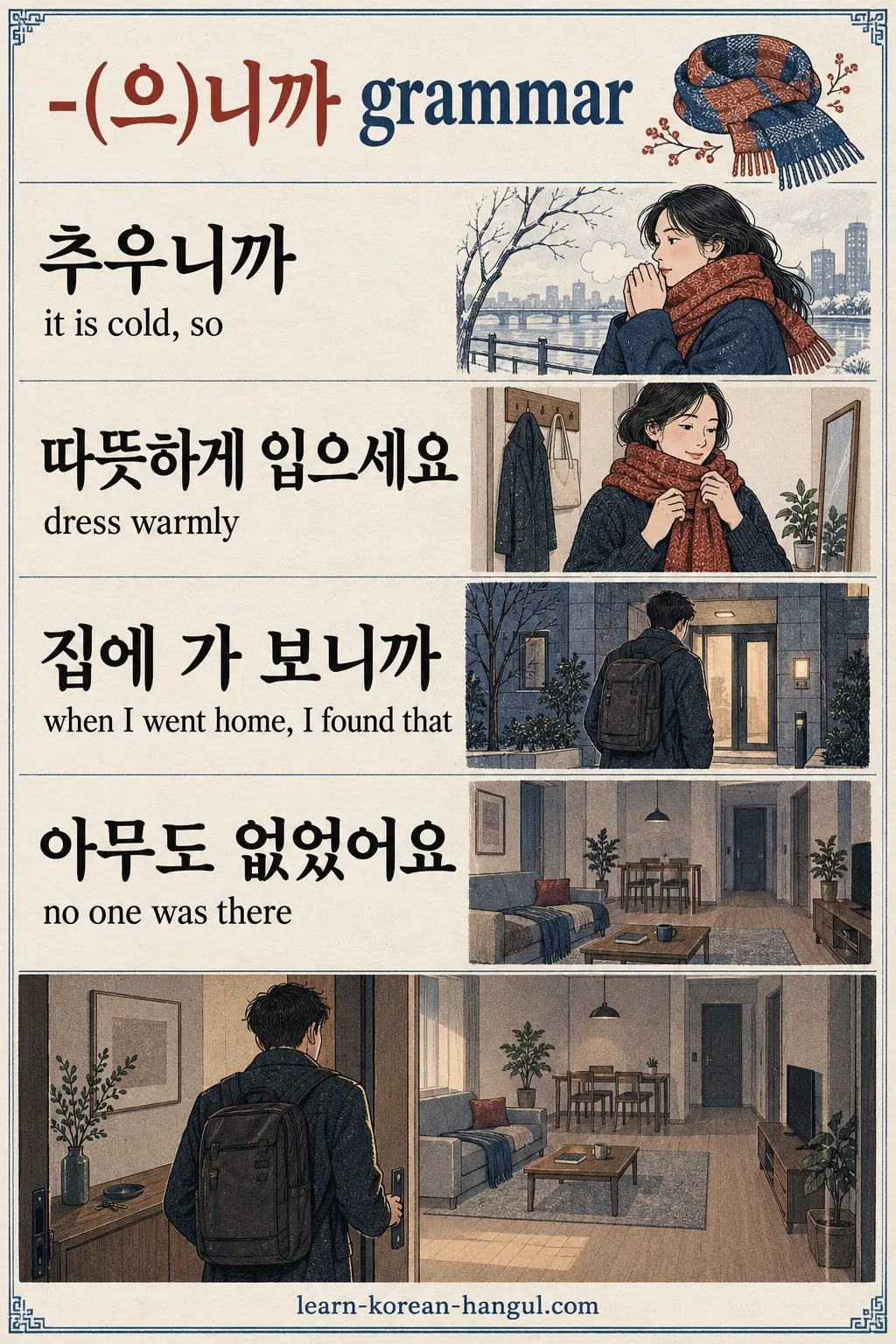
What you'll learn
- Attach -(으)니까 to a vowel stem, a consonant stem, a ㄹ stem and an irregular stem.
- Use it before a command or a suggestion, which -아/어서 cannot do.
- Read the discovery meaning in 가 보니까.
- Choose between -(으)니까, -아/어서 and -기 때문에.
Prerequisites: the polite ending -아요/어요 and the past tense -았/었-. Time: about 15 minutes.
Listen to two model sentences.
The next section defines the pattern.
What Does -(으)니까 Grammar Mean?

-(으)니까 means "because" or "since". A connective ending is a word ending that joins one clause to the next. -(으)니까 tells the listener, "Here is my reason, and you can see it too." The reason is usually something both people know: the weather, the time, a fact in front of you.
That shared view of the reason is the heart of this ending. The speaker is not announcing news. The speaker is pointing at something obvious and drawing a conclusion from it. This is why the clause after -(으)니까 can be a command, a suggestion or a question.
Here are two glossed examples.
| Part | 추우니까 따뜻하게 입으세요. | 집에 가 보니까 아무도 없었어요. |
|---|---|---|
| First clause | 추우니까 (it is cold, so) | 집에 가 보니까 (when I went home, I found that) |
| Second clause | 따뜻하게 입으세요 (dress warmly) | 아무도 없었어요 (no one was there) |
| Spoken | [추우니까 따뜨타게 이브세요] | [지베 가 보니까 아무도 업써써요] |
| RR (aid) | chuunikka ttatteutage ibeuseyo | jibe ga bonikka amudo eopseosseoyo |
| English | It is cold, so dress warmly. | When I went home, no one was there. |
The second sentence shows the second meaning. After -아/어 보다 ("try doing"), -(으)니까 does not give a reason. It marks a discovery: "I did X, and then I found Y." The second clause is a fact the speaker has just learned, so it is always a statement.
The next section shows how to build the form.
How Do You Form -(으)니까?
Remove 다 from the dictionary form to get the stem. The stem of 먹다 is 먹. Then look at the last sound of the stem.
- If the stem ends in a vowel, add 니까: 가 + 니까 = 가니까.
- If the stem ends in a consonant, add 으니까: 먹 + 으니까 = 먹으니까.
- If the stem ends in ㄹ, drop the ㄹ and add 니까: 살 + 니까 = 사니까.
The 으 is a helping vowel. It keeps two consonants from colliding, so it appears only after a final consonant.
| Dictionary form | Stem | Stem + -(으)니까 | Spoken | RR (aid) |
|---|---|---|---|---|
| 가다 (go) | 가 | 가니까 | [가니까] | ganikka |
| 하다 (do) | 하 | 하니까 | [하니까] | hanikka |
| 먹다 (eat) | 먹 | 먹으니까 | [머그니까] | meogeunikka |
| 읽다 (read) | 읽 | 읽으니까 | [일그니까] | ilgeunikka |
| 좋다 (be good) | 좋 | 좋으니까 | [조으니까] | joeunikka |
| 있다 (exist, have) | 있 | 있으니까 | [이쓰니까] | isseunikka |
| 살다 (live) | 살 | 사니까 | [사니까] | sanikka |
| 만들다 (make) | 만들 | 만드니까 | [만드니까] | mandeunikka |
Three details hide in this table. First, the ㅎ of 좋 is silent before a vowel, so 좋으니까 sounds like [조으니까]. Second, 있으니까 sounds like [이쓰니까] because ㅆ moves over to the next syllable. Third, the stems 살 and 만들 lose their ㄹ. This ㄹ drop is regular for every ㄹ stem before ㄴ, ㅂ and ㅅ.
Stems Ending in a Vowel
A vowel stem takes 니까 with no helping vowel: 가니까, 오니까, 하니까, 바쁘니까. There is no contraction. Compare this with -아/어서, where 가 + 아서 becomes 가서. With -(으)니까 the stem stays whole.
For 하다 verbs and adjectives, write 하니까: 피곤하니까 ("because I am tired"), 공부하니까 ("because I study").
Stems Ending in a Consonant
A consonant stem takes 으니까: 먹으니까, 읽으니까, 많으니까, 있으니까. Say the 으 clearly, because it is what links the stem to 니까. Spoken Korean joins the final consonant to the vowel, so 먹으니까 sounds like [머그니까].
Irregular Stems and Nouns
An irregular stem is one that changes its shape in some endings. The ㅂ-irregular and ㄷ-irregular stems change before 으니까, because that ending begins with a vowel. The 르-irregular and ㅡ stems do not change, because their change happens only before 아/어.
| Type | Dictionary form | With -(으)니까 | Note |
|---|---|---|---|
| ㅂ-irregular | 춥다 (be cold) | 추우니까 | ㅂ becomes 우; compare 추워요 |
| ㅂ-irregular | 덥다 (be hot) | 더우니까 | same pattern |
| ㄷ-irregular | 듣다 (listen) | 들으니까 [드르니까] | ㄷ becomes ㄹ; compare 들어요 |
| 르-irregular | 모르다 (not know) | 모르니까 | 르 stays; the change happens only before 아/어 |
| ㅡ stem | 아프다 (be sick) | 아프니까 | ㅡ stays; compare 아파요 |
| ㄹ stem | 알다 (know) | 아니까 | ㄹ drops before ㄴ |
Compare 몰라요 and 아파요 with 모르니까 and 아프니까. The stems stay whole before 니까, because 니까 begins with a consonant.
For nouns, use 이다 ("to be"). After a consonant, add 이니까. After a vowel, 이 may drop.
| Noun | With -(이)니까 | Meaning |
|---|---|---|
| 일요일 (Sunday) | 일요일이니까 [이료이리니까] | because it is Sunday |
| 의사 (doctor) | 의사니까 or 의사이니까 | because I am a doctor |
| 아니다 (is not) | 아니니까 | because it is not |
The next section builds a full sentence.
Worked Example: Building 추우니까 따뜻하게 입으세요

Say "It is cold, so dress warmly." Follow five steps.
- Write the reason. The word is 춥다, "be cold".
- Find the stem. Remove 다 to get 춥.
- Check the last sound. ㅂ is a consonant, and 춥다 is a ㅂ-irregular adjective. ㅂ becomes 우 before a vowel, so the stem turns into 추우.
- Add 니까. 추우 ends in a vowel, so the ending is 니까: 추우니까.
- Add the main clause. 따뜻하게 입으세요 means "dress warmly". The polite command ending 세요 appears only once, at the end.
You'll know it worked when the first part ends in 니까 with no speech-level ending inside it. Try the same steps with "It is Sunday, so we are closed": 일요일 + 이니까 gives 일요일이니까, and 쉬어요 follows.
Sentence
It is cold, so dress warmly.
Show answer
추우니까 따뜻하게 입으세요
The next section covers tense and sentence types.
Which Tenses and Sentence Types Work with -(으)니까?

-(으)니까 is flexible. It accepts tense markers inside the clause, and it accepts every sentence type after it. That makes it the main reason ending for giving advice.
| Slot | Form | Example | English |
|---|---|---|---|
| Past before 니까 | stem + 았/었 + 으니까 | 먹었으니까 [머거쓰니까] | because I ate |
| Past with 하다 | 했 + 으니까 | 피곤했으니까 | because I was tired |
| Guess before 니까 | stem + 겠 + 으니까 | 비가 오겠으니까 | because it will probably rain |
| Honorific before 니까 | stem + (으)시 + 니까 | 주무시니까 | because he or she is sleeping |
| Statement after | any style | 시간이 없으니까 택시를 타요. | There is no time, so I take a taxi. |
| Question after | rising for yes/no | 피곤하니까 일찍 잘래요? | You are tired, so shall we sleep early? |
| Command after | 세요, 으세요 | 추우니까 따뜻하게 입으세요. | It is cold, so dress warmly. |
| Suggestion after | ㅂ시다, 아요/어요 | 시간이 없으니까 빨리 갑시다. | There is no time, so let's hurry. |
Look at the past forms. The past marker 았/었 comes first, and 으니까 follows it. Because 았/었 ends in a consonant, the helping 으 appears: 먹었으니까, 갔으니까, 늦었으니까. This is a common slip for learners who expect the vowel rule to stop at the stem. The past tense itself has its own page: past tense -았/었-.
For a future reason, Korean speakers often use -(으)ㄹ 테니까 instead of 겠으니까: 비가 올 테니까 우산을 가져가세요 means "It will probably rain, so take an umbrella."
Yes/no questions end with a rise: 피곤하니까 일찍 잘래요? A wh-question puts the stress on the question word and often ends with a fall or a rise-fall, rather than a sharp rise: 날씨가 추우니까 뭐 입을 거예요? means "It is cold, so what will you wear?"
The honorific 시 goes before the ending when the subject deserves respect: 아버지가 주무시니까 조용히 하세요 means "Father is sleeping, so please be quiet."
The next section compares -(으)니까 with its neighbours.
How Is -(으)니까 Different from -아/어서?
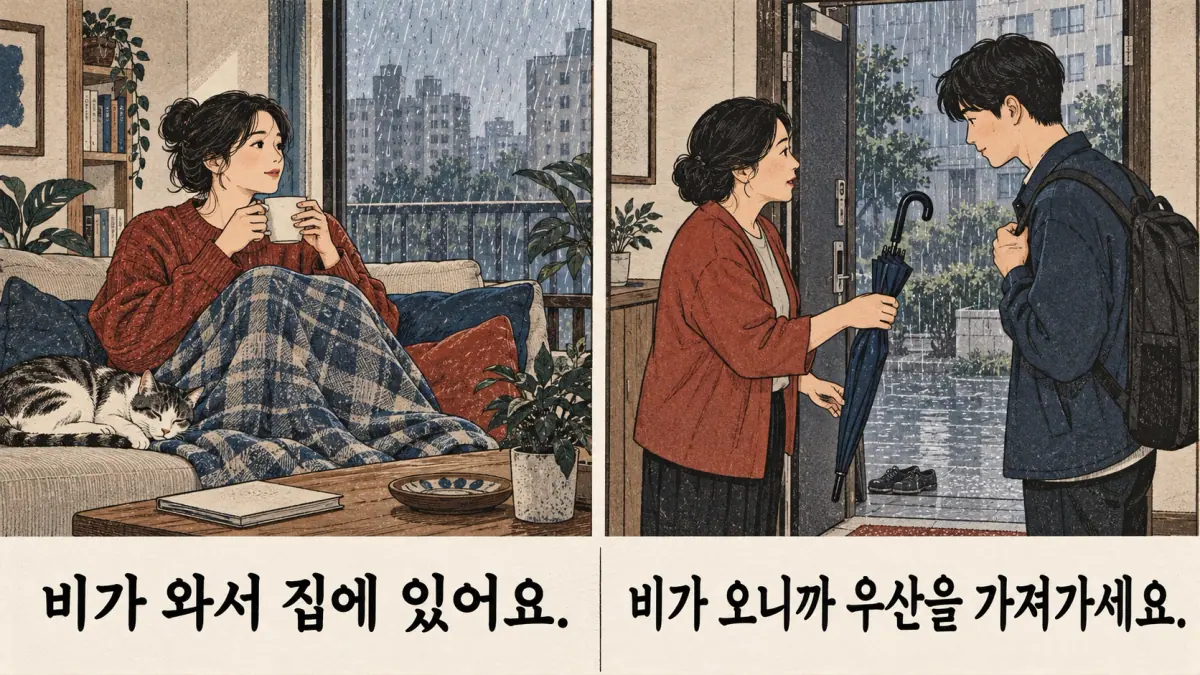
Both are translated as "because" or "so", and learners mix them up. The difference is who owns the reason and what may follow.
| Feature | -아/어서 | -(으)니까 | -기 때문에 |
|---|---|---|---|
| Core idea | a neutral cause and result | the speaker's visible reason | a firm, stated reason |
| Command after | not allowed | allowed | not allowed |
| Suggestion after | not allowed | allowed | not allowed |
| Tense marker inside | not allowed | allowed | allowed |
| Thanks and apology | natural | not natural | not natural |
| Example | 비가 와서 집에 있어요. | 비가 오니까 우산을 가져가세요. | 비가 오기 때문에 취소했어요. |
Compare these two pairs.
- 비가 와서 집에 있어요. ("It rains, so I stay home.") A plain cause and result.
- 비가 오니까 집에 있으세요. ("It is raining, so please stay home.") The speaker gives advice, so a command is possible.
Now the second pair, with thanks.
- 도와주셔서 감사합니다. ("Thank you for helping me.") Correct. Thanks always uses -아/어서.
- 도와주시니까 감사합니다. This sounds odd, as if you were giving a reason for being thankful instead of thanking.
A good test is to ask whether you want the listener to do something. If yes, use -(으)니까. If you only describe a cause and its result, -아/어서 is the neutral choice. For a longer comparison with practice, see -아/어서 vs -(으)니까 and -(으)니까 vs -기 때문에. The lessons for the neighbouring patterns are -아/어서 and -기 때문에.
The next section covers set phrases and edge cases.
Variations and Edge Cases of -(으)니까

The Discovery Use
After -아/어 보다 ("try doing"), -(으)니까 means "when I did X, I found Y." The finding is a statement of fact, and a command never follows it.
| Sentence | Meaning |
|---|---|
| 집에 가 보니까 아무도 없었어요. | When I went home, no one was there. |
| 문을 열어 보니까 비가 오고 있었어요. [무늘 여러 보니까] | When I opened the door, it was raining. |
| 먹어 보니까 맛있었어요. | When I tried it, it tasted good. |
This meaning is tied to the structure "verb + 아/어 보니까". It is not a reason. Think of it as a short scene: the speaker does something, and the result surprises them.
The Short Answer: -(으)니까요
Adding 요 lets the clause stand alone. It is the natural way to answer a question that asks "why". 왜 안 가요? 비가 오니까요. means "Why aren't you going? Because it is raining." The speaker offers the reason as something the listener could see too.
Set Phrases
그러니까 is a common connector at the start of a sentence. It means "so" or "therefore" and often introduces a conclusion: 그러니까 일찍 가세요 ("So please go early"). 그러니까요 is a short reply meaning "Exactly" or "I know, right?".
Other Forms
The older, written style uses -(으)므로 for reasons. In ordinary speech, learners do not need it yet. For a firm written reason, see the lesson on -기 때문에.
The next section lists the mistakes that appear most often.
What Mistakes Do Learners Make with -(으)니까?
Learners make seven predictable mistakes. Each has a reason and a fix.
Learners often use -아/어서 before a command. Actually only -(으)니까 allows a command. Wrong: 비가 와서 우산을 가져가세요. Right: 비가 오니까 우산을 가져가세요. Fix: if the main clause is a command or a suggestion, use -(으)니까.
Learners often keep the ㄹ of a ㄹ stem. Wrong: 살으니까 and 놀으니까. Right: 사니까 and 노니까. Fix: drop the ㄹ and add 니까.
Learners often forget the ㅂ change. Wrong: 춥으니까. Right: 추우니까. Fix: ㅂ-irregular stems become 우 before a vowel.
Learners often add 으 after a vowel. Wrong: 가으니까 and 하으니까. Right: 가니까 and 하니까. Fix: use 으 only after a final consonant.
Learners often use -(으)니까 for thanks or apology. Wrong: 늦으니까 죄송합니다. Right: 늦어서 죄송합니다. Fix: for thanks and apologies, use -아/어서.
Learners often drop 이 from a noun after a consonant. Wrong: 일요일니까. Right: 일요일이니까. Fix: after a consonant, keep 이. After a vowel, 이 can drop: 의사니까.
Learners often read the discovery meaning as a reason. 집에 가 보니까 아무도 없었어요 does not mean "Because I went home, no one was there." Fix: when you see 아/어 보니까, read it as "when I tried".
The next section gives you practice.
Practice and Answers
Do the four tasks, then compare with the key.
Task 1: join the sentences with -(으)니까. Write one sentence for each pair.
- 춥다 / 따뜻하게 입으세요.
- 시간이 없다 / 빨리 갑시다.
- 일요일이다 / 회사에 안 가요.
- 서울에 살다 / 지하철이 편해요.
Task 2: fix the error. Each sentence has one mistake. Rewrite it correctly.
- 비가 와서 우산을 가져가세요.
- 날씨가 춥으니까 모자를 쓰세요.
- 늦으니까 죄송합니다.
Task 3: translate. Write in Korean: "It is late, so let's go home." and "When I looked it up, it was cheap."
Task 4: write your own. Write one sentence that gives advice using the weather, and one that describes a discovery with 보니까.
Practice · 5
Which form of 살다 (live) means "because I live..."?
Show answer
사니까
A final ㄹ drops before ㄴ, so 살 + 니까 becomes 사니까. Never add 으 after ㄹ.
How do you say "because it is cold" with 춥다?
Show answer
추우니까
춥다 is a ㅂ-irregular adjective. The ㅂ changes to 우 before a vowel, so 춥 + 으니까 becomes 추우니까.
Which sentence is correct?
Show answer
배가 고프니까 드세요.
A command needs -(으)니까. -아/어서 cannot be followed by a command or a suggestion.
What does 문을 열어 보니까 비가 오고 있었어요 mean?
Show answer
When I opened the door, it was raining.
After -아/어 보다, -(으)니까 marks a discovery. The second clause is something the speaker found out, and it is always a fact in the past or present.
Which is the correct noun form?
Show answer
일요일이니까
A noun needs 이다 before the ending. 일요일 + 이니까 gives 일요일이니까, "because it is Sunday".
Answer key
- (1) 추우니까 따뜻하게 입으세요. (2) 시간이 없으니까 빨리 갑시다. (3) 일요일이니까 회사에 안 가요. (4) 서울에 사니까 지하철이 편해요.
- (1) 비가 오니까 우산을 가져가세요. (2) 날씨가 추우니까 모자를 쓰세요. (3) 늦어서 죄송합니다.
- 늦었으니까 집에 가요. 찾아보니까 쌌어요. Other correct versions exist, for example 늦었으니까 집에 갑시다.
- Sample answers: 비가 오니까 우산을 가져가세요. 먹어 보니까 맛있었어요. Any pair is correct if the first verb ends in 니까 or 으니까 and the discovery sentence uses 아/어 보니까.
If task 1 was correct, you have the formation rule. If task 2 was hard, check whether the main clause is a command and whether the stem changed. The next section points you to what comes after this lesson.
What Should You Learn after -(으)니까 Grammar?
After -(으)니까, learn -기 때문에, the firmer and more formal "because". Then read the lesson on -아/어서 if you have not yet, because the two endings are used together in daily speech.
For a wider view, the parent page Cause and Reason lists every connector in this group. To plan by level, use Beginner Grammar.
This lesson covers -(으)니까 in the polite and casual styles. It does not cover every written variation. About this page. Last updated 2026-10-09. Revised Romanization follows the national rules and is shown only as a learning aid.
Frequently Asked Questions
What Does -(으)니까 Mean?
-(으)니까 means "because" or "since". It gives a reason that the speaker and the listener can both see, such as the weather. 추우니까 따뜻하게 입으세요 means "It is cold, so dress warmly." After -아/어 보다, it also means "when I tried it, I found out": 가 보니까 아무도 없었어요.
How Do I Attach -(으)니까 to a Verb or Adjective?
Take the stem, which is the dictionary form without 다. After a vowel or ㄹ, add 니까: 가니까, 사니까. After a final consonant, add 으니까: 먹으니까. The final ㄹ drops before ㄴ, so 살다 becomes 사니까. ㅂ-irregular stems turn into 우: 춥다 becomes 추우니까. For nouns, add 이니까 or 니까.
Can -(으)니까 Be Used in the past Tense?
Yes. Put 았/었 before it: 갔으니까, 먹었으니까, 늦었으니까. You can also add 겠 or the honorific 시: 바쁘시니까. Unlike -아/어서, this ending accepts tense markers inside the clause. The speech level still goes only on the last verb, for example 늦었으니까 빨리 오세요.
Is -(으)니까 Used in Speech or Only in Writing?
Mostly in speech. It is one of the most common reason endings in daily conversation, in polite and casual Korean. In writing, -기 때문에 and -(으)므로 sound more formal. With 요, as in 비가 오니까요, it works as a short answer to a why-question.
What Is the Most Common Mistake with -(으)니까?
The classic mistake is the opposite one: using -아/어서 before a command or a suggestion. 비가 와서 우산을 가져가세요 is wrong. Say 비가 오니까 우산을 가져가세요. The other frequent mistakes are keeping the ㄹ (살으니까) and forgetting the ㅂ change (춥으니까).
What Is the Difference between -(으)니까 and -아/어서?
-아/어서 links a cause to its result in a neutral way, so it cannot be followed by a command or a suggestion, and it takes no tense marker. -(으)니까 gives the speaker's own reason and allows commands, suggestions and tense markers. For thanks and apologies, use -아/어서: 늦어서 죄송합니다.