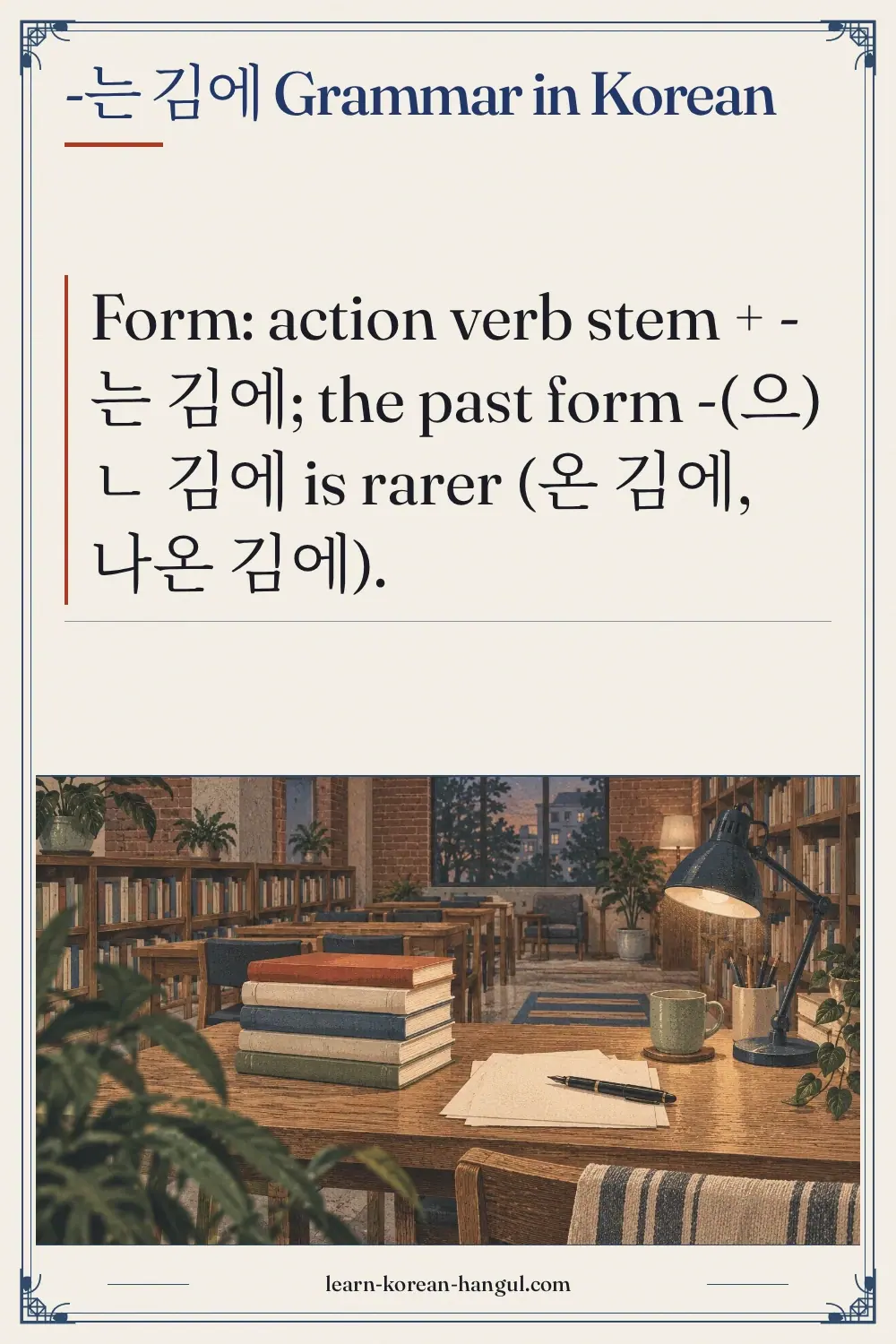
Before you start: you should know -(으)면서 ("while") and how to make polite requests with 주세요. You should also know how to find a verb stem (the dictionary form without its final 다, such as 가 in 가다). Estimated time: 15 minutes.
What Does -는 김에 Grammar Mean?
-는 김에 grammar means "while at it" or "since I am already doing this": the first action is under way, and you add a second one because the chance is there. In 서울에 가는 김에 친구도 만날 거예요, the trip to Seoul was planned anyway. The meeting is an extra that rides on the same trip. It works as a connector, a form that links one clause to the next, but it is built from a modifier ending plus a noun rather than one connective ending (연결 어미, yeongyeol eomi).
The pattern has three parts. The first is the verb stem, such as 가. The second is -는, the present modifier ending, which lets the verb describe the noun after it. The third is 김에: 김 is a dependent noun (의존 명사, a noun that cannot stand without a modifier before it) meaning "occasion" or "chance", and 에 marks the point. Together they mean "at the occasion of going". The second clause often carries 도 ("also"), which shows that it is an addition: 친구도, 창문도, 우유도.
서울에 가는 김에 친구도 만날 거예요.
seoure ganeun gime chingudo mannal geoyeyo.
Since I am going to Seoul anyway, I will meet a friend too.
청소하는 김에 창문도 닦았어요.
cheongsohaneun gime changmundo dakkasseoyo.
Since I was cleaning anyway, I wiped the windows too.
마트에 가는 김에 우유도 사 올게요.
mateue ganeun gime uyudo sa olgeyo.
Since I am going to the supermarket anyway, I will bring some milk too.
In each example the first action is real and already decided, and the second is optional. The next section shows how to build the form.
How Do You Form -는 김에?
You form -는 김에 by adding -는 to the verb stem, then 김에. There is only one version for the present, and the stem does not change, except that ㄹ stems drop their ㄹ.
| Verb | Dictionary form | With -는 김에 | Revised Romanization |
|---|---|---|---|
| Vowel stem | 가다 | 가는 김에 [가는 기메] | ganeun gime |
| Vowel stem | 나가다 | 나가는 김에 [나가는 기메] | naganeun gime |
| Consonant stem | 먹다 | 먹는 김에 [멍는 기메] | meongneun gime |
| Consonant stem | 읽다 | 읽는 김에 [잉는 기메] | ingneun gime |
| ㄹ stem | 만들다 | 만드는 김에 | mandeuneun gime |
| ㄹ stem | 놀다 | 노는 김에 | noneun gime |
| ㄷ stem | 듣다 | 듣는 김에 [든는 기메] | deunneun gime |
| ㅂ stem | 돕다 | 돕는 김에 [돔는 기메] | domneun gime |
| 하다 verb | 청소하다 | 청소하는 김에 | cheongsohaneun gime |
| Past (set phrase) | 오다 | 온 김에 [온 기메] | on gime |
| Past (set phrase) | 말이 나오다 | 말이 나온 김에 [마리 나온 기메] | mari naon gime |
Revised Romanization (RR, the official Latin spelling) is only an aid. It writes the sound changes that happen inside a word, so 먹는 is meongneun, and the linking in 김에 is shown as gime.
Stems Ending in a Vowel
Add -는 김에 straight after the vowel and say it as written: 가는 김에, 하는 김에, 청소하는 김에, 나가는 김에. There is no sound change inside the verb. The only change is in 김에, where the ㅁ links onto the vowel of 에 and the phrase is said [기메].
Stems Ending in a Consonant
Add -는 김에 after the final consonant, with no linking 으. The final consonant then meets the ㄴ of -는 and turns into a nasal sound (a sound made through the nose, such as ㅇ, ㄴ or ㅁ). The Standard Pronunciation Rules (표준 발음법, Articles 9, 11 and 18) give the pattern:
- Final ㄱ becomes ㅇ: 먹는 [멍는].
- Final ㄺ is said as ㄱ and then becomes ㅇ: 읽는 [잉는].
- Final ㄷ becomes ㄴ: 듣는 [든는].
- Final ㅂ becomes ㅁ: 돕는 [돔는].
Irregular Stems and past Forms
A ㄹ stem drops its ㄹ before -는, which is a regular rule: 만들다 becomes 만드는 김에, and 놀다 becomes 노는 김에. Other irregular stems do not change, because -는 begins with a consonant: 듣다 stays 듣는 김에 and 돕다 stays 돕는 김에.
When the first action has already happened, Korean uses the past modifier -(으)ㄴ. It appears mostly with 오다 (온 김에, "since I have come"), 나오다 and 가다: 온 김에 같이 밥 먹고 가요 means "Since you are here already, let's eat together before you go" [온 기메 가치 밤 먹꼬 가요]. 서울에 간 김에 친구를 만났어요 also works for "Since I had gone to Seoul, I met a friend". The -는 form is still the most common in daily speech.
온 김에 같이 밥 먹고 가요.
on gime gachi bap meokgo gayo.
Since you are here already, let's eat together before you go.
Next, here is one full sentence built step by step.
Worked Example: Building a Sentence with -는 김에
You build it in five steps, working from the planned action and the extra. This example makes "Since I am going to the supermarket anyway, I will buy milk too".
- Write the planned action and the extra with their dictionary verbs. 마트에 가다 and 우유도 사다.
- Decide which action is the plan. Going to the supermarket is already decided, so it goes into the -는 김에 clause.
- Find the stem of the plan verb. Remove 다 from 가다. The stem is 가.
- Add -는 김에. 가 + 는 김에 = 가는 김에, said [가는 기메].
- Give the last verb its tense and politeness. 사다 becomes the polite future 살 거예요. Put the clause first: 마트에 가는 김에 우유도 살 거예요.
Sentence
Since I am going to the supermarket anyway, I will buy milk too.
Show answer
마트에 가는 김에 우유도 살 거예요
Checkpoint. You have it when you can turn the sentence into a request without changing 가는 김에. The answer is 마트에 가는 김에 우유 좀 사다 주세요, "Since you are going to the supermarket anyway, please buy some milk for me". Only the end of the sentence changes.
The sentence built here is a statement. The next section shows which tenses and sentence types can follow -는 김에.
Which Tenses and Sentence Types Work with -는 김에?
The main verb can have any tense or sentence type, and the first clause normally keeps the -는 form. The ending carries no time of its own, so the time is read from the final verb.
| Feature | Where it goes | Example |
|---|---|---|
| Present habit | final verb | 청소하는 김에 창문도 닦아요. |
| Past | final verb | 청소하는 김에 창문도 닦았어요. |
| Future or promise | final verb | 마트에 가는 김에 우유도 사 올게요. |
| Request | final verb | 하는 김에 내 것도 해 주세요. |
| Question with a question word | final verb | 가는 김에 뭐 살 거예요? = "What will you buy while you are at it?" |
| Honorific -(으)시- | before 는 | 가시는 김에 이것도 부탁드려요. |
| First action already done | -(으)ㄴ 김에 | 온 김에 같이 먹고 가요. |
| Past ending in the first clause | not allowed | 갔는 김에 is wrong |
Requests are the most natural use. A speaker uses it to ask for a small favour that costs the other person nothing extra: 하는 김에 내 것도 해 주세요. A question that uses a question word, such as 뭐 ("what"), puts the stress on that word and does not end with a sharp rise. The honorific -(으)시- is the ending that shows respect for the subject. See honorific -(으)시- for the ending itself.
Next comes the pattern that learners confuse with -는 김에 most often.
How Is -는 김에 Different from -는 길에?
-는 김에 describes an opportunity, while -는 길에 describes a trip. The two endings look and sound alike: 김에 is said [기메] and 길에 is said [기레]. But 김 is a chance, and 길 is a road. The lesson on -는 길에 gives the full rules.
Compare two sentences. 서울에 가는 김에 친구를 만났어요 means "Since I was going to Seoul anyway, I also met a friend", and the meeting was added on purpose. 서울에 가는 길에 친구를 만났어요 means "I met a friend on the way to Seoul", and it may have been a chance meeting on the road. Only 김에 works when the first action is not a trip: 청소하는 김에 창문도 닦았어요 has no road in it.
-는 김에
since I am already doing it: any action
-는 길에
on the way to: motion verbs only
| Comparison | -는 김에 | -는 길에 |
|---|---|---|
| Idea | an opportunity | a road with a stop |
| Second action | planned extra, often with 도 | stop or event on the road |
| Example | 청소하는 김에 창문도 닦았어요. | 집에 가는 길에 빵을 샀어요. |
| Sound | [기메] | [기레] |
Use -는 김에 when you add a second action because you are already doing the first; use -는 길에 when something happens on the road of a trip.
The other neighbour is -(으)ㄹ 때, which means "when" and only points to a time. 서울에 갈 때 친구를 만났어요 says that the meeting happened at the time of the trip, with no idea of a plan. The lesson on -(으)ㄹ 때 explains that pattern. Also note that -는 김에 does not mean "at the same moment". The two actions share an occasion, but they are often done one after another.
A quick test: if you can add "while I'm at it" or "might as well" to the English, -는 김에 fits. If there is a road, use 길에. Next are the useful variations of the pattern.
Variations and Edge Cases of -는 김에
-는 김에 has three useful variations: the set phrases with -(으)ㄴ 김에, the noun-like 내친김에 and the adverb 겸사겸사.
- 말이 나온 김에. This set phrase means "since we are on the subject". It introduces a new point in a conversation.
- 내친김에. This one-word phrase means "since I have already gone this far". 내친김에 한 권 더 읽었어요 means "Having come this far, I read one more".
- 겸사겸사. This adverb means "for several purposes at once". 겸사겸사 왔어요 means "I came for a couple of reasons". It is a casual way to give the same idea without a full clause.
말이 나온 김에 하나 물어볼게요.
mari naon gime hana mureobolgeyo.
Since we are on the subject, I will ask one thing.
For more neighbours of this pattern, see Time and Sequence. Next are the errors that appear most often.
What Mistakes Do Learners Make with -는 김에?
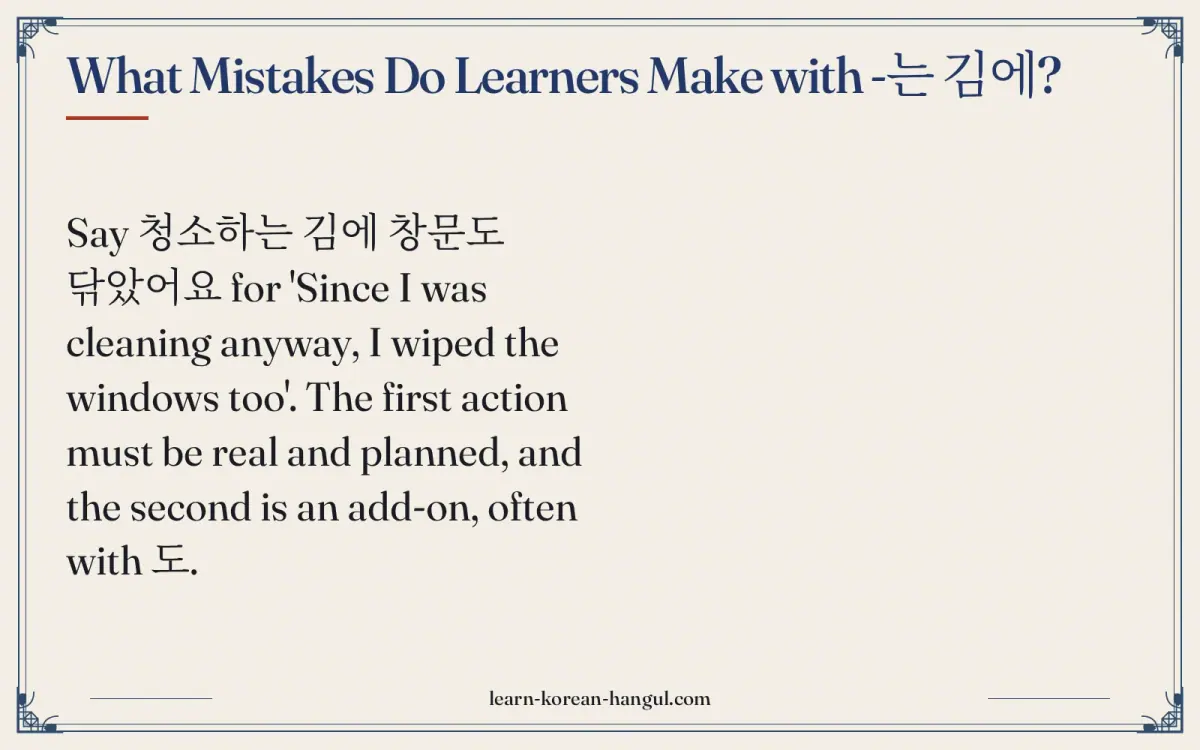
Learners make five common mistakes with -는 김에. Each one follows the pattern "learners often assume X; actually Y, because Z".
- Using it with an event that is not an action. Learners write 비가 오는 김에 우산을 샀어요. Actually the first action must be something the speaker really does. Use -아/어서 for a reason: 비가 와서 우산을 샀어요.
- Using it for two actions at the same moment. Learners write 걷는 김에 이야기해요 for "talk while walking". Actually -는 김에 adds an extra. Use -(으)면서: 걸으면서 이야기해요.
- Putting a past ending before 김에. Learners write 갔는 김에. Actually the first clause keeps 가는, or uses the past modifier 간 when the action is already done.
- Mixing up 김에 and 길에. Learners say 집에 가는 김에 for "on the way home". Actually the road idea needs 길에.
- Saying 김에 as [김에]. Learners follow the spelling. Actually the ㅁ links onto the vowel, so say [기메].
Whenever you reach for "while I'm at it", check that the first action is real and the second is an extra. Now test yourself.
Practice and Answers
These four exercises check the main skills: joining a plan and an extra, repairing a mistake and choosing the right word. Try each one before you read the answers.
Practice · 5
How do you say "while I am going to Seoul anyway" with 가다?
Show answer
가는 김에
The stem 가 takes -는 김에. The sentence then names a second action that you add.
Which phrase means "since I have come (already)"?
Show answer
온 김에
When the first action has already happened, the modifier -ㄴ replaces -는: 오 + ㄴ = 온.
Which sentence is odd?
Show answer
비가 오는 김에 우산을 샀어요.
Rain is not an action that the speaker is doing. -는 김에 needs a first action that you are really carrying out.
How is 김에 pronounced?
Show answer
[기메]
The final ㅁ of 김 links onto the vowel of 에, so 김에 is said [기메].
A learner writes 청소했는 김에 창문도 닦았어요. What is the correct first clause?
Show answer
청소하는 김에
The verb before 김에 drops its past ending, and the final verb 닦았어요 carries the past. 길에 needs a trip, and cleaning is not one.
Exercise 1: Join the actions. Make one sentence with -는 김에: 마트에 가다 + 우유도 사다. ("I go to the supermarket" and "I buy milk too".) Use the polite future with 거예요.
Exercise 2: Fix the error. A learner writes 청소했는 김에 창문도 닦았어요. Correct it.
Exercise 3: Choose the right word. You want to say "I bought bread on the way home". Is the pattern 길에 or 김에?
Exercise 4: Translate. "Since I'm washing dishes anyway, I'll wash the cups too." (wash dishes = 설거지하다, wash = 씻다, cup = 컵)
Answer Key
- Exercise 1: 마트에 가는 김에 우유도 살 거예요. [마트에 가는 기메 우유도 살꺼예요] The verb 가 takes -는 김에, and 살 거예요 carries the future.
- Exercise 2: 청소하는 김에 창문도 닦았어요. [청소하는 기메 창문도 다까써요] The first verb loses its past ending.
- Exercise 3: 길에. The sentence is 집에 가는 길에 빵을 샀어요 [지베 가는 기레 빵을 사써요]. There is a road in this sentence.
- Exercise 4: 설거지하는 김에 컵도 씻을게요. [설거지하는 기메 컵또 씨슬께요] The promise ending -(으)ㄹ게요 sits on the last verb.
If you missed Exercise 1 or 2, return to the five building steps. If you missed Exercise 3, reread the comparison with -는 길에. Next, plan where to go from here.
What Should You Learn Next after -는 김에 Grammar?
The best next lesson is -는 길에, the "on the way to" pattern, because it sounds almost the same and teaches you to keep opportunity and road apart. Then review -(으)ㄹ 때 for plain "when". The full set of timing patterns is on Time and Sequence. To see where -는 김에 sits in a study plan, use the Intermediate Grammar list. The modifier endings behind this pattern are explained in Noun-Modifying Forms.
What this lesson does not cover. It does not cover 김에 after a noun in other set words, the spoken shortenings, or the written style. The level given here, B1, is an editorial estimate based on common textbook order and TOPIK II, not an official grading.
In short, -는 김에 grammar attaches -는 to an action verb stem, adds a second action to an occasion that already exists, and puts the tense on the last verb.
Frequently Asked Questions
What does -는 김에 mean? -는 김에 means "while at it" or "since I am already doing this". It marks a first action that is already planned or under way, and a second action that you add because the occasion is there. 서울에 가는 김에 친구도 만날 거예요 means "Since I am going to Seoul anyway, I will meet a friend too".
How do I attach -는 김에 to a verb or adjective? Remove 다 from an action verb and add -는 김에: 가다 becomes 가는 김에, 하다 becomes 하는 김에. A ㄹ stem drops its ㄹ: 만들다 becomes 만드는 김에. The pattern is used with action verbs. Adjectives do not take it, because it needs an action that you are really doing, or that you have already decided to do.
Can -는 김에 be used in the past tense? The main verb can be past, present or future, but the first clause keeps -는 in most sentences. Say 청소하는 김에 창문도 닦았어요, "Since I was cleaning, I wiped the windows too". When the first action has already happened, the form -(으)ㄴ 김에 is used instead, in phrases such as 온 김에 ("since I have come") and 말이 나온 김에.
Is -는 김에 used in speech or only in writing? -는 김에 is used in both and is very common in speech, especially in requests. 하는 김에 내 것도 해 주세요 means "While you are at it, do mine too". The tone is neutral and friendly. The sound point is linking: 김에 is said [기메], and 먹는 김에 is said [멍는 기메].
What is the most common mistake with -는 김에? Learners use it for an unplanned or imaginary first action, or for events outside their control, as in 비가 오는 김에. The pattern needs an action that the speaker really does. A second error is using it for two actions at the same moment, where -(으)면서 fits. A third is putting a past ending before 김에, as in 갔는 김에.
What is the difference between -는 김에 and -는 길에? -는 김에 describes an opportunity: because you are already doing one thing, you add another. -는 길에 describes a trip: something happens on the road. 서울에 가는 김에 means "since I am going to Seoul anyway", and 서울에 가는 길에 means "on the way to Seoul". Only 김에 works with actions that are not trips.