What you'll learn
- Attach -(으)ㄹ 때 to verbs, adjectives and nouns.
- Choose between 갈 때 ("when going") and 갔을 때 ("when I had gone").
- Tell -(으)ㄹ 때 apart from -(으)면, -기 전에 and -(으)ㄴ 후에.
- Add 마다 and 는 to say "every time" and "as for the time when".
Prerequisites: the polite ending -아요/어요 and the past tense -았/었-. Time: about 15 minutes.
Key facts
- -(으)ㄹ 때 means "when" or "at the time of".
- The form is stem + ㄹ 때 after a vowel (갈 때) and stem + 을 때 after a final consonant (먹을 때).
- 때 is a noun that means "time", so it has a space before it.
- The main verb shows the tense of the whole sentence.
- It works with statements, questions, commands and suggestions.
Listen to two model sentences.
The next section defines the pattern.
What Does -(으)ㄹ 때 Grammar Mean?

-(으)ㄹ 때 means "when" or "at the time of". It builds a time phrase. 때 is a noun that means "time". The part before it, such as 갈, is a modifier ending. A modifier ending changes a verb or adjective into a describing word that sits in front of a noun. Together, 갈 때 literally means "the time of going".
The pattern tells the listener what moment you are talking about. Then the main clause says what happens at that moment. It is one of the first connectors learners meet because it is so useful: you can talk about habits (피곤할 때), plans (갈 때) and memories (어렸을 때).
Here are two glossed examples.
| Part | 한국에 갈 때 비행기를 탈 거예요. | 어렸을 때 서울에 살았어요. |
|---|---|---|
| Time clause | 한국에 갈 때 (when I go to Korea) | 어렸을 때 (when I was little) |
| Main clause | 비행기를 탈 거예요 (I will take a plane) | 서울에 살았어요 (I lived in Seoul) |
| Spoken | [한구게 갈 때 비행기를 탈꺼예요] | [어려쓸 때 서우레 사라써요] |
| RR (aid) | Hanguge gal ttae bihaenggireul tal geoyeyo | eoryeosseul ttae seoure sarasseoyo |
| English | When I go to Korea, I will take a plane. | When I was little, I lived in Seoul. |
Revised Romanization (RR) is the national system for writing Korean in the Latin alphabet. It is shown here only as a learning aid. RR does write the tense consonant of 때 as tt, but it does not show the tensing of 거 after ㄹ in 탈 거예요, so it writes tal geoyeyo.
The next section shows how to build the form.
How Do You Form -(으)ㄹ 때?
Take the dictionary form, remove 다 to get the stem, and look at the last sound of the stem. The stem is the verb or adjective without its dictionary ending -다. For 먹다 the stem is 먹.
| Stem ends in | Add | Dictionary form | Result | Spoken | RR (aid) |
|---|---|---|---|---|---|
| a vowel | ㄹ 때 | 가다 (go) | 갈 때 | [갈 때] | gal ttae |
| a vowel | ㄹ 때 | 공부하다 (study) | 공부할 때 | [공부할 때] | gongbuhal ttae |
| a final consonant | 을 때 | 먹다 (eat) | 먹을 때 | [머글 때] | meogeul ttae |
| a final consonant | 을 때 | 읽다 (read) | 읽을 때 | [일글 때] | ilgeul ttae |
| a final consonant | 을 때 | 앉다 (sit) | 앉을 때 | [안즐 때] | anjeul ttae |
| a final consonant | 을 때 | 좋다 (be good) | 좋을 때 | [조을 때] | joeul ttae |
| a final consonant | 을 때 | 많다 (be many) | 많을 때 | [마늘 때] | maneul ttae |
| ㄹ | 때 only | 살다 (live) | 살 때 | [살 때] | sal ttae |
| ㄹ | 때 only | 만들다 (make) | 만들 때 | [만들 때] | mandeul ttae |
The form is the same as the future modifier ending -(으)ㄹ that you meet in 갈 거예요. If you already know -(으)ㄹ 거예요, you know the front half of this pattern. The full set of modifier endings is on the Noun-Modifying Forms page.
A few sound notes help your ear. In 먹을 때 the final ㄱ of 먹 moves to the next syllable, so you hear [머글 때]. In 좋을 때 the ㅎ is silent before a vowel, so you hear [조을 때]. In 많을 때 the ㅎ is silent and the ㄴ stays, so you hear [마늘 때].
Stems Ending in a Vowel
Vowel stems take ㄹ directly, and the ㄹ sits under the last syllable: 가 + ㄹ = 갈, 하 + ㄹ = 할, 바쁘 + ㄹ = 바쁠. No vowel is added.
Stems Ending in a Consonant
Consonant stems take 을: 먹 + 을 = 먹을. The 을 is a helping syllable. It keeps two consonants from piling up. After a stem that ends in ㄹ, you do not add it, because ㄹ is already there.
Irregular Stems and Nouns
An irregular stem is one that changes its shape before an ending that begins with a vowel. The -(으)ㄹ part is built on 으, a vowel, so the usual irregular changes appear.
| Type | Dictionary form | With -(으)ㄹ 때 | Note |
|---|---|---|---|
| ㅂ-irregular | 덥다 (be hot) | 더울 때 | ㅂ becomes 우; compare 더워요 |
| ㅂ-irregular | 돕다 (help) | 도울 때 | ㅂ becomes 우 |
| ㄷ-irregular | 듣다 (listen) | 들을 때 | ㄷ becomes ㄹ |
| 르-irregular | 모르다 (not know) | 모를 때 | 르 becomes 를, with no 으 added |
| ㅡ stem | 바쁘다 (be busy) | 바쁠 때 | ㅡ stays; the ending is just ㄹ |
| ㄹ stem | 알다 (know) | 알 때 | ㄹ stays; only 때 is added |
In 더울 때 the sound is [더울 때], in 들을 때 it is [드를 때] and in 모를 때 it is [모를 때].
A noun can take 때 directly, with no ending: 방학 때 ("during the school break"), 시험 때 ("at exam time"), 학생 때 ("when I was a student"). If you want to say "when X is a student" in a more exact way, use 이다: 학생일 때. After a vowel it is 의사일 때, with the same 일 때.
The next section builds a full sentence.
Worked Example: Building 한국어를 공부할 때 음악을 들어요

Say that you listen to music when you study Korean. Follow five steps.
- Write the time clause. "I study Korean" is 한국어를 공부해요 in the polite style.
- Find the stem. The dictionary form is 공부하다, so the stem is 공부하.
- Add ㄹ 때. The stem ends in a vowel, so 공부하 + ㄹ 때 = 공부할 때. Take away the polite ending, because the ending belongs to the last verb only.
- Write the main clause. "I listen to music" is 음악을 들어요. The verb 듣다 changes to 들어요.
- Join the two parts. 한국어를 공부할 때 음악을 들어요.
You'll know it worked when the first verb ends in 할 때 with nothing after it, and the polite ending 요 appears only once, at the end. Spoken, it is [한구거를 공부할 때 으마글 드러요], and in RR it is hangugeoreul gongbuhal ttae eumageul deureoyo.
Try the same steps with "When I am hungry, I eat ramyeon": 배고프다 gives 배고플 때, and 라면을 먹어요 follows.
Sentence
I listen to music when I study Korean.
Show answer
한국어를 공부할 때 음악을 들어요
The next section covers tense and sentence types.
Which Tenses and Sentence Types Work with -(으)ㄹ 때?

The main verb tells you when the moment is. The -(으)ㄹ form does not carry tense itself; it shows that the action in the time clause is not yet complete at that moment. Compare the same time clause with three main verbs.
| Main verb | Example | English |
|---|---|---|
| present or habit | 집에 갈 때 우유를 사요. | When I go home, I buy milk. |
| past | 집에 갈 때 우유를 샀어요. | When I was going home, I bought milk. |
| future | 집에 갈 때 우유를 살 거예요. | When I go home, I will buy milk. |
Notice that 갈 때 stays the same in all three. You do not put 었 or 겠 into the first verb to show past or future.
But there is one case where the clause itself takes a past marker. Use -았/었을 때 when the action in the clause was already finished before the main action.
| Form | Example | What it means |
|---|---|---|
| -(으)ㄹ 때 | 집에 갈 때 전화했어요. | I called while I was going home. |
| -았/었을 때 | 집에 갔을 때 전화했어요. | I called when I had got home. |
| -았/었을 때 | 어렸을 때 서울에 살았어요. | I lived in Seoul when I was little. |
For 어렸을 때, the adjective 어리다 ("be young") has the past form 어렸 inside the clause. The spoken form is [어려쓸 때]. For 집에 갔을 때, the spoken form is [지베 가쓸 때].
The two clauses can have different subjects. 제가 집에 왔을 때 동생은 자고 있었어요 means "When I came home, my younger sibling was sleeping." The speech style comes from the last verb, so -(으)ㄹ 때 works in polite, casual and formal speech.
After -(으)ㄹ 때, every sentence type is possible.
| Sentence type | Example | English |
|---|---|---|
| statement | 졸릴 때 커피를 마셔요. | When I am sleepy, I drink coffee. |
| yes/no question | 피곤할 때 운동해요? | Do you exercise when you are tired? |
| wh-question | 심심할 때 뭐 해요? | What do you do when you are bored? |
| command | 시간이 있을 때 전화하세요. | Please call when you have time. |
| suggestion | 시간이 있을 때 같이 가요. | Let's go together when we have time. |
Yes/no questions usually end with a rise. A wh-question puts the stress on the question word and often ends with a fall or a rise-fall. A sharp final rise can turn the question word into "someone" or "something".
The next section compares -(으)ㄹ 때 with similar patterns.
How Is -(으)ㄹ 때 Different from -(으)면?
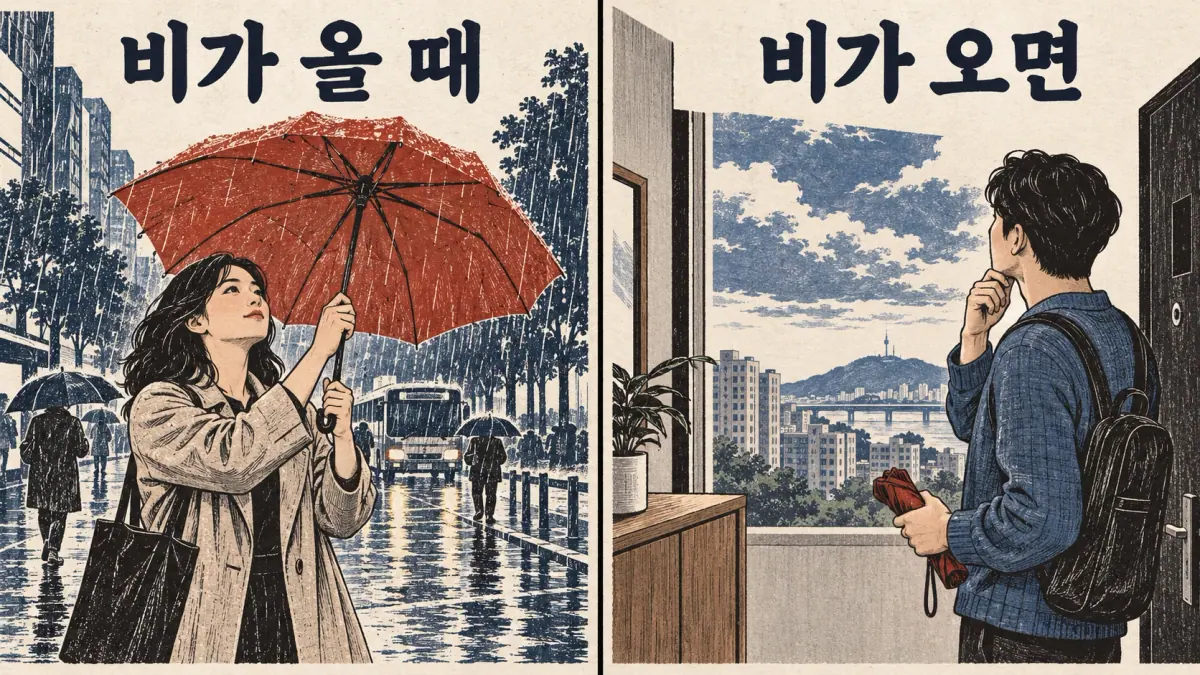
Both patterns can be translated "when" in English, which is why learners mix them up. The difference is whether the clause names a time or states a condition.
| Pattern | Core idea | Example | Feeling |
|---|---|---|---|
| -(으)ㄹ 때 | a time that is real or expected | 비가 올 때 우산을 써요. | When it rains, I use an umbrella. The rain is an event. |
| -(으)면 | a condition that may or may not happen | 비가 오면 우산을 써요. | If it rains, I use an umbrella. The rain is a possibility. |
| -기 전에 | the time before an action | 집에 가기 전에 전화해요. | I call before I go home. |
| -(으)ㄴ 후에 | the time after an action | 집에 간 후에 전화해요. | I call after I go home. |
Ask yourself: is "if" possible in English? If so, -(으)면 may fit better. With a time that will certainly come, use -(으)ㄹ 때. 한국에 갈 때 is natural because the trip is planned. 한국에 가면 would be more like "if I go to Korea" or "once I go to Korea".
Sentence type does not decide it. Both patterns can be followed by a statement, a question or a command. What decides it is the first clause: a time that is fixed or expected takes 때, and a possibility takes -(으)면. For a full side-by-side with practice, see -(으)ㄹ 때 vs -(으)면.
Here are the "before" and "after" partners told with the same verb, 가다.
| Time relation | Pattern | Example |
|---|---|---|
| before going | -기 전에 | 가기 전에 전화했어요. |
| while going | -(으)ㄹ 때 | 갈 때 전화했어요. |
| after going | -(으)ㄴ 후에 | 간 후에 전화했어요. |
| after arriving | -았/었을 때 | 갔을 때 전화했어요. |
The next section covers set phrases and edge cases.
Variations and Edge Cases of -(으)ㄹ 때

때마다: Every Time
Add 마다 ("every") to 때 to say "every time". It is followed by a habit.
한국에 갈 때마다 김치를 먹어요 means "Every time I go to Korea, I eat kimchi." Spoken, it is [한구게 갈 때마다 김치를 머거요], and the RR aid is Hanguge gal ttaemada gimchireul meogeoyo.
때는: as for the Time When
Add 는 to 때 to set the time apart as a topic. 바쁠 때는 문자를 보내세요 means "When you are busy, send a message" (but at other times, a call is fine). The 는 adds contrast. The RR aid is bappeul ttaeneun munjareul bonaeseyo.
때에 and 그때
You can add the particle 에 to a noun of time, but 때 usually stands alone: 어릴 때 is normal in speech. In formal writing, you may see 때에 or 때에는. The word 그때 means "at that time", as in 그때 저는 학생이었어요.
살 때: Two Meanings
The form 살 때 has two sources. 살다 ("live") gives 살 때 because its ㄹ stays. 사다 ("buy") gives 살 때 because 사 + ㄹ = 살. Only the context tells you which one is meant. 서울에 살 때 means "when I live in Seoul", and 옷을 살 때 means "when I buy clothes".
때 for Dates and Times
Use 에 for a point on the clock or calendar: 세 시에, 월요일에, 3월에. Use 때 for events and periods of time: 방학 때, 점심때, 어렸을 때, 학생 때. Do not say 세 시 때.
때문에 Is a Different Word
때문에 means "because of". It is built from the same noun 때 but has nothing to do with "when". 비 때문에 늦었어요 means "I was late because of the rain". For that meaning, see -기 때문에.
The next section lists the mistakes that appear most often.
What Mistakes Do Learners Make with -(으)ㄹ 때?
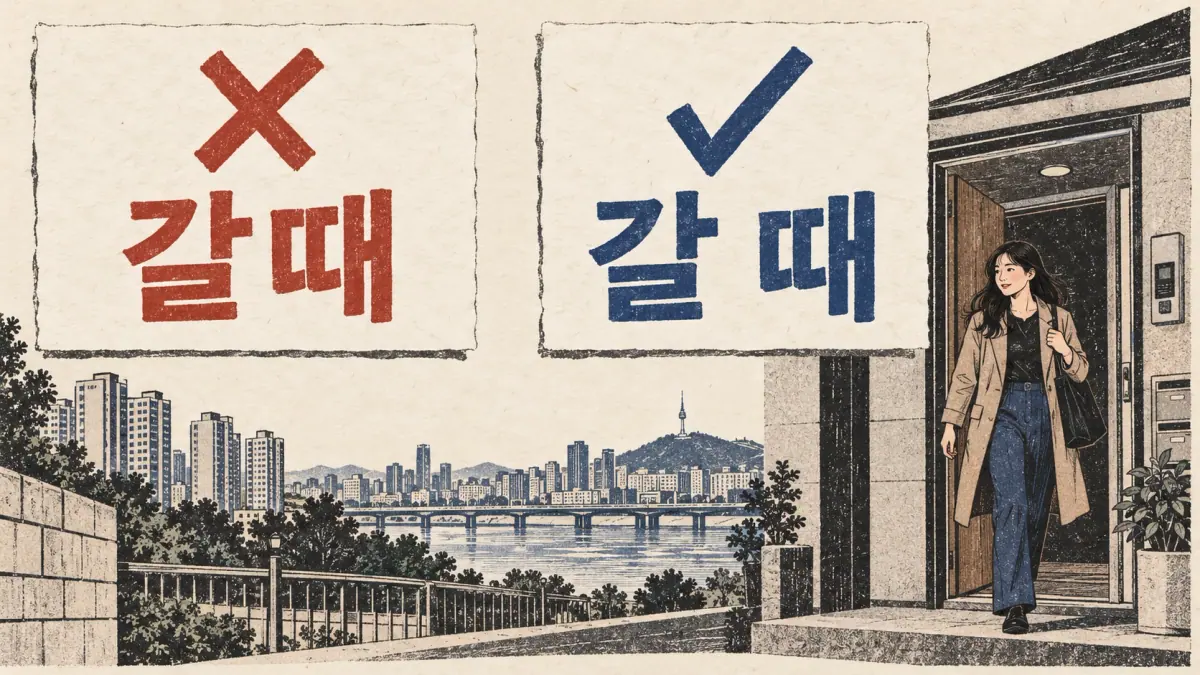
Learners make six predictable mistakes. Each has a reason and a fix.
Learners often use -(으)ㄴ 때 for the past. Wrong: 한국에 간 때 비행기를 탔어요. Right: 한국에 갔을 때 비행기를 탔어요. Fix: for a finished action, put 았/었 inside the clause and then use -(으)ㄹ 때: 갔을 때.
Learners often drop the space. Wrong: 갈때, 먹을때. Right: 갈 때, 먹을 때. Fix: 때 is a noun, so it stands alone, just like the word "time" in English.
Learners often put 을 on a vowel stem. Wrong: 가을 때. Right: 갈 때. Fix: after a vowel, add only ㄹ. After a consonant, add 을: 먹을 때.
Learners often use 때 for a one-time possibility. Odd: 내일 비가 올 때 우산을 살 거예요. This sounds as if the rain is certain. Better: 내일 비가 오면 우산을 살 거예요 ("If it rains tomorrow, I will buy an umbrella"). Fix: if the English sentence works with "if", use -(으)면.
Learners often use 때 for clock times. Wrong: 세 시 때 만나요. Right: 세 시에 만나요. Fix: use 에 for exact times and dates.
Learners often use -(으)ㄹ 때 to ask "when?". Wrong: 때 한국에 가요? Right: 언제 한국에 가요? Fix: the question word for "when" is 언제.
The next section gives you practice.
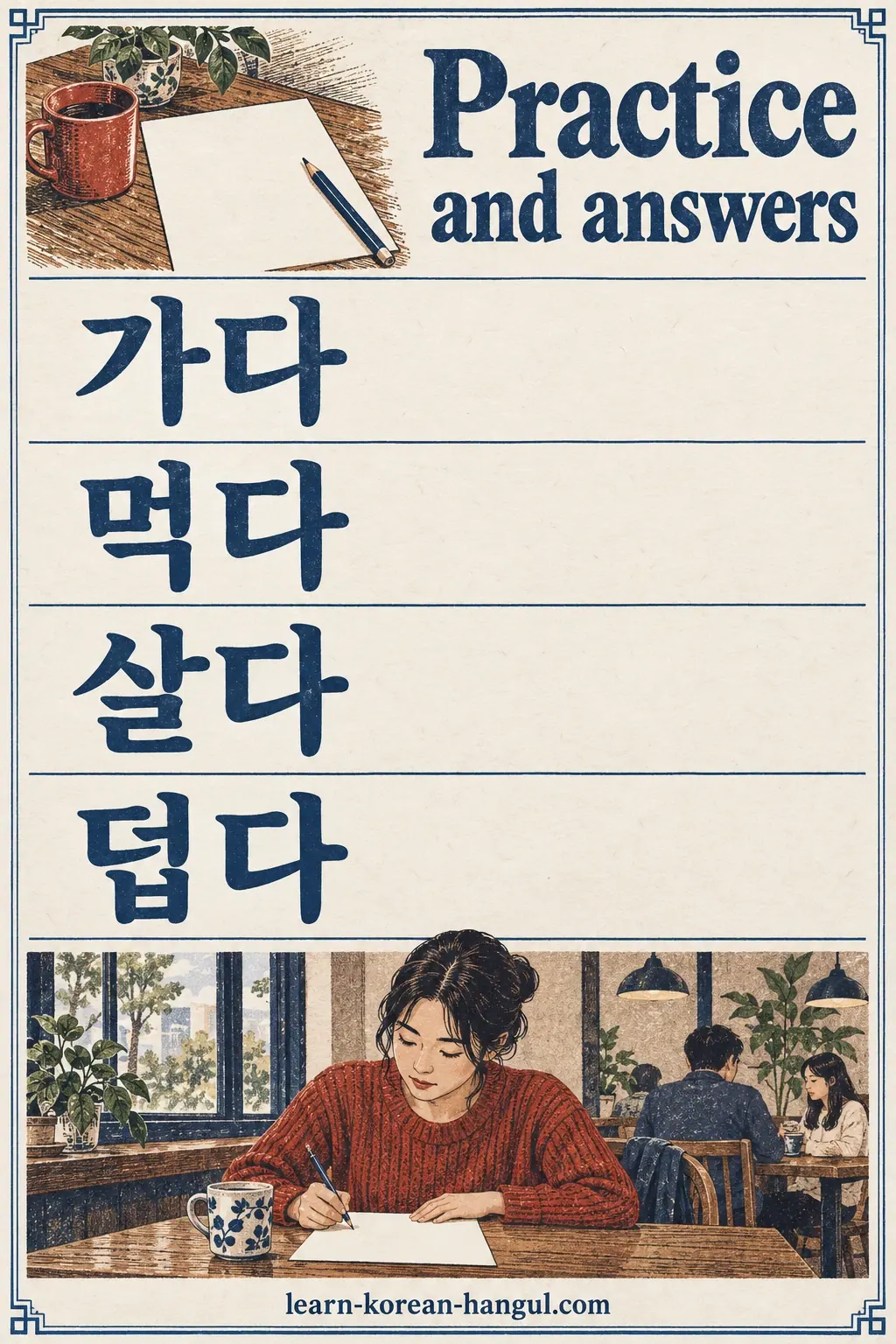
Practice and Answers
Do the four tasks, then compare with the key.
Task 1: add -(으)ㄹ 때. Write the "when" form of each verb or adjective.
- 가다 (go)
- 먹다 (eat)
- 살다 (live)
- 덥다 (be hot)
- 듣다 (listen)
Task 2: join the sentences with -(으)ㄹ 때. Write one sentence for each pair.
- 저는 피곤해요. / 커피를 마셔요.
- 저는 어렸어요. / 부산에 살았어요.
- 시간이 있어요. / 전화하세요.
Task 3: fix the error. Each sentence has one mistake. Rewrite it correctly.
- 갈때 연락하세요.
- 세 시 때 만나요.
- 한국에 간 때 친구를 만났어요.
Task 4: write your own. Write one sentence about what you do when you are tired, and one about what you will do when you go to a new country.
Practice · 5
Which form of 먹다 means "when I eat"?
Show answer
먹을 때
The stem 먹 ends in a final consonant, so it takes 을 때: 먹을 때.
How do you say "when it is hot" with 덥다?
Show answer
더울 때
덥다 is a ㅂ-irregular adjective. ㅂ becomes 우, and the ending is ㄹ 때: 더울 때.
Which sentence means "When I got home, there was no milk"?
Show answer
집에 갔을 때 우유가 없었어요.
The action of getting home was finished, so 았/었 goes inside the clause: 갔을 때.
Which sentence is correct for a meeting time?
Show answer
세 시에 만나요.
Use 에 for a clock time. 때 is for events and periods such as 방학 때.
Which pattern fits "if it rains"?
Show answer
비가 오면
A possible condition takes -(으)면. 비가 올 때 means "when it rains".
Answer key
- (1) 갈 때 (2) 먹을 때 (3) 살 때 (4) 더울 때 (5) 들을 때
- (1) 저는 피곤할 때 커피를 마셔요. (2) 저는 어렸을 때 부산에 살았어요. (3) 시간이 있을 때 전화하세요.
- (1) 갈 때 연락하세요. (2) 세 시에 만나요. (3) 한국에 갔을 때 친구를 만났어요.
- Sample answers: 피곤할 때 저는 일찍 자요. 새로운 나라에 갈 때 사진을 많이 찍을 거예요. Any pair is correct if each time clause ends in ㄹ 때 or 을 때 with a space.
If task 1 was correct, you have the formation rule. If task 3 was hard, check the space before 때 and whether you used the right past form. The next section points you to what comes after this lesson.
What Should You Learn after -(으)ㄹ 때 Grammar?
After -(으)ㄹ 때, learn -(으)면 to talk about conditions, and -기 전에 for "before". Then read -(으)ㄴ 후에 for "after". When you want to say "until", continue with -(으)ㄹ 때까지.
For a wider view, the parent page Time and Sequence lists every time connector in this group. To plan by level, use Beginner Grammar.
This lesson shows -(으)ㄹ 때 with polite-style endings; the pattern itself is the same in every speech style, because the style comes from the last verb. It does not cover every written variation. About this page. Last updated 2026-10-09. Revised Romanization follows the national rules and is shown only as a learning aid.
Frequently Asked Questions
What Does -(으)ㄹ 때 Mean?
-(으)ㄹ 때 means "when" or "at the time of". It turns a verb or adjective into a time phrase that sits before the main clause. 한국에 갈 때 비행기를 탈 거예요 means "When I go to Korea, I will take a plane." The word 때 is a noun that means "time".
How Do I Attach -(으)ㄹ 때 to a Verb or Adjective?
Remove 다 to get the stem. After a vowel, add ㄹ 때: 가다 becomes 갈 때. After a final consonant, add 을 때: 먹다 becomes 먹을 때. A stem that ends in ㄹ keeps it and adds only 때: 살다 becomes 살 때. Nouns take 때 directly: 방학 때.
Can -(으)ㄹ 때 Be Used in the past Tense?
Yes, in two ways. The main verb can be past: 집에 갈 때 우유를 샀어요. Or you can put 았/었 inside the clause when the action was already finished: 집에 갔을 때 우유가 없었어요. The first means "while going home". The second means "when I had got home".
Is -(으)ㄹ 때 Used in Speech or Only in Writing?
Both. It is one of the most common connectors in everyday talk, messages, textbooks and news. It works in every speech style because the style is set by the last verb of the sentence. You can write 바쁠 때 in a text message or 바쁠 때에는 in a formal letter.
What Is the Most Common Mistake with -(으)ㄹ 때?
Learners use -(으)ㄴ 때 for the past, as in 한국에 간 때. The normal past is -았/었을 때: 한국에 갔을 때. Another frequent slip is writing 때 without a space, as in 갈때. Write 갈 때 with a space, because 때 is a separate noun.
What Is the Difference between -(으)ㄹ 때 and -(으)면?
-(으)ㄹ 때 names a time that is real or expected, such as the moment you go to Korea. -(으)면 states a condition that may or may not happen, such as "if it rains". 비가 올 때 is "when it rains", and 비가 오면 is "if it rains". Both can be translated "when" in everyday English.