
Before you start: you should know what an adjective stem is (the dictionary form of a describing word without its final 다, such as 예쁘 in 예쁘다) and how to make a simple polite sentence. Estimated time: 15 minutes. To see where this ending sits among the other adverb lessons, start from korean adverbs.
What Does the Adverb -게 in Korean Mean?
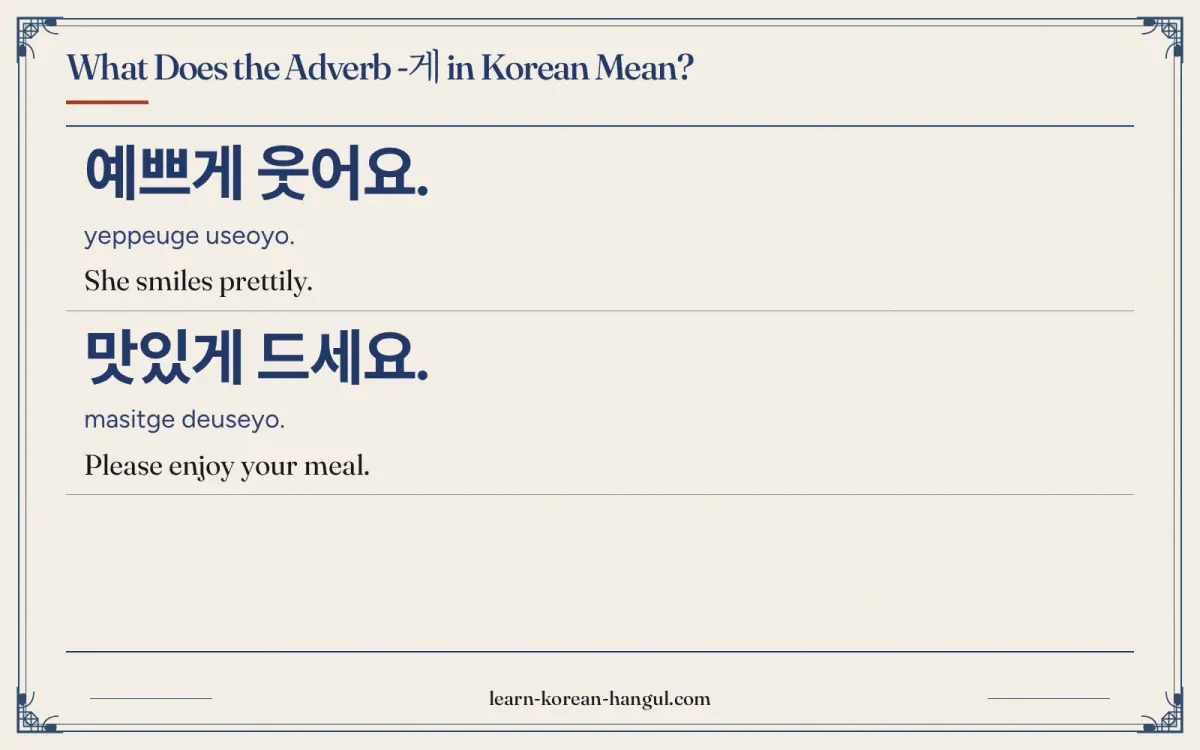
The adverb -게 in korean means "in a ... way": it takes a describing word and makes it describe an action. A describing word that tells you what something is like is an adjective. A word that tells you how, when or how much an action happens is an adverb. In Korean, the adjective 예쁘다 ("to be pretty") is not enough to describe a smile. You need the adverb form, 예쁘게, in front of the verb.
English often does the same with -ly (quick → quickly) or with a phrase ("in a loud voice"). Korean has one regular ending that works for nearly every adjective, and that is -게. Grammar books call it an adverbial ending (부사형 어미, busahyeong eomi): an ending that lets an adjective do the job of an adverb.
A First Example
Look at one sentence in parts. The table labels each piece of 예쁘게 웃어요, and the second row does the same for 맛있게 드세요.
| Sentence | Adjective | Stem | Ending | Adverb | Verb it describes |
|---|---|---|---|---|---|
| 예쁘게 웃어요. | 예쁘다 (pretty) | 예쁘 | 게 | 예쁘게 (prettily) | 웃어요 (smiles) |
| 맛있게 드세요. | 맛있다 (tasty) | 맛있 | 게 | 맛있게 (deliciously) | 드세요 (please eat) |
예쁘게 웃어요.
yeppeuge useoyo.
She smiles prettily.
맛있게 드세요.
masitge deuseyo.
Please enjoy your meal.
The second sentence is the standard thing to say before someone eats. Literally it is "please eat deliciously". The first sentence shows the plain pattern: the adverb stands directly in front of the verb. The next section shows how to build the form on every kind of adjective.
How Does the Adverb -게 in Korean Work?
You build the adverb by removing 다 from the adjective and adding 게. There is one version only, so you never choose between -게 and -으게. The adverb then stands in front of the verb it describes.
Pattern Table
| Adjective | Meaning | With -게 | Revised Romanization | Example meaning |
|---|---|---|---|---|
| 예쁘다 | pretty | 예쁘게 | yeppeuge | prettily |
| 크다 | big, loud | 크게 | keuge | loudly, big |
| 작다 | small, quiet | 작게 [작께] | jakge | softly, small |
| 길다 | long | 길게 | gilge | long |
| 짧다 | short | 짧게 [짤께] | jjalge | short |
| 맛있다 | tasty | 맛있게 [마싣께] | masitge | deliciously |
| 재미있다 | fun | 재미있게 [재미읻께] | jaemiitge | in a fun way |
| 쉽다 | easy | 쉽게 [쉽께] | swipge | easily |
| 늦다 | late | 늦게 [늗께] | neutge | late |
| 빠르다 | fast | 빠르게 | ppareuge | quickly |
| 편하다 | comfortable | 편하게 | pyeonhage | comfortably |
| 조용하다 | quiet | 조용하게 | joyonghage | quietly |
| 따뜻하다 | warm | 따뜻하게 [따뜨타게] | ttatteutage | warmly |
| 깨끗하다 | clean | 깨끗하게 [깨끄타게] | kkaekkeutage | cleanly |
| 행복하다 | happy | 행복하게 [행보카게] | haengbokage | happily |
Revised Romanization (RR, the official Latin spelling) is only an aid. It writes the letters ㄲ, ㄸ and ㅃ when they appear in Hangul, as in 예쁘게 (yeppeuge), but it does not show tensing that comes from a neighbouring sound. So 작게 is written jakge even though it is said [작께]. For adjectives built on 하다, RR shows the aspiration, as in haengbokage.
Three rules cover all of these:
- Vowel stems. Add 게 and say it as written: 예쁘게, 크게, 편하게. There is no sound change.
- Consonant stems. Add 게 after the final consonant. After most consonant stems the ㄱ of 게 becomes tense. The Standard Pronunciation Rules (표준 발음법, Articles 9, 10, 11 and 23) say that after the final sounds ㄱ, ㄷ and ㅂ, the next ㄱ is tense: 작게 [작께], 늦게 [늗께], 쉽게 [쉽께]. The cluster ㄼ in 짧 is said as ㄹ, and after a ㄼ stem the ㄱ is still tense (Article 25), so 짧게 is [짤께]. A plain ㄹ stem has no tensing: 길게 is said [길게].
- 하다 adjectives. The final ㄱ, ㅅ or ㅂ of the noun part meets the ㅎ of 하 and merges into an aspirated sound: 따뜻하게 [따뜨타게], 깨끗하게 [깨끄타게], 행복하게 [행보카게]. 조용하게 has no such change.
Irregular adjectives do not change before 게, because 게 starts with a consonant. The ㅂ, 르 and ㅅ irregulars change only before endings that start with a vowel. So 춥다 becomes 춥게 (not 추워), 어렵다 becomes 어렵게, 빠르다 becomes 빠르게 (not 빨라), and 낫다 becomes 낫게. A ㄹ stem keeps its ㄹ: 길다 becomes 길게, and 멀다 becomes 멀게.
The next section puts one adverb into a full sentence.
Worked Example, Step by Step
You build a sentence with an -게 adverb in five steps. This example makes "Please speak loudly".
- Choose the adjective that names the manner. 크다 ("big, loud").
- Find the stem. Remove 다 from 크다. The stem is 크.
- Add 게. 크 + 게 = 크게.
- Choose the verb. 말하다 ("to speak"). Its polite request form is 말해 주세요.
- Put the adverb right before the verb. 크게 말해 주세요.
Sentence
Please speak loudly.
Show answer
크게 말해 주세요
Checkpoint. You have it when you can change the manner and keep the pattern. For "Please cut it short", use 짧다 and 자르다: 짧게 잘라 주세요 [짤께 잘라 주세요]. The adverb moves and the rest stays the same. You can also make a statement from the same pieces: 늦게 일어났어요 [늗께 이러나써요] means "I got up late".
The adverb always comes before the verb because Korean puts the verb last. Next, learn how -게 differs from the other forms that learners meet.
How Is -게 Different from Similar Forms?
-게 differs from -히/-이 because it is open, while they form a closed list. You can add -게 to almost any adjective and be understood. The adverbs ending in -히 or -이, such as 천천히 ("slowly") and 깨끗이 ("cleanly"), are separate words that you learn one at a time. The lesson on adverb -히 -이 in korean lists them.
-게
adjective stem + 게: open and productive
-히/-이
fixed adverbs learned as words
| Comparison | -게 | -히/-이 |
|---|---|---|
| How many | almost every adjective | a closed list |
| Example | 조용하게 말해요. | 조용히 말해요. |
| Fixed forms | 예쁘게, 크게, 쉽게 | 천천히, 열심히, 깨끗이 |
| Level | A2 | B1 |
Use -게 to make a new adverb from an adjective; use a -히/-이 adverb when it already exists as a word you know.
Some adjectives have both forms, and the two mean almost the same: 조용하게 말해요 and 조용히 말해요 both mean "She speaks quietly". 깨끗하게 and 깨끗이 are another pair, and 깨끗이 is said [깨끄시]. Others have only the -히 form, such as 열심히 ("hard, diligently"), which you must learn as a word.
A third group of adjectives uses its own adverb word. These are very common, and -게 does not replace them:
| Adjective | Its own adverb | Example |
|---|---|---|
| 좋다 (good) | 잘 (well) | 노래를 잘 불러요. = "She sings well." |
| 많다 (many) | 많이 (a lot) | 많이 먹어요. = "I eat a lot." |
| 빠르다 (fast) | 빨리 (quickly) | 빨리 오세요. = "Please come quickly." |
| 같다 (same) | 같이 (together) | 같이 가요. = "Let's go together." |
Notice that 빠르게 also exists, and it describes speed in a more descriptive way, as in 빠르게 걸어요 ("walks at a fast pace"). 좋게 exists too, but it means "in a good way", as in 좋게 생각해요 ("I think about it positively"), not "well". The lesson on korean adverbs of degree 아주 너무 정말 covers the adverbs of "how much".
A quick test: ask whether you already know a -히 or special adverb for the word. If you do, use it. If you do not, -게 is a safe choice. Next, see when the ending is used and when it is not.
When Do You Use It, and When Not?
Use an -게 adverb before a verb or before a verb-like word to say how something is done. Do not use it before a noun. The two jobs belong to two different forms. A word that describes a noun uses the modifier ending -(으)ㄴ, and a word that describes an action uses -게.
| Describing | Form | Example |
|---|---|---|
| A noun | adjective + -(으)ㄴ | 예쁜 꽃 = "a pretty flower" |
| A verb | adjective + -게 | 예쁘게 피었어요 = "It bloomed prettily." |
The same ending appears in a few related patterns that you will see at once. They use the same -게, but they are not covered in full here:
- Result after 만들다 or 하다. 방을 깨끗하게 만들었어요 means "I made the room clean". The adverb names the result.
- Looks and appearance. 예쁘게 생겼어요 means "She is pretty (looks pretty)" [예쁘게 생겨써요], and 맛있게 보여요 means "It looks delicious". The adverb describes how something appears.
- -게 되다 ("come to be"). 한국어를 공부하게 됐어요 means "I came to study Korean" [한구거를 공부하게 돼써요]. It attaches to verbs too.
- -게 하다 ("make or let someone"). 아이를 웃게 했어요 means "I made the child laugh" [아이를 욷께 해써요]. See causative -게 하다.
한국어를 공부하게 됐어요.
hangugeoreul gongbuhage dwaesseoyo.
I came to study Korean.
Where the adverb stands matters too. In Korean, the adverb goes right before the verb it describes. The lesson on korean adverb position in a sentence gives the full word-order rules, and the lesson on the korean sov sentence pattern shows why the verb ends the sentence. The adverb tone is neutral, so -게 is correct in casual speech, polite speech and writing. Next are the errors that appear most often.
What Mistakes Do Learners Make?
Learners make five common mistakes with the adverb -게. Each one follows the pattern "learners often assume X; actually Y, because Z".
- Using the adjective form before a verb. Learners write 예쁜 웃어요. Actually 예쁜 describes a noun. A verb needs 예쁘게: 예쁘게 웃어요.
- Forcing -게 where a fixed adverb exists. Learners write 열심하게 공부해요. Actually 열심 is a noun, not an adjective stem, so Korean uses the fixed word 열심히. With 천천하다 ("to be slow"), the everyday adverb is also the fixed word: say 천천히 걸어요 ("I walk slowly").
- Using 좋게 for "well". Learners write 노래를 좋게 불러요. Actually 잘 is the adverb for "well": 노래를 잘 불러요.
- Putting the adverb after the verb. Learners write 웃어요 예쁘게. Actually the adverb stands in front of the verb, because the verb ends the sentence.
- Saying 작게 as [작게]. Learners follow the spelling. Actually the ㄱ is tense after a consonant stem, so say [작께].
Whenever you want to say how something is done, check whether a fixed adverb already exists. Now test yourself.
Practice and Answers
These four exercises check the main skills: building the adverb, repairing a mistake and choosing the right word. Try each one before you read the answers.
Practice · 5
How do you say "quietly" with 조용하다?
Show answer
조용하게
Remove 다 from the adjective and add 게: 조용하 + 게 = 조용하게. 조용한 would describe a noun.
Which sentence means "She smiles prettily"?
Show answer
예쁘게 웃어요.
A word that describes a verb takes the adverb form 예쁘게. The form 예쁜 describes a noun.
What do you say at the table before you start to eat?
Show answer
맛있게 드세요.
맛있게 드세요 is the set phrase for "Enjoy your meal". The adverb 맛있게 describes how you eat.
Which word is the natural adverb for "work hard"?
Show answer
열심히
열심히 is a fixed -히 adverb. You learn these words one by one, and 열심하게 is not used.
How is 작게 pronounced?
Show answer
[작께]
After the final sound ㄱ, the ㄱ of 게 becomes tense, so 작게 is said [작께].
Exercise 1: Choose the form. Make the adverb from 크다 and use it with 말하다 in a polite request: "Please speak loudly."
Exercise 2: Fix the error. A learner writes 맛있는 드세요 to mean "Enjoy your meal". Correct it.
Exercise 3: Choose the right word. You want to say "I study hard". Do you use 열심하게 or 열심히?
Exercise 4: Translate. "Please cut it short." (cut = 자르다, short = 짧다; polite request with 주세요)
Answer Key
- Exercise 1: 크게 말해 주세요. [크게 말해 주세요] The stem 크 takes 게, and the adverb stands before the verb.
- Exercise 2: 맛있게 드세요. [마싣께 드세요] The verb 드세요 needs the adverb 맛있게, not the noun-describing form 맛있는.
- Exercise 3: 열심히. The sentence is 열심히 공부해요. 열심히 is a fixed -히 adverb, so 열심하게 is not used.
- Exercise 4: 짧게 잘라 주세요. [짤께 잘라 주세요] The stem 짧 takes 게, and the cluster ㄼ is said as ㄹ.
If you missed Exercise 1 or 2, return to the five building steps. If you missed Exercise 3, reread the section on the difference between -게 and -히/-이. Next, plan where to go from here.
Next Lessons and Where to Go from Here
The best next lesson is adverb -히 -이 in korean, because it covers the fixed adverbs that sit beside -게. Then study korean adverbs of degree 아주 너무 정말 for adverbs that say "how much". When you are ready for the related pattern with verbs, read causative -게 하다. To see where the adverb -게 in korean sits in a study plan, use the Beginner Grammar list.
What this lesson does not cover. It does not cover the full range of -게 되다 and -게 하다 patterns, the casual sentence ending -게 as in 내가 할게 (a different ending, -(으)ㄹ게), or the purpose ending -도록. The level given here, A2, is an editorial estimate based on common textbook order, not an official grading.
In short, the adverb -게 in korean attaches to an adjective stem to say how an action is done, stands right before the verb, and leaves a closed list of fixed adverbs to be learned as words.
Frequently Asked Questions
What does -게 mean? -게 turns an adjective into an adverb, so it tells you how an action is done. 예쁘다 means "pretty", and 예쁘게 웃어요 means "She smiles prettily". 크다 ("big, loud") becomes 크게 in 크게 말해 주세요, "Please speak loudly". English often uses an ending such as -ly or the phrase "in a ... way" for the same job.
How do I form -게? Remove 다 from the adjective and add 게 to the stem: 예쁘다 becomes 예쁘게, 맛있다 becomes 맛있게, 조용하다 becomes 조용하게. Nothing else changes, even for irregular adjectives, because 게 starts with a consonant: 춥다 becomes 춥게, and 빠르다 becomes 빠르게. A ㄹ stem keeps its ㄹ: 길다 becomes 길게.
What is the most common mistake with -게? Learners use the adjective form before a verb, as in 예쁜 웃어요. This is wrong because 예쁜 describes a noun (예쁜 꽃, "a pretty flower"). A word that describes a verb needs the adverb form 예쁘게. The second common mistake is forcing -게 where a fixed adverb exists, such as 잘, 많이 or 열심히.
How is -게 different from similar forms? -게 is a productive ending: you can add it to almost any adjective. -히 and -이 adverbs, such as 천천히 and 깨끗이, form a closed list that you memorize word by word. Some adjectives have both, as in 조용하게 and 조용히. A few common adjectives have their own adverb instead, such as 좋다 with 잘 and 많다 with 많이.
Do I use -게 in speech, writing or both? -게 adverbs are used in speech, writing, signs and requests, and they are neutral in tone. The set phrase 맛있게 드세요 ("Enjoy your meal") is heard at every table. In speech, watch the sound: after a consonant stem the ㄱ of 게 is tense, so 맛있게 is said [마싣께] and 작게 is said [작께].