What you'll learn
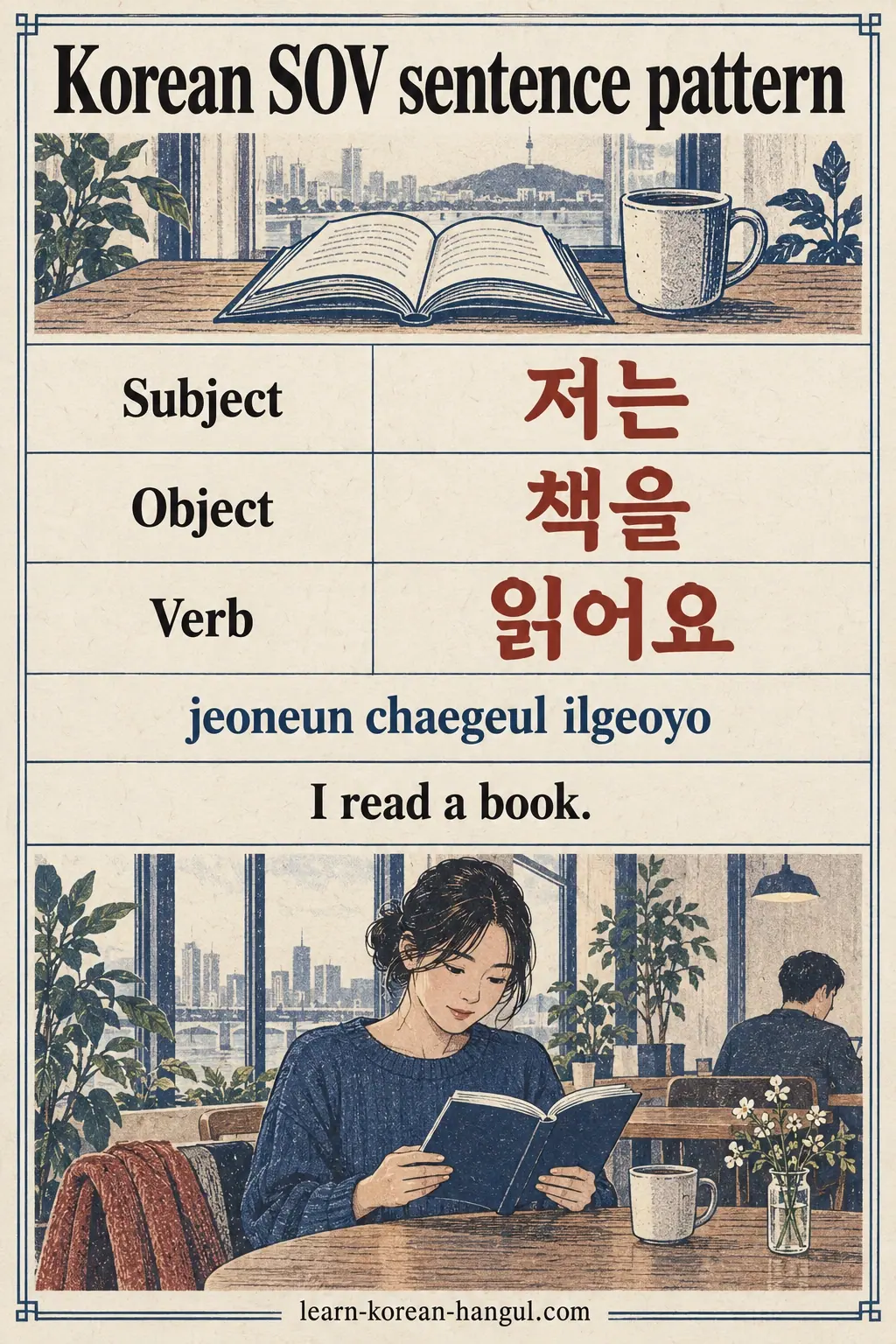
- Build a Korean sentence with the subject, object and verb in the right order.
- Attach a particle to each noun so that the roles are clear.
- Explain why Korean can move nouns around while English cannot.
- Spot and fix the error of putting the verb in the middle.
Prerequisites: none, apart from reading Hangul. Time: about 15 minutes.
Key facts
- The Korean sentence pattern is subject, object, verb (SOV). The verb or adjective is always last.
- Particles after nouns show roles: 은/는 for the topic, 이/가 for the subject, 을/를 for the object.
- English uses position to show roles. Korean uses particles.
- A modifier stands directly before the word it describes.
- Spoken Korean may add an afterthought after the verb, but careful speech and writing keep the verb last.
Listen to the two model sentences for this lesson.
The next section explains what SOV order is and why it matters for a learner.
What Is the Korean SOV Sentence Pattern?
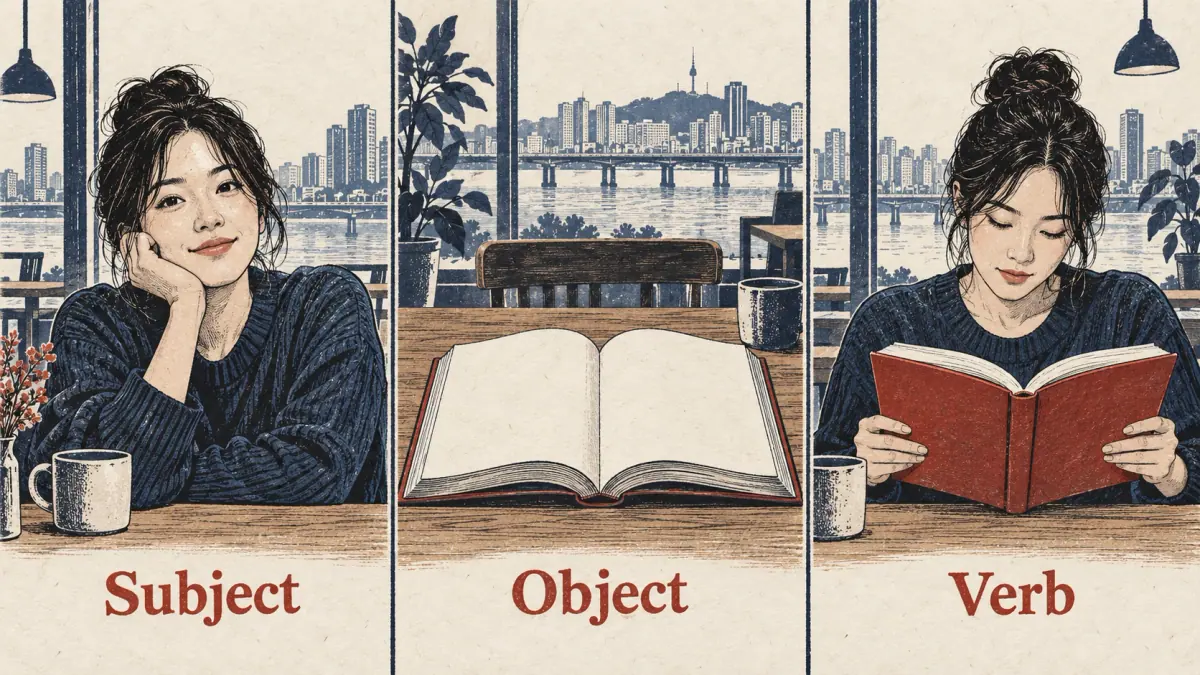
The Korean SOV sentence pattern is the habit of ending every sentence with its verb, with the subject and object in front. The letters stand for subject (who does the action), object (what receives the action) and verb (the action). A language with this order is called verb-final. Korean, Japanese, Turkish and Hindi are all verb-final languages.
English uses SVO: "I read a book." The verb sits in the middle, between the doer and the receiver. In Korean the same idea reads "I book read." If you translate word by word, the order looks backwards to an English speaker. It is not backwards, only different, and it follows one fixed rule: the last word of a basic Korean sentence is the verb or adjective.
A First Example
Here are two sentences that show the pattern. Each noun carries a particle, which is a small marker attached to a noun that shows its role.
| Part | 저는 책을 읽어요. | 동생이 밥을 먹어요. |
|---|---|---|
| Subject | 저는 (as for me) | 동생이 (my younger sibling) |
| Object | 책을 (a book) | 밥을 (a meal, rice) |
| Verb | 읽어요 (read) | 먹어요 (eat) |
| Spoken | [저는 채글 일거요] | [동생이 바블 머거요] |
| RR (aid) | jeoneun chaegeul ilgeoyo | dongsaengi babeul meogeoyo |
| English | I read a book. | My younger sibling eats a meal. |
In both sentences the order is subject, object, verb. The particle after each noun is the role marker: 는 and 이 mark the subject side, and 을 marks the object. The particle 은/는 is explained in topic particle 은/는, and the object marker is taught in object particle 을/를.
The next section shows how the pieces fit together in every sentence.
How Does the Korean SOV Sentence Pattern Work?

The pattern works in three steps: the nouns come first with their particles, the modifiers stay next to the words they describe, and the verb closes the sentence. Everything else, such as time and place words, fits in front of the verb.
Pattern Table
| Slot | What goes there | Marker | Example |
|---|---|---|---|
| 1. Topic or subject | who or what the sentence is about | 은/는 or 이/가 | 저는, 동생이 |
| 2. Extra information | time, place, reason (optional) | 에, 에서 and others | 어제, 학교에서 |
| 3. Object | what receives the action | 을/를 | 책을, 밥을 |
| 4. Verb or adjective | the action or description | polite ending -어요/-아요 | 읽어요, 먹어요 |
Slot 3 can be missing. Some verbs never take an object: 저는 가요 means "I go", and 비가 와요 means "It rains". The sentence is then subject plus verb, and the verb is still last. A verb that needs no object is called intransitive, and a verb that takes one is called transitive.
Modifiers stay close. A word that describes a noun stands directly before it. 예쁜 꽃 means "pretty flower", and the whole phrase moves as one block: 저는 예쁜 꽃을 사요 means "I buy a pretty flower." An adverb that describes the verb stands just before the verb. Never insert the verb between a modifier and its noun.
Particles are the role markers. In the sentence 개가 사람을 물어요 ("The dog bites the person"), 가 marks the dog as the biter and 을 marks the person as the one bitten. The particles stay attached to their nouns wherever the nouns go.
The next section builds a full sentence from scratch.
Worked Example: Building 저는 책을 읽어요

To build 저는 책을 읽어요, choose the doer, choose the thing, add a particle to each and end with the verb. Five steps cover most basic sentences.
- Choose the topic. To say "I", use 저, and add the topic particle 는 because 저 ends in a vowel: 저는.
- Choose the object. The thing being read is 책, "book".
- Add the object particle. 책 ends in a consonant, so the particle is 을: 책을. It is said [채글] because the final ㄱ moves onto the vowel of the next syllable.
- Choose the verb. The dictionary form is 읽다, "to read". The polite present form is 읽어요, said [일거요].
- Put the verb last. 저는 + 책을 + 읽어요 = 저는 책을 읽어요.
You'll know it worked when you can point to the verb and it is the final word, with a particle on each of the nouns before it. Now change the object: 저는 신문을 읽어요 means "I read a newspaper". Only the object changes; the order stays fixed.
Say the sentence slowly and clap once for each word. You should clap three times, and the third clap lands on the verb.
The next section compares this order with the English pattern.
Korean SOV vs English SVO
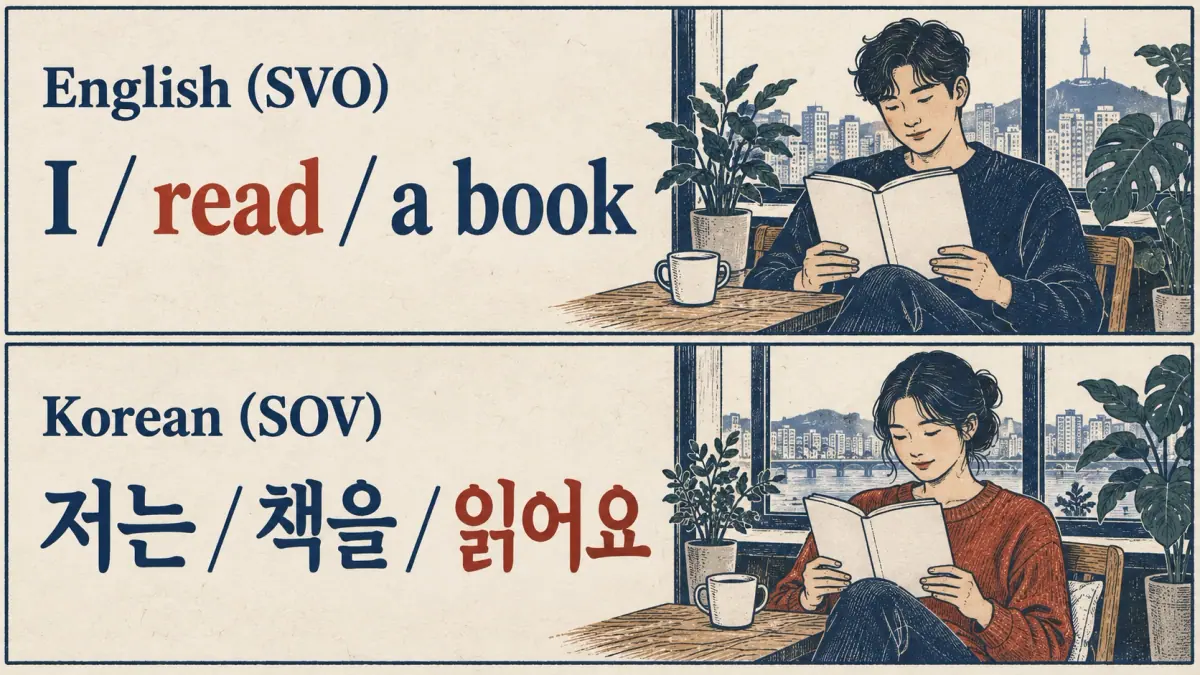
Korean and English reach the same meaning by different tools. English uses the position of a word to show its role. Korean uses the particle on a word. This single difference explains why Korean nouns can move and English nouns cannot.
| Feature | English (SVO) | Korean (SOV) |
|---|---|---|
| Order of the main parts | I / read / a book | 저는 / 책을 / 읽어요 |
| What shows the role | position | particle |
| Where the verb sits | in the middle | at the end |
| Can the nouns swap places? | no, the meaning changes | yes, the meaning usually stays |
| Words for "a" and "the" | required | no articles |
The swap test shows the difference clearly. In English, "The dog bites the man" and "The man bites the dog" mean opposite things. In Korean, 개가 사람을 물어요 and 사람을 개가 물어요 both mean that the dog bites the person, because 가 stays on the dog and 을 stays on the person. To reverse the meaning you change the particles: 사람이 개를 물어요 means "The person bites the dog."
Moving nouns around is called scrambling, and it is covered in Korean flexible word order. For now, treat the order subject, object, verb as your safe default. It is the order that textbooks, news and polite speech use.
The next section looks at how SOV affects listening and where the pattern has exceptions.
When Do You Use SOV Order, and When Not?
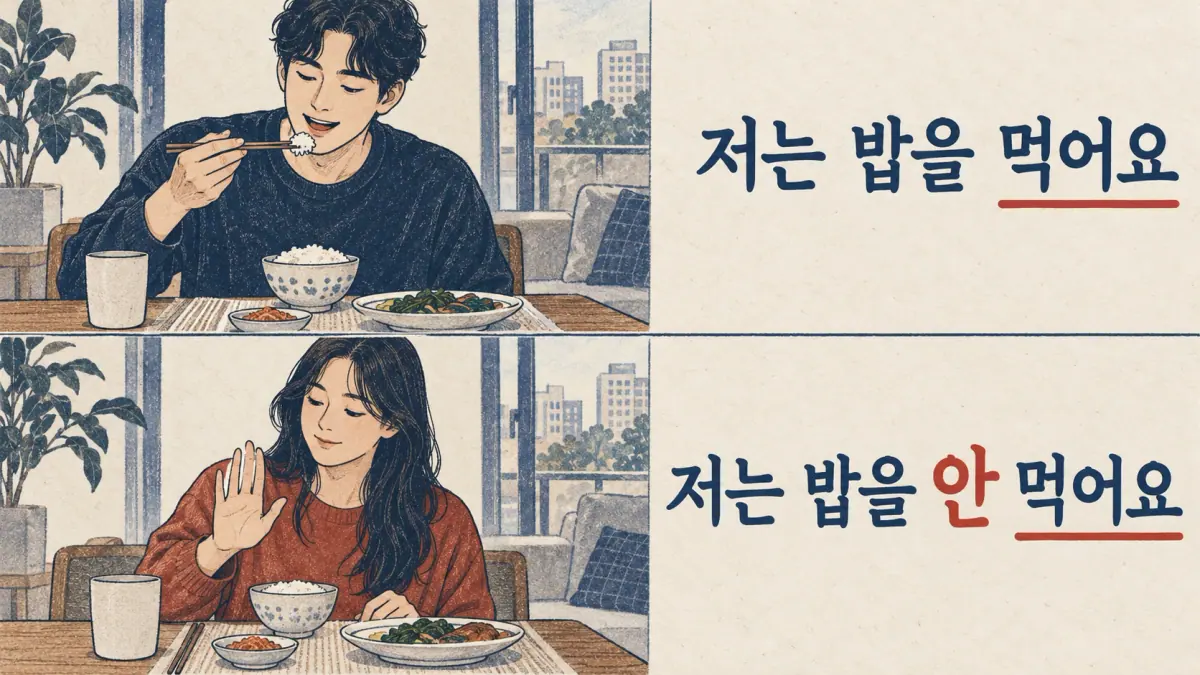
Use SOV order for every ordinary statement, question and command in Korean. The verb or adjective comes last in all of them. Three situations deserve a closer look.
1. Key information arrives at the end. In a verb-final language, the listener hears whether a sentence is positive, negative, or a question only at the last word. 저는 밥을 먹어요, 저는 밥을 안 먹어요 and 저는 밥을 먹어요? differ only near the end. A good habit when you listen is to wait for the final word before you decide what a speaker means. The negative word 안 sits immediately before the verb, as taught in 안 negation in Korean.
2. Adjective sentences follow the same rule. 꽃이 예뻐요 means "The flower is pretty". The subject comes first and the adjective closes the sentence. A sentence with the copula follows it too: 저는 학생이에요 ends with 이에요.
3. Afterthoughts in speech. In casual conversation, Koreans sometimes add a word after the verb that they forgot or wish to stress: 밥 먹었어요, 아침에. The extra phrase is an afterthought, and it sounds natural only in relaxed speech. Written Korean and careful speech keep the verb last. Learners should not copy afterthoughts until the basic order is automatic.
What this lesson does not cover. The order of time, place and object is taught in Korean word order: time and place. Longer sentences with several verbs, relative clauses and embedded questions follow the same verb-final logic but belong to later lessons.
An honest limit. SOV describes the basic order, not every sentence. Korean also drops subjects and objects when the context makes them clear, so many real sentences contain only a verb: 읽어요 can mean "I read it". The pattern describes where words go, and not which words must appear.
The next section lists the errors that appear most often.
What Mistakes Do Learners Make with SOV Order?
Learners make four predictable mistakes with SOV order. Each has a reason and a fix.
Learners often assume the verb belongs in the middle. Actually it belongs at the end, because Korean has no English-style slot between doer and receiver. Wrong: 저는 읽어요 책을. Right: 저는 책을 읽어요. Fix: finish the sentence in your head, then say the verb last.
Learners often assume the particles can be skipped. Actually particles carry the roles that English position carries. Wrong for beginners: 저 책 읽어요. Right: 저는 책을 읽어요. Native speakers drop particles in casual talk, but only because the context already shows the roles. Fix: write the full particles until the pattern is natural.
Learners often assume a modifier can follow its noun. Actually the modifier comes first. Wrong: 꽃 예쁜을 사요. Right: 예쁜 꽃을 사요. Fix: build the noun phrase first, then add the particle at its end.
Learners often assume every noun in front of a verb takes 을/를. Actually only a thing that receives the action takes the object particle. Movement verbs such as 가다 normally take 에 for the destination: 저는 학교에 가요, "I go to school." The form 학교를 가요 is heard in casual speech, but 에 is the form to learn first. Fix: check whether the noun is a receiver or a destination before you add a particle.
Practice puts these rules into your own sentences, as the next section shows.
Practice and Answers
Complete the four tasks, then compare your answers with the key.
Task 1: put the words in order.
- 읽어요 / 책을 / 저는
- 먹어요 / 동생이 / 밥을
- 마셔요 / 커피를 / 친구가
- 봐요 / 영화를 / 우리는
Task 2: fix the error. Each sentence has one mistake. Rewrite it correctly.
- 저는 먹어요 밥을.
- 친구가 마셔요 커피를.
- 꽃 예쁜을 사요.
Task 3: translate. Write in Korean: "I eat rice." and "My friend drinks coffee."
Task 4: write your own. Write one subject, object, verb sentence about something you do every day.
Practice · 8
In a basic Korean sentence, where does the verb or adjective go?
Show answer
At the end
Korean is verb-final: the last word of a basic sentence is the verb or adjective.
Which sentence correctly says "I eat rice"?
Show answer
저는 밥을 먹어요.
The verb goes last, so 먹어요 follows the object 밥을. Putting the verb in the middle copies English SVO order.
In Korean, what shows who does what in a sentence?
Show answer
The particles attached to the nouns
English uses position to show roles, but Korean uses particles such as 이/가 and 을/를, and it has no articles.
What do 개가 사람을 물어요 and 사람을 개가 물어요 mean?
Show answer
Both mean that the dog bites the person
가 stays on the dog and 을 stays on the person wherever they go, so swapping the nouns keeps the meaning.
Which sentence means "The person bites the dog"?
Show answer
사람이 개를 물어요.
To reverse the meaning you change the particles: the biter takes 이 and the one bitten takes 를.
Which phrase correctly says "(I) buy a pretty flower"?
Show answer
예쁜 꽃을 사요.
A modifier stands directly before the word it describes, and the particle goes at the end of the whole noun phrase.
Which particle marks the object, the thing that receives the action?
Show answer
을/를
을/를 marks the object, as in 책을 and 밥을. 은/는 marks the topic and 이/가 marks the subject.
In 저는 밥을 안 먹어요, where does the negative word 안 sit?
Show answer
Immediately before the verb
안 sits right before the verb, so in a verb-final language the negative is heard near the end.
Answer key
- 저는 책을 읽어요. 동생이 밥을 먹어요. 친구가 커피를 마셔요. 우리는 영화를 봐요.
- (1) 저는 밥을 먹어요. (2) 친구가 커피를 마셔요. (3) 예쁜 꽃을 사요.
- 저는 밥을 먹어요. 친구가 커피를 마셔요.
- Sample answers: 저는 물을 마셔요. ("I drink water.") 저는 음악을 들어요. ("I listen to music.") Any verb is correct if it is last and each noun has a particle.
If you ordered all four sentences correctly, you have the pattern. If one was hard, find the verb first, put it last, and then add the subject and object in front. The next section points you to what comes after this lesson.
What Should You Learn after the Korean SOV Sentence Pattern?
After the Korean SOV sentence pattern, learn the common ways to combine it with other words in Korean basic sentence patterns. That lesson shows the basic sentence frames you will meet in almost every beginner conversation. Then see how time and place words fit before the verb in Korean word order: time and place.
For a wider view, the parent page Korean sentence structure shows how this lesson fits with the copula, existence and subject omission. If you want the pattern with the verb "to be", read 이에요/예요 to be.
This lesson covers the basic statement order only. It does not cover scrambling, relative clauses or embedded sentences. About this page. Last updated 2026-10-09. The Korean text, spoken forms and audio on this page were machine-generated and reviewed and signed off by Min-ji Park on 15 October 2026. Romanization follows the Revised Romanization of Korean and is shown only as a learning aid.
Frequently Asked Questions
What does SOV order mean? SOV stands for subject, object, verb, the order in which the main parts of a sentence appear. In Korean the verb or adjective comes last, so "I read a book" is 저는 책을 읽어요, literally "I book read." English follows subject, verb, object instead. Japanese, Turkish and Hindi are also verb-final languages.
How do I form a sentence in SOV order? Start with the topic or subject plus 은/는 or 이/가. Add the object with 을/를. Insert time, place and adverbs between them as needed, then end with the verb. For example 동생이 밥을 먹어요 has a subject, an object and a verb in that order, with a particle on each noun.
What is the most common mistake with SOV order? The most common mistake is copying English order and putting the verb in the middle, as in 저는 읽어요 책을. Native speakers may say a word after the verb as an afterthought in casual talk, but a learner sentence should keep the verb last. The second mistake is dropping the particles, which removes the role markers.
How is Korean SOV different from English SVO? English shows who does what by position, so "The dog bites the man" and "The man bites the dog" differ only in order. Korean shows roles with particles, so 개가 사람을 물어요 and 사람을 개가 물어요 both mean the dog bites the man. Position matters less, but the verb stays last.
Do I use SOV order in speech, writing or both? SOV order is used in both. Careful speech, writing, news and textbooks keep the verb last. Casual conversation sometimes places an extra phrase after the verb, such as 밥 먹었어요, 아침에, as an afterthought. A learner should use verb-last sentences everywhere first, then notice afterthoughts as a spoken habit.