What you'll learn
- Build -게 하다 from verb and adjective stems.
- Mark the causer and the causee with the right particles.
- Read the sentence as "make" or "let" from the context.
- Choose between -게 하다, the suffix causatives and -시키다.
- Fix the five most common mistakes.
Before you start: you should know the polite ending -아요/어요, the particles 이/가, 을/를 and 에게, and how to find a stem. If the idea of a causative is new, skim the causative suffixes 이 히 리 기 우 구 추 lesson first. Audio plays only when you press a button.
What Does the Causative -게 하다 Mean?
A causative sentence says that one person makes or lets another person do something. In English: "Mom makes the child eat vegetables" and "Mom lets the child play". Korean uses one pattern for both ideas: stem + 게 + 하다. The word 게 is a linking ending that turns the stem into an adverb-like form, and 하다 means "do" or "cause".
The roles are the same as in other causatives:
- The causer is the subject and takes 이/가.
- The causee is the one who acts. The causee takes 에게 or 을/를.
A First Example
- 엄마가 아이에게 채소를 먹게 해요. (eommaga aiege chaesoreul meokge haeyo.) [엄마가 아이에게 채소를 먹께 해요] = "Mom makes the child eat vegetables."
- 선생님이 학생들을 웃게 했어요. (seonsaengnimi haksaengdeureul utge haesseoyo.) [선생니미 학쌩드를 욷께 해써요] = "The teacher made the students laugh."
In the first sentence, 엄마가 is the causer, 아이에게 is the causee, 채소를 is the object, 먹게 is the stem 먹 plus 게, and 해요 is 하다 in the polite present. In the second sentence, 학생들을 is the causee with 을/를, because 웃다 has no object. The next section shows how to build the pattern.
How Does the Causative -게 하다 Work?
The causative -게 하다 works by adding 게 to the stem and then conjugating 하다. All the endings go on 하다, not on the stem. The table shows the pattern for several kinds of stems.
| Dictionary form | Stem | With 게 하다 | Polite present | Polite past |
|---|---|---|---|---|
| 먹다 (eat) | 먹 | 먹게 하다 | 먹게 해요 | 먹게 했어요 |
| 웃다 (laugh) | 웃 | 웃게 하다 | 웃게 해요 | 웃게 했어요 |
| 가다 (go) | 가 | 가게 하다 | 가게 해요 | 가게 했어요 |
| 읽다 (read) | 읽 | 읽게 하다 | 읽게 해요 | 읽게 했어요 |
| 행복하다 (be happy) | 행복하 | 행복하게 하다 | 행복하게 해요 | 행복하게 했어요 |
The table shows that the stem needs no change before 게. The only change is in pronunciation: after a stem whose final consonant is pronounced [ㄱ], [ㄷ] or [ㅂ] (as in 먹, 웃 or 읽), the ㄱ of 게 is said as a tense sound, so 먹게 sounds like [먹께] and 웃게 like [욷께]. Revised Romanization does not mark this: meokge, utge. The verbs in the table can come from any group, so no stem is excluded.
Adjectives and Negatives
An adjective stem also takes 게 하다, and the meaning is "make something become that way". 그 소식이 저를 행복하게 했어요 (geu sosigi jeoreul haengbokage haesseoyo) [그 소시기 저를 행보카게 해써요] means "That news made me happy." Here the causer is a thing, not a person.
To say "do not let" or "prevent", add 못: 아빠가 저를 못 가게 했어요 (appaga jeoreul mot gage haesseoyo) [아빠가 저를 몯 까게 해써요] means "Dad didn't let me go." The next part explains how to read "make" and "let".
Make or Let?
The pattern itself does not tell you whether the causer forces the action or allows it. Context and extra words decide.
- 엄마가 아이에게 억지로 채소를 먹게 했어요. (eommaga aiege eokjiro chaesoreul meokge haesseoyo.) [엄마가 아이에게 억찌로 채소를 먹께 해써요] = "Mom made the child eat vegetables by force."
- 엄마가 저를 친구 집에 가게 해 주셨어요. (eommaga jeoreul chingu jibe gage hae jusyeosseoyo.) [엄마가 저를 친구 지베 가게 해 주셔써요] = "Mom let me go to my friend's house."
The word 억지로 ("by force") leads to "made". The verb 해 주셨어요 is -아/어 주다 with the honorific -(으)시-, which shows respect for Mom, and a favour verb like this leads to "let". For more on the favour verb, see -아/어 주다 do for. The next section builds a sentence step by step.
Worked Example: from a Plain Sentence to -게 하다
The causative -게 하다 turns a plain sentence into a causative one in four steps. Follow the sentence "Mom makes the child eat vegetables."
- Start with the plain sentence. 아이가 채소를 먹어요. (aiga chaesoreul meogeoyo.) [아이가 채소를 머거요] = "The child eats vegetables."
- Change the verb to stem + 게 하다. 먹어요 becomes 먹게 해요. The stem is 먹, and 하다 takes the polite ending.
- Add the causer. 엄마가 is the new subject.
- Mark the old subject as the causee. The sentence has an object, so use 에게: 아이에게.
Result: 엄마가 아이에게 채소를 먹게 해요.
Sentence
You know it worked when the sentence has a new subject, the old subject has 에게 or 을/를, and the verb ends in 게 해요. For a verb with no object, step 4 uses 을/를: 아이가 웃어요 becomes 엄마가 아이를 웃게 해요 ("Mom makes the child laugh"). The pattern is productive, so it works for new verbs too. The next section compares it with the other causative patterns.
How Is -게 하다 Different from 먹이다, -시키다 and -게 되다?
The causative -게 하다 works on almost any stem, the suffix pairs are a closed list, and -시키다 attaches to nouns. The table compares them.
| Point | -게 하다 | Suffix causative | -시키다 | -게 되다 |
|---|---|---|---|---|
| Attaches to | any verb or adjective stem | specific verbs only | nouns | verb or adjective stems |
| Example | 아이에게 채소를 먹게 해요. | 아이에게 밥을 먹여요. | 아이에게 공부를 시켜요. | 한국에 가게 됐어요. |
| Meaning | make or let the child eat | feed the child | make the child study | it turned out that I'm going to Korea |
| Causer | yes | yes | yes | no |
Two guidelines decide most cases. First, if a suffix pair exists and you do the action yourself (feeding, dressing), the pair sounds natural: 먹여요 means that you feed, while 먹게 해요 means that the child eats. This is a tendency that grammar books describe, not a strict rule. Second, if no pair exists, use -게 하다. The page -시키다 causative teaches the noun pattern.
The last word is the key to the meaning. -게 하다 has a causer, while -게 되다 describes a change of situation that happens on its own. The adverb ending 게 appears in both, and in simple adverbs too: adverb -게 in korean explains that use. The next section looks at the limits.
When Do You Use -게 하다, and When Not?
-게 하다 is the most flexible causative, but it has limits.
- Nouns need a verb first. 공부게 하다 is not possible. Use 공부하게 하다 or 공부를 시키다.
- A stronger neighbour. -게 만들다 means "cause something to happen, often against someone's wish": 영화가 저를 울게 만들었어요 (yeonghwaga jeoreul ulge mandeureosseoyo) [영화가 저를 울게 만드러써요] means "The movie made me cry." It is not covered in depth here.
- Things as causers. A thing or event can be the causer when the effect is emotional: 그 소식이 저를 행복하게 했어요.
- Politeness. To ask for permission, use 해 주세요 as in 가게 해 주세요. Compare with a plain request, 가 주세요, which means "please go for me".
This lesson covers the productive causative with 하다. It does not cover the suffix pairs in depth, and it does not compare the causative with the passive. That comparison is on the page causative vs passive in korean. The mistakes below show where learners go wrong.
What Mistakes Do Learners Make with -게 하다?
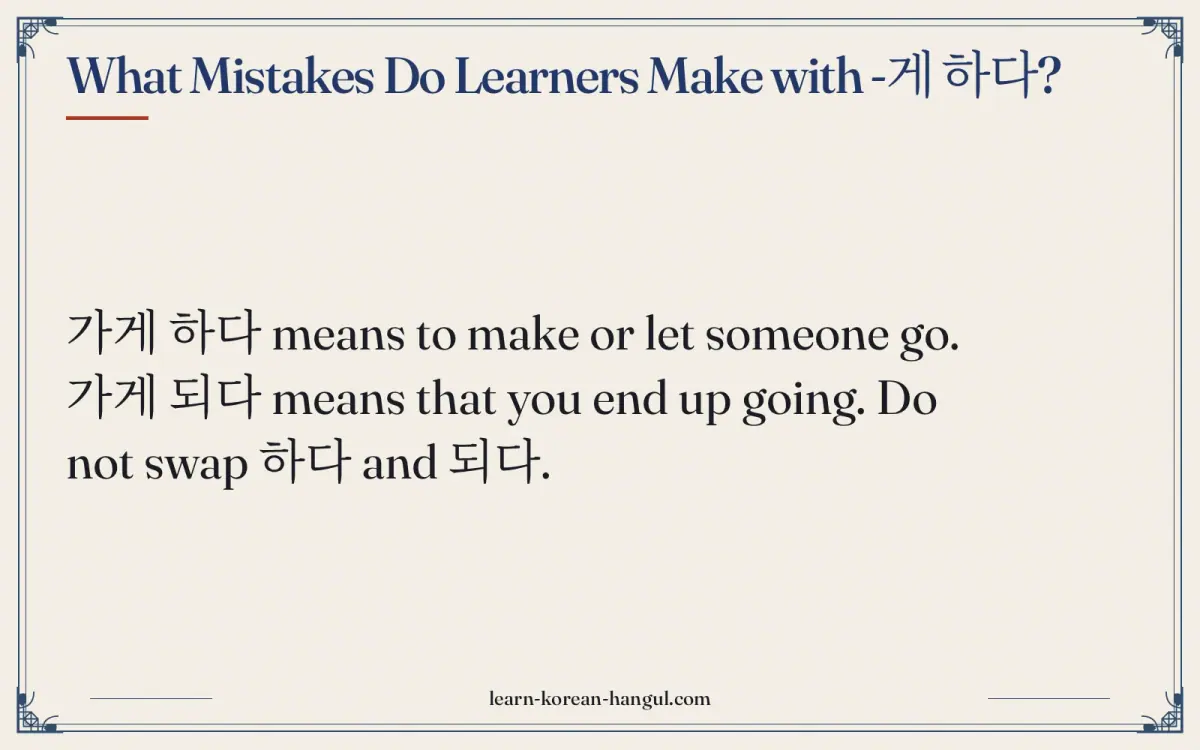
Learners most often forget 게, mix up the roles or choose the wrong last word. Five mistakes appear again and again.
- Leaving out 게. 아이에게 채소를 먹어 해요 is wrong. The causative needs stem + 게: 먹게 해요.
- Making the causee the subject. 아이가 채소를 먹게 해요 says that the child makes someone eat. For "Mom makes the child eat", the causer, 엄마, must be the subject.
- Using -게 되다 for a causative. 한국에 가게 됐어요 means "It turned out that I go to Korea", not "I made someone go". The last word must be 하다.
- Attaching 게 to a noun. 공부게 하다 is wrong. Say 공부하게 하다.
- Leaving "make" and "let" unclear. 아이를 가게 했어요 can mean either. If it matters, add a clue such as 억지로 or 해 주셨어요.
A quick check helps: Is the causer the subject? Is the causee marked with 에게 or 을/를? Does the verb end in 게 하다 and not 게 되다? If all three answers are yes, the sentence is sound.
The practice set tests these points.
Practice and Answers
Try the four items before you read the answers.
- Choose the form. Complete: 엄마가 아이에게 채소를 ___. (먹게 해요 / 먹게 돼요)
- Fix the error. A learner says 아이에게 채소를 먹어 해요. Correct it.
- Translate. "Please let me go." Use 가다 and 하다.
- Write your own. Write one sentence with -게 하다 that means "make" and one that means "let".
Practice · 6
Which sentence means "Mom makes the child eat vegetables"?
Show answer
엄마가 아이에게 채소를 먹게 해요.
The causative needs the stem + 게 + 하다: 먹게 해요.
Which phrase means "Please let me go"?
Show answer
가게 해 주세요.
해 주세요 is the request form of 하다, so 가게 해 주세요 asks for permission.
Which sentence means "The teacher made the students laugh"?
Show answer
선생님이 학생들을 웃게 했어요.
웃다 + 게 하다 is 웃게 하다. The students are the causee and take 을/를.
How do you say "make someone study" with -게 하다?
Show answer
공부하게 하다
A noun cannot take 게 directly. Use the verb 공부하다 first: 공부하게 하다.
What does 한국에 가게 됐어요 mean?
Show answer
It turned out that I am going to Korea.
-게 되다 describes a change of situation. -게 하다 is the causative.
Which word pushes the reading of 먹게 했어요 toward "made" rather than "let"?
Show answer
억지로
억지로 means "by force", so 억지로 먹게 했어요 means "made someone eat".
Answer key
- 먹게 해요. The causer is Mom, so the last word must be 하다.
- 아이에게 채소를 먹게 해요. Add 게 to the stem.
- 가게 해 주세요. (gage hae juseyo.) [가게 해 주세요]
- Answers vary. Check that the causer is the subject and that the verb ends in 게 하다. An example: 아빠가 아이에게 억지로 약을 먹게 했어요 ("Dad made the child take the medicine") and 아빠가 아이를 놀게 해 주셨어요 ("Dad let the child play").
If you can complete items 1 to 3 without the key, you can use -게 하다 in conversation. The next section points to related lessons.
What Should You Learn Next after the Causative -게 하다?
After -게 하다, learn the noun causative and then compare the causatives with the passives. This lesson teaches the productive pattern. It does not teach the closed list of suffix pairs or the noun pattern in depth.
- Read -시키다 causative for words like 소개시키다.
- Read causative suffixes 이 히 리 기 우 구 추 for pairs such as 먹이다.
- Read causative vs passive in korean to separate the two ideas.
- Read passive agent 에게 에 의해 to see how the doer is marked in passives.
- Return to the full set of korean passive verbs.
With these steps, the pattern becomes automatic: take the stem, add 게 하다, make the causer the subject, and mark the causee with 에게 or 을/를.
Frequently Asked Questions
What does -게 하다 mean in Korean?
-게 하다 means "make someone do something" or "let someone do something". You attach 게 to a verb or adjective stem and add 하다, as in 먹게 하다 (make or let eat) and 행복하게 하다 (make happy). The person who causes it is the subject.
How do I form -게 하다?
Take the dictionary form, drop 다 to get the stem, add 게 and then 하다. 먹다 gives 먹게 하다, 웃다 gives 웃게 하다 and 가다 gives 가게 하다. Then conjugate 하다 as usual: 먹게 해요, 먹게 했어요, 먹게 할 거예요.
How can I tell "make" from "let"?
The grammar is the same, so use context and extra words. 억지로 (by force) or 반드시 (without fail) suggests "make". 마음대로 (as one likes) or the request form 해 주세요 suggests "let", as in 가게 해 주세요 (please let me go).
What is the difference between -게 하다 and -게 되다?
-게 하다 is causative: someone makes or lets another person act. -게 되다 describes a change of situation that comes about on its own: 한국에 가게 됐어요 means "it turned out that I am going to Korea". The last word, 하다 or 되다, decides the meaning.
When should I use 먹이다 instead of 먹게 하다?
Use the suffix pair when it exists and you do the action for the other person, as in feeding a baby with a spoon: 아기에게 밥을 먹여요. Use 먹게 하다 when the other person does the eating by themselves, or when no suffix pair exists. The two can overlap in everyday use.