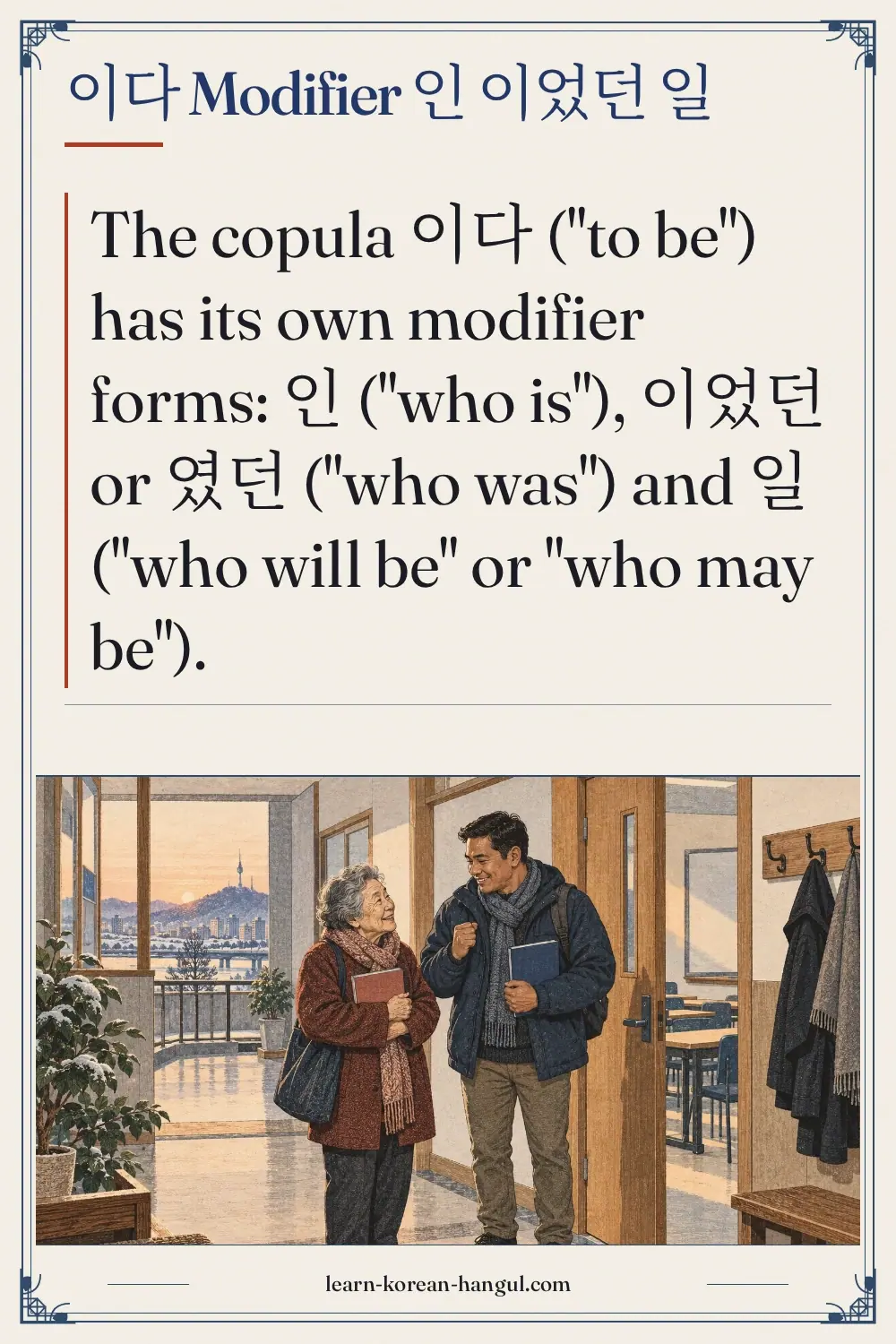
What you'll learn
- Say "a friend who is a student" with 인.
- Say "a father who used to be a doctor" with 이었던 and 였던.
- Use 일 in the patterns 일 때 and 일 거예요.
- Tell the copula 인 apart from the suffix 인 in 한국인.
Prerequisites: 이에요/예요 to be and the modifier endings in -(으)ㄴ adjective and past modifier. Time: about 15 minutes.
Key facts
- 이다 means "to be". Its stem is 이, so the modifier forms are 이 + ㄴ (인), 이 + ㄹ (일) and 이 + 었던 (이었던).
- The word before it is always a noun: 학생, 의사, 친구.
- After a vowel noun the past form contracts to 였던.
- The negative copula 아니다 has its own present form, 아닌.
- The 인 in 한국인 is a different word, the suffix for "person".
Listen to the two model phrases for this lesson.
The next section explains where these forms come from.
What Are the 이다 Modifier Forms 인, 이었던 and 일?
The 이다 modifier forms are the stem 이 plus a modifier ending. 이다 is the copula, the word that links a noun to its description, as in 저는 학생이에요 ("I am a student"). Because 이다 behaves like a verb, it takes the same endings as other verbs: 이 + ㄴ makes 인, and 이 + ㄹ makes 일.
The copula 이다 is not the same as the subject particle 이/가. Both are spelled with 이, but 이다 is attached to a noun and conjugates, while the particle only marks a subject.
A First Example
| Part | 학생인 친구가 있어요. | 의사였던 아버지 |
|---|---|---|
| Noun | 학생 (student) | 의사 (doctor) |
| Modifier | 인 (who is), from 이다 + ㄴ | 였던 (who was), from 이었던 |
| Noun described | 친구가 (a friend, as the subject) | 아버지 (father) |
| Predicate | 있어요 (there is) | none (a noun phrase) |
| Spoken | [학쌩인 친구가 이써요] | [의사엳떤 아버지] |
| RR (aid) | haksaengin chinguga isseoyo | uisayeotdeon abeoji |
| English | I have a friend who is a student. | a father who used to be a doctor |
In both phrases the noun before the modifier tells you what the person is or was. The next section shows how to build each form.
How Do You Form 인, 이었던/였던 and 일?
Attach 인 or 일 directly to the noun, and choose 이었던 or 였던 by the last sound of the noun. A noun that ends in a consonant is followed by 이었던, and a noun that ends in a vowel is followed by the contracted 였던.
| Time | Form | After a consonant noun | After a vowel noun | Meaning |
|---|---|---|---|---|
| Present | 인 | 학생인 친구 | 의사인 아버지 | who is |
| Past | 이었던 / 였던 | 학생이었던 친구 | 의사였던 아버지 | who was |
| Future or guess | 일 | 학생일 때 | 의사일 때 | who will be, who may be |
| Negative present | 아닌 | 학생이 아닌 사람 | 의사가 아닌 사람 | who is not |
The spoken forms follow the usual sound rules. 학생인 sounds like [학쌩인], because ㅅ after a final ㄱ is tense. 선생님인 sounds like [선생니민], because the final ㅁ moves onto the next syllable. 의사였던 sounds like [의사엳떤], because the final ㅆ is said as [ㄷ] and the ㄷ after it is tense.
The variant 이던 also exists: 학생이던 시절 means "the time when I was a student". It looks back at an ongoing past state in the way -던 does, and it is covered in the -던 retrospective modifier lesson.
The next section shows what 인 does that an ordinary adjective does not.
What Does 인 Do That 예쁜 Does Not?
The form 인 names the identity of the noun it describes, so it works like an explanation attached to the noun. An adjective such as 예쁜 describes a quality. A phrase with 인 says what the noun is: 학생인 친구 is "a friend who is a student". This is called apposition (동격), a noun phrase that renames another noun.
Compare three phrases built from the same two nouns.
| Phrase | Structure | Meaning |
|---|---|---|
| 학생 친구 | noun + noun | a student friend (a compound idea) |
| 학생인 친구 | noun + 인 + noun | a friend who is a student |
| 학생의 친구 | noun + 의 + noun | a student's friend |
The most useful pattern for introductions is "my friend, who is X": 제 친구인 민수 means "Minsu, who is my friend", and 한국어 선생님인 김 선생님 means "Teacher Kim, who is a Korean teacher". The phrase before 인 gives the title or role, and the name follows.
The next section builds one phrase step by step.
Worked Example: Building 학생인 친구가 있어요
To say "I have a friend who is a student", start from the noun and add the modifier in five steps.
- Choose the description. The idea is "who is a student", so the noun is 학생.
- Add the copula. 학생 + 이다 means "to be a student".
- Turn it into a modifier. The stem 이 plus ㄴ gives 인, so 학생인 means "who is a student".
- Put the described noun after it. 학생인 친구 means "a friend who is a student".
- Finish the sentence. Add the subject particle 가 and the predicate: 학생인 친구가 있어요.
You'll know it worked when 인 sits between the description and the noun with no particle in the way. For the past, change only step 3: 의사 + 이었던 gives 의사였던 after the contraction, and 의사였던 아버지 is "a father who used to be a doctor".
The next section looks at the patterns that contain these forms.
Which Patterns Use 인 and 일?
Both forms appear in common patterns that you probably know already. In 인 줄, 일 거예요 and 일 수 the modifier is followed by a dependent noun (줄, 거, 수), a noun that always needs a modifier before it. In 일 때 it is followed by the noun 때 ("time"), and in 인데 the ㄴ is part of a connecting ending.
| Pattern | Meaning | Example | Spoken |
|---|---|---|---|
| 인 줄 알았어요 | I thought it was | 학생인 줄 알았어요. | [학쌩인 줄 아라써요] |
| 인데 | background, "it is X, and" | 학생인데 | [학쌩인데] |
| 일 때 | when it is | 학생일 때 | [학쌩일 때] |
| 일 거예요 | will be, probably is | 학생일 거예요. | [학쌩일꺼예요] |
| 일 수 있어요 | could be | 학생일 수 있어요. | [학쌩일쑤 이써요] |
The form 일 is rare before an ordinary noun. Learners do not say 학생일 친구. The reading "a friend who will be a student" would use a verb phrase instead, such as 학생이 될 친구. The patterns on the table are where 일 lives.
The detailed meanings of these patterns are taught elsewhere. For the future guess, see future tense -(으)ㄹ 거예요, and for the past of the copula see 이었어요/였어요 past of 이다.
What this lesson does not cover. It does not cover the full meaning of 인데 and 인지, which are the copula plus -ㄴ데 and -ㄴ지, or the honorific 이신. It also skips 이라는 and 이라고 (quoted forms).
The next section covers the look-alike that causes the most confusion.
Edge Cases: 한국인, 아닌 and 이던
Three details help learners avoid confusion.
The 인 in 한국인 is a different word. It is the suffix 人 that means "person", fused with a country or group name: 한국인 (Korean person), 외국인 (foreigner), 미국인 (American). 한국인 친구 means "a Korean friend". To say "a friend who is Korean", use the copula: 한국 사람인 친구. The sound is [한국 사라민 친구].
아니다 has its own modifier. 아니다 means "to be not", and its present modifier is 아닌, as in 학생이 아닌 사람 ("a person who is not a student"). The noun before it takes 이/가, not 이다.
이던 and 이었던 overlap. Both look back at a past state. 학생이던 시절 and 학생이었던 시절 both mean "the days when I was a student". The first stresses the period, and the second states that it is over.
An honest limit: many native speakers prefer the contracted 였던 after a vowel noun, and use 이었던 there only in careful writing. Treat 의사였던 as the normal form.
The next section lists the errors that appear most often.
What Mistakes Do Learners Make with 인, 이었던 and 일?
Learners make six predictable mistakes. Each one has a reason and a fix.
Learners often attach an adjective ending to a noun. Actually the noun needs 이다. Wrong: 학생은 친구, 학생이는 친구. Right: 학생인 친구. Fix: put 이다 between the noun and the modifier ending.
Learners often use 였던 after a consonant. Actually 였던 is only for vowel nouns. Wrong: 학생였던 친구. Right: 학생이었던 친구. Fix: look at the last sound of the noun before choosing.
Learners often use 이었던 after a vowel. Actually the contracted 였던 is the normal form. Weak: 의사이었던 아버지. Better: 의사였던 아버지. Fix: contract after a vowel.
Learners often use 인 for a quality. Actually qualities need an adjective. Wrong: 예쁜인 꽃. Right: 예쁜 꽃. Fix: use 인 only after nouns.
Learners often use the subject particle instead of 이다. Actually the particle 이/가 cannot form a modifier. Wrong: 학생이 친구. Right: 학생인 친구. Fix: ask whether you mean "student friend" (학생 친구) or "friend who is a student" (학생인 친구).
Learners often read the 인 in 한국인 as the copula. Actually it is the suffix 人 inside one noun. 한국인 친구 means "a Korean friend", and no 이다 is involved. Fix: treat 한국인, 외국인 and 미국인 as single nouns, and use 한국 사람인 친구 for "a friend who is Korean".
Practice turns these rules into habits, as the next section shows.
Practice and Answers
Complete the four tasks, then compare your answers with the key.
Task 1: choose the form. Join the noun to the correct form of 이다.
- 선생님 + 인, for "a friend who is a teacher": 선생님___ 친구
- 가수 (singer), for "a sister who used to be a singer": 가수___ 언니
- 대학생 (university student), for "a younger sibling who used to be a university student": 대학생___ 동생
- 회사원 (office worker), for "when I am an office worker": 회사원___ 때
Task 2: fix the error. Each phrase has one mistake. Rewrite it correctly.
- 학생은 친구
- 학생였던 친구
- 의사이었던 아버지 (make it more natural)
Task 3: translate. Write in Korean: "a father who is a doctor" and "a person who is not a student".
Task 4: write your own. Introduce one person you know in the pattern 제 친구인 ___.
Sentence
I have a friend who is a student.
Show answer
학생인 친구가 있어요
Practice · 5
Which phrase means "a friend who is a student"?
Show answer
학생인 친구
인 is the present modifier of 이다. 학생의 친구 would mean a student's friend.
Which phrase means "a father who used to be a doctor"?
Show answer
의사였던 아버지
The past modifier of 이다 is 이었던, contracted to 였던 after a vowel noun such as 의사.
Which form fits "a friend who used to be a student"?
Show answer
학생이었던 친구
After a consonant noun such as 학생 the past form is 이었던. The contraction 였던 is only for vowel nouns.
What is the present modifier of 아니다 (to be not)?
Show answer
아닌
아니다 takes -ㄴ, so 학생이 아닌 사람 means a person who is not a student.
In 한국인 친구, what is the 인?
Show answer
a person suffix inside the noun 한국인
한국인 is one noun that means a Korean person. The copula version is 한국 사람인 친구.
Answer key
- (1) 선생님인 친구 (2) 가수였던 언니 (3) 대학생이었던 동생 (4) 회사원일 때.
- (1) 학생인 친구 (2) 학생이었던 친구 (3) 의사였던 아버지.
- 의사인 아버지. 학생이 아닌 사람.
- Sample answers: 제 친구인 민수, 제 친구인 수진. Any noun phrase plus 인 and a name is correct.
If task 1 was correct, you can choose the form from the last sound. If task 2 was hard, return to the section on the formation rule. The next section points you to the lessons that follow.
Next Lessons after the 이다 Modifier Forms 인, 이었던 and 일
After the 이다 modifier 인 이었던 일, learn the closely related words in 있는 없는 modifier 재미있는, which also take unusual modifier forms. Then review relative clauses in korean to see how longer modifiers work.
The parent page, Noun-Modifying Forms, lists every lesson in this set in learning order.
This lesson covers the three modifier forms of 이다 and the main patterns that contain them. It does not cover 인데, 인지 or the quoted forms in detail. About this page. Last updated 2026-10-09. The Korean text and spoken forms on this page were generated with AI assistance. Romanization follows the Revised Romanization of Korean and is shown only as a learning aid.
Frequently Asked Questions
What do 인, 이었던 and 일 mean? They are the modifier forms of the copula 이다 ("to be"). 인 means "who is", as in 학생인 친구 ("a friend who is a student"). 이었던 or 였던 means "who was", as in 의사였던 아버지 ("a father who used to be a doctor"). 일 means "who will be" or "who may be" and mostly appears in patterns such as 일 때.
How do I form 인, 이었던 and 일? Attach the form straight to the noun. 인 and 일 work after a vowel or a consonant: 의사인, 학생인, 학생일. For the past, use 이었던 after a consonant (학생이었던) and the contracted 였던 after a vowel (의사였던). The negative of 이다 is 아니다, and its present modifier is 아닌.
What is the most common mistake with 인, 이었던 and 일? The most common mistake is attaching -는 or -은 to a noun, as in 학생은 친구 or 학생이는 친구. Those forms do not exist, because 이다 uses 인. The correct phrase is 학생인 친구. A second mistake is writing 학생였던 after a consonant; the correct form is 학생이었던.
How is 인 different from the suffix 인 in 한국인? The 인 in 한국인 is a suffix that means "person" (人), and it is part of a single noun. 한국인 친구 means "a Korean friend". The copula 인 follows a noun and means "who is". 한국 사람인 친구 means "a friend who is Korean". The spelling is the same, but the words and their jobs differ.
Do I use 인, 이었던 and 일 in speech, writing or both? Both. 인 and 일 are common in speech inside patterns such as 학생인데, 학생인 줄 알았어요 and 학생일 때. Full phrases like 제 친구인 민수 are common when introducing people. 이었던 and 였던 sound natural for memories, as in 선생님이었던 분 ("a person who used to be a teacher").