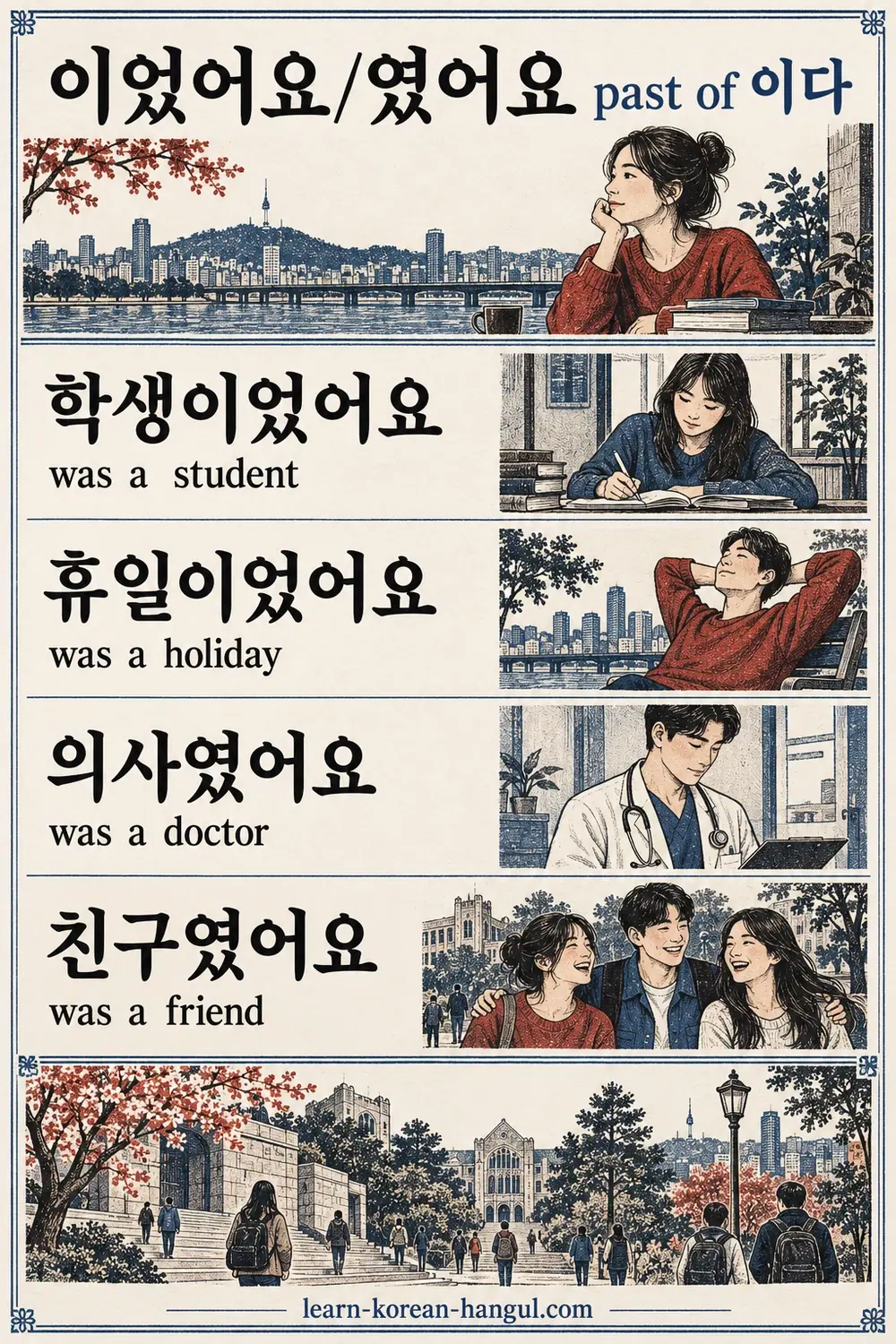
이었어요/였어요 is the polite past form of the Korean copula 이다 ("to be"), used after a noun to say "was" or "were". Add 이었어요 after a noun ending in a consonant (학생이었어요) and 였어요 after a vowel (의사였어요). With the 이었어요/였어요 past of 이다, you can describe people, jobs, days and things in the past.
What you'll learn
- Choose 이었어요 or 였어요 for any noun by checking its final sound.
- Say "was not" with 이/가 아니었어요.
- Recognize the formal, casual and written versions of "was".
- Diagnose and fix the misspelling 학생이였어요.
Before you start: you know 이에요/예요 and the basic past marker -았/었-. Estimated time: 20 minutes.
What Does the 이었어요/였어요 past of 이다 Mean?

The 이었어요/였어요 past of 이다 means "was" or "were" when the thing after "was" is a noun. 학생이었어요 means "was a student"; 휴일이었어요 means "was a holiday". The copula 이다 is the Korean word that links a noun to what it is, like "be" in "I am a student".
Korean treats "to be" with a noun differently from "to be" with an adjective. "I was a student" uses 이다: 학생이었어요. "I was tired" uses the adjective 피곤하다 directly: 피곤했어요. This lesson covers only the noun case.
The form also has no separate words for "I was", "he was" or "they were". 학생이었어요 can mean any of those; the topic or the context tells you who. Korean does not change the verb for the person.
A First Example
The two sentences below show both halves of the rule: a consonant-final noun and a time expression with 이었어요.
- 작년에 저는 학생이었어요. (jangnyeone jeoneun haksaengieosseoyo) [장녀네 저는 학쌩이어써요] = "Last year I was a student." Word by word: 작년에 (last year) + 저는 (I, topic) + 학생 (student) + 이었어요 (was).
- 어제는 휴일이었어요. (eojeneun hyuirieosseoyo) [어제는 휴이리어써요] = "Yesterday was a holiday." Word by word: 어제는 (yesterday, topic) + 휴일 (holiday) + 이었어요 (was).
Both nouns end in a consonant (ㅇ in 학생, ㄹ in 휴일), so both take the full form 이었어요. In speech, the final consonant links into the next syllable: 휴일이 sounds like [휴이리]. The next section explains where this form comes from.
Why Does 이다 Need Its Own past Form?
이다 needs its own lesson because it behaves differently from ordinary verbs. 이다 attaches directly to a noun with no space, and it has a vowel-ending short form after vowels.
Ordinary verbs make the past with the marker -았/었- on the verb stem: 가다 (go) becomes 갔어요, 먹다 (eat) becomes 먹었어요. That general rule is taught in the lesson on past tense -았/었-. 이다 follows the same rule: its stem 이 has the vowel ㅣ, which takes 었, so 이 + 었 + 어요 gives 이었어요.
The difference is what happens after a vowel. A noun such as 의사 (doctor) ends in a vowel, so 의사 + 이었어요 would put two vowels side by side. Korean merges 이 + 었 into one syllable, 였, giving 의사였어요. The present tense does the same thing, which is why you already know 학생이에요 and 의사예요 from the lesson on 이에요/예요 to be. With the origin clear, the next section lays out the rule.
How Does the 이었어요/였어요 past of 이다 Work?
The 이었어요/였어요 past of 이다 is chosen by the last sound of the noun, exactly like the present 이에요/예요. The meaning of the noun plays no part.
- Take the noun you want to describe: 학생, 의사, 휴일.
- Check the last syllable block of the noun.
- If it has a final consonant (받침, batchim), add 이었어요.
- If it ends in a vowel, add 였어요.
- Write it attached to the noun, with no space: 학생이었어요.
Pattern Table
The table shows common nouns with their past forms and pronunciation. Brackets show the sound where it differs from the spelling.
| Noun | Last block ends in | Past of 이다 | Pronunciation | Meaning |
|---|---|---|---|---|
| 학생 | consonant ㅇ | 학생이었어요 | [학쌩이어써요] | was a student |
| 선생님 | consonant ㅁ | 선생님이었어요 | [선생니미어써요] | was a teacher |
| 휴일 | consonant ㄹ | 휴일이었어요 | [휴이리어써요] | was a holiday |
| 회사원 | consonant ㄴ | 회사원이었어요 | [회사워니어써요] | was an office worker |
| 의사 | vowel ㅏ | 의사였어요 | [의사여써요] | was a doctor |
| 친구 | vowel ㅜ | 친구였어요 | [친구여써요] | was a friend |
| 가수 | vowel ㅜ | 가수였어요 | [가수여써요] | was a singer |
| 생일 | consonant ㄹ | 생일이었어요 | [생이리어써요] | was a birthday |
The ending 었어요 always sounds like [어써요], because the double ㅆ links into the next syllable. Once you hear that, the long forms are easier to say.
Why 이었 Becomes 였 after a Vowel
The short form 였 is 이 + 었 said as one syllable. Say 이었 quickly and the two vowels blend into [여]. After a vowel such as the ㅏ in 의사, Korean writes the blended form: 의사였어요.
After a consonant, there is nothing to blend with, so the full 이었 stays: 학생이었어요. The full form also makes the ㅇ at the end of 학생 easier to hear. Standard spelling treats 의사이었어요 as the long version of 의사였어요, but in speech and everyday writing the short form is what you will hear and read.
The Negative past: 아니었어요
The negative past "was not" uses a different word, 아니다, with the subject particle 이/가 on the noun. The noun takes 이 after a consonant and 가 after a vowel.
- 저는 학생이 아니었어요. (jeoneun haksaengi anieosseoyo) [학쌩이 아니어써요] = "I wasn't a student."
- 그 사람은 의사가 아니었어요. = "That person wasn't a doctor."
Unlike 이었어요, 아니었어요 is a separate word with a space before it. The present form is covered in the lesson on 아니에요 not to be. The rule is complete; the next section uses it to build one sentence.
Worked Example, Step by Step

This worked example builds 어제는 휴일이었어요 ("Yesterday was a holiday") from its parts. You are telling a coworker why the office was closed.
- Choose the topic. You are talking about yesterday, so the topic is 어제 + 는 = 어제는. 어제 ends in a vowel, so it takes 는.
- Choose the noun. The thing yesterday was is a holiday: 휴일.
- Check the last sound. 휴일 ends in the consonant ㄹ.
- Pick the form. A consonant ending takes the full form: 휴일 + 이었어요.
- Attach without a space. 휴일이었어요.
- Put it together. Topic first, predicate last: 어제는 휴일이었어요.
- Say it aloud. The ㄹ links forward and ㅆ links into 어요: [어제는 휴이리어써요].
You'll know it worked when you can swap the noun and still choose correctly. Try 제 생일 (my birthday): it ends in ㄹ, so 어제는 제 생일이었어요. Try 토요일 (Saturday): it also ends in ㄹ, so 어제는 토요일이었어요. For a vowel-final noun, try 어릴 때 제 꿈은 의사였어요 = "As a child, my dream was to be a doctor."
The next section compares this form with its closest neighbours.
How Is 이었어요/였어요 Different from Similar Forms?

이었어요/였어요 is the past "was", 이에요/예요 is the present "is", and 아니었어요 is the negative past "was not". All three attach to nouns, but they answer different questions about time and truth.
| Form | Meaning | After a consonant | After a vowel |
|---|---|---|---|
| 이에요/예요 | is, am, are | 학생이에요 | 의사예요 |
| 이었어요/였어요 | was, were | 학생이었어요 | 의사였어요 |
| 이/가 아니에요 | is not | 학생이 아니에요 | 의사가 아니에요 |
| 이/가 아니었어요 | was not | 학생이 아니었어요 | 의사가 아니었어요 |
The same "was" changes shape with the speech level. Polite 이었어요 is the everyday choice. The table below shows the other levels so you can recognize them.
| Speech level | After a consonant | After a vowel | Where you meet it |
|---|---|---|---|
| Polite (해요체) | 학생이었어요 | 의사였어요 | daily conversation with adults |
| Formal (합쇼체) | 학생이었습니다 | 의사였습니다 | presentations, news, announcements |
| Casual (해체) | 학생이었어 | 의사였어 | close friends, younger people |
| Plain written (해라체) | 학생이었다 | 의사였다 | diaries, essays, novels |
The plain written form is taught in plain past -았다/었다. One more neighbour is the double past 이었었어요, which stresses that something was true earlier but is no longer; it belongs to the lesson on past perfect -았었-. With the neighbours sorted, the next section shows when to use the form.
When Do You Use 이었어요/였어요, and When Not?

Use 이었어요/였어요 whenever a noun describes something in the past: a former job, a past day or date, an earlier identity, or a past event. Do not use it with adjectives or action verbs, which make their own past forms.
Four Common Uses
- Past jobs and roles. 전에 저는 선생님이었어요. = "I used to be a teacher."
- Days, dates and events. 어제는 제 생일이었어요. = "Yesterday was my birthday."
- Describing a past thing. 정말 좋은 영화였어요. (jeongmal joeun yeonghwayeosseoyo) = "It was a really good movie."
- Asking about the past. 그 사람은 누구였어요? = "Who was that person?" 뭐였어요? = "What was it?"
When Not to Use It
- With adjectives. "It was good" is 좋았어요, not 좋이었어요. Adjectives such as 좋다 take -았/었- directly.
- With action verbs. "I went" is 갔어요. Verbs never take 이다.
- For a respected subject. When the subject is someone you honour, use the honorific 이셨어요/셨어요: 할아버지는 선생님이셨어요 = "My grandfather was a teacher."
Speech and Writing
The polite form 이었어요/였어요 works in speech and in informal writing such as messages and emails to people you know. Formal writing and announcements switch to 이었습니다/였습니다, and essays and diaries use 이었다/였다. The next section lists the mistakes that appear most often.
What Mistakes Do Learners Make with 이었어요/였어요?

Learners make five predictable mistakes with 이었어요/였어요. Even native speakers make the first one, so it is worth extra attention.
- Writing 학생이였어요. Learners, and many native speakers in casual writing, often assume the ending is 이였어요. Actually the correct spelling is 학생이었어요, because 이 + 었 either stays as 이었 or merges into 였; it never becomes both. 이였 is a spelling error.
- Writing 학생였어요. Learners often use the short form after every noun. Actually 였 is only for vowel-final nouns, because the merge needs a vowel before it. After a consonant, use 이었어요.
- Adding a space. Learners write 학생 이었어요 as if 이었어요 were a separate word. Actually 이다 attaches to the noun, according to the Hangul spelling rules (한글 맞춤법) of the National Institute of Korean Language (국립국어원). Write 학생이었어요.
- Keeping the present with a past time word. Learners say 어제는 휴일이에요. Actually Korean marks the past on the ending even when a time word is present: 어제는 휴일이었어요.
- Using 이었어요 with adjectives. Learners say 피곤이었어요 for "I was tired". Actually 피곤 is a noun, and the natural sentence uses the verb 피곤하다: 피곤했어요.
A quick self-check: if the word before "was" is a noun, use 이었어요/였어요; if it is an adjective, conjugate the adjective. The practice set below tests these points.
Practice and Answers
These four exercises check the outcomes listed at the top of the lesson. Try each one before you read the answers.
Reference Examples
| Noun | Last block ends in | Past of 이다 | Pronunciation | Meaning |
|---|---|---|---|---|
| 학생 | consonant ㅇ | 학생이었어요 | [학쌩이어써요] | was a student |
| 선생님 | consonant ㅁ | 선생님이었어요 | [선생니미어써요] | was a teacher |
| 휴일 | consonant ㄹ | 휴일이었어요 | [휴이리어써요] | was a holiday |
| 회사원 | consonant ㄴ | 회사원이었어요 | [회사워니어써요] | was an office worker |
| 의사 | vowel ㅏ | 의사였어요 | [의사여써요] | was a doctor |
| 친구 | vowel ㅜ | 친구였어요 | [친구여써요] | was a friend |
| 가수 | vowel ㅜ | 가수였어요 | [가수여써요] | was a singer |
| 생일 | consonant ㄹ | 생일이었어요 | [생이리어써요] | was a birthday |
| Form | Meaning | After a consonant | After a vowel |
|---|---|---|---|
| 이에요/예요 | is, am, are | 학생이에요 | 의사예요 |
| 이었어요/였어요 | was, were | 학생이었어요 | 의사였어요 |
| 이/가 아니에요 | is not | 학생이 아니에요 | 의사가 아니에요 |
| 이/가 아니었어요 | was not | 학생이 아니었어요 | 의사가 아니었어요 |
| Speech level | After a consonant | After a vowel | Where you meet it |
|---|---|---|---|
| Polite (해요체) | 학생이었어요 | 의사였어요 | daily conversation with adults |
| Formal (합쇼체) | 학생이었습니다 | 의사였습니다 | presentations, news, announcements |
| Casual (해체) | 학생이었어 | 의사였어 | close friends, younger people |
| Plain written (해라체) | 학생이었다 | 의사였다 | diaries, essays, novels |
Practice · 8
Fill the gap: 가수__ (was a singer)
Show answer
였어요
가수 ends in a vowel, so 이 + 었 merges into 였. 이였 is a spelling error, and 예요 is the present.
Fill the gap: 회사원__ (was an office worker)
Show answer
이었어요
회사원 ends in the consonant ㄴ, so it takes the full form 이었어요. 였 is only for vowel-final nouns.
Which sentence is written correctly?
Show answer
저는 학생이었어요.
이 + 었 stays as 이었 after a consonant and never becomes 이였. 이다 attaches to the noun with no space.
Which sentence means "I wasn't a student"?
Show answer
저는 학생이 아니었어요.
"Was not" uses 아니다 in the past, with 이/가 on the noun. 아니에요 is the present "is not".
How do you say "It was good"?
Show answer
좋았어요.
좋다 is an adjective, so it takes -았/었- directly. 이었어요/였어요 is only for nouns.
Which sentence means "Yesterday was a holiday"?
Show answer
어제는 휴일이었어요.
The past must be marked on the ending, and 휴일 ends in ㄹ, so it takes 이었어요.
Which is the formal (합쇼체) past of 학생이다?
Show answer
학생이었습니다
Formal speech uses 이었습니다/였습니다. 학생이었어 is casual, and 학생이었다 is the plain written style.
Which form fits a respected subject, as in "My grandfather was a teacher"?
Show answer
the honorific 이셨어요/셨어요
For someone you honour, use the honorific: 할아버지는 선생님이셨어요.
Exercise 1: Choose the form. Add 이었어요 or 였어요.
- 가수__ (singer)
- 회사원__ (office worker)
- 숙제__ (homework)
- 일요일__ (Sunday)
Exercise 2: Fix the error. Each sentence has one mistake.
- 저는 학생이였어요.
- 어제는 토요일 이었어요.
Exercise 3: Translate. "That was my bag." (that = 그건, my = 제, bag = 가방)
Exercise 4: Write your own. Write one sentence about a job you, or someone you know, used to have. Start with 전에 (before).
Answer Key
- Exercise 1: 1 가수였어요 (vowel). 2 회사원이었어요 (ㄴ) [회사워니어써요]. 3 숙제였어요 (vowel). 4 일요일이었어요 (ㄹ) [이료이리어써요].
- Exercise 2: 1 저는 학생이었어요. 이였 is a spelling error; after a consonant, use 이었. 2 어제는 토요일이었어요. 이다 attaches to the noun with no space.
- Exercise 3: 그건 제 가방이었어요. (geugeon je gabangieosseoyo) 가방 ends in ㅇ, so it takes 이었어요.
- Exercise 4: One model answer: 전에 제 언니는 간호사였어요. = "My older sister used to be a nurse." 간호사 ends in a vowel, so it takes 였어요. Any job noun is correct with the right form.
If you missed Exercise 1, reread the pattern table. If you missed Exercise 2, reread mistakes 1 and 3. The next section shows where to go next.
Next Lessons and Where to Go from Here
The next step is how to conjugate korean verbs in past tense, which applies the same -았/었- logic to action verbs and adjectives, including irregular ones. For a full table of every form of 이다 and 아니다, use the reference page on korean ida conjugation.
What this lesson does not cover. This lesson does not cover the past of adjectives and action verbs, the honorific past in depth, or the double past 이었었어요 beyond a short mention. Those topics are in the other lessons of korean past tense.
In short, the 이었어요/였어요 past of 이다 turns "is" into "was" after a noun: 이었어요 after a consonant, 였어요 after a vowel, and 이/가 아니었어요 for "was not".
Frequently Asked Questions
How do I say "it was" in Korean? Use the noun plus 이었어요 or 였어요, and leave "it" out. 좋은 영화였어요 means "It was a good movie", and 제 실수였어요 means "It was my mistake". Korean does not need a word for it when the context is clear. If the thing was an adjective, such as good or fun, conjugate the adjective instead: 좋았어요, 재미있었어요.
Is 의사이었어요 wrong? 의사이었어요 is the long, unmerged version of 의사였어요, and it is not a spelling error in the way 이였어요 is. In everyday speech and writing, however, Koreans almost always use the short form after a vowel. Use 의사였어요 in your own Korean, and simply recognize the long version if you see it.
How do I ask "Who was that?" or "What was it?" Attach the past of 이다 to the question word. 누구 ends in a vowel, so "Who was it?" is 누구였어요? 뭐 also ends in a vowel, so "What was it?" is 뭐였어요? For a place, 어디였어요? means "Where was it?" The answers follow the same rule: 제 친구였어요, 선물이었어요.
Do I use 이었어요/였어요 in speech, writing or both? Both, in informal situations. 이었어요/였어요 is the everyday polite form for conversation, text messages and friendly emails. Formal writing, news and presentations use 이었습니다/였습니다, and diaries, essays and novels use the plain form 이었다/였다. With close friends, drop the 요: 학생이었어, 의사였어.
What is the difference between 이었어요 and 이었었어요? 이었어요 simply says something was true in the past. 이었었어요, the double past, stresses that it was true earlier but is no longer, and often that it was further back in time. 전에 선생님이었었어요 suggests "I used to be a teacher, but not any more". Beginners can use 이었어요 for both meanings.