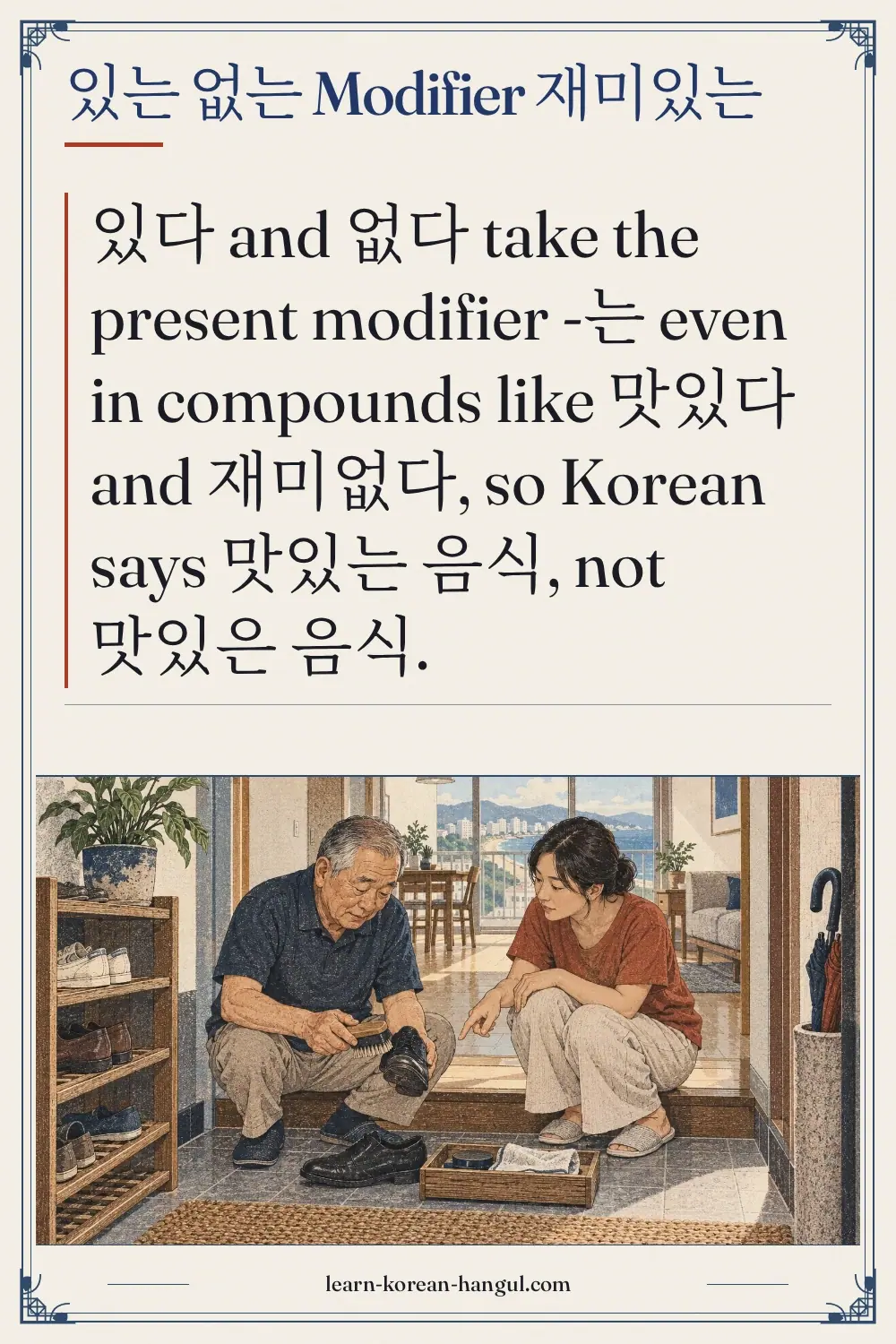
What you'll learn
- Use 있는 and 없는 to describe people, places and things.
- Say 맛있는, 멋있는, 재미있는, 맛없는 and 재미없는 correctly.
- Show past and future with 있었던, 있던 and 있을.
- Avoid the classic errors 맛있은 and 괜찮는.
Prerequisites: the meaning of 있다 and 없다 from 있어요 없어요 meaning and the form -(으)ㄴ from -(으)ㄴ adjective and past modifier. Time: about 15 minutes.
Key facts
- 있다 means "to exist, to be there, to have", and 없다 means "to not exist, to lack".
- Their modifier forms are 있는 and 없는, built with -는.
- Every word that ends in 있다 or 없다 behaves the same way: 맛있는, 멋있는, 재미있는, 재미없는.
- 괜찮다 is the main look-alike. It is a true adjective and takes 은: 괜찮은.
- The form is the same in casual, polite and formal speech.
Listen to the two model phrases for this lesson.
The next section defines the modifier and shows it in use.
What Is the 있는 없는 Modifier?
The 있는 없는 modifier is the noun-describing form of 있다 and 없다. A modifier is a form that stands before a noun and describes it. 있다 and 없다 can show three kinds of meaning, and the modifier follows all three.
| Meaning | With 있는 | With 없는 |
|---|---|---|
| Being somewhere | 집에 있는 사람 (the person at home) | 집에 없는 사람 (the person not at home) |
| Having | 돈이 있는 사람 (a person who has money) | 시간이 없는 사람 (a person who has no time) |
| A quality (compounds) | 맛있는 음식 (tasty food) | 재미없는 영화 (a boring movie) |
A First Example
| Part | 맛있는 음식 | 재미없는 영화 |
|---|---|---|
| Compound word | 맛있다 (be tasty) | 재미없다 (be boring) |
| Parts | 맛 (taste) + 있다 (exist) | 재미 (fun) + 없다 (not exist) |
| Modifier | 맛있는 | 재미없는 |
| Noun | 음식 (food) | 영화 (movie) |
| Spoken | [마신는 음식] | [재미엄는 영화] |
| RR (aid) | masinneun eumsik | jaemieomneun yeonghwa |
| English | tasty food | a boring movie |
The compound 맛있다 is literally "taste exists", and 재미없다 is literally "fun does not exist". That literal meaning explains the next section.
Why Do 있다 and 없다 Take -는?
Korean treats 있다 and 없다 like action verbs when they take a modifier, so they use -는. The usual rule gives -는 to action verbs and -(으)ㄴ to adjectives, as the lessons on -는 noun modifier and -(으)ㄴ adjective and past modifier explain. 있다 and 없다 are existence words, and they follow the action-verb pattern.
The consequence reaches every compound. 맛있다 ends in 있다, so it takes -는. 예쁘다 does not end in 있다, so it takes -(으)ㄴ.
| Word | Type | Modifier | Meaning |
|---|---|---|---|
| 맛있다 | ends in 있다 | 맛있는 | tasty |
| 예쁘다 | adjective | 예쁜 | pretty |
| 먹다 | action verb | 먹는 | that someone eats |
| 괜찮다 | adjective | 괜찮은 | decent, fine |
An honest note: Korean dictionaries and school grammar describe 있다 and 없다 in more than one word class, and learner books also differ. This page does not try to settle that debate. The practical rule has no exceptions in everyday use: 있다 and 없다, and every word that ends in them, take -는. A longer discussion is on Korean 있다 and 없다 Adjectives.
The next section lists the words that follow this rule.
Which Words Take the 있는 없는 Modifier, Like 재미있는?
Twelve words cover most of the cases. All of them end in 있다 or 없다, so all of them take -는.
| Word | Meaning | Modifier | Spoken | Example |
|---|---|---|---|---|
| 맛있다 | be tasty | 맛있는 | [마신는] (also [마딘는]) | 맛있는 음식 |
| 맛없다 | be not tasty | 맛없는 | [마덤는] | 맛없는 커피 |
| 멋있다 | be cool, stylish | 멋있는 | [머신는] (also [머딘는]) | 멋있는 사람 |
| 재미있다 | be fun | 재미있는 | [재미인는] | 재미있는 영화 |
| 재미없다 | be boring | 재미없는 | [재미엄는] | 재미없는 책 |
| 관심 있다 | be interested | 관심 있는 | [관심 인는] | 관심 있는 사람 |
| 의미 있다 | be meaningful | 의미 있는 | [의미 인는] | 의미 있는 일 |
| 상관없다 | not matter | 상관없는 | [상과넘는] | 상관없는 일 |
| 관계없다 | be unrelated | 관계없는 | [관계엄는] | 관계없는 사람 |
| 필요 없다 | be unnecessary | 필요 없는 | [피료 엄는] | 필요 없는 물건 |
| 쓸데없다 | be useless | 쓸데없는 | [쓸데엄는] | 쓸데없는 말 |
| 있다 / 없다 | exist / not exist | 있는 / 없는 | [인는] / [엄는] | 집에 있는 사람 |
Notice the spacing. 맛있다, 멋있다, 재미있다, 재미없다, 상관없다, 관계없다 and 쓸데없다 are single words. 관심 있다, 의미 있다 and 필요 없다 are written as two words in a dictionary, and the modifier keeps the space: 관심 있는 사람.
The sound change is regular. The final ㅆ of 있는 is said as [ㄷ], and ㄷ before ㄴ becomes [ㄴ], so 있는 sounds like [인는]. 없는 sounds like [엄는], because ㅂ before ㄴ becomes [ㅁ]. The word 맛있는 has two accepted readings under the Standard Pronunciation Rules (표준 발음법): [마신는] and [마딘는]. The first is common in speech.
The next section builds a sentence step by step.
Worked Example: Building 맛있는 음식이 많아요
To say "There is a lot of tasty food", start from the word 맛있다 and build the phrase in five steps.
- Pick the word. The idea is "tasty", so the word is 맛있다.
- Check the ending. 맛있다 ends in 있다, so the modifier ending is -는.
- Take off 다. The stem is 맛있-.
- Add 는. 맛있 + 는 gives 맛있는.
- Put the noun after it. 맛있는 음식 means "tasty food". Add 이 and 많아요 to finish: 맛있는 음식이 많아요.
You'll know it worked when the modifier sits directly in front of the noun and ends in 는, not 은. Replace 맛있다 with 재미없다, and the same method gives 재미없는 영화. The adverb form is different: 맛있게 드세요 uses -게, as the lesson adverb -게 in korean explains.
The next section covers the other times.
How Do 있다 and 없다 Show past and Future?
The past and future forms use -던, -았/었던 and -(으)ㄹ. The present is -는, as in all the examples so far. The other times work like those of any other verb.
| Time | Form | Example | Meaning |
|---|---|---|---|
| Present | 있는 / 없는 | 집에 있는 사람 | the person who is at home |
| Past (a finished event) | 있었던 | 어제 있었던 일 | what happened yesterday |
| Past (a remembered state) | 있던 | 책상 위에 있던 책 | the book that was on the desk |
| Past (a quality) | 맛있었던 / 맛있던 | 맛있었던 음식 | food that was tasty |
| Future | 있을 / 없을 | 있을 곳 | a place to stay |
The retrospective -던 has its own lesson, -던 retrospective modifier, and the future -(으)ㄹ is in -(으)ㄹ future modifier. 있었던 일 is a very common phrase for "what happened", and it is [어제 이썯떤 일].
The next section looks at the words that cause confusion.
Edge Cases: 괜찮은, 보이는 and 없는 for "Without"
Three details help learners sound natural.
괜찮다 is a true adjective. It does not end in 있다 or 없다, so it follows the adjective rule: 괜찮은 사람 means "a decent person" and is pronounced [괜차는 사람]. The form 괜찮는 is wrong. Learners guess it because 괜찮다 feels like a close cousin of 있다.
Looking tasty uses 보이다. 맛있어 보이는 음식 means "food that looks tasty". The modifier is 보이는, from the verb 보이다, and it takes the ending -는 as an action verb does.
없는 means "without". 설탕 없는 커피 means "coffee without sugar" and 이름 없는 길 means "a road without a name". The noun that is missing comes before 없는, and the described noun comes after.
What this lesson does not cover. It does not cover the honorific 계시는 and 안 계시는, or the question of which compounds are single words. A dictionary is the best check.
An honest limit. Some learners hear 맛있는 pronounced [마딘는] and think they heard a different word. Both readings are standard, and the choice is mostly personal.
The next section lists the errors that appear most often.
What Mistakes Do Learners Make with 있는/없는?
Learners make five predictable mistakes. Each one has a reason and a fix.
Learners often give 맛있다 the adjective ending. Actually it ends in 있다. Wrong: 맛있은 음식. Right: 맛있는 음식. Fix: check the last two syllables of the word.
Learners often give 재미없다 the adjective ending. Actually it ends in 없다. Wrong: 재미없은 영화. Right: 재미없는 영화. Fix: the same check works for every 없다 word.
Learners often give 괜찮다 the -는 ending. Actually 괜찮다 is a true adjective. Wrong: 괜찮는 사람. Right: 괜찮은 사람. Fix: learn 괜찮은 as a set form.
Learners often put 없는 first, as in English "no". Actually the missing noun comes first. Wrong: 없는 시간 for "a person with no time". Right: 시간이 없는 사람. Fix: put the noun with 이/가 before 없는, then the person or thing it describes. 없는 시간 means "time that does not exist".
Learners often use the polite ending as a modifier. Actually a modifier needs the bare ending. Wrong: 있어요 사람, 맛있어요 음식. Right: 있는 사람, 맛있는 음식. Fix: remove 요, and use -는.
Practice turns these rules into habits, as the next section shows.
Practice and Answers
Complete the four tasks, then compare your answers with the key.
Task 1: choose the form. Write the modifier form before the noun.
- 재미있다 + 책
- 맛없다 + 커피
- 있다 + 사람, for "the person who is in the room" (방에 ___ 사람)
- 괜찮다 + 식당 (restaurant)
Task 2: fix the error. Each phrase has one mistake. Rewrite it correctly.
- 멋있은 사람
- 괜찮는 식당
- 맛있어요 음식
Task 3: translate. Write in Korean: "a boring movie" and "a person who has money".
Task 4: write your own. Describe your favourite food with 맛있는 and a noun.
Sentence
There is a lot of tasty food.
Show answer
맛있는 음식이 많아요
Practice · 5
Which phrase means "tasty food"?
Show answer
맛있는 음식
Words that end in 있다 take -는.
Which phrase is correct for "a decent person"?
Show answer
괜찮은 사람
괜찮다 does not end in 있다 or 없다. It is a true adjective, so it takes 은 after the consonant.
How do you say "a person who has no time"?
Show answer
시간이 없는 사람
The missing noun with 이/가 comes first, then 없는, then the person described.
Which phrase means "what happened yesterday"?
Show answer
어제 있었던 일
-았/었던 is the usual past modifier for 있다 when you recall an event: 어제 있었던 일.
How is 있는 usually pronounced?
Show answer
[인는]
The final ㅆ is said as [ㄷ], and ㄷ before ㄴ turns into [ㄴ].
Answer key
- (1) 재미있는 책 (2) 맛없는 커피 (3) 방에 있는 사람 (4) 괜찮은 식당.
- (1) 멋있는 사람 (2) 괜찮은 식당 (3) 맛있는 음식.
- 재미없는 영화. 돈이 있는 사람.
- Sample answers: 맛있는 김치찌개, 맛있는 불고기. Any food with 맛있는 before it is correct.
If task 1 was correct, you can choose -는 for 있다 words. If task 2 was hard, return to the section on edge cases. The next section points you to the lessons that follow.
Next Lessons after the 있는 없는 Modifier
After the 있는 없는 modifier, review the whole system in -는 vs -(으)ㄴ vs -(으)ㄹ, and see how a whole clause can modify a noun in relative clauses in korean. The copula has its own forms in 이다 modifier 인 이었던 일.
The parent page, Noun-Modifying Forms, lists every lesson in this set in learning order.
This lesson covers the modifier forms of 있다, 없다 and their compounds. It does not cover the honorific forms or the spacing rules in detail. About this page. Last updated 2026-10-09. The Korean text and spoken forms on this page were generated with AI assistance. Romanization follows the Revised Romanization of Korean and is shown only as a learning aid.
Frequently Asked Questions
What does 있는/없는 mean? 있는 means "that exists, that is there, that has" and 없는 means "that does not exist, that is not there, that lacks". They describe a noun that follows. 집에 있는 사람 is "the person who is at home", and 시간이 없는 사람 is "a person who has no time". Words ending in 있다 or 없다 use the same endings.
How do I form 있는/없는? Take the stem of 있다 or 없다 and add -는, which gives 있는 and 없는. A compound keeps its first part: 맛 + 있는 gives 맛있는, and 재미 + 없는 gives 재미없는. The form never changes with the last sound of the stem, because -는 attaches the same way to every stem.
What is the most common mistake with 있는/없는? The most common mistake is writing 맛있은 or 재미없은, because these words feel like adjectives. Words that end in 있다 or 없다 take -는, so the correct forms are 맛있는 음식 and 재미없는 영화. The second mistake is using -는 on 괜찮다, which is a true adjective and takes 은: 괜찮은 사람.
How is 있는/없는 different from 예쁜 and 괜찮은? 예쁜 and 괜찮은 are adjectives, and adjectives use -(으)ㄴ for the present. 있는 and 없는 belong to 있다 and 없다, which use -는 even when the meaning feels like a quality. 맛있는 음식 means "tasty food" and 예쁜 꽃 means "a pretty flower", but the two endings differ.
Do I use 있는/없는 in speech, writing or both? Both. 맛있는, 재미있는 and 재미없는 are among the most common modifiers in everyday conversation, and 있는 and 없는 appear in writing at every level. The forms stay the same in casual, polite and formal speech. In speech 있는 sounds like [인는], and 없는 sounds like [엄는].