What you'll learn
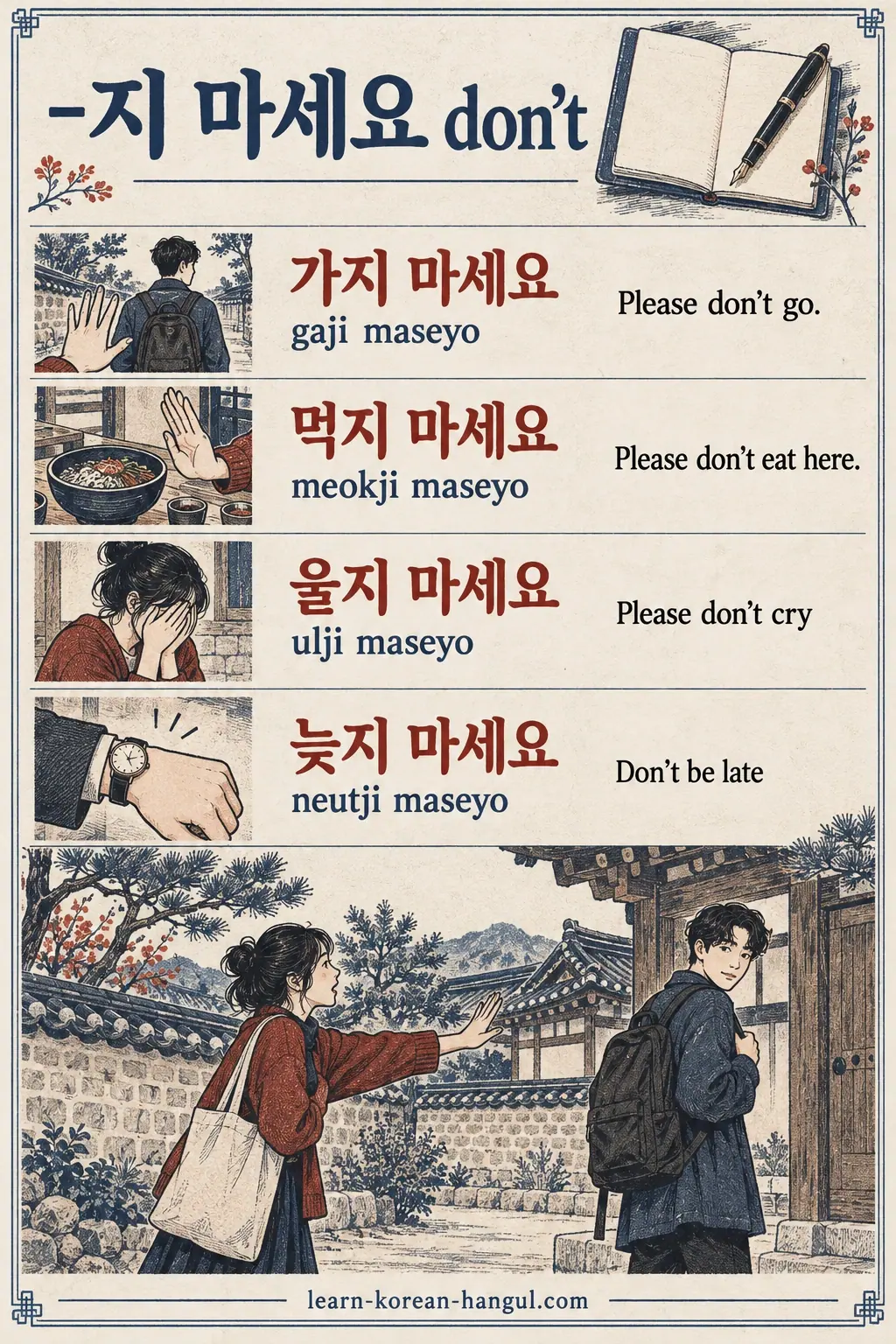
- Build a polite prohibition from any action verb: 가다 becomes 가지 마세요.
- Choose the right ending for a stranger, a friend or a sign.
- Explain why 안 가세요 does not mean "don't go."
- Recognise the ㄹ-drop in 마세요 and the ㄹ that stays in 말자.
- Soften a prohibition with -지 말아 주세요.
Before you start: you should know how to find a verb stem (remove 다 from the dictionary form: 가다 → 가, 먹다 → 먹) and the polite ending -아요/-어요. Audio plays only when you press a button.
What Does -지 마세요 Don't Mean?

-지 마세요 means "please do not" or "don't." It tells another person to stop an action or to avoid it. The pattern has three parts: the verb stem, the link -지, and 마세요, which comes from the verb 말다 ("to refrain") with the polite honorific ending -(으)세요.
Because the ending 세요 shows respect, -지 마세요 is safe with strangers, shop staff and older people. The word "polite" here means the 해요체 style, which learners meet first.
Two First Examples
Here are two common sentences, each with a Revised Romanization (RR) aid. RR is South Korea's official Latin spelling, and it is only a guide here.
- 여기서 사진을 찍지 마세요. (yeogiseo sajineul jjikji maseyo.) = "Please do not take photos here." The verb is 찍다 (to take, to snap), the stem is 찍, and 찍지 is pronounced [찍찌].
- 걱정하지 마세요. (geokjeonghaji maseyo.) = "Do not worry." The verb is 걱정하다 (to worry), pronounced [걱쩡하지 마세요].
Both sentences end with 지 마세요 and keep the stem unchanged. The next section shows exactly how the pattern is built and how it changes at other politeness levels.
How Does -지 마세요 Work?
-지 마세요 works by attaching to the verb stem, not to the finished polite form. Take the dictionary form, remove 다, add 지, then add 마세요. No other change to the stem happens, which makes the pattern easy: no vowel harmony, no irregular stems.
| Dictionary form | Stem | + 지 | Polite prohibition |
|---|---|---|---|
| 가다 (to go) | 가 | 가지 | 가지 마세요 (gaji maseyo) |
| 먹다 (to eat) | 먹 | 먹지 | 먹지 마세요 (meokji maseyo) |
| 울다 (to cry) | 울 | 울지 | 울지 마세요 (ulji maseyo) |
| 늦다 (to be late) | 늦 | 늦지 | 늦지 마세요 (neutji maseyo) |
| 잊다 (to forget) | 잊 | 잊지 | 잊지 마세요 (itji maseyo) |
| 걱정하다 (to worry) | 걱정하 | 걱정하지 | 걱정하지 마세요 |
Korean uses 늦다 and 울다 as verbs, so they fit the pattern directly. The pattern ignores whether the stem ends in a vowel or a consonant.
Endings by Speech Level
The ending changes with politeness, and the base idea stays the same: stem + 지 + a form of 말다. The table lists the five forms you will meet.
| Style | Form | Example | Meaning | Used with |
|---|---|---|---|---|
| Polite (해요체) | -지 마세요 | 가지 마세요 | Please don't go. | strangers, shops, older people |
| Formal (합쇼체) | -지 마십시오 | 만지지 마십시오 | Do not touch. | signs, announcements, formal speech |
| Casual (해체) | -지 마 | 가지 마 | Don't go. | close friends, younger people |
| Plain (해라체) | -지 마라 | 가지 마라 | Do not go. | books, quotations, strong orders |
| Suggestion | -지 말자 | 가지 말자 | Let's not go. | friends, a group including you |
Here is the point learners often miss: the ㄹ of 말다 disappears before ㅅ in 마세요 and 마십시오, but it stays in 말자. The casual 마 is a shortened form of 말아, and both 마 and 말아 are accepted as standard. The drop before ㅅ is the regular ㄹ-drop of Korean verbs that end in ㄹ, the same change you see when 살다 (to live) becomes 사세요. You do not need to memorise a new rule, only to recognise that 마세요 is 말다 in disguise.
Before you build a full sentence, check how the ending sounds.
Pronunciation of -지 마세요
-지 마세요 is pronounced [지 마세요], but the 지 sounds like [찌] after many consonant stems. This is tensification, a sound change described in the National Institute of Korean Language (국립국어원) standard pronunciation rules: after the final sounds ㄱ, ㄷ and ㅂ, the next ㅈ becomes a tense sound (Article 23). Verb stems ending in ㄴ or ㅁ also tense it (Article 24): 신지 마세요 [신찌 마세요], "don't wear them". Stems ending in ㄹ, such as 울, do not: 울지 is [울지]. The spelling does not change, so you only hear it.
- After a vowel stem there is no change: 가지 마세요 is [가지 마세요].
- After 먹 (ending in ㄱ): 먹지 is [먹찌].
- After 늦 and 잊 (ending in ㅈ, which is pronounced like ㄷ at the end of a syllable): 늦지 is [늗찌] and 잊지 is [읻찌].
Revised Romanization (RR) does not write this tensification, which is why 먹지 is romanized as meokji. Listen first and copy the rhythm.
Worked Example: Building a Sentence with -지 마세요
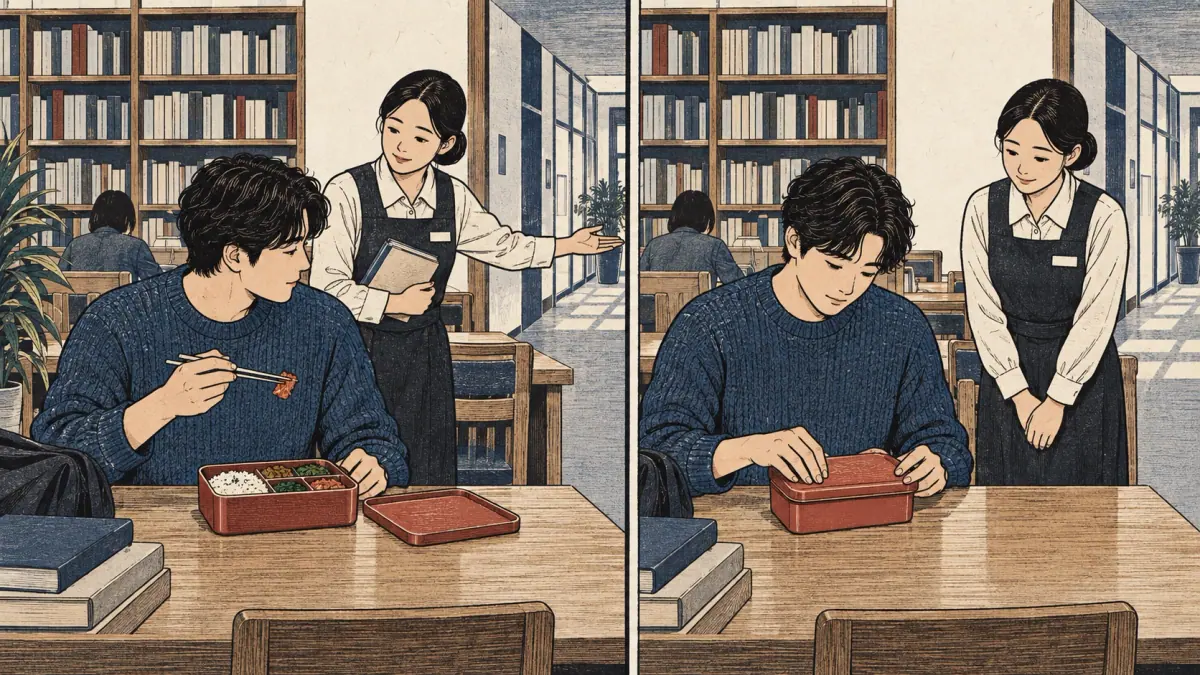
Follow the steps to turn the plain sentence "You eat here" into "Please don't eat here."
- Start with the verb. The dictionary form is 먹다. The verb should be an action. The sentence is 여기서 먹어요. (yeogiseo meogeoyo.) = "I/you eat here."
- Find the stem. Remove 다 from 먹다 to get 먹.
- Add -지. The stem plus 지 gives 먹지. You will know it worked when the new word sounds like [먹찌].
- Add 마세요. The result is 먹지 마세요.
- Put the sentence in order. Korean verbs come last, so the finished sentence is 여기서 먹지 마세요. (yeogiseo meokji maseyo.) = "Please don't eat here."
Reference Examples
| Dictionary form | Stem | + 지 | Polite prohibition |
|---|---|---|---|
| 가다 (to go) | 가 | 가지 | 가지 마세요 (gaji maseyo) |
| 먹다 (to eat) | 먹 | 먹지 | 먹지 마세요 (meokji maseyo) |
| 울다 (to cry) | 울 | 울지 | 울지 마세요 (ulji maseyo) |
| 늦다 (to be late) | 늦 | 늦지 | 늦지 마세요 (neutji maseyo) |
| 잊다 (to forget) | 잊 | 잊지 | 잊지 마세요 (itji maseyo) |
| 걱정하다 (to worry) | 걱정하 | 걱정하지 | 걱정하지 마세요 |
| Style | Form | Example | Meaning | Used with |
|---|---|---|---|---|
| Polite (해요체) | -지 마세요 | 가지 마세요 | Please don't go. | strangers, shops, older people |
| Formal (합쇼체) | -지 마십시오 | 만지지 마십시오 | Do not touch. | signs, announcements, formal speech |
| Casual (해체) | -지 마 | 가지 마 | Don't go. | close friends, younger people |
| Plain (해라체) | -지 마라 | 가지 마라 | Do not go. | books, quotations, strong orders |
| Suggestion | -지 말자 | 가지 말자 | Let's not go. | friends, a group including you |
| Form | Meaning | Type | Example |
|---|---|---|---|
| 가지 마세요 | Please don't go. | command | 지금 가지 마세요. |
| 안 가세요? | Aren't you going? / You don't go. | statement or question | 내일 안 가세요? |
| 가지 않으세요? | Aren't you going? (longer, more formal) | statement or question | 내일 가지 않으세요? |
| 못 가세요 | You cannot go. | statement | 오늘은 못 가세요. |
A typical slip at step 3 is to start from the polite form 먹어요 and write 먹어요지 마세요. The pattern attaches to the bare stem, so remove 다 only. If you can say the sentence without the ending 요 in the middle, the build is correct. Next, the question is how this pattern differs from the negatives you already know.
How Is -지 마세요 Different from Similar Forms?

-지 마세요 is a command, while 안 -(으)세요 and -지 않으세요 are statements or questions. This difference decides the meaning, so check it before you speak. The comparison table uses 가다 (to go) and the honorific ending.
| Form | Meaning | Type | Example |
|---|---|---|---|
| 가지 마세요 | Please don't go. | command | 지금 가지 마세요. |
| 안 가세요? | Aren't you going? / You don't go. | statement or question | 내일 안 가세요? |
| 가지 않으세요? | Aren't you going? (longer, more formal) | statement or question | 내일 가지 않으세요? |
| 못 가세요 | You cannot go. | statement | 오늘은 못 가세요. |
The key point is that 안 and 못 only describe facts. Neither can tell someone what to do. The lesson on 안 negation in Korean explains 안 sentences, and banmal commands and suggestions shows the casual commands. For the formal positive command, see formal commands -(으)십시오. The honorific -(으)세요 inside 마세요 is explained in honorific -(으)시-.
With the contrast clear, the next question is where the pattern fits and where it does not.
When Do You Use -지 마세요, and When Not?

Use -지 마세요 to ask someone to stop or avoid an action, and avoid it when you want to give the reason for a refusal or to describe your own habits. It has four common uses and three limits.
Common uses
- Signs and rules: 문을 열지 마세요 (Do not open the door) and 만지지 마십시오 (Do not touch).
- Advice and comfort: 울지 마세요 (Please don't cry), 걱정하지 마세요 (Don't worry).
- Reminders: 잊지 마세요 (Don't forget), 늦지 마세요 (Don't be late).
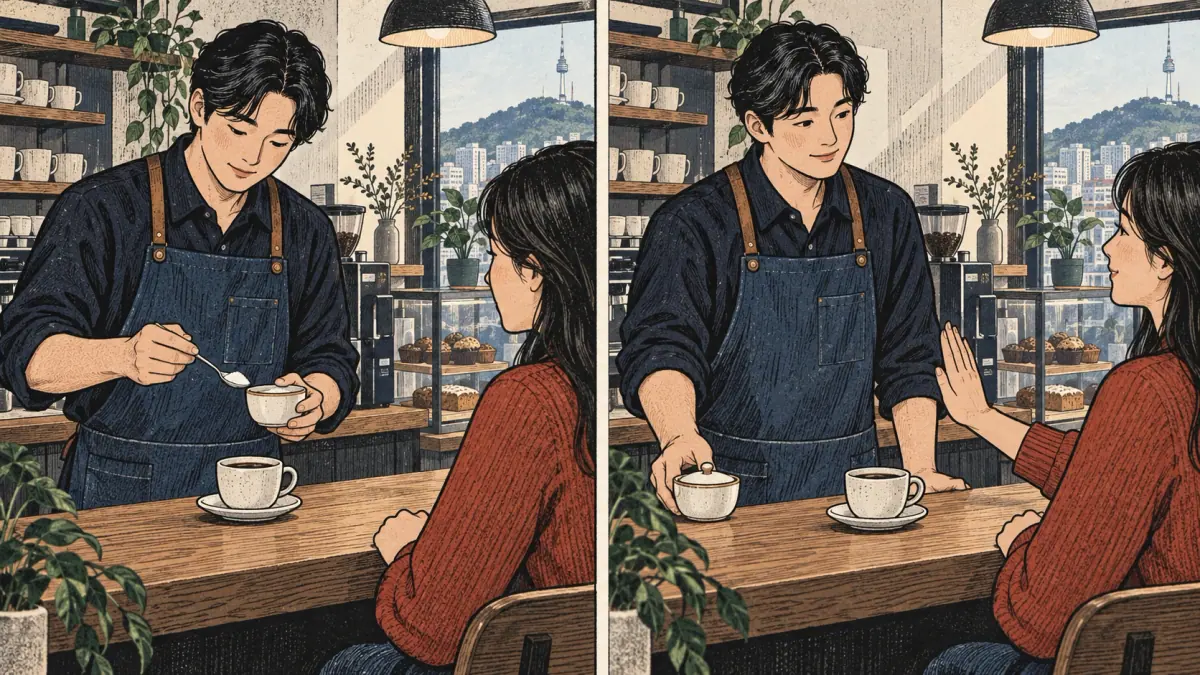
- Requests to a service person: 설탕을 넣지 마세요 (Please don't add sugar).
Limits and edge cases
- Softer requests. With a boss or a stranger, -지 말아 주세요 ("please do not do it for me") is gentler: 문을 열지 말아 주세요. The helper 주세요 turns the order into a favour.
- "Don't do X, do Y." Use -지 말고 to connect: 가지 말고 여기 있어요 means "Don't go, stay here." This is a very common way to give an instead-of command.
- Adjectives. The pattern fits action verbs. A few adjectives work as a caring wish, such as 아프지 마세요 ("please don't be sick"). For feelings, Korean turns the adjective into a verb with -아/어하다: 슬퍼하지 마세요 (don't be sad).
- No reason or own choice. To say that you do not do something, use 안: 저는 커피를 안 마셔요. The lesson on 안 vs 못 compares the two short negatives.
An honest limit: this lesson covers the everyday patterns. It does not cover indirect speech, where 마세요 becomes 말라고 in reported commands, nor the literary form -지 말라. Those belong to later grammar lessons.
Having seen how the pattern is used, we can look at where learners most often go wrong.
What Mistakes Do Learners Make with -지 마세요?
Learners most often confuse prohibitions with ordinary negatives. Four mistakes are worth fixing now.
- Using 안 for a prohibition. Learners often assume that adding 안 to a command makes "don't." Actually, 안 가세요 means "aren't you going?" because Korean commands are not negated with 안. Say 가지 마세요 instead.
- Attaching 지 마세요 to the polite form. 가요지 마세요 and 먹어요지 마세요 are wrong. Attach -지 to the bare stem: 가지 마세요, 먹지 마세요.
- Dropping the ㄹ in the wrong place. 말세요 is wrong, and 마자 is wrong. Say 마세요 but 말자. The ㄹ stays before ㅈ and drops before ㅅ.
- Using the casual form with the wrong person. 가지 마 sounds rude to a teacher or a stranger. When in doubt, use 가지 마세요.
Use one test when a sentence feels wrong: if you want the listener to do something (or stop), is 말다 in the sentence? If not, it is probably not a prohibition. Practice shows whether the pattern is secure.
Practice and Answers
Try these four items. Answers are below, so cover them first.
- Choose the form. Make a polite prohibition from 먹다: 여기서 ___ . (먹지 마세요 / 안 먹으세요)
- Fix the error. A friend says 안 가세요 to mean "please don't go." Write the correct sentence.
- Translate. "Please don't be late." Use 늦다.
- Write your own. Write a sign for a library, using the formal ending, with 떠들다 (to make noise).
Practice · 8
Make a polite prohibition from 먹다: 여기서 ___.
Show answer
먹지 마세요
The pattern is bare stem + 지 마세요; 안 cannot make a command.
A friend says 안 가세요 to mean "please don't go". What is the correct sentence?
Show answer
가지 마세요.
안 가세요 is a statement or question; a prohibition needs 말다: 가지 마세요.
Translate "Please don't be late" with 늦다.
Show answer
늦지 마세요.
Add 지 마세요 to the stem 늦; the ㄹ of 말다 drops before ㅅ, and 말자 means "let's not".
Which form means "Let's not go"?
Show answer
가지 말자
The ㄹ of 말다 stays before ㅈ, so it is 말자; 마자 and 말세요 are wrong.
Which form should you use to tell a close friend "Don't cry"?
Show answer
울지 마
The casual form -지 마 is for close friends; 마십시오 is for signs and formal speech, and 말자 means "let's not".
Which ending is typical on signs and in formal announcements?
Show answer
-지 마십시오
The formal 합쇼체 form -지 마십시오 is used for signs, as in 만지지 마십시오.
How is 늦지 in 늦지 마세요 pronounced?
Show answer
[늗찌]
The final ㅈ of 늦 is pronounced like ㄷ, and the next ㅈ becomes tense: [늗찌]. [읻찌] is 잊지.
Which phrase is a gentler request to a boss or a stranger?
Show answer
문을 열지 말아 주세요.
-지 말아 주세요 turns the order into a favour; 열지 마 is casual and 마라 is a strong plain order.
Answer key
- 먹지 마세요. The sentence is 여기서 먹지 마세요 (Please don't eat here).
- 가지 마세요. 안 가세요 is a question or statement, not a command.
- 늦지 마세요. (neutji maseyo.) The stem of 늦다 is 늦, so add 지 마세요 to it.
- 떠들지 마십시오. (tteodeulji masipsio.) The stem of 떠들다 is 떠들, so add -지 마십시오 for a formal sign. The polite alternative 떠들지 마세요 is also correct.
Check yourself with one rule: stem + 지 + 마세요 gives a request, and stem + 지 + 말자 gives "let's not." The next lessons build on this base.
Next Lessons after -지 마세요
After -지 마세요, learn the other negative forms and then the commands that are its positive partners. This lesson covers the polite prohibition and its speech-level forms. It does not cover indirect speech or literary forms.
- Read 안 negation in Korean to master the short negative that learners confuse with -지 마세요.
- Learn the long negative in -지 않다 negation, which shares the -지 link with this pattern.
- See how 하다 verbs take negatives in negating 하다 verbs 공부 안 해요, the next lesson in the set.
- Review the cannot-form in -지 못하다 cannot.
- Return to Korean negation for the complete list.
Say the sentences aloud a few times. Once 가지 마세요 and 걱정하지 마세요 feel natural, -지 마세요 is ready for real conversations.
Frequently Asked Questions
What does -지 마세요 mean in Korean?
-지 마세요 means "please do not" or "don't" and is the standard polite negative command. Attach it to the stem of an action verb: 가다 becomes 가지 마세요 (please don't go). It is polite enough for strangers, shop staff and older people, and signs use the same pattern.
Why can't I say 안 가세요 to mean "don't go"?
안 가세요 is a statement or question meaning "you do not go" or "aren't you going?" Korean does not form commands with 안. A command needs the helper 말다, so "don't go" is 가지 마세요. The two sentences differ in grammar, not only in tone.
Is -지 마세요 rude?
No. -지 마세요 is polite, because the 세요 ending carries respect. It is still a direct request, so with a boss or an older stranger a softer version, -지 말아 주세요 (please don't do it for me), is common. Adding 죄송하지만 (sorry, but) at the start also softens the request.
How do I tell a friend not to do something?
Use the casual form -지 마: 가지 마 (don't go), 울지 마 (don't cry). It drops 세요 and is only for close friends, children and people younger than you. To a stranger or an older person it sounds rude, so switch to -지 마세요.
Can -지 마세요 follow an adjective?
Mostly no. The pattern fits action verbs. A few adjectives work as a caring wish, such as 아프지 마세요 (please don't be sick). For feelings, Korean usually turns the adjective into a verb with -아/어하다: 슬퍼하지 마세요 (don't be sad).