What you'll learn
- Make any verb or adjective negative by placing 안 before it.
- Negate a 하다 verb correctly: 공부 안 해요.
- Tell 안 apart from 못 and from the long form -지 않다.
- Spot and fix the three most common 안 mistakes.
Prerequisites: the lesson on the Korean SOV sentence pattern and the polite ending -어요. Time: about 15 minutes.
Key facts
- 안 is a short negative adverb. It stands directly before the verb or adjective.
- 안 means "do not" or "is not". It does not mean "cannot".
- A 하다 verb made from a noun splits: 공부 안 해요.
- 안 is not used with 이다 or with commands.
- The long form -지 않다 means the same thing and sounds more formal.
Listen to the two model sentences for this lesson.
The next section defines 안 and shows what it means.
What Does 안 Negation in Korean Mean?

안 means "not" and turns a positive verb or adjective into a negative one. It is an adverb, which is a word that modifies a verb or adjective. It does not change the verb itself. The verb keeps its tense and polite ending, and 안 stands in front like a small warning sign.
The meaning is plain denial. 안 먹어요 can mean "I do not eat it", "I am not eating it" or, depending on the situation, "I will not eat it". It does not say whether you are able to eat. The idea of "cannot" needs a different word, 못, which is the subject of 못 can't in Korean.
A First Example
Here are two sentences that show 안 on a verb and on an adjective. An adjective is a word that describes a state, and in Korean it works like a verb with its own endings.
| Part | 저는 고기를 안 먹어요. | 오늘은 안 추워요. |
|---|---|---|
| Topic | 저는 (as for me) | 오늘은 (as for today) |
| Object | 고기를 (meat) | none |
| Negative | 안 | 안 |
| Predicate | 먹어요 (eat) | 추워요 (is cold) |
| Spoken | [저는 고기를 안 머거요] | [오느른 안 추워요] |
| RR (aid) | jeoneun gogireul an meogeoyo | oneureun an chuwoyo |
| English | I do not eat meat. | It is not cold today. |
In both sentences 안 stands directly before the final word. The first sentence also shows verb-last order, so 안 sits between the object and the verb. The second sentence has no object, so 안 follows the topic.
Notice the spaces. 안 is written as a separate word, with a space before the verb. The next section shows how it behaves with different kinds of predicates.
How Does 안 Negation in Korean Work?

The rule has one step: put 안 immediately before the predicate, which is the verb or adjective at the end of the sentence. Nothing else changes. The pattern differs only for verbs made with 하다.
Pattern Table
| Type | Positive | Negative | Spoken | English |
|---|---|---|---|---|
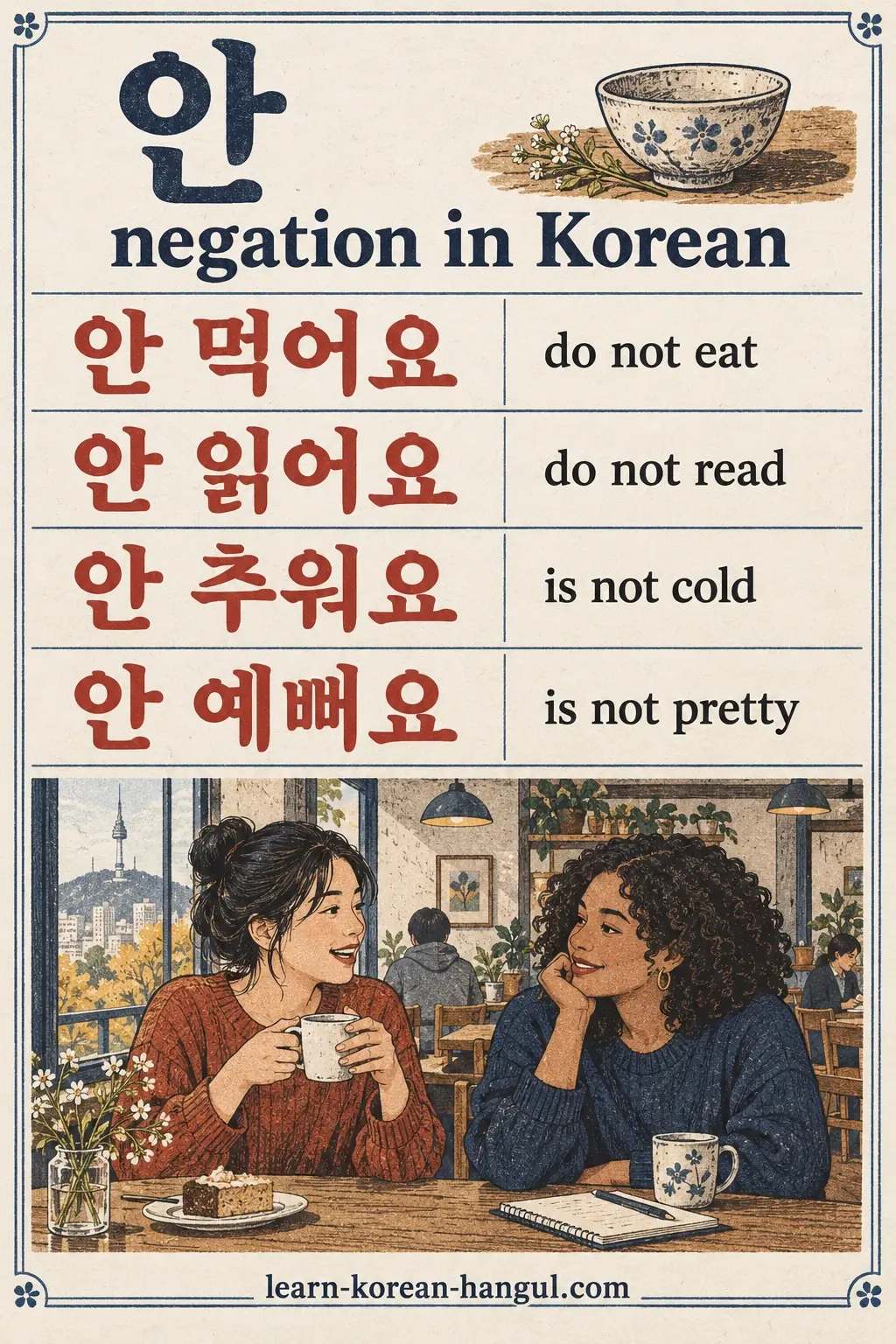
| Regular verb | 먹어요 | 안 먹어요 | [안 머거요] | do not eat |
| Regular verb | 읽어요 | 안 읽어요 | [안 일거요] | do not read |
| Adjective | 추워요 | 안 추워요 | [안 추워요] | is not cold |
| Adjective | 예뻐요 | 안 예뻐요 | [안 예뻐요] | is not pretty |
| Noun + 하다 verb | 공부해요 | 공부 안 해요 | [공부 안 해요] | do not study |
| Noun + 하다 verb | 운동해요 | 운동 안 해요 | [운동 안 해요] | do not exercise |
Why do 하다 verbs split? A verb such as 공부하다 is made of a noun, 공부 ("study"), and the verb 하다 ("do"). To negate it, Korean places 안 between the two parts: 공부 안 해요. The noun can also take an object particle, as in 공부를 안 해요, which has the same meaning. The full lesson is negating 하다 verbs: 공부 안 해요.
Verbs that only look like 하다 verbs. Some verbs end in 하다 but behave as single words, such as 좋아하다 ("to like") and 싫어하다 ("to dislike"). For these, 안 stands before the whole word: 안 좋아해요. Adjectives that end in 하다, such as 피곤하다 ("tired"), also take 안 in front: 안 피곤해요.
Tense stays on the verb. 안 does not change for past or future. 먹었어요 ("I ate") becomes 안 먹었어요 ("I did not eat"). This is explained in negative past tense in Korean.
The next section builds a full sentence from scratch.
Worked Example: Building 저는 고기를 안 먹어요

To build this sentence, start from the positive sentence and insert 안 before the last word. Five steps cover every sentence of this kind.
- Write the positive sentence. 저는 고기를 먹어요 means "I eat meat."
- Find the predicate. The last word, 먹어요, is the verb.
- Check the verb type. 먹다 is a regular verb, not a 하다 verb, so no splitting is needed.
- Insert 안 directly before the verb. Put a space on each side: 고기를 안 먹어요.
- Read the whole sentence. 저는 고기를 안 먹어요. The negative is complete.
You'll know it worked when 안 is next to the verb with nothing between them, and the sentence still ends with the verb. Now try the adjective version: 오늘은 추워요 becomes 오늘은 안 추워요 by the same steps.
The same steps work in questions and short answers. Ask 커피 마셔요? ("Do you drink coffee?") and answer 아니요, 안 마셔요 ("No, I do not drink it"). The reply uses 아니요 for "no" and then repeats the negative verb. The sentence order follows the verb-final habit taught in the Korean SOV sentence pattern.
The next section compares 안 with the two forms learners confuse it with.
안 vs 못 vs -지 않다

The three forms give three different messages. 안 says "not". 못 says "cannot". The long form -지 않다 says "not" in a more formal way. The word you pick tells the listener why something does not happen.
| Form | Meaning | Example | English | Typical use |
|---|---|---|---|---|
| 안 | do not, is not | 수영 안 해요. | I do not swim. | speech, messages |
| 못 | cannot | 수영을 못 해요. | I cannot swim. | inability or an outside block |
| -지 않다 | do not, is not (long form) | 수영하지 않아요. | I do not swim. | writing, formal speech |
The difference between 안 and 못 is the most important one. 수영 안 해요 and 수영을 못 해요 refer to the same action but give different reasons: the first says you do not swim, and the second says that you are unable to. Use 안 for a choice or a plain fact, and 못 for ability or circumstance. The full comparison is in 안 vs 못.
The long form is built from the verb stem, the ending -지 and the verb 않다 ("not do"). It is covered in -지 않다 negation. Both forms are polite and correct. The short form with 안 is typical for conversation, and the long form appears in writing, in news and in formal speeches.
The next section covers the cases where 안 does not apply.
When Do You Use 안, and When Not?

Use 안 for ordinary denials of actions and states. Do not use it in four situations.
1. With 이다. The copula 이다 has its own negative, 아니다. Wrong: 학생이 안 이에요. Right: 학생이 아니에요. The lesson 아니에요 not to be covers it.
2. With 있다. The opposite of 있다 is 없다. Wrong style: 시간이 안 있어요. Right: 시간이 없어요. The phrase 안 있어요 exists but means "does not stay", so it is a different sentence.
3. In commands. To say "do not go", Korean uses -지 마세요, not 안: 가지 마세요. The sentence 안 가세요 means "he or she does not go" or "you do not go", and it is a statement or a question, not a command.
4. When you mean "cannot". Use 못 when the reason is inability. 안 gives the impression that you could but do not.
Three words that look alike. The syllable 안 appears in other, unrelated words. A noun 안 means "inside", as in 방 안에 있어요 ("It is inside the room"). The word 안녕 ("peace", used in 안녕하세요 for "hello") is another. When 안 stands right before a verb or adjective, it is the negative.
What this lesson does not cover. Negative questions, negative words such as 아무도 and 전혀, and the formal ending -습니다 with 안 are covered in later lessons. The overview of every form is on the page for Korean negation.
An honest limit. Some Koreans use 안 + noun + 하다 forms in casual talk, such as 안 공부해요. They are heard in speech, but textbooks and most grammars treat them as unnatural, so learners should use 공부 안 해요.
The next section lists the errors that appear most often.
What Mistakes Do Learners Make with 안?

Learners make four predictable mistakes with 안. Each has a reason and a fix.
Learners often assume 안 can go after the verb. Actually 안 always comes before. Wrong: 먹어요 안. Right: 안 먹어요. Fix: place 안 as the last word before the predicate.
Learners often assume 하다 verbs take 안 at the front. Actually the natural form splits. Wrong: 안 공부해요. Right: 공부 안 해요. Fix: separate the noun and 하다 and insert 안 between them.
Learners often assume 안 works with 이다. Actually 이다 has 아니다. Wrong: 저는 학생이 안 이에요. Right: 저는 학생이 아니에요. Fix: use 아니에요 for "is not" with nouns.
Learners often assume 안 means "cannot". Actually it means "do not". Wrong: 저는 한국어를 안 해요 when you mean "I cannot speak Korean". Right: 저는 한국어를 못 해요. Fix: ask yourself whether the cause is choice (안) or ability (못).
Practice puts these rules into your own sentences, as the next section shows.
Practice and Answers
Complete the four tasks, then compare your answers with the key.
Task 1: make it negative. Add 안 to each sentence.
- 저는 커피를 마셔요.
- 오늘은 추워요.
- 책을 읽어요.
- 운동해요.
Task 2: fix the error. Each sentence has one mistake. Rewrite it correctly.
- 저는 안 공부해요.
- 저는 학생이 안 이에요.
- 저는 먹어요 안.
Task 3: translate. Write in Korean: "I do not drink coffee." and "It is not hot today."
Task 4: write your own. Write one sentence about something you do not eat and one about something you do not do on Sundays.
Practice · 8
Make 저는 커피를 마셔요 negative with 안.
Show answer
저는 커피를 안 마셔요.
안 stands directly before the verb, with nothing between them.
How do you negate 운동해요 with 안?
Show answer
운동 안 해요
A noun + 하다 verb splits, and 안 goes between the noun and 하다; 아니에요 is only for "is not" with nouns.
Which word negates 이다 ("to be")?
Show answer
아니다
안 is not used with 이다; the copula has its own negative, 아니다, as in 학생이 아니에요.
Make 오늘은 추워요 negative.
Show answer
오늘은 안 추워요.
Adjectives take 안 directly before them, just like verbs.
What does 안 먹어요 mean?
Show answer
I do not eat (it).
안 means "do not"; "cannot" needs 못, and commands use -지 마세요.
How do you negate 먹었어요 ("I ate") with 안?
Show answer
안 먹었어요
안 does not change; the tense stays on the verb, so 먹었어요 becomes 안 먹었어요.
How do you say "I don't have time"?
Show answer
시간이 없어요.
The opposite of 있다 is 없다; 안 있어요 means "does not stay", and 아니에요 is for nouns.
How do you negate 좋아해요 ("I like it")?
Show answer
안 좋아해요
좋아하다 behaves as a single word, so 안 stands before the whole verb.
Answer key
- (1) 저는 커피를 안 마셔요. (2) 오늘은 안 추워요. (3) 책을 안 읽어요. (4) 운동 안 해요.
- (1) 저는 공부 안 해요. (2) 저는 학생이 아니에요. (3) 저는 안 먹어요.
- 저는 커피를 안 마셔요. 오늘은 안 더워요.
- Sample answers: 저는 매운 음식을 안 먹어요. ("I do not eat spicy food.") 일요일에는 일을 안 해요. ("I do not work on Sundays.") Any verb is correct if 안 stands directly before it.
If you answered all of task 1 correctly, you have the rule. If task 2 was hard, return to the pattern table and check the verb type. The next section points you to what comes after this lesson.
What Should You Learn after 안 Negation in Korean?
After 안 negation in Korean, learn the word for inability in 못 can't in Korean. It uses the same position as 안, so the pattern will feel familiar. Then read 안 vs 못 to practise choosing between them.
For a wider view, the parent page Korean negation lists every lesson in learning order, from the short forms to prohibitions. If you want the formal version, -지 않다 negation teaches the long form. For past-tense negatives, continue with negative past tense in Korean.
This lesson covers the short negative 안 in the polite present. It does not cover negative questions, negative polarity words or prohibitions in depth. About this page. Last updated 2026-10-09. The Korean text, spoken forms and audio on this page were machine-generated and reviewed and signed off by Min-ji Park on 15 October 2026. Romanization follows the Revised Romanization of Korean and is shown only as a learning aid.
Frequently Asked Questions
What does 안 mean? 안 is the short negative adverb in Korean and means "not". It is placed before a verb or an adjective to say that an action does not happen or that something is not so. 안 먹어요 means "I do not eat", and 안 예뻐요 means "it is not pretty". It says nothing about ability, which needs 못.
How do I form 안 negation? Put 안 and a space directly before the verb or adjective, and keep the rest of the sentence as it is. 먹어요 becomes 안 먹어요. For 하다 verbs made from a noun, put 안 before 하다, as in 공부 안 해요. The tense is shown on the verb, so 먹었어요 becomes 안 먹었어요 in the past.
What is the most common mistake with 안? The most common mistake is putting 안 in front of the noun in a 하다 verb, as in 안 공부해요. The natural form is 공부 안 해요. A second mistake is using 안 with 이다, as in 학생이 안 이에요. The correct form is 학생이 아니에요. A third is using 안 for "cannot", which needs 못.
How is 안 different from 못 and -지 않다? 안 says "do not" or "is not", and 못 says "cannot". 수영 안 해요 means "I do not swim", not "I cannot swim"; for inability, say 수영을 못 해요. The long form -지 않다 means the same as 안 but sounds more formal and fits writing: 먹지 않아요. Speech uses 안 more often.
Do I use 안 in speech, writing or both? 안 is common in speech and informal writing such as messages. Formal writing, news and speeches often prefer the long form -지 않다, as in 먹지 않습니다. Both forms are correct and mean the same thing. A learner can use 안 in conversation and switch to -지 않다 when the situation is formal.