What you'll learn
- Place 못 correctly before a verb in the present, past and future.
- Negate a 하다 verb with 못, as in 운동 못 해요.
- Explain the difference between 못 and 안 in one sentence.
- Tell 못 하다 (cannot do) from 못하다 (be bad at).
- Avoid the three most common mistakes with 못.
Before you start: you should know the polite ending -아요/-어요 and how to read basic Korean sentences. A short comparison with the other negative word is in 안 negation in Korean. Audio plays only when you press a button.
What Does 못 Can't in Korean Mean?

못 means "cannot" or "could not." It tells the listener that the speaker is unable to do an action, whether the cause is skill, time, health, money or weather. The word 못 is an adverb, so it does not change its form, and the verb after it carries the tense and the politeness.
The cause may be inside you (you never learned to swim) or outside you (the bus did not come). In both cases, you want to do the action, or the action was expected, and something blocks it. That is the core difference from 안, which does not signal any block.
Two First Examples
Two everyday sentences show the pattern. The Revised Romanization (RR), South Korea's official Latin spelling, is a learning aid only.
- 저는 수영을 못 해요. (jeoneun suyeongeul mot haeyo.) = "I can't swim." The verb 수영하다 (to swim) is a 하다 verb, so 못 sits between 수영 and 해요.
- 오늘은 못 가요. (oneureun mot gayo.) [오느른 몯까요] = "I can't go today." The speaker may want to go, but something stops them.
Both sentences keep the normal polite verb ending, and only 못 was added. The next section lays out the pattern for different kinds of verbs.
How Does 못 Work?
못 works by sitting right before the verb, with a space, and leaving the verb unchanged. There are no stem changes, no vowel harmony and no new endings, so the pattern is one of the easiest in Korean. The verb you place after 못 takes the tense you need.
| Verb type | Positive | With 못 | Meaning |
|---|---|---|---|
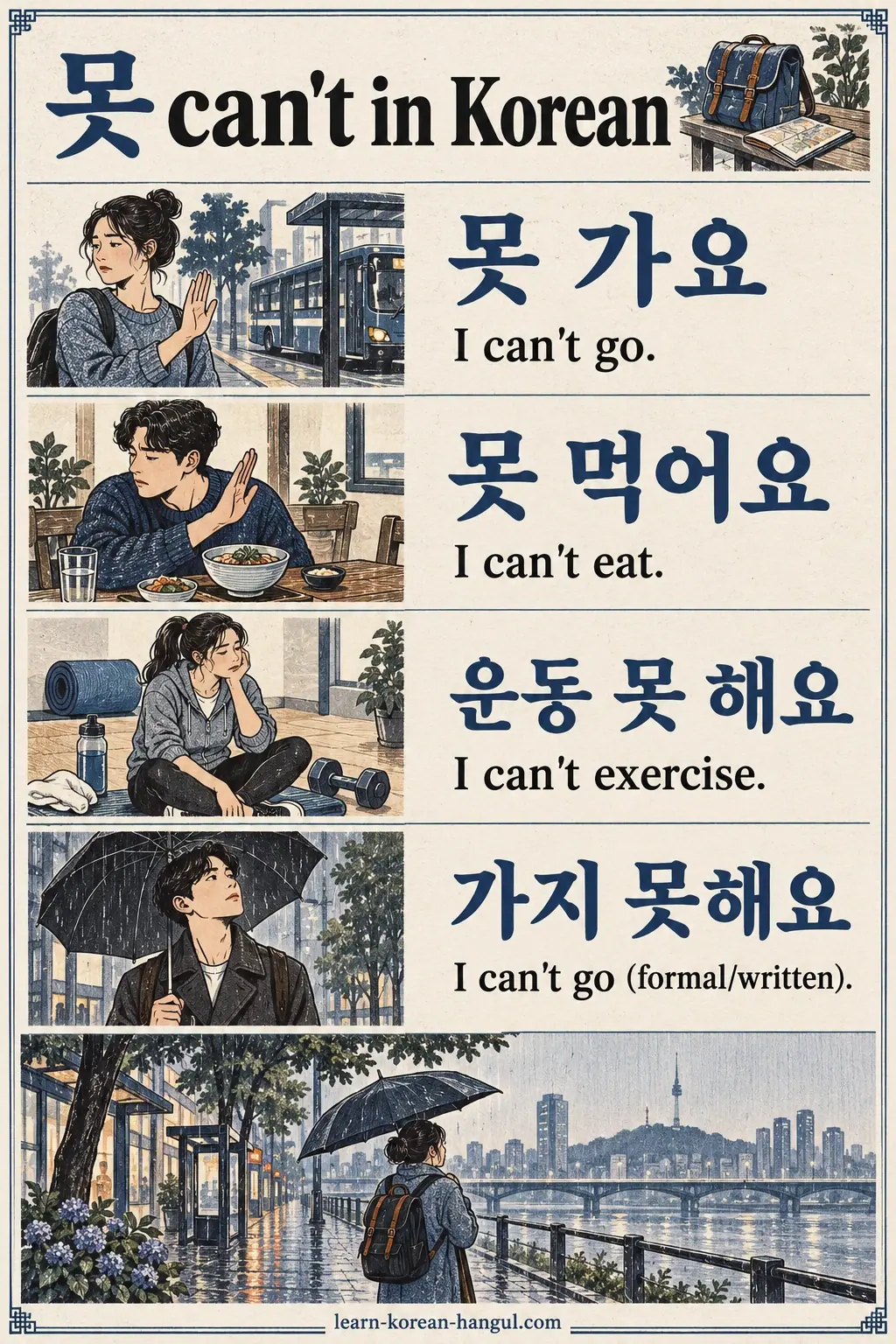
| Regular verb | 가요 | 못 가요 | I can't go. |
| Regular verb | 먹어요 | 못 먹어요 | I can't eat. |
| Past tense | 갔어요 | 못 갔어요 | I couldn't go. |
| Future tense | 갈 거예요 | 못 갈 거예요 | I won't be able to go. |
| 하다 verb | 운동해요 | 운동 못 해요 | I can't exercise. |
| Long form | 가요 | 가지 못해요 | I can't go (formal/written). |
Two details in the table matter. First, 하다 verbs split in two: the noun stays in front, 못 comes next and 하다 closes the sentence (공부 못 해요, "I can't study"). The lesson on negating 하다 verbs 공부 안 해요 explains why. Second, the long form 가지 못해요 means the same as 못 가요 but is used in writing and formal speech, as in -지 못하다 cannot.
Pronunciation of 못
못 changes its sound depending on the next syllable, but the spelling stays the same. The final ㅅ in 못 is pronounced as a stopped ㄷ sound, then the sound next to it changes according to the standard pronunciation rules (표준 발음법) of the National Institute of Korean Language.
- Before ㄱ, ㄷ, ㅂ, ㅅ, ㅈ: the next sound becomes tense. 못 가요 is [몯까요], and 못 자요 is [몯짜요].
- Before ㅁ or ㄴ: the final sound becomes a nasal ㄴ. 못 먹어요 is [몬 머거요], and 못 마셔요 is [몬 마셔요].
- Before ㅎ: 못 해요 is spoken [모태요], because the stopped ㄷ and ㅎ merge into an aspirated ㅌ.
RR does not mark the tensification, so you will see mot gayo for 못 가요. Listen to the audio and copy what you hear, since the written romanization hides these changes.
The sound changes do not affect the meaning, so the next step is to build a full sentence with the pattern.
Worked Example: Building a Sentence with 못

Follow these steps to turn "I eat spicy food" into "I can't eat spicy food."
- Start with the positive sentence. 저는 매운 음식을 먹어요. (jeoneun maeun eumsigeul meogeoyo.) = "I eat spicy food." The verb is 먹어요.
- Check the verb type. 먹다 is an action verb, so 못 is allowed. If the word were an adjective, such as 맵다 (to be spicy), you could not use 못.
- Check the reason. Ask: am I unable to, or do I choose not to? Suppose spicy food hurts your stomach: you are unable, so 못 is right.
- Insert 못 directly before the verb. Put it in front of 먹어요 with a space.
- Read the result. 저는 매운 음식을 못 먹어요. (jeoneun maeun eumsigeul mot meogeoyo.) [몬 머거요] = "I can't eat spicy food."
Reference Examples
| Verb type | Positive | With 못 | Meaning |
|---|---|---|---|
| Regular verb | 가요 | 못 가요 | I can't go. |
| Regular verb | 먹어요 | 못 먹어요 | I can't eat. |
| Past tense | 갔어요 | 못 갔어요 | I couldn't go. |
| Future tense | 갈 거예요 | 못 갈 거예요 | I won't be able to go. |
| 하다 verb | 운동해요 | 운동 못 해요 | I can't exercise. |
| Long form | 가요 | 가지 못해요 | I can't go (formal/written). |
| Form | Meaning | Example | Translation |
|---|---|---|---|
| 안 + verb | do not (choice or fact) | 저는 운동을 안 해요. | I don't exercise. |
| 못 + verb | cannot (inability or block) | 저는 운동을 못 해요. | I can't exercise. |
| 못하다 (one word) | be bad at | 저는 요리를 못해요. | I'm bad at cooking. |
| -지 못하다 (long form) | cannot (formal/written) | 저는 가지 못해요. | I cannot go. |
You will know it worked when 못 appears right before the verb and the verb ending did not change. A typical slip at step 4 is to place 못 after the verb, as English "not" or "can't" might suggest. Korean verbs close the sentence, so 못 always comes first. Having the form is useful only if you can tell 못 from its neighbours.
How Is 못 Different from Similar Forms?

못 differs from 안 in the reason, and from 못하다 in spacing and meaning. The table sets three similar forms side by side, using the verb 하다 (to do) and one other example.
| Form | Meaning | Example | Translation |
|---|---|---|---|
| 안 + verb | do not (choice or fact) | 저는 운동을 안 해요. | I don't exercise. |
| 못 + verb | cannot (inability or block) | 저는 운동을 못 해요. | I can't exercise. |
| 못하다 (one word) | be bad at | 저는 요리를 못해요. | I'm bad at cooking. |
| -지 못하다 (long form) | cannot (formal/written) | 저는 가지 못해요. | I cannot go. |
The key point is the spacing. 못 해요 with a space says that you cannot do a specific action right now. 못해요 as one word says that you do the activity poorly as a general skill. In real writing, even Korean speakers sometimes mix the two, but learners should keep them apart, because the meaning differs: 요리를 못 해요 can mean "I can't cook (I have no stove)," while 요리를 못해요 means "I'm a bad cook."
To see 못 against 안 in more detail, read 안 vs 못. Once you know where 못 fits, you can decide when to use it.
When Do You Use 못, and When Not?

Use 못 for blocked actions, and use another form for choices, adjectives and descriptions. The rule is short, but it has several useful extensions.
Use 못 when
- A skill is missing: 저는 운전을 못 해요 (I can't drive).
- Circumstances block you: 시간이 없어서 못 가요 (I can't go because I have no time).
- A body limit stops you: 너무 매워서 못 먹어요 (It's too spicy to eat).
- A feeling is too strong: 못 믿겠어요 (I can't believe it) and 못 참겠어요 (I can't stand it). The ending -겠- shows an in-the-moment judgement.
- You want a soft refusal: 내일은 못 갈 것 같아요 (I don't think I can go tomorrow). The ending -ㄹ 것 같다 means "it seems that", which softens the refusal.
Do not use 못 when
- The word is an adjective. Say 안 예뻐요 (not pretty), not 못 예뻐요.
- You are choosing. Say 안 마셔요 (I don't drink), not 못 마셔요.
- You want to give a command. 못 does not make "don't." Use -지 마세요 don't.
An honest limit: this page covers the short form 못 in everyday speech. It does not teach the ability pattern -ㄹ 수 있다/없다, which also expresses "can" and "cannot" and is a separate lesson. A few words also contain 못 as a fixed part: 못생기다 (to be ugly) and 못되다 (to be bad-natured). They are single vocabulary items, not 못 plus a verb, so learn them as whole words.
The uses above show a consistent logic, and the mistakes in the next section break that logic in predictable ways.
What Mistakes Do Learners Make with 못?

Learners most often use 못 in places where Korean needs 안, or put it in the wrong position. Four mistakes recur.
- Using 못 for "I don't want to." Learners often assume 못 is the polite form of "no." Actually, 못 says you are unable, so 저는 커피를 못 마셔요 tells the listener that you cannot drink coffee. For a preference, say 안 마셔요.
- Using 못 with an adjective. 못 예뻐요 and 못 비싸요 sound wrong. Use 안 예뻐요 and 안 비싸요, because adjectives describe a state and 못 needs an action.
- Putting 못 after the verb or the noun of a 하다 verb. 가요 못 is wrong, and 못 운동해요 sounds unnatural. The correct forms are 못 가요 and 운동 못 해요.
- Mixing up 못 해요 and 못해요. If you mean "I can't do it now," write two words. If you mean "I'm poor at it," write one word.
A good test: ask whether the English sentence can use "can't" or "couldn't," and whether the Korean word is an action verb. If both answers are yes, 못 fits. Now apply the test in practice.
Practice and Answers
Try these four items before reading the answer key.
- Choose the form. You have an allergy. Complete: 저는 땅콩을 ___ 먹어요. (안 / 못)
- Fix the error. A learner writes 못 예뻐요 for "not pretty." Correct it.
- Translate. "I couldn't sleep last night." Use 자다 and the past polite form 잤어요.
- Write your own. Write one sentence that says you cannot do a 하다 verb, such as 공부하다 or 운동하다, and one that says you cannot go somewhere.
Practice · 8
You have an allergy. Complete: 저는 땅콩을 ___ 먹어요.
Show answer
못
The allergy blocks the action, so use 못 (cannot), not 안 (do not).
A learner writes 못 예뻐요 for "not pretty". What is the correct form?
Show answer
안 예뻐요
못 works only with action verbs; adjectives take 안.
Translate "I couldn't sleep last night" with 잤어요.
Show answer
어젯밤에 못 잤어요.
못 goes directly before the verb, and the past form 잤어요 carries the tense.
How do you say "I can't exercise" with 운동하다?
Show answer
운동 못 해요
With 하다 verbs, 못 goes between the noun and 하다; 운동 안 해요 means "I don't exercise".
What does 요리를 못해요 (one word) mean?
Show answer
I'm bad at cooking.
못하다 written as one word means "be bad at" as a general skill.
Which sentence says you choose not to drink coffee?
Show answer
저는 커피를 안 마셔요.
A choice or preference takes 안; 못 says you are unable, and 못해요 as one word means "bad at".
How is 못 가요 pronounced?
Show answer
[몯까요]
Before ㄱ, the final sound of 못 is a stopped ㄷ and the next sound becomes tense; [모태요] is 못 해요 and [몬 머거요] is 못 먹어요.
How does 못 make a command like "don't go"?
Show answer
It can't; use -지 마세요.
못 does not make commands; "don't" is -지 마세요, as in 가지 마세요.
Answer key
- 못. The allergy blocks the action, so the sentence is 저는 땅콩을 못 먹어요.
- 안 예뻐요. 못 does not work with adjectives, so 안 is the correct word.
- 어젯밤에 못 잤어요. (eojetbame mot jasseoyo.) The past form 잤어요 follows 못 directly, and the sentence means "I couldn't sleep last night."
- Answers vary. Check that 못 sits between the noun and 하다, as in 저는 공부 못 해요, and right before 가요 in 학교에 못 가요. Check that the sentences show something blocking the action.
If your answers match, the pattern is secure. The next lessons round out the set.
Next Lessons: Where to Go after 못 Can't in Korean
After 못 can't in Korean, compare it with 안, then learn the long form. This lesson covers the short form 못 for inability. It does not cover the ability pattern -ㄹ 수 있다, passive meanings or the idiom-like uses of 못 in older texts.
- Read 안 vs 못 to practise choosing between the two short negatives.
- Study the 안 pattern in 안 negation in Korean.
- Learn the formal version in -지 못하다 cannot.
- See how 하다 verbs work in negating 하다 verbs 공부 안 해요.
- Look at the helper pattern -아/어 보다 try, which lets you say that you tried something, for example before saying you could not finish it.
- Return to Korean negation for the whole set.
Say a few of the example sentences aloud each day. When 못 가요 and 못 먹어요 come out without thinking, the 못 can't in Korean pattern is yours.
Frequently Asked Questions
What does 못 mean in Korean?
못 means "cannot" or "could not". It is a short negative adverb that says the speaker is unable to do an action, because of skill, time, health, weather or another outside cause. Place it before the verb: 못 가요 means "I can't go", and 못 먹어요 means "I can't eat".
Can 못 be used with adjectives?
No. 못 attaches to action verbs, because it says that an attempted or expected action is blocked. For adjectives, use 안: 안 예뻐요 means "not pretty". A few fixed words contain 못, such as 못생기다 (to be ugly) and 못되다 (to be bad-natured), but they are single vocabulary items.
What is the difference between 못 해요 and 못해요?
못 해요, with a space, means "I can't do it" because of a specific block. 못해요, written as one word, comes from 못하다 and means "I am bad at it" as a general skill. 노래를 못 해요 can mean "I can't sing now"; 노래를 못해요 means "I'm a poor singer".
Is 못 polite enough for speaking to elders?
Yes, if the verb ends in -아요/-어요 or -습니다. The word 못 itself has no politeness level; the verb ending carries it. 못 가요 is polite, 못 가 is casual, and 못 갑니다 is formal. Adding 죄송하지만 (sorry, but) before 못 makes a refusal softer.
How do I ask "Can't you come?" in Korean?
Say 못 와요?, or 못 오세요? to someone you honour. Both ask "Are you unable to come?" and assume that something may be blocking the listener. For a neutral question about whether someone can come, Korean speakers usually ask the positive 올 수 있어요? (Can you come?).