What you'll learn
- Attach 조차 or 마저 to a noun, in place of 이/가 and 을/를.
- Use 조차 with a negative ending: 이름조차 몰라요.
- Use 마저 for "even the last one": 돈마저 잃었어요.
- Tell 조차 and 마저 apart from 까지, 도, 만 and (이)라도.
- Avoid the common mistake of using 조차 with a positive verb.
Before you start: you should know that a particle is a small word that attaches to a noun, such as 이/가 or 을/를, and that 도 means "also". If these are new, read also particle 도 first. Audio plays only when you press a button. Estimated time: 15 minutes.
What Does the 조차 마저 Even Particles Lesson Mean?
The 조차 마저 even particles add the meaning "even" to a noun, with a feeling that something is surprising, unwelcome or lost. A particle that adds a shade of meaning, instead of a grammar role like subject or object, is called an auxiliary particle (보조사, bojosa). Both words in this lesson are auxiliary particles.
The message of 조차 is: "Even this basic thing is missing, so everything else must be worse." In 이름조차 몰라요, the speaker does not know the most basic fact about the person, the name. The message of 마저 is: "Even this last thing, the only one that remained, has gone as well." In 마지막 남은 돈마저 잃었어요, the speaker had one thing left, and it too was lost.
Because of these feelings, both particles belong to emotional or serious speech. You find them in writing, news reports, essays and drama dialogue more often than in a quick chat. The plain "also" is 도, and the plain "even" with a neutral tone is 까지. Learning 조차 and 마저 lets you express disappointment, shock and sympathy in a very Korean way.
A First Example
Here are two sentences that show the pattern with each particle.
- 이름조차 몰라요. (ireumjocha mollayo.) [이름조차 몰라요] = "I do not even know the name."
- 마지막 남은 돈마저 잃었어요. (majimak nameun donmajeo ireosseoyo.) [마지막 나믄 돈마저 이러써요] = "I even lost the last of my money."
In the first sentence, 조차 follows 이름 and the sentence ends in a negative verb, 몰라요 ("do not know"). In the second, 마저 follows 돈 ("money") and the verb 잃었어요 ("lost") shows a sad outcome. In both sentences the particle replaces 을/를: you do not write 이름을조차 or 돈을마저. The next section shows exactly how the particles attach.
How Do the 조차 마저 Even Particles Work?
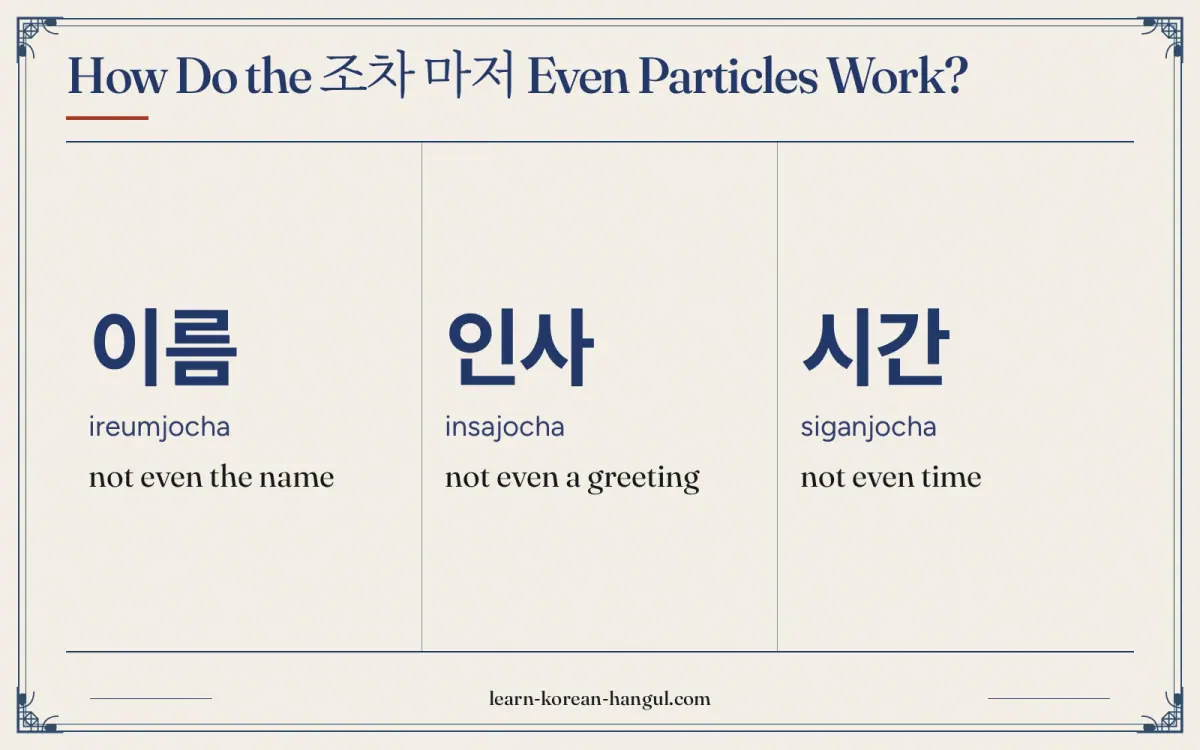
The 조차 and 마저 even particles work by attaching directly to the end of a noun, with no change in shape. Unlike 이/가 or 은/는, they do not have two versions, so you never choose by the last sound of the noun. They also replace 이/가 and 을/를. After location and direction particles such as 에서 and 에게, they attach to the end of the phrase.
Pattern Table
The table shows the nouns and phrases that take the particles. Each row has the noun, the form with the particle, the sound and the Revised Romanization.
| Noun or phrase | With the particle | Sound | Revised Romanization | Meaning |
|---|---|---|---|---|
| 이름 | 이름조차 | [이름조차] | ireumjocha | not even the name |
| 인사 | 인사조차 | [인사조차] | insajocha | not even a greeting |
| 시간 | 시간조차 | [시간조차] | siganjocha | not even time |
| 집에서 | 집에서조차 | [지베서조차] | jibeseojocha | not even at home |
| 친구에게 | 친구에게조차 | [친구에게조차] | chinguegejocha | not even to a friend |
| 돈 | 돈마저 | [돈마저] | donmajeo | even the money |
| 친구 | 친구마저 | [친구마저] | chingumajeo | even a friend |
| 비 | 비마저 | [비마저] | bimajeo | even the rain |
Revised Romanization (RR, the official Latin spelling) follows the sounds of the words. It does not show tensing caused by a neighbouring sound. Words separated by a space are romanized separately. The particles are attached to the noun with no space: 이름조차, never 이름 조차.
The rule for the ending is the other half of the pattern. 조차 almost always goes with a negative, a lack or an unwelcome situation: 몰라요 (do not know), 못 했어요 (could not do), 없어요 (there is none), 않았어요 (did not). 마저 usually goes with a sad or unwelcome outcome: 잃었어요 (lost), 떠났어요 (left), 팔렸어요 (sold out).
인사조차 못 했어요.
insajocha mot haesseoyo.
I could not even say hello.
물 한 잔조차 못 마셨어요.
mul han janjocha mot masyeosseoyo.
I could not even drink a glass of water.
After other particles. 조차 and 마저 can follow 에서, 에게 and 한테. 집에서조차 쉴 수 없어요 (jibeseojocha swil su eopseoyo) [지베서조차 쉴쑤 업써요] means "I cannot rest even at home". The bound noun 수 joins the -ㄹ word before it, so 쉴 수 is said [쉴쑤]. Here 조차 sits at the end of the phrase 집에서.
A look-alike to avoid. 마저 is also a plain adverb meaning "finish the rest of it": 밥을 마저 먹으세요 means "Please finish your meal". There the word stands alone, after the object particle 을, and it is not an even particle. Compare 밥마저 먹었어요 ("I even ate the rice").
Next, here is one full sentence built step by step.
Worked Example, Step by Step
You build the sentence in five steps, working from a plain sentence and adding the even meaning. This example makes "I do not even know that person's name".
- Start with the plain sentence. 그 사람 이름을 몰라요. = "I do not know that person's name."
- Find the noun that gets the emphasis. The noun is 이름, with the object particle 을.
- Remove the old particle. Take away 을. The particle 조차 replaces it, and particles do not stack here.
- Add 조차 directly. 이름 + 조차 = 이름조차, with no space.
- Keep a negative ending. The verb 몰라요 already means "do not know". The sentence is 그 사람 이름조차 몰라요.
Sentence
I do not even know that person's name.
Show answer
그 사람 이름조차 몰라요
Checkpoint. You have it when the noun and the verb are both still there and only the particle has changed. The usual slip is to keep 을 and write 이름을조차, which is wrong.
The sentence built here is a statement. The next section shows how these particles differ from their neighbours.
How Is 조차/마저 Different from Similar Forms?
조차 and 마저 both mean "even", but they feel different, and neither means the same as 까지, 도, 만 or (이)라도. Four neighbours are easy to confuse with them. The lesson on 까지 covers "until" and "even", 도 covers "also", 만 covers "only", and (이)라도 covers "at least" and "even if".
| Particle | Meaning | Usual ending | Example |
|---|---|---|---|
| 조차 | not even (the basic thing) | negative | 이름조차 몰라요. |
| 마저 | even (the last one) | sad or unwelcome | 마지막 남은 돈마저 잃었어요. |
| 까지 | even, as well, up to | any | 비가 오는데 바람까지 불어요. |
| 도 | also | any | 저도 몰라요. |
| 만 | only | any | 이름만 알아요. |
| (이)라도 | at least, even if | request or offer | 이름이라도 알려 주세요. |
조차
not even: basic thing, negative
마저
even the last: sad outcome
까지
even, as well: adding on
도
also: neutral
| Comparison | 조차 | 마저 | 까지 | 도 |
|---|---|---|---|---|
| Feeling | shock at a lack | loss of the last | one more on top | neutral |
| Ending | negative | often sad | any | any |
| Example | 이름조차 몰라요. | 돈마저 잃었어요. | 바람까지 불어요. | 저도 몰라요. |
| Level | B2 | B2 | A2 | A1 |
Use 조차 with a negative for "not even", 마저 for the last thing to go, 까지 to add one more thing and 도 for a plain "also".
Compare 저도 몰라요 and 이름조차 몰라요. The first means "I do not know either", and it only says that another person is in the same position. The second means "I do not even know the name", and it says that the situation is bad. A quick test: if you can add "not even" or "even the last" to the English with a sad feeling, choose 조차 or 마저. If you only want "also", choose 도. Next, here is when to use them and when not.
When Do You Use 조차/마저, and When Not?
Use 조차 and 마저 when you want to show shock, sadness or strong emphasis, especially in writing, speeches, news and drama. Use 조차 when the missing thing is basic, such as a name, a greeting or a moment of time: 쉴 시간조차 없어요 ("There is not even time to rest"). Use 마저 when the thing is the last one, or the last to stay: 가장 친한 친구마저 떠났어요 ("Even my closest friend left").
Do not use 조차 with a plain, welcome positive. 이름조차 알아요 is wrong, because "I even know the name" has no surprise of lack. For a positive sense, use 까지 or 도. Do not use these particles for a neutral list, either. For a plain "also", say 도.
Both particles are more literary than 도 or 까지. In daily talk, speakers often reach for 도 or 까지 and keep 조차 and 마저 for moments of strong feeling. You may also hear the forms 조차도 and 마저도, which add a little more stress.
가장 친한 친구마저 떠났어요.
gajang chinhan chingumajeo tteonasseoyo.
Even my closest friend left.
비마저 오네요.
bimajeo oneyo.
And now it is even raining.
When a speaker uses these particles, the listener hears emotion. Next are the errors that appear most often.
What Mistakes Do Learners Make with 조차/마저?
Learners make five common mistakes with 조차 and 마저.
- Using 조차 with a positive verb. Learners write 이름조차 알아요. Actually 조차 needs a negative or a lack. Say 이름조차 몰라요, or use 이름도 알아요 for a plain positive.
- Keeping the old particle. Learners write 이름을조차 몰라요 or 돈을마저 잃었어요. Actually the even particle replaces 을/를 and 이/가, so write 이름조차 and 돈마저.
- Adding a space. Learners write 이름 조차 몰라요. Actually a particle attaches to the noun, so write 이름조차.
- Translating both as "also". Learners say 이름조차 몰라요 means "I do not know the name either". Actually "either" is 도. 조차 adds shock: "not even".
- Reading the adverb 마저 as a particle. Learners translate 밥을 마저 먹으세요 as "even eat the rice". Actually it is a plain adverb that means "finish the rest".
Whenever you reach for "even", check the ending, the old particle and the spacing. Now test yourself.
Practice and Answers
These four exercises check the main skills: building the sentence, repairing a mistake, choosing the particle and translating. Try each one before you read the answers.
Practice · 5
Which sentence is correct for "I do not even know the name"?
Show answer
이름조차 몰라요.
조차 needs a negative ending, replaces 을/를, and attaches to the noun without a space.
Which ending fits 쉴 시간조차 ___?
Show answer
없어요
조차 goes with a lack. 쉴 시간조차 없어요 means "There is not even time to rest".
Which sentence is wrong?
Show answer
시험조차 합격했어요.
조차 needs a negative or a lack. 합격했어요 is a positive result.
How is 못 마셨어요 pronounced?
Show answer
[몬 마셔써요]
The final ㅅ of 못 is said as ㄷ, and it becomes ㄴ before the ㅁ of 마셨어요. The ending 셨어요 is said [셔써요].
Which sentence means "And now it is even raining"?
Show answer
비마저 오네요.
마저 adds one more unwelcome thing and replaces the old particle. 비조차 needs a negative, and 비만 means "only rain".
Exercise 1: Build the sentence. Make one sentence with 조차: 그 사람 이름을 모르다. ("I do not know that person's name" becomes "I do not even know it".) Use the polite present.
Exercise 2: Fix the error. A learner writes 이름을조차 몰라요. Correct it.
Exercise 3: Choose the particle. You want to say "Even my closest friend left", where the friend was the last one to stay. Is 조차 or 마저 better?
Exercise 4: Translate. "I cannot rest even at home." (rest = 쉬다, at home = 집에서)
Answer Key
- Exercise 1: 그 사람 이름조차 몰라요. [그 사람 이름조차 몰라요] 조차 replaces 을 and the verb stays negative.
- Exercise 2: 이름조차 몰라요. [이름조차 몰라요] The even particle replaces the object particle.
- Exercise 3: 마저. The sentence is 가장 친한 친구마저 떠났어요 [가장 친한 친구마저 떠나써요]. The friend was the last to stay, and the outcome is sad.
- Exercise 4: 집에서조차 쉴 수 없어요. [지베서조차 쉴쑤 업써요] 조차 follows 에서 and goes with 없어요.
If you missed Exercise 1 or 2, return to the pattern table. If you missed Exercise 3, reread the section on how the particles differ. Next, plan where to go from here.
Next Lessons and Where to Go from Here
The best next lesson is (이)라도, which offers a second-best choice with "at least". Then review also particle 도 and only particle 만 to keep "also" and "only" apart from "even". The lesson on 까지 shows the neutral "up to and even". After the even particles, learn the polite particle in 요 polite particle. The full set of lessons is on Korean auxiliary particles.
What this lesson does not cover. It does not cover 조차도 and 마저도 in depth, the old uses of 조차 in written Korean, or the particle 커녕. The level given here, B2, is an editorial estimate based on common textbook order, not an official grading.
In short, 조차 and 마저 attach straight to a noun, replace 이/가 and 을/를, and add "even": 조차 with a negative for a missing basic thing, and 마저 for the last thing to go.
Frequently Asked Questions
What do 조차 and 마저 mean? Both are auxiliary particles that mean "even", with a feeling of surprise or loss. 조차 stresses that not even a basic thing is there, as in 이름조차 몰라요, "I do not even know the name". 마저 stresses the last remaining thing, as in 마지막 남은 돈마저 잃었어요, "I even lost the last of my money".
How do I attach 조차 or 마저 to a noun? Add the particle directly to the end of the noun, with no space and no change in shape: 이름 becomes 이름조차, 돈 becomes 돈마저. There is no 이/가-style choice by final sound. The particle replaces 이/가 and 을/를, so 이름을조차 is wrong. After 에서 or 에게 it goes at the end: 집에서조차.
Can I use 조차 with a positive verb? Not with a plain, welcome positive. 조차 needs a negative, a lack or an unwelcome situation: 몰라요, 못 했어요, 없어요, 않았어요. 이름조차 알아요 is wrong. If you mean a plain positive, use 도 ("also") or 까지 ("even, as well"). 마저 is freer, but it usually goes with a sad or unwelcome outcome such as 잃었어요 or 떠났어요.
Are 조차 and 마저 used in speech or in writing? Both, but they are more literary and emotional than 도 or 까지. You meet them in news, essays, drama and strong feelings in speech: 쉴 시간조차 없어요. In a quick chat, speakers often use 도 or 까지. The longer forms 조차도 and 마저도 add extra stress.
What is the most common mistake with 조차 and 마저? The most common mistake is using 조차 with a positive verb, as in 이름조차 알아요. A second mistake is keeping the old particle, as in 이름을조차. Also remember that 밥을 마저 먹으세요 uses the adverb 마저, "finish the rest", which is a different word from the particle.
What is the difference between 조차/마저 and 까지? 까지 is neutral and adds one more item, as in 비가 오는데 바람까지 불어요 ("it is raining, and the wind blows too"). It can follow any verb. 조차 goes with a negative and shows shock at a lack, while 마저 stresses the last thing and usually a sad outcome. 까지 also means "until", which 조차 and 마저 never do.