
What Are Korean Particles?

Korean particles are small words, usually one or two syllables long, that follow a noun and mark its job in the sentence. English uses word order for this: "Minsu reads a book" works because Minsu comes first. Korean uses particles, so the verb stays last and the nouns can move.
One sentence shows the idea. In 민수가 학교에서 책을 읽어요 (minsuga hakgyoeseo chaegeul ilgeoyo) = "Minsu reads a book at school," 가 marks Minsu as the subject, 에서 marks school as the place of the action, and 을 marks the book as the object. The verb 읽어요 (reads) closes the sentence.
Two facts make particles easier to learn. First, each particle is attached with no space. Second, a pair like 은/는 is one particle with two spellings, chosen by whether the noun ends in a consonant or a vowel. For the sentence order that particles work with, see Korean grammar and subject-object-verb order. Knowing what particles do, the next question is the order in which to learn them.
Where Should You Start with Korean Particles?
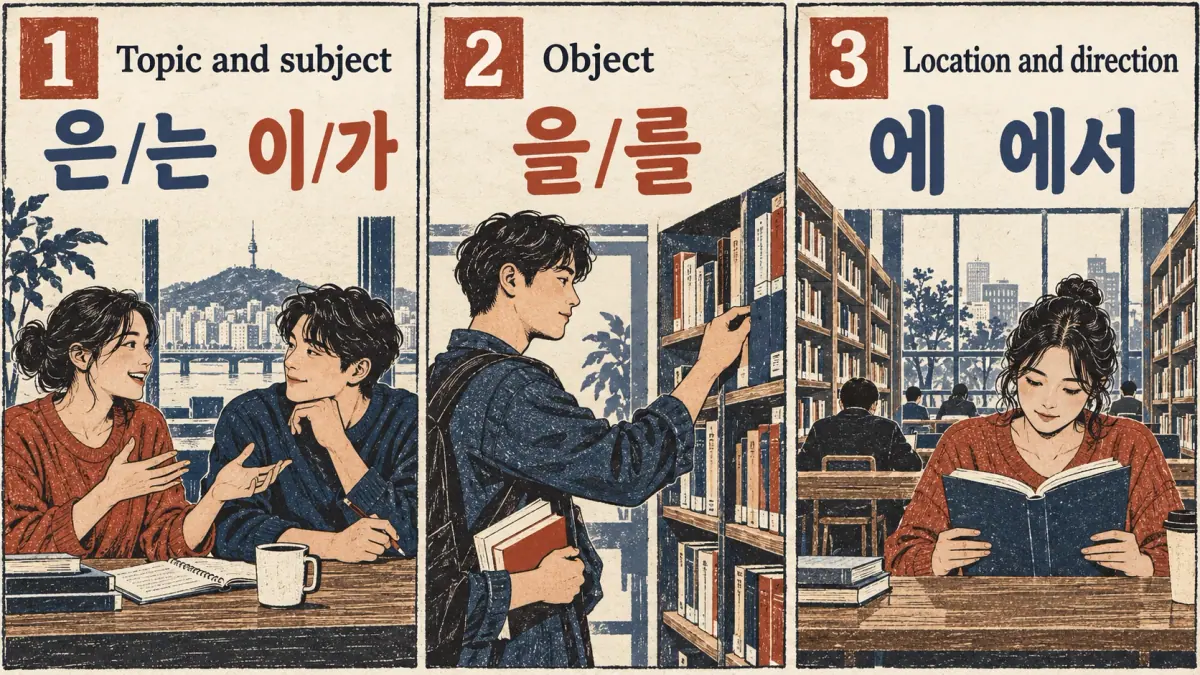
Start with topic and subject particles, then object particles, then location and direction particles. Almost every beginner sentence uses 은/는 or 이/가, so those two pairs give the fastest return. Object and location particles are next because they appear in every sentence with a verb and a place.
- Topic and subject (A1): 은/는 and 이/가.
- Object (A1): 을/를 and the verbs that need special care.
- Location and direction (A1): 에, 에서, (으)로, 에게/한테.
- Possessive and linking (A1): 의, 와/과, 하고, (이)랑.
- Comparison and extent (A1 to A2): 보다, 처럼, 까지, 부터, 만, 밖에.
- Auxiliary (A1 to B2): 도, 만, (이)나, 들, 요 and combinations.
The most common first mistake is memorising verb endings without particles, so sentences come out as strings of verbs. The second mistake is dropping particles too early because native speakers do. Learn the particles first, then drop them where speech allows. The six sets below follow this order.
Browse Korean Particles by Topic
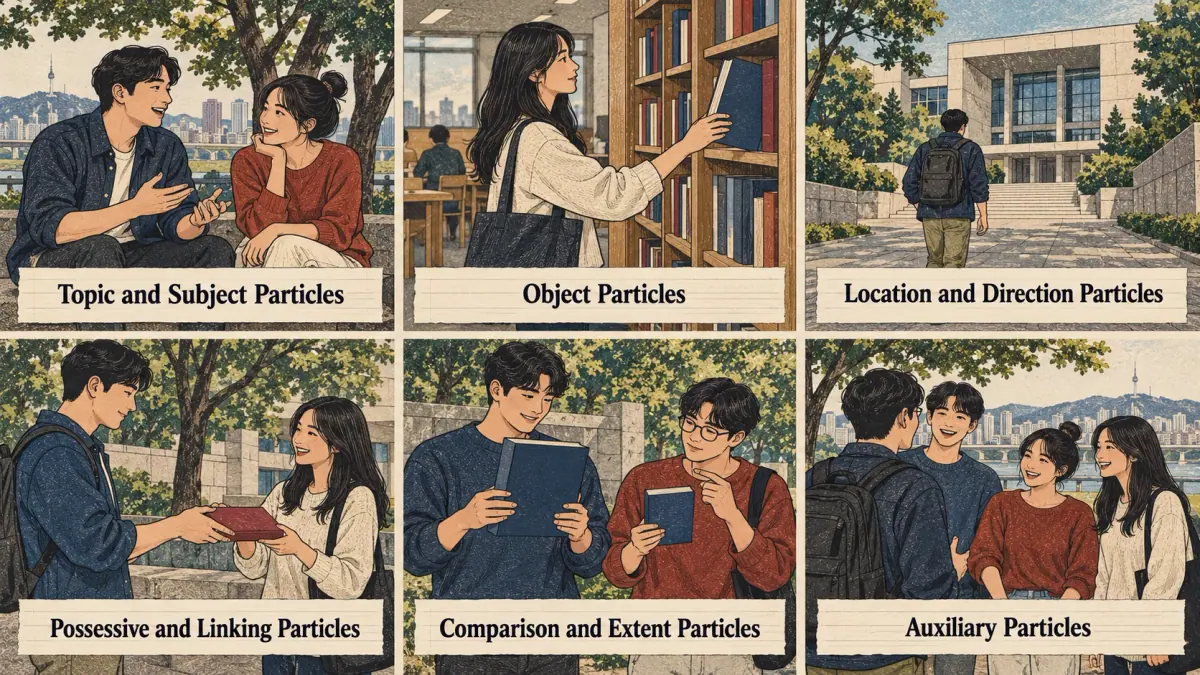
Each set below has its own hub with ordered lessons. Open the set that matches the job you need.
Topic and Subject Particles
Topic and subject particles explain 은/는, which marks what a sentence is about, and 이/가, which marks who or what does the action. The key lessons are topic particle 은/는, subject particle 이/가 and the direct comparison 은/는 vs 이/가. The set also covers dropping particles in speech.
Object Particles
Object particles cover 을/를, which marks the thing a verb acts on, plus the verbs that behave differently, such as 좋아하다 and motion verbs. If you can say "I eat rice" in Korean, you need this set to say it correctly. The first lesson is object particle 을/를.
Location and Direction Particles
Location and direction particles cover 에 (at, to, in time), 에서 (where an action happens), (으)로 (toward, by means of) and 에게/한테 (to a person). The contrast 에 vs 에서 is the one learners search for most.
Possessive and Linking Particles
Possessive and linking particles explain 의 (of, 's) and the three ways to say "with" or "and": 와/과, 하고 and (이)랑. The lesson 와/과 vs 하고 vs (이)랑 shows which one fits speech and which fits writing.
Comparison and Extent Particles
Comparison and extent particles cover 보다 (than), 처럼 (like), 까지 (until), 부터 (from) and 만 versus 밖에 (only). Start with comparison particle 보다 and 까지 until particle.
Auxiliary Particles
Auxiliary particles add meaning such as "also", "only", "or" and "even". The first lessons are also particle 도 and only particle 만, with combining particles for B1 learners.
With the six sets in view, the decision guide helps when you have a specific sentence to fix.
Which Particle Lesson Fits Your Sentence?

Choose the lesson by the meaning you want to add to the noun. The table pairs each need with an example and the set that explains it.
| You want to say | Example | Particle | Open this set |
|---|---|---|---|
| This is what I am talking about | 저는 학생이에요. | 은/는 | Topic and subject |
| What does the action | 비가 와요. | 이/가 | Topic and subject |
| What I eat, read, buy | 물을 마셔요. | 을/를 | Object |
| Where it happens | 도서관에서 공부해요. | 에서 | Location and direction |
| Where I go, when it happens | 7시에 가요. | 에 | Location and direction |
| Whose it is, who with | 친구의 책 / 친구와 가요. | 의, 와/과 | Possessive and linking |
| More than, until, from | 버스보다 빨라요. | 보다, 까지, 부터 | Comparison and extent |
| Also, only, or | 저도 가요. | 도, 만, (이)나 | Auxiliary |
Read the table from left to right. If your sentence has a verb and a thing it acts on, you need an object particle. If it has a place, you need 에 or 에서. If the sentence feels unfinished, check whether a noun is missing its particle. Once you can tell which set you need, practice makes the choice automatic.
How Do You Practise Korean Particles?

Practise Korean particles with a quiz, a flashcard deck and a worksheet, each built on the same sets. Try the Korean particles quiz after the first two sets. Review pairs and examples with the Korean particles flashcards. Print the Korean particles worksheet for writing practice.
A good routine is to read one lesson, say its examples aloud, and then write three of your own sentences with the new particle. An honest limit: this hub lists the particles in each set but does not teach each one in full. The lessons in each set cover forms, examples, mistakes and exercises. Return to Korean grammar when you want to move on to verbs, tenses or speech levels.
Frequently Asked Questions
What is the difference between 은/는 and 이/가?
은/는 marks the topic, the thing the sentence is about, and often adds contrast or background. 이/가 marks the subject and often introduces new information or answers "who". 저는 학생이에요 states a topic. 제가 학생이에요 stresses that I, not someone else, am the student. A full lesson compares them.
Can I leave particles out when speaking?
Yes, speakers often drop 은/는, 이/가 and 을/를 in casual speech when the meaning is clear: 밥 먹었어? instead of 밥을 먹었어?. Place particles such as 에서 and 에게 are dropped less often. Writing, formal speech and exams keep them, so learn them first and drop them later.
What level are Korean particles?
The core particles are A1: topic and subject, object, location and direction. Possessive and linking particles, comparison particles and the common auxiliary particles 도 and 만 also start at A1. Combined particles such as 에서도 and rare ones such as 조차 are B1 to B2, so plan to return to this hub.
Why do particles like 은/는 have two forms?
The two forms keep pronunciation smooth. 은 follows a noun that ends in a consonant, as in 선생님은, and 는 follows a noun that ends in a vowel, as in 저는. The same choice applies to 이/가, 을/를 and 와/과 (과 after a consonant, 와 after a vowel), so each pair is one particle with two spellings.
Which particle lesson should I read first?
Start with topic and subject particles, because almost every sentence uses 은/는 or 이/가. Then read the object particle 을/를, then the location particles 에 and 에서. These three sets cover most beginner sentences. The other sets add detail, so read them as the sentences you want to say require.