
What you'll learn
- Attach 이라도 or 라도 to a noun by its last sound.
- Offer a second-best choice: "at least a cup of coffee", "even just water".
- Use 지금이라도 and 한 번이라도 for "even now" and "at least once".
- Build "any ... at all" words such as 언제라도, 누구라도 and 어디라도.
- Tell (이)라도 apart from (이)나, 도 and the verb ending -아/어도.
Before you start: you should know that a particle is a small word that attaches to a noun, such as 이/가 or 을/를. If the object particle is new, read object particle 을/를 first. Audio plays only when you press a button.
What Does the (이)라도 Even If Particle Mean?
The (이)라도 particle means "even" or "at least". It marks a noun as an acceptable second choice, either because the first choice is not available or because the speaker wants to lower the bar. A particle that works this way is called an auxiliary particle (보조사), because it adds a shade of meaning instead of a grammar role such as subject or object.
The speaker's message is: "The best option may be missing, but this smaller option is still worth taking." That is why (이)라도 shows up so often in requests, suggestions and encouragement.
A First Example
Here are two sentences that show the pattern on a noun and on a time word.
- 물이라도 주세요. (murirado juseyo.) [무리라도 주세요] = "Please give me water, at least."
- 지금이라도 가요. (jigeumirado gayo.) [지그미라도 가요] = "Let's go, even if it is only now."
In the first sentence, 물 ("water") ends in a consonant, so 이라도 follows it. The speaker may be asking for something better, but accepts water. In the second sentence, 지금 ("now") ends in a consonant too. The speaker admits that it is late and still urges action. The next section shows exactly how the particle attaches.
How Does the (이)라도 Even If Particle Work?
The (이)라도 particle works like the topic marker 은/는 and the subject marker 이/가: it has two shapes, chosen by the last sound of the noun. After a consonant, use 이라도. After a vowel, use 라도. It also replaces 이/가 and 을/를, so the noun does not get two particles.
| Noun ends in | Particle | Example | Sound | Meaning |
|---|---|---|---|---|
| consonant | 이라도 | 물 → 물이라도 | [무리라도] | even water |
| consonant | 이라도 | 지금 → 지금이라도 | [지그미라도] | even now |
| consonant | 이라도 | 책 → 책이라도 | [채기라도] | at least a book |
| vowel | 라도 | 커피 → 커피라도 | [커피라도] | at least coffee |
| vowel | 라도 | 차 → 차라도 | [차라도] | at least tea |
| vowel | 라도 | 누구 → 누구라도 | [누구라도] | anyone at all |
The same particle also attaches after the location and direction particles. 에서 becomes 에서라도, and 에게 becomes 에게라도: 집에서라도 공부하세요 (jibeseorado gongbuhaseyo) [지베서라도 공부하세요] means "Study at home, at least." and 친구에게라도 물어보세요 (chinguegerado mureoboseyo) [친구에게라도 무러보세요] means "Ask a friend, at least." Here the particle sits at the end of the phrase.
Numbers work too, and they are common. 한 번이라도 가 보세요 (han beonirado ga boseyo) [한 버니라도 가 보세요] means "Go at least once." The counter 번 ends in a consonant, so 이라도 follows. With these forms in hand, a sentence can be built step by step.
Worked Example: Building a Sentence with (이)라도
The (이)라도 particle turns a plain request into a flexible one. Follow the steps for "Please give me water, at least."
- Start with the plain request. 물을 주세요. (mureul juseyo.) = "Please give me water." The object is 물을.
- Find the noun and its last sound. The noun is 물. It ends in the consonant ㄹ.
- Remove the old particle. Take away 을. Particles do not stack here, because (이)라도 replaces it.
- Add the matching form. After a consonant, add 이라도: 물이라도.
- Rebuild the sentence. 물이라도 주세요. (murirado juseyo.) [무리라도 주세요] = "Please give me water, at least."
Sentence
You know it worked when the noun and the verb are still there and only the particle has changed. The usual slip is to keep 을 and write 물을이라도, which is wrong. A second sentence uses a vowel-ending noun: 커피라도 한 잔 하세요 (keopirado han jan haseyo) [커피라도 한 잔 하세요] means "Have at least a cup of coffee."
The same particle also appears in other kinds of sentences, and each of them has a slightly different meaning.
What Are the Main Meanings of (이)라도?
The (이)라도 particle has four main uses: "at least", "even now", "any ... at all" and "even a ...". All four share one idea, that the noun is a low-cost or surprising choice, and the context tells you which one is meant.
- "At least" or "even just". The noun is a smaller option that still helps.
- 시간이 없으면 샌드위치라도 드세요. (sigani eopseumyeon saendeuwichirado deuseyo.) [시가니 업쓰면 샌드위치라도 드세요] = "If you have no time, at least have a sandwich."
- 심심하면 책이라도 읽어요. (simsimhamyeon chaegirado ilgeoyo.) [심심하면 채기라도 일거요] = "If you are bored, at least read a book."
- "Even now" or "even late". A time word marks a late start that is still worth it.
- 늦었지만 지금이라도 시작해요. (neujeotjiman jigeumirado sijakaeyo.) [느젇찌만 지그미라도 시자캐요] = "It is late, but let's start even now."
- "Any ... at all". A question word plus (이)라도 means "any" or "every". The words 언제라도, 누구라도, 어디라도 and 뭐라도 are set forms.
- 언제라도 전화하세요. (eonjerado jeonhwahaseyo.) = "Call me any time at all."
- 누구라도 할 수 있어요. (nugurado hal su isseoyo.) [누구라도 할쑤 이써요] = "Anyone at all can do it."
- 어디라도 좋아요. (eodirado joayo.) [어디라도 조아요] = "Anywhere is fine."
- "Even a ..." for surprise. A person or thing you would not expect to manage it.
- 어린이라도 그건 알아요. (eorinirado geugeon arayo.) [어리니라도 그건 아라요] = "Even a child knows that."
In the "at least" sense, the sentence often ends with a request or a suggestion. In the "any" sense, the sentence usually ends with a statement of what is possible. The next section compares (이)라도 with two particles that look similar.
How Is (이)라도 Different from (이)나 and 도?
The (이)라도 particle offers a second-best choice, (이)나 gives a neutral "or" or a large amount, and 도 adds "also". The three attach to nouns in the same position, so learners confuse them. The table puts them side by side with the same nouns.
| Point | (이)라도 | (이)나 | 도 |
|---|---|---|---|
| Core meaning | at least, even | or; as many as | also |
| Speaker attitude | lowers the bar | neutral choice, or surprise at a big number | adds one more item |
| Example | 커피라도 마셔요. | 커피나 차를 마셔요. | 저도 커피를 마셔요. |
| Meaning | Have at least coffee. | I drink coffee or tea. | I drink coffee too. |
| Replaces 이/가, 을/를 | yes | yes | yes |
Compare the first two. 커피라도 마셔요 (keopirado masyeoyo) tells someone to have at least a coffee, as a minimum. 커피나 차를 마셔요 (keopina chareul masyeoyo) says only that coffee and tea are the options. The second sentence does not suggest that coffee is a poor choice. The particle (이)나 also expresses surprise at an amount: 세 시간이나 기다렸어요 (se siganina gidaryeosseoyo) [세 시가니나 기다려써요] means "I waited as long as three hours." (이)라도 never does that. The neighbouring lessons are (이)나 or particle and also particle 도. For the "even" particles that carry a negative tone, see 조차 마저 even particles.
A last neighbour is the verb ending -아/어도, which also means "even if". It attaches to a verb or adjective stem, not to a noun: 가도 돼요 means "You may go" or "It is fine even if I go". (이)라도 is the noun version. The lesson -아/어도 vs -더라도 covers the verb endings. These contrasts lead to a few smaller variations.
Variations and Edge Cases of (이)라도
The (이)라도 particle has three small variations that appear in everyday Korean.
- Question words. Add (이)라도 to 언제, 누구, 어디 and 뭐 to make "any ... at all". With 무엇 the form is 무엇이라도 (mueosirado), and the short form 뭐라도 is common in speech: 뭐라도 먹어요 (mworado meogeoyo) [뭐라도 머거요] means "Eat something, anything."
- Tone. The "at least" meaning is gentle in a request (물이라도 주세요) and slightly pushy in a command (책이라도 읽어요). Teachers and parents use it to encourage; with a stranger, add 주세요 or -세요 and keep the tone friendly.
- Not for "even if" with verbs. There is no 가라도 for "even if I go". Use 가도 or 가더라도. In the meanings taught here, (이)라도 attaches to nouns, pronouns, numbers, question words and noun phrases ending in a particle like 에서 or 에게.
This lesson covers the particle on nouns. Verb endings for "even if" belong to other lessons. The mistakes below show where the boundary causes real errors.
What Mistakes Do Learners Make with (이)라도?
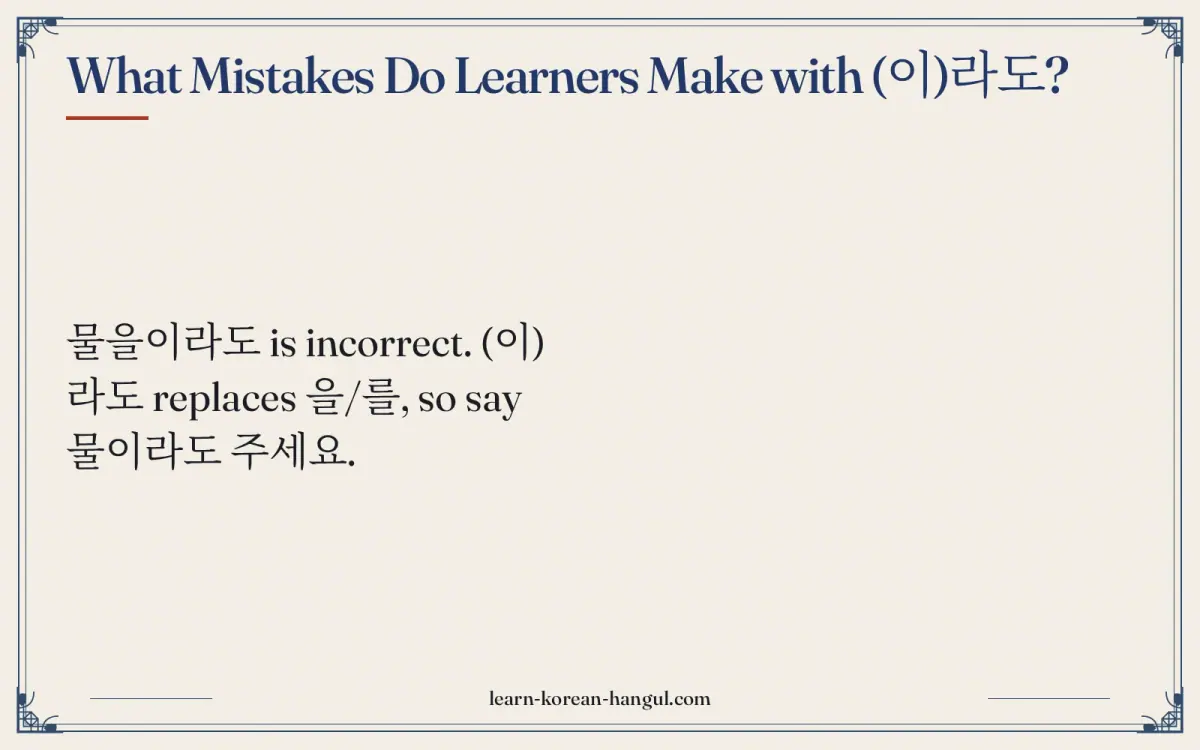
Learners most often choose the wrong shape of the particle or use it as a plain statement. Four mistakes appear again and again.
- Using the wrong shape. 커피이라도 is wrong, because 커피 ends in a vowel. 물라도 is wrong, because 물 ends in a consonant. Say 커피라도 and 물이라도.
- Stacking particles. 물을이라도 and 물이라도를 are wrong. (이)라도 replaces 이/가 and 을/를. Say 물이라도 주세요.
- Using it for a plain fact. 저는 매일 물이라도 마셔요 sounds odd, because it says "I drink at least water every day" and leaves the listener wondering what is missing. For a plain fact, use 을/를: 저는 매일 물을 마셔요. Use (이)라도 for a request, a suggestion or a concession.
- Using it for "even if" with a verb. 먹어라도 does not mean "even if I eat". Say 먹어도.
A quick check: Is the word before the particle a noun? Does it end in a consonant (이라도) or a vowel (라도)? Is the sentence a request, suggestion or concession? If all three answers are yes, the sentence is sound.
The practice set tests these points.
Practice and Answers
Try the four items before you read the answers.
- Choose the form. Complete: 우유___ 마셔요. (이라도 / 라도)
- Fix the error. A learner says 물을이라도 주세요. Correct it.
- Translate. "If you are hungry, at least eat some bread." Use 배고프다 and 빵.
- Write your own. Write one sentence that suggests a small second choice, using (이)라도. Then say which of the four meanings it has.
Practice · 8
Choose the right form: 커피___ 마셔요.
Show answer
라도
커피 ends in a vowel, so it takes 라도.
Which sentence correctly says "Please give me water, at least"?
Show answer
물이라도 주세요.
물 ends in a consonant, so it takes 이라도, and (이)라도 replaces 을/를 instead of stacking on it.
What does 누구라도 할 수 있어요 mean?
Show answer
Anyone at all can do it.
A question word plus (이)라도 means "any ... at all".
Which particle shows surprise at a large amount, as in "I waited as long as three hours"?
Show answer
(이)나
(이)나 can show surprise at an amount (세 시간이나 기다렸어요); (이)라도 never does that, and 도 means "also".
Which sentence sounds odd as a plain statement of fact?
Show answer
저는 매일 물이라도 마셔요.
(이)라도 suits requests, suggestions and concessions. In a plain fact it suggests that something better is missing.
How do you say "even if I eat" with a verb?
Show answer
먹어도
(이)라도 attaches to nouns. For "even if" with a verb, use -아/어도.
Which word means "any time at all"?
Show answer
언제라도
언제 means "when", so 언제라도 is "any time at all". 누구라도 is "anyone" and 어디라도 is "anywhere".
How is 지금이라도 pronounced?
Show answer
[지그미라도]
The final ㅁ of 지금 moves to the next syllable before the vowel of 이라도.
Answer key
- 라도. 우유 ends in the vowel ㅠ, so the form is 우유라도 마셔요.
- 물이라도 주세요. The particle 이라도 replaces 을.
- 배고프면 빵이라도 드세요. (baegopeumyeon ppangirado deuseyo.) [배고프면 빵이라도 드세요] The verb 드세요 is the honorific form of 먹어요.
- Answers vary. Check that the noun has the matching particle shape and the sentence is a suggestion. An example: 비가 오면 우산이라도 쓰세요 ("If it rains, at least use an umbrella").
If you can complete items 1 to 3 without the key, you can use the particle in conversation. The next section points to related lessons.
What Should You Learn Next after the (이)라도 Even If Particle?
After the (이)라도 even if particle, learn the particles that sit next to it. This lesson teaches the "at least" and "any" meanings and does not cover every use of auxiliary particles or the verb endings for "even if". Those have their own pages.
- Read (이)나 or particle for "or" and "as many as".
- Read also particle 도 for "also".
- Read only particle 만 for "only".
- Read 조차 마저 even particles for the stronger "even".
- Return to the full set of Korean auxiliary particles.
With these steps, the particle becomes automatic: end the noun with 이라도 or 라도, drop the old particle, and use it for a request, a suggestion or a concession.
Frequently Asked Questions
What does (이)라도 mean in Korean?
(이)라도 means "even" or "at least". It marks a noun as an acceptable second choice. 물이라도 주세요 means "Please give me water, at least", and 지금이라도 가요 means "Let's go, even if it is only now". With question words it means "any ... at all", as in 언제라도 (any time at all).
How do I form (이)라도?
Look at the last sound of the noun. After a consonant, add 이라도: 물 becomes 물이라도. After a vowel, add 라도: 커피 becomes 커피라도. The particle replaces 이/가 and 을/를, so you never write 물을이라도. It can also follow 에서 and 에게, as in 집에서라도.
What is the most common mistake with (이)라도?
The most common mistake is using it in a plain statement of fact, such as 저는 매일 물이라도 마셔요. The sentence suggests that water is a poor substitute, so the listener expects more context. Use it for requests, suggestions and concessions, and use 을/를 for ordinary facts.
How is (이)라도 different from (이)나?
(이)라도 offers a minimum or second choice ("at least coffee"). (이)나 gives a neutral choice ("coffee or tea") or shows surprise at a large amount ("as long as three hours"). If you can add "at least" in English, use (이)라도. If you can add "or", use (이)나.
Do I use (이)라도 in speech, writing or both?
Both. Speakers use it daily in requests such as 물이라도 주세요, and writers use it in advice and arguments. The forms 언제라도, 누구라도 and 어디라도 are common in speech and writing. A common spoken shortening is 뭐라도 for 무엇이라도.