What you'll learn
- Choose between 당하다 and 받다 for the noun in front.
- Write both forms with a particle (사랑을 받다) and as one word (사랑받다).
- Mark the doer with 에게, 한테 or 께.
- Tell these passives from the neutral -되다 passive.
- Fix the five most common mistakes.
Before you start: you should know the polite ending -아요/어요, the particles 이/가, 을/를 and 에게, and the idea of a passive. If the neutral passive is new, read -되다 passive 하다 verbs first. Audio plays only when you press a button.
What Does the -당하다 -받다 Passive Mean?
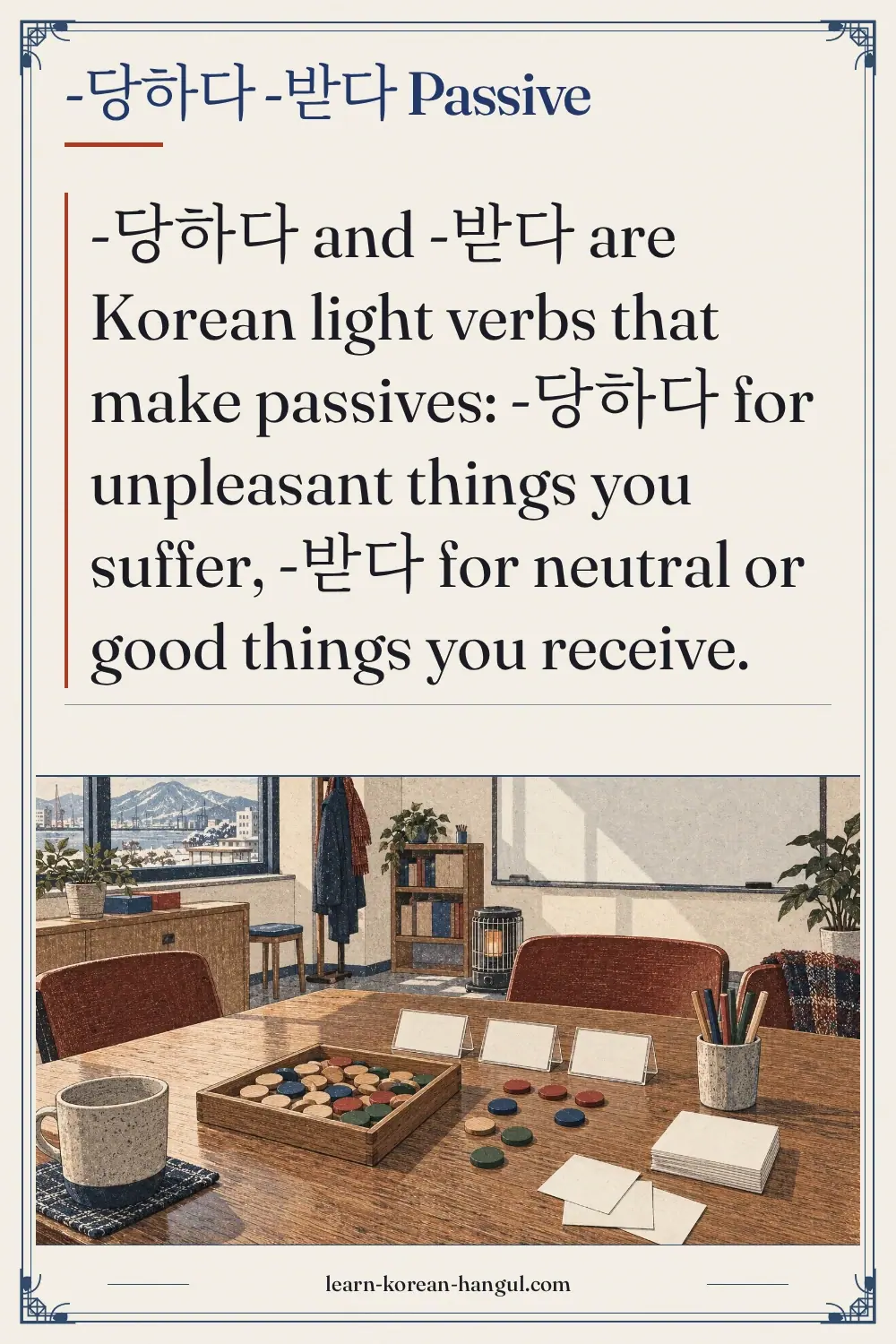
The verb 받다 means "receive", and the verb 당하다 means "suffer" or "undergo something bad". When they attach to a noun, they turn that noun into a passive idea. 사랑 means "love" and 사랑을 받다 means "to receive love", so "to be loved". 사기 means "fraud" and 사기를 당하다 means "to suffer a fraud", so "to be scammed".
English often uses "get" for both ideas: "get praised" and "get scammed". Korean must choose, and the choice carries a feeling. 당하다 tells the listener that the event was unwelcome and that someone else caused it. 받다 tells the listener that the person received something, which is usually good or at least neutral.
A First Example
- 사기를 당했어요. (sagireul danghaesseoyo.) [사기를 당해써요] = "I got scammed."
- 그는 모두에게 사랑을 받아요. (geuneun moduege sarangeul badayo.) [그는 모두에게 사랑을 바다요] = "He is loved by everyone."
In the first sentence, the subject 제가 is left out. 사기를 is the noun with 을/를, and 당했어요 is 당하다 in the polite past. In the second sentence, 그는 is the topic and acts as the subject, 모두에게 marks the people who give the love, and 받아요 is 받다 in the polite present. Both sentences keep 을/를 on the noun, although the sentence is passive in meaning. The next section shows which nouns go with which verb.
How Does the -당하다 -받다 Passive Work?
The -당하다 -받다 passive works by choosing the verb that matches the noun. Each noun usually goes with one of the two, and the pairs are learned as vocabulary. The table lists common nouns for each verb with the polite past.
| Verb | Noun | Whole expression | Polite past | Meaning |
|---|---|---|---|---|
| 당하다 | 사기 | 사기를 당하다 | 사기를 당했어요 | get scammed |
| 당하다 | 무시 | 무시당하다 | 무시당했어요 | be ignored, be looked down on |
| 당하다 | 거절 | 거절당하다 | 거절당했어요 | be turned down |
| 당하다 | 해고 | 해고당하다 | 해고당했어요 | be fired |
| 당하다 | 모욕 | 모욕당하다 | 모욕당했어요 | be insulted |
| 받다 | 사랑 | 사랑받다 | 사랑받았어요 | be loved |
| 받다 | 칭찬 | 칭찬받다 | 칭찬받았어요 | be praised |
| 받다 | 인정 | 인정받다 | 인정받았어요 | be recognised |
| 받다 | 존경 | 존경받다 | 존경받았어요 | be respected |
| 받다 | 치료 | 치료받다 | 치료받았어요 | receive treatment |
The table shows that the nouns are all "event" nouns. You can write each one with a particle (사기를 당했어요) or attach it (무시당했어요). The next parts explain the particle and the doer.
Particles and Spacing
Both patterns can be written in two ways, and both are common.
- Apart, with 을/를: 칭찬을 받았어요, 무시를 당했어요. The noun is the object of 받다 or 당하다.
- As one word, with no particle: 칭찬받았어요, 무시당했어요. The noun and verb join.
The meaning is the same. Choose one style and stay consistent inside a text. With a one-word verb, never put 을/를 inside it: 칭찬을받았어요 is a spacing error.
Marking the Doer
The doer is the person or group that gives the love, praise or harm. It is not the subject. It takes 에게 or 한테 (casual), and 께 when you respect the person.
- 선생님께 칭찬을 받았어요. (seonsaengnimkke chingchaneul badasseoyo.) [선생님께 칭차늘 바다써요] = "I was praised by my teacher."
- 친구에게 무시당했어요. (chinguege musidanghaesseoyo.) [친구에게 무시당해써요] = "I was ignored by a friend."
The subject in both sentences is the speaker, who is not named. The next section builds a sentence from an active one.
Worked Example: from Active to -당하다
The -당하다 -받다 passive turns an active sentence into a passive one in four steps. Follow the sentence "A friend ignored me."
- Start with the active sentence. 친구가 저를 무시했어요. (chinguga jeoreul musihaesseoyo.) [친구가 저를 무시해써요] = "A friend ignored me." The doer is 친구가, and the object is 저를.
- Make the receiver the subject. 저를 becomes 저는 (or the subject is dropped): 저는.
- Mark the doer with 에게. 친구가 becomes 친구에게.
- Replace 무시하다 with 무시당하다. The polite past is 무시당했어요.
Result: 저는 친구에게 무시당했어요.
Sentence
You know it worked when the receiver is the subject and the doer has 에게. The same steps work for a welcome event: 선생님이 저를 칭찬했어요 ("The teacher praised me") becomes 저는 선생님께 칭찬받았어요 (jeoneun seonsaengnimkke chingchanbadasseoyo) [저는 선생님께 칭찬바다써요], "I was praised by the teacher." The next section compares these passives with -되다.
How Is -당하다 -받다 Different from -되다?
The -되다 passive is neutral, while -당하다 and -받다 add a feeling about the event and a person who causes it. The table compares the three on a similar idea.
| Point | -되다 | -받다 | -당하다 |
|---|---|---|---|
| Feeling | neutral | welcome or neutral | unwelcome |
| Doer | not in focus | a person or group, with 에게 | a person or group, with 에게 |
| Example | 문제가 해결됐어요. | 인정을 받았어요. | 거절당했어요. |
| Meaning of example | The problem was solved. | I was recognised. | I was turned down. |
Two guidelines decide most cases. First, if the event is a result that no one in particular caused, use 되다. Second, if a person caused it and you want to show how it feels, use 받다 for welcome or neutral events and 당하다 for unwelcome ones. The page passive agent 에게 에 의해 explains the particle that marks the doer, and passive suffixes 이 히 리 기 teaches the fixed pairs such as 잡히다.
- 회사에서 인정받았어요. (hoesaeseo injeongbadasseoyo.) [회사에서 인정바다써요] = "I was recognised at my company."
- 면접에서 거절당했어요. (myeonjeobeseo geojeoldanghaesseoyo.) [면저베서 거절당해써요] = "I was turned down at the interview."
The next section looks at the limits of both verbs.
When Do You Use -당하다 or -받다, and When Not?
Choose by the noun and by the feeling. Many nouns accept only one verb, so treat each combination as vocabulary.
받다 is not always positive. 받다 means "receive", so it is also used for 치료받다 ("receive treatment") and 수술받다 ("have surgery"), which are neutral. Some unwelcome events also use 받다: 오해받다 ("be misunderstood"), 의심받다 ("be suspected") and 비난받다 ("be criticised").
당하다 is for harm. 사기, 무시, 거절 and 해고 all mean something bad happened to the person.
Some events use both. A noun such as 차별 (discrimination) is heard with both 받다 and 당하다. The 당하다 form puts more weight on the wrong that was done.
Do not use these for plain results. 문이 열렸어요 ("The door opened") needs a suffix passive, and 문제가 해결됐어요 needs 되다.
병원에서 치료를 받았어요. (byeongwoneseo chiryoreul badasseoyo.) [병워네서 치료를 바다써요] = "I received treatment at the hospital."
This lesson covers the common nouns. It does not list every noun that takes 당하다 or 받다, and the spacing rules for each combination are listed in a Korean dictionary. The mistakes below show where learners go wrong.
What Mistakes Do Learners Make with -당하다 and -받다?

Learners most often choose the wrong verb for the noun or change who the subject is. Five mistakes appear again and again.
- Using 받다 for harm. 사기를 받았어요 is wrong. A scam is suffered: 사기를 당했어요.
- Using 당하다 for something welcome. 칭찬을 당했어요 is unnatural. Praise is received: 칭찬을 받았어요.
- Putting 이/가 on the noun. 사기가 당했어요 is wrong. The noun is the object of the verb and takes 을/를, or it joins the verb with no particle.
- Changing the subject by accident. 선생님이 칭찬을 받았어요 means "The teacher received praise". To say that the teacher praised you, write 선생님께 칭찬을 받았어요.
- Assuming 받다 is always positive. 오해받다 and 의심받다 are the usual forms for being misunderstood or suspected. Forms such as 오해당하다 are much less usual.
A quick check helps: Does the noun fit the feeling of the verb? Does the receiver have the subject role? Does the doer have 에게, 한테 or 께? If all three answers are yes, the sentence is sound.
The practice set tests these points.
Practice and Answers
Try the four items before you read the answers.
- Choose the form. Complete: 저는 사기를 ___. (당했어요 / 받았어요)
- Fix the error. A learner says 선생님께 칭찬을 당했어요. Correct it.
- Translate. "I was turned down at the interview." Use 면접 and 거절당하다.
- Write your own. Write one sentence with 받다 and one with 당하다, each with a doer marked by 에게 or 께.
Practice · 6
Which sentence means "I got scammed"?
Show answer
사기를 당했어요.
사기 (a scam) is an unwelcome event, so it pairs with 당하다. The noun keeps 을/를.
Which sentence means "He is loved by everyone"?
Show answer
그는 모두에게 사랑을 받아요.
사랑 is welcome, so it pairs with 받다. The people who give the love take 에게.
Which sentence means "I was praised by my teacher"?
Show answer
선생님께 칭찬을 받았어요.
The teacher is the doer, so 께 (honorific 에게) marks them. Praise pairs with 받다.
What mainly decides between 당하다 and 받다?
Show answer
Whether the experience is unwelcome or welcome
당하다 marks unwelcome experiences and 받다 marks received, welcome or neutral ones.
Which sentence means "I was ignored by a friend"?
Show answer
친구에게 무시당했어요.
The friend is the doer and takes 에게. 친구가 would make the friend the one who was ignored.
Which pairing is wrong?
Show answer
사기를 받다
A scam is something you suffer, so it pairs with 당하다: 사기를 당하다.
Answer key
- 당했어요. A scam is an unwelcome event, so it pairs with 당하다.
- 선생님께 칭찬을 받았어요. Praise is welcome, so it pairs with 받다.
- 면접에서 거절당했어요. (myeonjeobeseo geojeoldanghaesseoyo.) [면저베서 거절당해써요]
- Answers vary. Check that the verb fits the noun and the doer has 에게, 한테 or 께. An example: 친구에게 사랑을 받았어요 ("I was loved by a friend") and 직장에서 무시를 당했어요 ("I was looked down on at work").
If you can complete items 1 to 3 without the key, you can use these passives in conversation. The next section points to related lessons.
What Should You Learn Next after the -당하다 -받다 Passive?
After these passives, learn how to mark the doer exactly and how causatives mirror them. This lesson teaches the nouns and the feeling of each verb. It does not teach the formal agent particle 에 의해, and it does not teach the causatives.
- Read passive agent 에게 에 의해 to choose the right particle for the doer.
- Review -되다 passive 하다 verbs for the neutral pattern.
- Review passive suffixes 이 히 리 기 for fixed pairs.
- Read -시키다 causative for the pattern in which someone else is made to act.
- Return to the full set of korean passive verbs.
With these steps, the pattern becomes automatic: pick 당하다 for harm and 받다 for what is received, keep the noun, and mark the doer with 에게.
Frequently Asked Questions
What is the difference between -당하다 and -받다?
-당하다 marks something unpleasant that happens to you, such as a scam or an insult: 사기를 당했어요. -받다 marks something you receive, usually welcome or neutral, such as love or praise: 칭찬을 받았어요. A few unwelcome events also use 받다, such as 오해받다 (be misunderstood) and 의심받다 (be suspected).
Do I put 을/를 on the noun?
You can. When the noun and verb are written apart, the noun takes 을/를: 사기를 당하다, 사랑을 받다. When they are written as one word, there is no particle: 사랑받다, 무시당하다. Both forms are common, and the meaning is the same.
How do I say who did it to me?
Mark the doer with 에게 or 한테, and with 께 for someone you respect: 친구에게 무시당했어요, 선생님께 칭찬을 받았어요. The doer is not the subject. The subject is the person who suffers or receives.
Is 받다 always positive?
No. 받다 simply means "receive". It is welcome in 사랑받다 and 칭찬받다, neutral in 치료받다 (receive treatment) and 수술받다 (have surgery), and unwelcome in 의심받다 and 비난받다. Use 당하다 when the focus is a wrong done to the person.
How is -당하다 different from -되다?
-되다 is a neutral passive that puts a result in focus: 문제가 해결됐어요. -당하다 adds the feeling that the event was unwelcome and that a person caused it. Use 당하다 for being scammed or ignored, and 되다 for a plain result.