
What you'll learn
- Choose between 에게, 한테, 께, 에 and 에 의해 for the doer.
- Turn an active sentence into a passive sentence with an agent in four steps.
- Tell formal written passives from everyday speech.
- Decide when an active sentence is the better choice.
- Fix the five most common mistakes.
Before you start: you should know what a passive verb is and the particles 이/가, 을/를 and 에게. If the passive is new, read passive suffixes 이 히 리 기 first. Audio plays only when you press a button.
What Does the Passive Agent 에게 에 의해 Mean?
An agent is the one who does the action. In an active sentence, the agent is the subject: 경찰이 도둑을 잡았어요 ("The police caught the thief"). In a passive sentence, the receiver becomes the subject, and the agent moves into an extra phrase: 도둑이 경찰에게 잡혔어요. English marks that phrase with the word "by". Korean marks it with a particle, and the particle changes with the agent.
Three particles do most of the work:
- 에게 / 한테 / 께 for people and animals. 한테 is casual, 에게 is neutral and 께 is respectful.
- 에 for forces, things and events, such as wind, snow or rain.
- 에 의해 (also 에 의해서) for formal writing, especially news, textbooks and official documents.
A First Example
- 이 그림은 피카소에 의해 그려졌어요. (i geurimeun pikasoe uihae geuryeojyeosseoyo.) [이 그리믄 피카소에 의해 그려저써요] = "This painting was painted by Picasso."
- 바람에 문이 열렸어요. (barame muni yeollyeosseoyo.) [바라메 무니 열려써요] = "The door was blown open by the wind."
In the first sentence, 이 그림은 is the topic and acts as the subject, 피카소에 의해 is the agent in the formal pattern, and 그려졌어요 is 그려지다 in the polite past. In the second sentence, 바람에 is the agent (a force), 문이 is the subject and 열렸어요 is 열리다 in the polite past. The next section shows the full set of choices.
How Does the Passive Agent 에게 에 의해 Work?
The passive agent works by choosing the particle that fits the doer and then placing the phrase before the verb. The table summarises the choices.
| Agent | Particle | Register | Example | Meaning |
|---|---|---|---|---|
| Person | 에게 | neutral | 경찰에게 잡혔어요 | was caught by the police |
| Person (casual) | 한테 | casual | 친구한테 잡혔어요 | was caught by a friend |
| Person you respect | 께 | respectful | 할머니께 안겼어요 | was held by grandmother |
| Animal | 에게 / 한테 | neutral / casual | 강아지에게 물렸어요 | was bitten by a puppy |
| Force or thing | 에 | neutral | 눈에 덮였어요 | was covered by snow |
| Any agent, formal | 에 의해 | formal, written | 건축가에 의해 설계되었습니다 | was designed by an architect |
The table shows that the particle follows the agent, not the verb: a puppy takes 에게 (강아지에게 물렸어요), while snow takes 에 (눈에 덮였어요). Here are more sentences.
- 아이가 강아지에게 물렸어요. (aiga gangajiege mullyeosseoyo.) [아이가 강아지에게 물려써요] = "The child was bitten by a puppy."
- 저는 모기한테 물렸어요. (jeoneun mogihante mullyeosseoyo.) [저는 모기한테 물려써요] = "I was bitten by a mosquito."
- 길이 눈에 덮였어요. (gili nune deopyeosseoyo.) [기리 누네 더펴써요] = "The road was covered by snow."
- 아이가 할머니께 안겼어요. (aiga halmonikke angyeosseoyo.) [아이가 할머니께 안겨써요] = "The child was held by grandmother."
Notice that none of the agents takes 이/가. The receiver already holds the subject role. The next section builds a sentence with an agent.
Worked Example: Adding an Agent
The passive agent can be added to a passive sentence in four steps. Follow the sentence "Picasso painted this picture", turned into a formal passive.
- Start with the active sentence. 피카소가 이 그림을 그렸어요. (pikasoga i geurimeul geuryeosseoyo.) [피카소가 이 그리믈 그려써요] = "Picasso painted this picture."
- Move the object to subject position. 이 그림을 becomes 이 그림은 (with the topic particle) or 이 그림이.
- Mark the agent. 피카소가 is a famous person and the register is formal, so use 피카소에 의해. For a casual sentence about a friend, 에게 or 한테 would replace it.
- Use the passive verb. 그리다 has no suffix passive, so use -아/어지다: 그려지다. The polite past is 그려졌어요.
Result: 이 그림은 피카소에 의해 그려졌어요.
Sentence
You know it worked when the receiver is the subject, the agent has its own particle and the verb is passive. A formal version for a document looks like this: 이 건물은 유명한 건축가에 의해 설계되었습니다 (i geonmureun yumyeonghan geonchukgaee uihae seolgyedoeeotseumnida) [이 건무른 유명한 건축까에 의해 설계되얻씀니다], "This building was designed by a famous architect." The next section compares the three particles directly.
How Are 에게, 에 and 에 의해 Different?
The three particles overlap in English "by" but not in Korean. The table compares them on the points that matter.
| Point | 에게 / 한테 | 에 | 에 의해 |
|---|---|---|---|
| Typical agent | person, animal | wind, snow, rain, events | person, group, cause (formal) |
| Register | neutral / casual | neutral | formal, written |
| Example | 경찰에게 잡혔어요. | 바람에 열렸어요. | 계획이 정부에 의해 발표되었습니다. |
| Meaning of example | Caught by the police. | Opened by the wind. | The plan was announced by the government. |
Two guidelines decide most cases. First, if the agent can act on purpose (a person or animal), use 에게 or 한테, and use 께 for a person you respect. Second, if the agent is a natural force or a thing, use 에; if you are writing formally, 에 의해 fits almost any agent. For more about the first group of particles, see 에게 한테 께 indirect object particles.
The verb also matters. A suffix passive such as 잡히다 or 물리다 comfortably takes 에게 or 한테. A -아/어지다 passive such as 그려지다 sounds better with 에 의해 when a doer is named. A neutral -되다 passive is explained on the page about -되다 passive 하다 verbs, and the -받다 and -당하다 passives usually take 에게 for the doer, as taught in -당하다 -받다 passive. The next section looks at when to skip the agent.
When Do You Use a Passive Agent, and When Not?
A passive with a named agent is correct, but Korean often chooses another way to say the same thing.
- Leave the agent out. Korean passives often have no agent: 문이 열렸어요 is complete. The agent is added only when it is new and important.
- Prefer the active sentence. When you know who did it and the doer matters, an active sentence is usually more natural. 피카소가 이 그림을 그렸어요 is what a speaker would say in conversation. A passive with an explicit agent, such as 이 그림은 피카소에 의해 그려졌어요, often sounds like a translation from English, and it suits writing about art or history.
- Formal writing. News, textbooks and official notices use 에 의해 more freely: 계획이 정부에 의해 발표되었습니다.
- Not for causatives. A causative has a causer and a causee, not an agent in this sense. The page causative vs passive in korean compares the two.
This lesson covers the particles that mark the doer. It does not cover every particle that can appear in a passive sentence, such as 으로 for tools, and it does not cover the suffix pairs themselves. The mistakes below show where learners go wrong.
What Mistakes Do Learners Make with the Passive Agent?
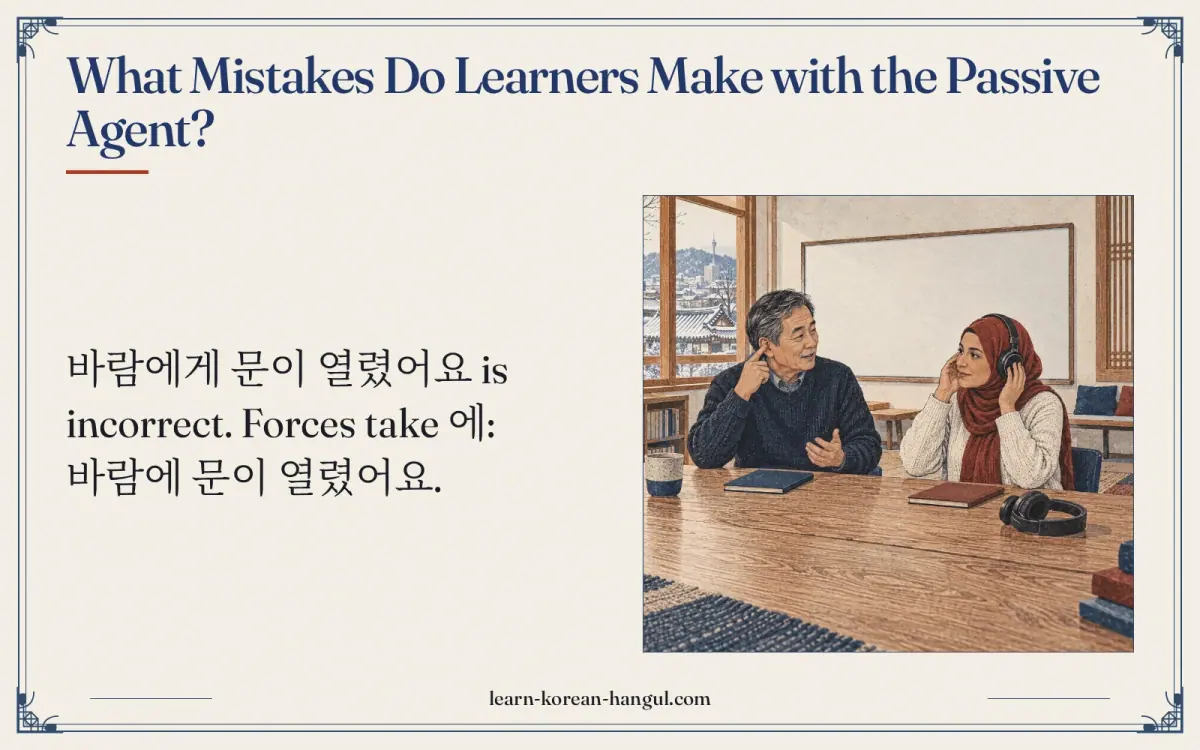
Learners most often pick the wrong particle for the type of agent. Five mistakes appear again and again.
- Using 에게 for a force. 바람에게 문이 열렸어요 is wrong. Wind is not a person or animal, so say 바람에 문이 열렸어요.
- Marking the agent with 이/가. 아이가 강아지가 물렸어요 is wrong, because it has two subjects. Say 아이가 강아지에게 물렸어요.
- Using 에 의해 in casual speech. 친구에 의해 잡혔어요 sounds stiff. In conversation, say 친구한테 잡혔어요.
- Using 에게 with a -아/어지다 passive. 이 그림이 피카소에게 그려졌어요 is not natural. Say 피카소에 의해 그려졌어요, or use the active sentence.
- Forcing a passive where the active is natural. A speaker who wants to say "He gave me a gift" says 그가 저에게 선물을 줬어요, not a stiff passive. Use the passive when the receiver is the topic.
A quick check helps: Is the agent marked with a particle and not 이/가? Does the particle fit the agent (person, force or formal)? Would an active sentence sound more natural? If the first two answers are yes, the sentence is correct.
The practice set tests these points.
Practice and Answers
Try the four items before you read the answers.
- Choose the form. Complete: 길이 ___ 덮였어요. (눈에 / 눈에게)
- Fix the error. A learner says 아이가 강아지가 물렸어요. Correct it.
- Translate. "I was bitten by a mosquito." Use 모기 and 물리다.
- Write your own. Write one passive sentence with an agent in each register: 한테 for a friend, and 에 의해 for a formal sentence.
Practice · 6
Which sentence correctly says "The door was blown open by the wind"?
Show answer
바람에 문이 열렸어요.
Wind is a force, so it takes 에. 에게 is for people and animals, and 이/가 would make a second subject.
Which particle is the most natural for a formal news article about a famous architect?
Show answer
에 의해
에 의해 is the formal, written way to mark the agent: 건축가에 의해 설계되었습니다.
Which sentence is wrong?
Show answer
아이가 강아지가 물렸어요.
The agent cannot take 이/가, because the child is already the subject. Use 에게 or 한테.
Which particle is the respectful form of 에게?
Show answer
께
께 is the honorific form of 에게/한테, used for a person you respect.
Which sentence is not natural?
Show answer
이 그림이 피카소에게 그려졌어요.
A -아/어지다 passive with a named doer uses 에 의해, not 에게. In everyday speech, the active sentence is the most natural.
Which particle marks a natural force such as snow as the agent?
Show answer
에
Forces and things take 에: 길이 눈에 덮였어요.
Answer key
- 눈에. Snow is a force, so it takes 에.
- 아이가 강아지에게 물렸어요. The child is the subject, and the puppy is the agent with 에게.
- 저는 모기한테 물렸어요. (jeoneun mogihante mullyeosseoyo.) [저는 모기한테 물려써요] 에게 also works.
- Answers vary. Check that the agent has its own particle and that the receiver is the subject. An example: 저는 친구한테 속았어요 ("I was fooled by a friend") and 이 책은 유명한 작가에 의해 쓰였습니다 ("This book was written by a famous author").
If you can complete items 1 to 3 without the key, you can use the passive agent in conversation. The next section points to related lessons.
What Should You Learn Next after the Passive Agent 에게 에 의해?
After the passive agent, learn the passive patterns that go with it and then the causatives. This lesson teaches the doer particles. It does not teach how each passive verb is formed.
- Read passive suffixes 이 히 리 기 for pairs such as 잡히다 and 열리다.
- Read -되다 passive 하다 verbs for 해결되다 and similar verbs.
- Read -당하다 -받다 passive for events you suffer or receive.
- Read causative -게 하다 for the opposite idea of making someone act.
- Compare the two in causative vs passive in korean.
- Return to the full set of korean passive verbs.
With these steps, the pattern becomes automatic: put the receiver in the subject slot, pick the particle by the type of doer, and leave the agent out when it is not needed.
Frequently Asked Questions
How do you say "by" in a Korean passive sentence?
Korean has no single word for "by". Use 에게 or 한테 for a person or animal (경찰에게 잡혔어요), 에 for a force or thing (바람에 열렸어요), and 에 의해 in formal writing (피카소에 의해 그려졌어요). Use 께 instead of 에게 for a person you respect.
What is the difference between 에게 and 한테 in a passive?
They mean the same. 한테 is more casual and is common in speech, while 에게 is neutral and common in writing. Both mark a person or animal as the agent. There is also a respectful form, 께.
When should I use 에 의해?
Use 에 의해 (or 에 의해서) in formal writing, news and textbooks, especially when the agent is an organisation, a famous person or a general cause: 이 건물은 유명한 건축가에 의해 설계되었습니다. In casual speech it sounds stiff, and 에게 or 한테 is more natural for people.
Why can I not use 에게 for wind or snow?
에게 is for animate agents, such as people and animals. Wind, snow, rain and other forces take 에: 바람에 문이 열렸어요, 눈에 덮였어요. Using 에게 with a force is a common learner mistake.
Do I always need to name the agent in a passive?
No. Korean often leaves the agent out, and the passive sentence is complete without it: 문이 열렸어요. When the doer is known and important, an active sentence is usually more natural than a passive with an agent.