What you'll learn
- Replace 하다 with 시키다 to make a causative.
- Mark the causer and the causee with the right particles.
- Use 하다 for your own action and 시키다 for someone else's.
- Recognise the everyday meaning "to order".
- Fix the five most common mistakes.
Before you start: you should know that many Korean verbs are a noun plus 하다, such as 공부하다, and you should know the particles 이/가, 을/를 and 에게. If the causative idea is new, skim causative suffixes 이 히 리 기 우 구 추 first. Audio plays only when you press a button.
What Does the -시키다 Causative Mean?
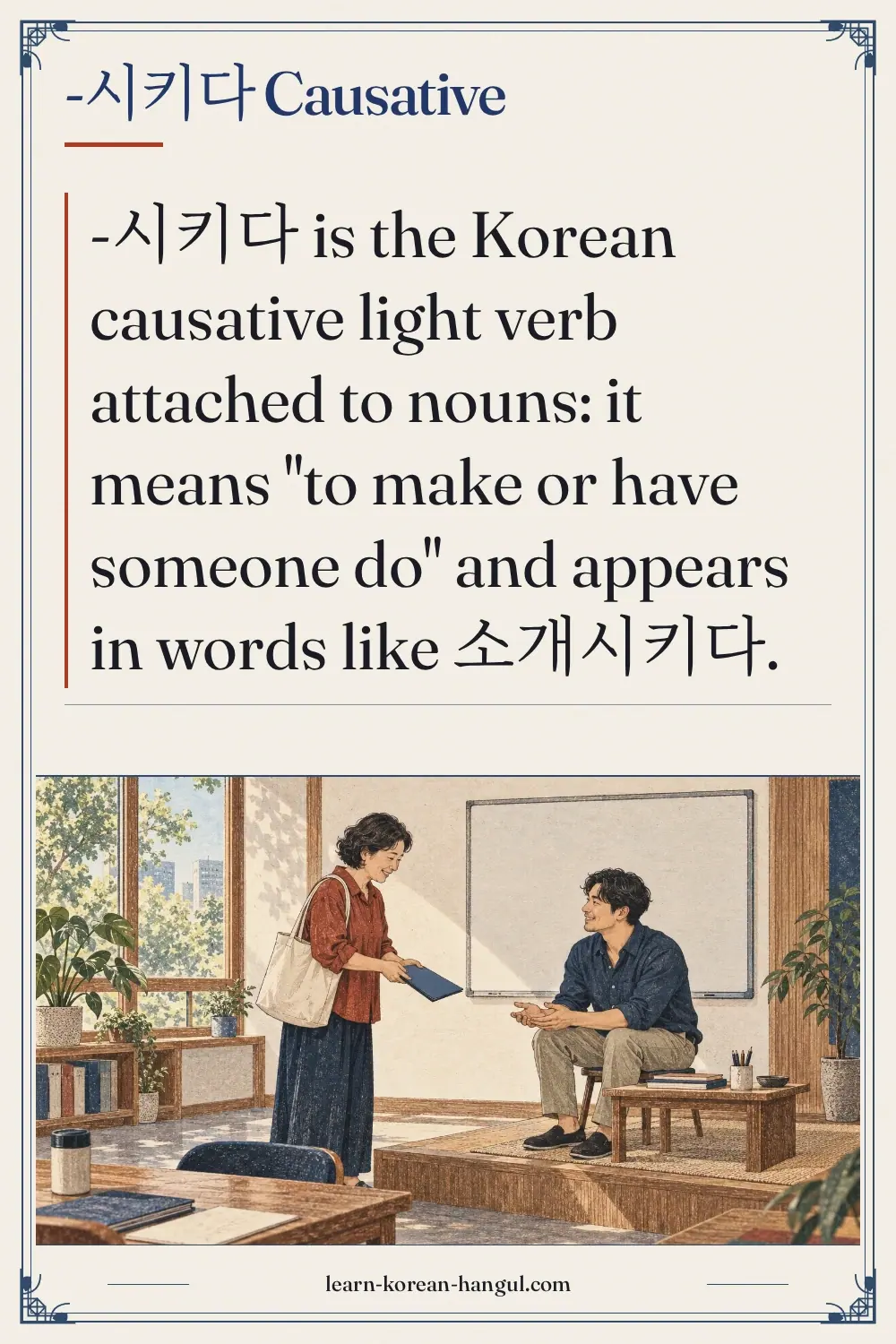
A causative sentence says that one person makes or lets another person do something. Korean builds the causative of a noun + 하다 verb by swapping 하다 for 시키다. The verb 시키다 comes from the idea of "cause to do". It is a light verb, which means a verb with little meaning of its own that adds a grammar job to the noun before it.
The roles are the same as in other causatives:
- The causer is the subject and takes 이/가.
- The causee is the one who is made to act. The causee takes 에게 or 을/를.
- The noun names the action and usually takes 을/를 when it is written apart from 시키다.
A First Example
- 부모님이 아이에게 공부를 시켜요. (bumonimi aiege gongbureul sikyeoyo.) [부모니미 아이에게 공부를 시켜요] = "The parents make the child study."
- 친구를 소개시켜 줄게요. (chingureul sogaesikyeo julgeyo.) [친구를 소개시켜 줄께요] = "I will introduce a friend to you."
In the first sentence, 부모님이 is the causer, 아이에게 is the causee, 공부를 is the noun with 을/를 and 시켜요 is 시키다 in the polite present. In the second sentence, 소개시켜 is the attached verb 소개시키다 plus -아/어, and 줄게요 is "I will do it for you". When you do the introducing yourself, usage guides prefer 소개해 줄게요, but 소개시켜 줄게요 is very common in everyday speech. The next section shows which nouns work.
How Does the -시키다 Causative Work?
The -시키다 causative works by adding 시키다 to a noun that means an action or a change. Most of these nouns are Sino-Korean words, which Korean borrowed from Chinese. The table lists common words with their polite past.
| Noun | Plain verb | Causative | Polite past | Meaning of the causative |
|---|---|---|---|---|
| 공부 | 공부하다 | 공부시키다 | 공부시켰어요 | make someone study |
| 소개 | 소개하다 | 소개시키다 | 소개시켰어요 | introduce someone |
| 입원 | 입원하다 | 입원시키다 | 입원시켰어요 | have someone hospitalised |
| 운동 | 운동하다 | 운동시키다 | 운동시켰어요 | make someone exercise |
| 이해 | 이해하다 | 이해시키다 | 이해시켰어요 | make someone understand |
| 만족 | 만족하다 | 만족시키다 | 만족시켰어요 | satisfy someone |
| 안심 | 안심하다 | 안심시키다 | 안심시켰어요 | reassure someone |
The table shows that the plain verb is always noun + 하다. The causative keeps the noun and changes the last word. Some of these words describe a state of mind. 만족시키다 and 안심시키다 mean "cause someone to feel satisfied or safe", so the causer can be a thing:
- 이 서비스는 고객을 만족시켜요. (i seobiseuneun gogaegeul manjoksikyeoyo.) [이 서비스는 고개글 만족씨켜요] = "This service satisfies customers."
- 의사가 환자를 입원시켰어요. (uisaga hwanjareul ibwonsikyeosseoyo.) [의사가 환자를 이붠시켜써요] = "The doctor had the patient admitted to hospital."
Spacing and Particles
There are two ways to write the same idea.
- Attached: 환자를 입원시켰어요. The noun and 시키다 form one word, and the causee takes 을/를.
- Apart, with the noun as an object: 아이에게 공부를 시켜요. The noun has 을/를, and the causee takes 에게.
Both forms are common. The attached form is typical when the noun is a ready-made verb such as 입원시키다 or 소개시키다. The apart form is common for 공부, 운동 and 일. The next part shows the second kind of 시키다.
시키다 Alone: "to Order"
The word 시키다 also stands alone in daily speech. It means "to order", as in asking for food to be made or brought, and it takes an object with 을/를.
- 피자를 시켰어요. (pijareul sikyeosseoyo.) [피자를 시켜써요] = "I ordered pizza."
This is a separate everyday use, and it is the one you will hear most in Korea. The next section builds a causative sentence step by step.
Worked Example: from 하다 to 시키다
The -시키다 causative turns a plain 하다 sentence into a causative one in four steps. Follow the sentence "The parents make the child study."
- Start with the plain sentence. 아이가 공부해요. (aiga gongbuhaeyo.) [아이가 공부해요] = "The child studies."
- Split the verb. 공부해요 is noun 공부 plus 하다.
- Swap 하다 for 시키다. 공부를 시켜요, with 을/를 on the noun.
- Add the causer and mark the causee. 부모님이 is the new subject. The old subject 아이가 becomes 아이에게.
Result: 부모님이 아이에게 공부를 시켜요.
Sentence
You know it worked when the sentence has a new subject, the old subject has 에게 or 을/를 and the last word is 시키다. For an attached verb, the order changes only slightly: 부모님이 아이를 공부시켜요 is also heard, with the causee marked by 를. The next section compares the pattern with the others.
How Is -시키다 Different from 하다 and -게 하다?
하다 means that the subject does the action, -시키다 means that someone else is made to do it, and -게 하다 does the same job for any verb. The table compares them.
| Point | 하다 | -시키다 | -게 하다 |
|---|---|---|---|
| Who acts | the subject | someone else | someone else |
| Attaches to | noun | noun + 하다 words | any verb or adjective stem |
| Example | 제가 운동해요. | 강아지를 운동시켜요. | 강아지를 운동하게 해요. |
| Meaning of example | I exercise. | I exercise the dog. | I make the dog exercise. |
Two guidelines decide most cases. First, ask who acts. If the subject acts, use 하다. Second, if someone else acts and the word is a noun + 하다 verb, choose 시키다 or 하게 하다. For many words both work: 공부시키다 and 공부하게 하다 both mean "make someone study". The version with 시키다 is shorter and can sound more like giving an order. The page on causative -게 하다 teaches the second pattern.
Many noun + 하다 verbs also have a neutral passive partner with 되다, which is covered in -되다 passive 하다 verbs. To learn what a 하다 verb is, see korean 하다 verbs noun + 하다. The next section looks at the limits.
When Do You Use -시키다, and When Not?
-시키다 fits Sino-Korean action nouns and states of mind. It does not fit plain verbs, and it can sound strong.
- Only noun + 하다 words. 먹시키다 and 가시키다 do not exist. For plain verbs use a suffix pair such as 먹이다, or -게 하다 (가게 하다).
- Authority. 시키다 suggests that the causer has the right to give orders. A teacher or parent can 공부시키다 a student, but saying that you 시키다 a boss sounds rude. To make a request to someone senior, use 부탁드리다 or 해 주세요.
- Ordering food. In shops and restaurants, 시키다 alone is the usual word for ordering food, and 주문하다 is the more formal word.
- Reassuring and calming. Words such as 안심시키다 and 진정시키다 are used in the news and in care situations: 아이를 안심시켰어요 (aireul ansimsikyeosseoyo) [아이를 안심시켜써요] means "I reassured the child."
This lesson covers the common nouns and the contrast with 하다 and -게 하다. It does not list every noun that takes 시키다. The mistakes below show where learners go wrong.
What Mistakes Do Learners Make with -시키다?
Learners most often use 시키다 for their own action or attach it to the wrong word. Five mistakes appear again and again.
- Using 시키다 for yourself. 제가 운동시켜요 is wrong for "I exercise". Say 제가 운동해요.
- Attaching 시키다 to a plain verb. 먹시키다 is wrong. Say 먹이다 or 먹게 하다.
- Using 시키다 for "order" with another noun. 음식을 주문시켰어요 is wrong. Say 음식을 주문했어요 or 음식을 시켰어요.
- Making the causee the subject. 부모님이 아이가 공부를 시켜요 is wrong. The child is the causee, so write 아이에게 or 아이를.
- Using 시키다 about a superior. 사장님께 일을 시켰어요 sounds impolite. Make a request instead.
A quick check helps: Does someone else do the action? Is the word a noun + 하다 verb? Does the causee have 에게 or 을/를? If all three answers are yes, the sentence is sound.
The practice set tests these points.
Practice and Answers
Try the four items before you read the answers.
- Choose the form. Complete: 제가 매일 ___. (운동해요 / 운동시켜요)
- Fix the error. A learner says 음식을 주문시켰어요 for "I ordered food". Correct it.
- Translate. "The doctor had the patient admitted to hospital." Use 입원시키다.
- Write your own. Write one sentence in which a person makes someone else do an action, using a noun + 시키다.
Practice · 6
Which sentence means "I exercise"?
Show answer
제가 운동해요.
Use 하다 for your own action. 시키다 would mean that you make someone else exercise.
Which sentence means "The parents make the child study"?
Show answer
부모님이 아이에게 공부를 시켜요.
The parents are the causers and the child is the causee with 에게. The verb 시키다 means to make someone do it.
What does 피자를 시켰어요 mean?
Show answer
I ordered pizza.
시키다 alone means "to order" in everyday speech.
Which verb means "to have someone admitted to a hospital"?
Show answer
입원시키다
입원하다 is for yourself, and 입원시키다 is for having someone else admitted. 입원되다 describes being admitted, not admitting someone.
Why can 시키다 sound rude about a boss?
Show answer
It suggests that you have authority over the person.
시키다 carries the feeling of ordering someone. For a senior person, use a request such as 부탁드리다.
Which form does not exist?
Show answer
먹시키다
시키다 attaches to noun + 하다 words, not to plain verb stems. For feeding, use 먹이다 or 먹게 하다.
Answer key
- 운동해요. You do the action yourself, so use 하다.
- 음식을 주문했어요 or 음식을 시켰어요. 주문 takes 하다, not 시키다.
- 의사가 환자를 입원시켰어요. (uisaga hwanjareul ibwonsikyeosseoyo.) [의사가 환자를 이붠시켜써요]
- Answers vary. Check that the causer is the subject, that the causee has 에게 or 을/를 and that the word is a noun + 하다 verb. An example: 선생님이 학생들에게 운동을 시켰어요 ("The teacher made the students exercise").
If you can complete items 1 to 3 without the key, you can use -시키다 in conversation. The next section points to related lessons.
What Should You Learn Next after the -시키다 Causative?
After -시키다, compare the causatives with each other and with the passives. This lesson teaches the noun causative. It does not teach the suffix pairs or the productive -게 하다 in depth.
- Read causative -게 하다 for the pattern that works on any verb.
- Read causative suffixes 이 히 리 기 우 구 추 for pairs such as 먹이다.
- Read causative vs passive in korean to separate the two ideas.
- Read -당하다 -받다 passive for the mirror idea of receiving.
- Browse korean transitive and intransitive verb pairs for related pairs.
- Return to the full set of korean passive verbs.
With these steps, the pattern becomes automatic: use 하다 for your own action, swap in 시키다 when someone else acts, and mark the causee with 에게 or 을/를.
Frequently Asked Questions
What does -시키다 mean in Korean?
-시키다 attaches to a noun and means to make or have someone do that action, or to cause something to happen. 공부시키다 means "make someone study", 입원시키다 means "have someone hospitalised" and 만족시키다 means "satisfy". The person who makes it happen is the subject.
What is the difference between 하다 and 시키다?
하다 is for actions you do yourself: 제가 운동해요 (I exercise). 시키다 is for making someone else do the action: 강아지를 운동시켜요 (I exercise the dog). Using 시키다 for your own action, such as 제가 운동시켜요, is a mistake.
Why does 음식을 시켜요 mean "I order food"?
시키다 on its own has a second everyday meaning: to order or ask for something to be brought. 피자를 시켰어요 means "I ordered pizza". This sense is separate from the causative suffix, and it is the most common use in daily speech.
How is -시키다 different from -게 하다?
Both make someone act. -게 하다 attaches to any verb or adjective stem, while -시키다 attaches only to noun + 하다 words. For many words, either works: 공부시키다 and 공부하게 하다 both mean "make study". 시키다 can sound more like giving an order.
Is -시키다 polite to use about a boss or an elder?
It can sound rude, because 시키다 suggests that you have authority over the person. To ask someone senior to do something, use a request such as 부탁드리다 (ask a favour) or 해 주세요 instead.