What you'll learn
- Attach -아/어야겠다 to any verb stem, including 하다 verbs and irregular verbs.
- Announce a decision after you notice a need, such as "I'm late, so I should go."
- Use the negative form -지 말아야겠다 for "I had better not."
- Explain how -아/어야겠다 differs from -아/어야 하다.
- Report an earlier decision with -다고 생각했다.
Before you start: you should know how to find a verb stem (drop 다 from the dictionary form) and the polite ending -아요/어요, because the first half of this pattern uses the -아/어 form. Audio plays only when you press a button.
What Does -아/어야겠다 Grammar Mean?
-아/어야겠다 grammar means "I need to" in the sense of "I have just decided that I need to." The pattern has two parts that you can see. -아/어야 means "only if" (the same piece gives -아/어야 하다 its "must" meaning), and -겠다 shows the speaker's will or inference. Together they say: "Given what I now see, the right thing is to do this."
Here are the first two examples. The pattern is the same in both, and only the verb changes.
- 너무 늦었네요. 이제 가야겠어요. (neomu neujeonneyo. ije gayagesseoyo.) [너무 느전네요. 이제 가야게써요] = "It's late. I should go now."
- 살을 빼야겠어요. (sareul ppaeyagesseoyo.) [사를 빼야게써요] = "I need to lose weight."
Notice what triggers each sentence. In the first, the speaker looks at the clock. In the second, the speaker sees a scale or a photo. A moment of noticing comes first, and the decision follows at once. That is why the pattern fits phrases such as "Right, I'd better…" in English. The speaker is not quoting a rule or reporting a duty. The next section shows how the pattern is built.
How Do You Form -아/어야겠다?
-아/어야겠다 is formed by making the -아/어 form of the verb stem and adding -야겠다. Choose 아 when the last vowel of the stem is ㅏ or ㅗ, and 어 for every other vowel. Many forms contract: 가 + 아야 becomes 가야, and 하 + 여야 becomes 해야.
| Dictionary form | Stem | Add -아/어야겠다 | Polite form | Meaning |
|---|---|---|---|---|
| 가다 | 가 | 가야겠다 | 가야겠어요 | I should go |
| 오다 | 오 | 와야겠다 | 와야겠어요 | I should come |
| 먹다 | 먹 | 먹어야겠다 | 먹어야겠어요 | I should eat |
| 앉다 | 앉 | 앉아야겠다 | 앉아야겠어요 | I should sit |
| 하다 | 하 | 해야겠다 | 해야겠어요 | I should do |
| 마시다 | 마시 | 마셔야겠다 | 마셔야겠어요 | I should drink |
The table shows one rule applied to six verbs. The next three parts look at the groups of stems one at a time.
Stems Ending in a Vowel
A vowel stem takes 야겠다 after the contracted -아/어 form. 가다 becomes 가야겠다, 일어나다 becomes 일어나야겠다, and 빼다 becomes 빼야겠다. Because the vowel contracts, the pattern often looks shorter than you expect.
- 일찍 일어나야겠어요. (iljjik ireonayagesseoyo.) [일찍 이러나야게써요] = "I should get up early."
- 좀 쉬어야겠어요. (jom swieoyagesseoyo.) [좀 쉬어야게써요] = "I need to rest a bit."
Vowel stems are the simplest case. A stem with a final consonant needs the full -아/어 syllable.
Stems Ending in a Consonant
A consonant stem keeps its final consonant and adds 아 or 어 as a separate syllable. 먹다 becomes 먹어야겠다, 읽다 becomes 읽어야겠다, and 앉다 becomes 앉아야겠다 (the last vowel is ㅏ).
- 책을 더 읽어야겠어요. (chaegeul deo ilgeoyagesseoyo.) [채글 더 일거야게써요] = "I need to read more books."
A 하다 verb works like a vowel stem, because 하 + 여야 contracts to 해야: 오늘부터 운동해야겠어요. (oneulbuteo undonghaeyagesseoyo.) [오늘부터 운동해야게써요] = "I will start exercising from today."
The final consonant moves to the next syllable in speech, so 읽어 sounds like [일거]. Also listen for the ending 겠어요, which sounds like [게써요]. The ㅆ is pronounced as written, and no tensing rule changes it. Two more groups need a short note, because learners expect trouble with them.
Irregular Stems and Nouns
Irregular stems change before the vowel in 아/어, as they do before any ending that starts with 아 or 어.
- ㅂ-irregular: 돕다 becomes 도와야겠다 ("I should help"). 친구를 도와야겠어요 = "I should help my friend." [친구를 도와야게써요]
- ㄷ-irregular: 듣다 becomes 들어야겠다 ("I should listen to it").
- 르-verbs: 고르다 becomes 골라야겠다, and 부르다 becomes 불러야겠다.
- ㅡ-verbs: 쓰다 becomes 써야겠다.
- ㄹ-stems: 만들다 becomes 만들어야겠다, with ㄹ kept.
- 하다 verbs: 공부하다 becomes 공부해야겠다, and 시작하다 becomes 시작해야겠다.
Nouns do not take the pattern. To say you need to become something, use 되다: 의사가 돼야겠어요. Adjectives take the pattern only in a "need to become" sense, as in 더 부지런해야겠어요 ("I need to be more diligent"). With the formation clear, one full sentence can be built step by step.
Worked Example: Building a Sentence with -아/어야겠다
-아/어야겠다 grammar turns a plain fact into a decision. Follow the steps with the situation "I have read too little lately."
- Start with the plain sentence. 책을 더 읽어요. (chaegeul deo ilgeoyo.) = "I read more books." The verb is 읽어요.
- Find the dictionary form and stem. 읽어요 comes from 읽다 (to read). The stem is 읽.
- Choose 아 or 어. The last vowel of 읽 is ㅣ, which is not ㅏ or ㅗ, so use 어: 읽어.
- Add -야겠다. 읽어 + 야겠다 = 읽어야겠다.
- Move to the polite style. Replace 다 with 어요: 읽어야겠어요. The sentence becomes 책을 더 읽어야겠어요. (chaegeul deo ilgeoyagesseoyo.) = "I need to read more books."
Sentence
You will know it worked when the sentence has a clear trigger in your mind and the verb has the shape stem + 아/어 + 야겠어요. The most common slip at step 3 is skipping the vowel: 읽야겠어요 is wrong. The second slip is swapping the pieces and writing 읽겠어야요. The order is always 야, then 겠. Each sentence can also appear in several tenses and sentence types, and each has limits.
Which Tenses and Sentence Types Work with -아/어야겠다?
-아/어야겠다 works in the present, in questions and in the negative form, and it has no everyday past form. The past marker -았/었- is not added to the pattern, so an earlier decision has to be reported in another way (see the last row). The table shows the forms for 가다 in the polite style.
| Sentence type | Form | Meaning |
|---|---|---|
| Present statement | 가야겠어요 | I should go. |
| Negative | 가지 말아야겠어요 | I had better not go. |
| Question to the listener | 가야겠어요? | Do you need to go (now)? |
| Formal | 가야겠습니다 | I must go (formal announcement). |
| Casual (banmal) | 가야겠어 | I should go (to a friend, or to myself). |
| Written plain style | 가야겠다 | I should go (diary). |
| Realisation | 가야겠네요 | Well, I had better go. |
| Reported earlier decision | 가야겠다고 생각했어요 | I thought I should go. |
The standard negative uses 말다 ("to stop"): 오늘은 커피를 마시지 말아야겠어요. (oneureun keopireul masiji marayagesseoyo.) [오느른 커피를 마시지 마라야게써요] = "I had better not drink coffee today." The question usually asks about a decision the listener has already made. 벌써 가야겠어요? (beolsseo gayagesseoyo?) means "Are you leaving already?"
- 감기에 걸렸어요. 병원에 가야겠어요. (gamgie georyeosseoyo. byeongwone gayagesseoyo.) [감기에 걸려써요. 병워네 가야게써요] = "I caught a cold. I should go to the hospital."
- 내일부터 일찍 일어나야겠다고 생각했어요. (naeilbuteo iljjik ireonayagetdago saenggakaesseoyo.) [내일부터 일찍 이러나야겓따고 생가캐써요] = "I thought I should get up early from tomorrow."
The second example shows the standard way to talk about a past decision: put the whole pattern inside a quotation with -다고 and add 생각했어요 ("I thought"). The most useful contrast for a learner is with a duty pattern.
How Is -아/어야겠다 Different from -아/어야 하다/되다?
-아/어야겠다 announces the speaker's decision, while -아/어야 하다/되다 states a duty or a necessary condition. Both translate as "must" or "need to" in English, but they come from different places. One comes from inside the speaker, and the other comes from outside.
| Point | -아/어야겠다 | -아/어야 하다/되다 |
|---|---|---|
| Core idea | I decide I should | it is necessary, it is a duty |
| Where the pressure comes from | the speaker's own judgement | a rule, a schedule or another person |
| Typical subject | I, we | anyone |
| Example | 이제 가야겠어요. | 이제 가야 해요. |
| Meaning of example | I think I'd better go now. | I have to go now (because of a schedule). |
The two examples can describe the same evening. If you leave because you suddenly feel tired and the hour is late, say 가야겠어요. If you leave because the last train departs at midnight, say 가야 해요. The second one would sound strange as a private decision, and the first one would sound strange as an official rule. A school notice says 학생은 숙제를 해야 합니다, never 해야겠습니다.
A second neighbour is -고 싶다, "want to." 가고 싶어요 shows desire, and 가야겠어요 shows need. A third neighbour is -(으)ㄹ 생각이다, which states a plan that has been thought through. 가야겠어요 sounds spontaneous, and 갈 생각이에요 sounds planned. These contrasts lead to the variations of the pattern itself.
Variations and Edge Cases of -아/어야겠다
-아/어야겠다 has four common variations: a thinking-aloud tone, a realisation ending, the negative with 말다 and a formal announcement. Each one is short, and each appears in real conversation.
- Thinking aloud. In casual speech, people say 공부해야겠어 or 가야겠다 to themselves. The sentence is addressed to nobody. This is the most natural use of the pattern, and it works as a mental note.
- Realisation: -아/어야겠네요. Adding -네요 shows that the speaker has just noticed the situation. 이제 가야겠네요 (ije gayagenneyo) [이제 가야겐네요] means "Well, I had better go now." It is a polite way to end a visit. The final ㅆ of 겠 becomes [ㄴ] before the ㄴ of 네요, so 겠네요 sounds like [겐네요].
- Negative with 말다. For "I should not," the standard form uses 말다: 먹지 말아야겠어요. 안 먹어야겠어요 is also heard in casual speech, but -지 말아야겠다 is the form textbooks and the TOPIK teach.
- Formal decisions. 가야겠습니다 is used in speeches and meetings to announce a firm decision: 이제 결정해야겠습니다 ("We will now have to decide").
This lesson covers the common forms used in daily life. It does not cover the written pattern -아/어야 하겠다, which is the longer form of the same ending, or past regret forms. The mistakes below show where the boundaries cause real errors.
Common Mistakes with -아/어야겠다
Learners most often get the meaning, the subject or the order of pieces wrong. Four mistakes appear again and again.
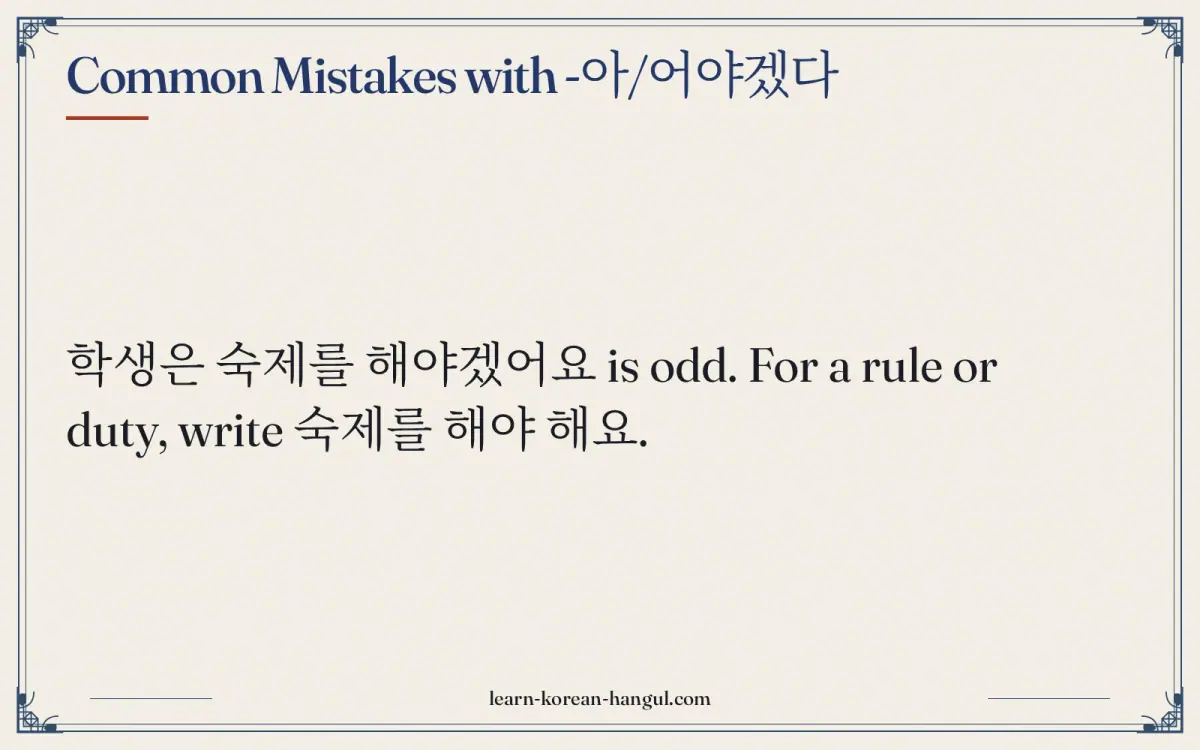
- Using it for a rule or a duty. 학생은 숙제를 해야겠어요 sounds wrong, because nobody has made a decision. Use 숙제를 해야 해요 for a duty.
- Using it for another person's duty. 동생이 가야겠어요 sounds as if you were deciding for your sibling. Report the person's own words instead: 동생이 가야겠다고 해요 ("My sibling says he should go").
- Looking for a past form. 가야겠었어요 is wrong. Report earlier decisions with 가야겠다고 생각했어요. For regret, Korean uses a different pattern, -았/었어야 했다, which is outside this lesson.
- Changing the order of the pieces. 가겠야요 is wrong. The order is 야, then 겠: 가야겠어요.
A quick check for any "I should" sentence: Did the speaker decide it just now? Is the subject "I" or "we"? Is the order 아/어, 야, 겠? If all three answers are yes, the sentence is sound.
The practice set below tests these four points directly.
Practice and Answers
Try the four items before you read the answer key. Cover the answers with your hand.
- Choose the pattern. You look at the clock and decide to leave. Which fits? (가야겠어요 / 가야 해요)
- Form the pattern. Say "I should exercise" with 운동하다.
- Report a decision. Say "Yesterday I thought I should go to the hospital."
- Make it negative. Say "I had better not eat" with 먹다.
Practice · 7
You look at the clock and decide to leave. Which sentence fits?
Show answer
이제 가야겠어요.
-아/어야겠다 announces a decision made at the moment of speaking. 가야 해요 fits when a rule or a schedule forces you.
How do you say "I need to read more books"?
Show answer
책을 더 읽어야겠어요.
A consonant stem keeps the full 어 syllable, then 야, then 겠: 읽어야겠어요.
What is the -아/어야겠다 form of 돕다 in 친구를 ___ ("I should help my friend")?
Show answer
도와야겠어요
돕다 is ㅂ-irregular, so before 아/어 it becomes 도와: 도와야겠어요.
Which sentence correctly reports a decision you made yesterday?
Show answer
어제 병원에 가야겠다고 생각했어요.
The pattern has no everyday past form. Put it inside -다고 and let 생각했어요 carry the past.
A school notice states a rule for students. Which sentence fits?
Show answer
학생은 숙제를 해야 합니다.
A rule or duty uses -아/어야 하다. -아/어야겠다 is the speaker's own decision, so it sounds odd in a notice.
What is the standard way to say "I had better not drink coffee today"?
Show answer
오늘은 커피를 마시지 말아야겠어요.
The standard negative uses 말다: -지 말아야겠어요.
What does 이제 가야겠네요 add compared with 이제 가야겠어요?
Show answer
It shows the speaker has just noticed the situation, a polite way to end a visit.
-네요 marks a realisation, so 가야겠네요 means "Well, I had better go now."
Answer key
- 가야겠어요. You made the decision when you saw the time. 가야 해요 would fit if a rule or a schedule forced you.
- 운동해야겠어요. The stem 운동하 becomes 운동해 + 야겠어요.
- 어제 병원에 가야겠다고 생각했어요. (eoje byeongwone gayagetdago saenggakaesseoyo.) [어제 병워네 가야겓따고 생가캐써요] The decision sits inside -다고, and 생각했어요 carries the past.
- 먹지 말아야겠어요. (meokji marayagesseoyo.) [먹찌 마라야게써요] The standard negative uses 말다.
If you can complete items 1 to 3 without the key, you can use the pattern in conversation. Next, the lesson hands off to related patterns.
What Should You Learn Next after -아/어야겠다 Grammar?
After -아/어야겠다 grammar, learn the duty pattern, then the plan pattern. This lesson teaches a decision made on the spot and does not cover rules, planned intentions or regret in depth. Those live on their own pages.
- Start with -아/어야 하다/되다, which states a duty or a need from outside.
- Continue with -(으)ㄹ 생각이다, which states a plan that has been thought out.
- Compare the wish for yourself in -고 싶다.
- Return to Desire and Wishes to see every lesson in this set, or to the Intermediate Grammar list for other B1 patterns.
With these steps, -아/어야겠다 becomes automatic: notice the need, make the -아/어 form of the stem, add 야겠어요, and keep the subject as "I."
Frequently Asked Questions
What does -아/어야겠다 mean?
-아/어야겠다 means "I should" or "I need to," as a decision. 너무 늦었네요. 이제 가야겠어요 means "It is late. I should go now." The speaker has just noticed a need and settles on an action. It sounds like thinking aloud, not like quoting a rule.
How do I attach -아/어야겠다 to a verb or adjective?
Make the -아/어 form of the stem, then add -야겠다. 가다 becomes 가야겠다, 먹다 becomes 먹어야겠다, 하다 becomes 해야겠다, and 돕다 becomes 도와야겠다. It is used mostly with verbs. An adjective appears only when the speaker means "I need to become" that quality.
Can -아/어야겠다 be used in the past tense?
Not directly. The pattern has no everyday past form. To report an earlier decision, quote it: 어제 병원에 가야겠다고 생각했어요 means "Yesterday I thought I should go to the hospital." For "should have done," a different pattern is used: -았/었어야 했다.
Is -아/어야겠다 used in speech or only in writing?
It is mostly spoken. People say 가야겠어요 in polite talk and 가야겠어 to friends, often while thinking aloud. In formal speech, 가야겠습니다 announces a decision. In writing, it appears in diaries, blogs and dialogue, but formal reports prefer 해야 한다.
What is the most common mistake with -아/어야겠다?
The most common mistake is using it for an obligation that comes from a rule or another person. 학생은 숙제를 해야겠어요 sounds odd, because nobody has decided anything. Use 숙제를 해야 해요 for a duty. A second mistake is the order of the pieces: it is 야 plus 겠, so 가겠야요 is wrong.
Can I use -아/어야겠다 for another person?
Mostly no. The pattern shows the speaker's own resolve, so statements use "I" or "we." To report someone else, quote them: 친구는 가야겠다고 해요 means "My friend says he should go." In a question, the subject is "you," as in 벌써 가야겠어요?, "Are you leaving already?"