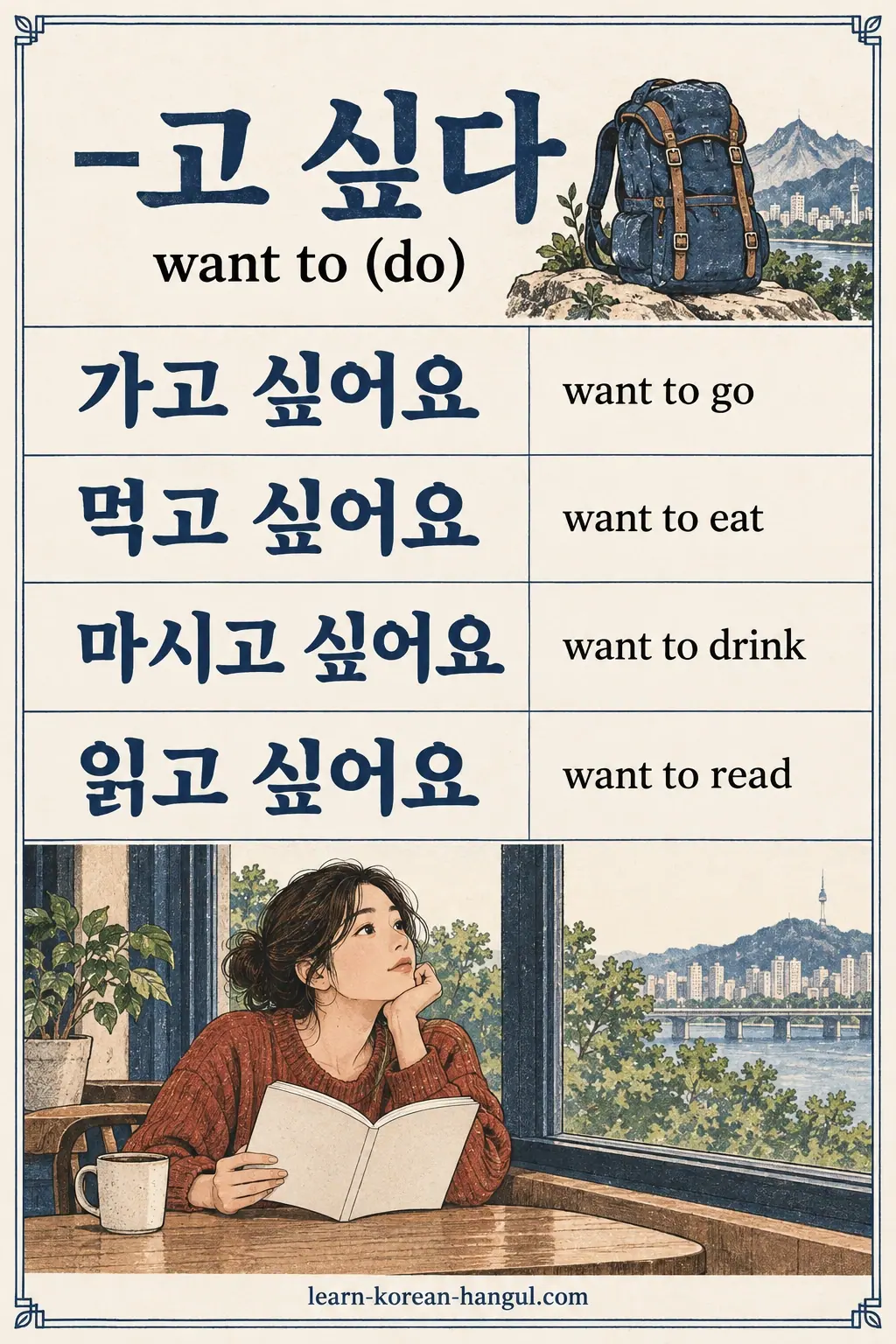
What you'll learn
- Attach -고 싶다 to any verb stem and say the polite form (-고 싶어요) from memory.
- Ask "What do you want to eat?" and answer it in a full Korean sentence.
- Say "wanted to" and "do not want to" with the past and negative forms.
- Explain why -고 싶다 cannot describe another person's wish, and name the form that can.
- Place the thing wanted with 을/를 or 이/가 and know both are accepted.
Before you start: you should know how to find a verb stem (drop 다 from the dictionary form) and the polite ending -아요/어요. If sentence order is new to you, read the Korean SOV sentence pattern first. Audio plays only when you press a button.
What Does -고 싶다 Grammar Mean?

-고 싶다 grammar means "want to (do something)." It joins a verb to the helper adjective 싶다, which carries the feeling of wanting. The verb says what you want to do, and 싶다 says that you want it. The result is one idea: a wish about your own action.
Here are the first two examples. The pattern is the same in both, and only the verb changes.
- 저는 한국에 가고 싶어요. (jeoneun hanguge gago sipeoyo.) [저는 한구게 가고 시퍼요] = "I want to go to Korea."
- 커피를 마시고 싶어요. (keopireul masigo sipeoyo.) [커피를 마시고 시퍼요] = "I want to drink coffee."
In 가고 싶어요, 가 is the verb stem of 가다 (to go), 고 is a connecting ending, and 싶어요 is the polite form of 싶다. Grammar books call 싶다 an auxiliary adjective (보조 형용사), which means it follows another verb and behaves like an adjective. That detail explains two later rules: the past tense goes on 싶다, and the thing you want can take 이/가. Next comes the mechanism that builds the pattern.
How Do You Form -고 싶다?
-고 싶다 is formed by dropping 다 from the dictionary form of a verb and adding -고 싶다. Nothing else changes. The same rule works for vowel stems, consonant stems and irregular verbs, because -고 starts with a consonant and never triggers a stem change.
| Dictionary form | Stem | Add -고 싶다 | Polite form | Meaning |
|---|---|---|---|---|
| 가다 | 가 | 가고 싶다 | 가고 싶어요 | want to go |
| 먹다 | 먹 | 먹고 싶다 | 먹고 싶어요 | want to eat |
| 마시다 | 마시 | 마시고 싶다 | 마시고 싶어요 | want to drink |
| 읽다 | 읽 | 읽고 싶다 | 읽고 싶어요 | want to read |
| 만들다 | 만들 | 만들고 싶다 | 만들고 싶어요 | want to make |
| 듣다 | 듣 | 듣고 싶다 | 듣고 싶어요 | want to listen |
The table shows one rule applied to six verbs. The next three parts look at the groups of stems one at a time.
Stems Ending in a Vowel
A vowel stem takes -고 싶다 directly. 가다 becomes 가고 싶다, 보다 becomes 보고 싶다, and 마시다 becomes 마시고 싶다. Examples:
- 영화를 보고 싶어요. (yeonghwareul bogo sipeoyo.) = "I want to watch a movie."
- 친구를 만나고 싶어요. (chingureul mannago sipeoyo.) = "I want to meet a friend."
Vowel stems are the simplest case. A stem with a final consonant looks different on the page but follows the same rule.
Stems Ending in a Consonant
A consonant stem also takes -고 싶다 directly, with no linking vowel. Compare this with endings such as -으세요, which need 으 after a consonant. For -고 싶다, 먹다 becomes 먹고 싶다, and 입다 (to wear) becomes 입고 싶다.
- 뭐 먹고 싶어요? (mwo meokgo sipeoyo?) [뭐 먹꼬 시퍼요] = "What do you want to eat?"
- 이 옷을 입고 싶어요. (i oseul ipgo sipeoyo.) [이 오슬 입꼬 시퍼요] = "I want to wear this outfit."
The spelling stays 먹고 and 입고, but the sound changes: after a final ㄱ or ㅂ, the ㄱ of 고 is pronounced tense, so you hear [먹꼬] and [입꼬]. This follows the standard pronunciation rules (표준 발음법) of the 국립국어원 (National Institute of Korean Language), which tense a plain consonant after ㄱ, ㄷ or ㅂ sounds. Write the plain spelling and say the tense sound.
Two more groups need a short note, because learners expect trouble with them.
Do Irregular Verbs and Nouns Change?
Irregular verbs do not change before -고 싶다. ㄷ-, ㅂ- and 르-irregular stems change only before an ending that starts with a vowel, and ㄹ-stems lose ㄹ only before ㄴ, ㅂ or ㅅ. The ending -고 starts with a consonant, so the dictionary stem stays whole:
- ㄷ-irregular: 듣다 stays 듣고 싶다 (not 들고). 음악을 듣고 싶어요 = "I want to listen to music."
- ㅂ-irregular: 돕다 stays 돕고 싶다 (not 도우고). 친구를 돕고 싶어요 = "I want to help my friend."
- ㄹ-stems: 만들다 stays 만들고 싶다. The ㄹ drops only before ㄴ, ㅂ and ㅅ endings.
- 르-verbs: 모르다 and 부르다 keep 르 before 고: 노래를 부르고 싶어요 = "I want to sing."
Nouns do not take -고 싶다 directly. To say you want to become something, use 되다 (to become): 의사가 되고 싶어요 ("I want to become a doctor"). Adjectives do not take it either, which the mistakes section explains. With the formation clear, one full sentence can be built step by step.
Worked Example: Building a Sentence with -고 싶다

-고 싶다 grammar works by turning a plain action sentence into a wish. Follow the steps with the sentence "I eat kimchi stew."
- Start with the plain sentence. 저는 김치찌개를 먹어요. (jeoneun gimchijjigaereul meogeoyo.) = "I eat kimchi stew." The verb is 먹어요.
- Find the dictionary form. 먹어요 comes from 먹다 (to eat). The stem is 먹.
- Add -고 싶다 to the stem. 먹 + 고 싶다 = 먹고 싶다.
- Put the sentence in the polite style. Replace 싶다 with 싶어요: 먹고 싶어요.
- Rebuild the sentence. Keep everything before the verb: 저는 김치찌개를 먹고 싶어요. (jeoneun gimchijjigaereul meokgo sipeoyo.) [저는 김치찌개를 먹꼬 시퍼요] = "I want to eat kimchi stew."
Sentence
You will know it worked when the original object (김치찌개를) and the subject (저는) stay in place, and only the last word changed from 먹어요 to 먹고 싶어요. The most common slip at this step is putting 고 싶다 after the full polite form (먹어요고 싶어요). Always work from the stem. The sentence is now a wish, but a wish can appear in several tenses and sentence types, and each has limits.
Which Tenses and Sentence Types Work with -고 싶다?

-고 싶다 works in the present, past and negative, in statements and in questions. The change always happens on 싶다, the last word. The table shows the forms for 가다 in the polite style.
| Sentence type | Form | Meaning |
|---|---|---|
| Present statement | 가고 싶어요 | I want to go. |
| Past statement | 가고 싶었어요 | I wanted to go. |
| Negative | 가고 싶지 않아요 | I do not want to go. |
| Question | 가고 싶어요? | Do you want to go? |
| Formal statement | 가고 싶습니다 | I want to go (formal). |
| Casual (banmal) | 가고 싶어 | I want to go (to a friend). |
| Written plain style | 가고 싶다 | I want to go (diary, essay). |
The present statement and the question have the same shape. Rising tone turns 가고 싶어요 into a question, and a written question mark marks it in text. In a question, the subject is "you": 어디에 가고 싶어요? means "Where do you want to go?" The speaker is asking about the listener's own feeling, which is why -고 싶다 works here.
The negative has a special sound. 가고 싶지 않아요 is pronounced [가고 십찌 아나요]. After the ㅍ of 싶, the ㅈ becomes tense, and 않아요 loses its ㅎ in speech.
- 어제는 영화를 보고 싶었어요. (eojeneun yeonghwareul bogo sipeosseoyo.) = "Yesterday I wanted to watch a movie."
- 지금은 집에 가고 싶지 않아요. (jigeumeun jibe gago sipji anayo.) = "I do not want to go home now."
The compatibility pattern is simple: the wish itself changes tense, and the verb before it never does. The most useful contrast for a learner is next to a neighbouring pattern that describes other people.
How Is -고 싶다 Different from -고 싶어 하다?

-고 싶다 gives the speaker's own wish, while -고 싶어 하다 describes someone else's wish. The difference is a point-of-view rule: you can feel your own wanting from the inside, but you can only see another person's wanting from the outside. Korean marks that difference in grammar.
| Point | -고 싶다 | -고 싶어 하다 |
|---|---|---|
| Meaning | I / you want to do | he, she or they want to do |
| Subject | first person (statement), second person (question) | third person |
| Word class of the helper | adjective (싶다) | verb (하다) |
| Object particle | 을/를 or 이/가 | 을/를 |
| Example | 저는 가고 싶어요. | 동생은 가고 싶어 해요. |
| Meaning of example | I want to go. | My younger sibling wants to go. |
The helper word explains the difference. 싶다 is an adjective, so it describes a feeling that belongs to the speaker. 하다 is a verb, so 싶어 하다 describes an act: the person shows that they want something. Full rules are on the page for -고 싶어 하다, and the side-by-side lesson is -고 싶다 vs -고 싶어 하다.
A second neighbour is -았/었으면 좋겠다, which means "I wish" or "I hope that." It expresses a wish about a situation, not an action you do yourself: 비가 그쳤으면 좋겠어요 ("I hope the rain stops"). A third neighbour is 주세요, the request form. 물 주세요 asks someone to give you water, while 물을 마시고 싶어요 only says that you are thirsty. A listener may respond to the second sentence, but you have not asked for anything. These contrasts lead to the smaller variations of the pattern itself.
Variations and Edge Cases of -고 싶다

-고 싶다 has three common variations: a choice of particle, a modifying form and a softened sentence ending. Each one is short, and each appears in real conversation.
- 이/가 or 을/를 for the thing wanted. Both are accepted: 커피를 마시고 싶어요 and 커피가 마시고 싶어요. The 이/가 version appears because 싶다 is an adjective, and adjectives mark the wanted thing as their subject. Learners should default to 을/를, which matches the verb, and recognise 이/가 when they hear it.
- Modifying a noun. Change 싶다 to 싶은 to describe a thing: 먹고 싶은 음식 (meokgo sipeun eumsik) [먹꼬 시픈 음식] = "food I want to eat." 가고 싶은 곳 means "a place I want to go."
- Soft endings. Add -은데요 for a gentle opening: 이 책을 읽고 싶은데요 ("I would like to read this book, but..."). Service staff and shop customers use this softener often.
- Honorific questions. For an older or respected listener, add the honorific -(으)시- to 싶다: 뭐 드시고 싶으세요? ("What would you like to have?"). 드시다 is the honorific verb for 먹다. See honorific -(으)시- for the full rule.
- Level of directness. -고 싶다 is direct. In very polite settings, such as service or business, speakers often prefer 주세요 or -고 싶습니다 so the request sounds courteous.
This lesson covers the short and polite forms used in daily life, not the full range of Korean wish expressions. Wishes about situations, such as "I hope it stops raining," belong to different patterns. The mistakes below show where the boundary with other patterns causes real errors.
Common Mistakes with -고 싶다
Learners most often get the subject, the word class or the spelling wrong. Four mistakes appear again and again.
- Using -고 싶다 for another person. Learners often assume that 싶다 works with any subject, as "want" does in English. Actually, 싶다 reports a feeling that only the speaker can know directly. 동생은 가고 싶어요 sounds as if you were speaking for your sibling from the inside. Say 동생은 가고 싶어 해요.
- Adding it to an adjective. 예쁘고 싶어요 is not natural, because 싶다 attaches to action verbs. To say "I want to become pretty," use 예뻐지고 싶어요, which first turns the adjective into a verb of change with -아/어지다.
- Putting the past tense on the main verb. 갔고 싶어요 is wrong. The past marker goes on 싶다: 가고 싶었어요.
- Misspelling 싶어요. The pronunciation [시퍼요] tempts learners to write 십어요 or 시퍼요. The correct spelling is 싶어요, with ㅍ in the stem 싶.
A quick check for any wish sentence: Is the subject "I" or "you"? Is the word before 고 a verb stem? Is the tense on 싶다? If all three answers are yes, the sentence is sound.
The practice set below tests these four points directly.
Practice and Answers
Try the four items before you read the answer key. Cover the answers with your hand.
- Choose the form. Complete: 저는 오늘 영화를 ___. (보고 싶어요 / 보고 싶어 해요)
- Fix the error. A learner says 친구는 한국에 가고 싶어요 about a friend. Correct it.
- Translate. "What do you want to drink?" Use 마시다 and the polite style.
- Write your own. Write one sentence about what you want to do this weekend, using -고 싶어요. Then change it to the past.
Practice · 8
How do you say "I want to go" in the polite style?
Show answer
가고 싶어요
Drop 다 from 가다 and add -고 싶다, then use the polite form 싶어요. Always work from the stem.
You are talking about your younger sibling. Which sentence correctly says "My younger sibling wants to go"?
Show answer
동생은 가고 싶어 해요.
-고 싶다 states the speaker's own wish; for a third person the form changes to -고 싶어 하다.
How do you say "I wanted to go"?
Show answer
가고 싶었어요.
The past marker goes on 싶다, the last word, and the verb before 고 never changes tense.
What is the -고 싶다 form of the ㄷ-irregular verb 듣다 (listen)?
Show answer
듣고 싶어요
-고 starts with a consonant, so no irregular stem change happens: 듣다 stays 듣고 싶다.
How do you say "I do not want to go home now"?
Show answer
지금은 집에 가고 싶지 않아요.
The negative is built on 싶다: -고 싶지 않아요.
How do you say "I want to become pretty"?
Show answer
예뻐지고 싶어요.
-고 싶다 attaches to action verbs, so the adjective first becomes a verb of change with -아/어지다: 예뻐지고 싶어요.
Which spelling of "want to" in the polite style is correct?
Show answer
싶어요
[시퍼요] is only the pronunciation; the stem is 싶 with ㅍ, so it is written 싶어요.
How do you say "food I want to eat"?
Show answer
먹고 싶은 음식
To modify a noun, 싶다 changes to 싶은: 먹고 싶은 음식.
Answer key
- 보고 싶어요. The speaker is "I," so the plain -고 싶다 pattern is right: 저는 오늘 영화를 보고 싶어요.
- 친구는 한국에 가고 싶어 해요. The subject is a third person, so -고 싶어 하다 replaces -고 싶다.
- 뭐 마시고 싶어요? (mwo masigo sipeoyo?) = "What do you want to drink?" The subject "you" is correct for a question with -고 싶다.
- Answers vary. Check that the verb stem comes before 고 싶어요 and the past form is 싶었어요. An example: 주말에 친구를 만나고 싶어요 → 주말에 친구를 만나고 싶었어요. (I wanted to meet a friend on the weekend.)
If you can complete items 1 to 3 without the key, you can use the pattern in conversation. Next, the lesson hands off to related patterns.
What Should You Learn Next after -고 싶다 Grammar?
After -고 싶다 grammar, learn how to talk about other people's wishes, then wishes about situations. This lesson teaches the speaker's own wish and does not cover the third person, hopes about events or polite requests in depth. Those live on their own pages.
- Start with -고 싶어 하다, which reports what another person wants.
- Continue with -았/었으면 좋겠다, which expresses a wish or hope about a situation.
- Compare the pair side by side in -고 싶다 vs -고 싶어 하다.
- Return to Desire and Wishes to see every lesson in this set, or to the Beginner Grammar list for other A1 patterns.
With these steps, -고 싶다 becomes automatic: take the verb stem, add 고 싶어요, and keep the subject as "I" or "you."
Frequently Asked Questions
What does -고 싶다 mean?
-고 싶다 means "want to" and attaches to a verb stem. 가고 싶어요 means "I want to go," and 먹고 싶어요 means "I want to eat." It describes a feeling inside the speaker, so statements are about "I" and questions are about "you." The negative is -고 싶지 않다.
How do I attach -고 싶다 to a verb or adjective?
Drop 다 from the dictionary form and add -고 싶다: 가다 becomes 가고 싶다, and 먹다 becomes 먹고 싶다. It works with verbs only, not adjectives. For an adjective, use -아/어지고 싶다, as in 예뻐지고 싶어요 ("I want to become pretty"). No stem needs special spelling.
Can -고 싶다 be used in the past tense?
Yes. Change 싶다 to its past form: 가고 싶었어요 means "I wanted to go." The past marker sits on 싶다, not on the main verb, so 갔고 싶어요 is wrong. A common story pattern is 가고 싶었지만 못 갔어요, meaning "I wanted to go, but I could not."
Is -고 싶다 used in speech or only in writing?
Both. In everyday speech, people say 가고 싶어요 (polite) and 가고 싶어 (casual). In notices, news and formal talks, they use 가고 싶습니다 or the plain written form 가고 싶다. The meaning stays the same, and only the ending changes with the speech level.
What is the most common mistake with -고 싶다?
The most common mistake is using it for another person. 동생은 가고 싶어요 sounds wrong when you describe your sibling. Say 동생은 가고 싶어 해요 instead, using -고 싶어 하다. A second slip is writing 십어요 for 싶어요, which is a spelling error.