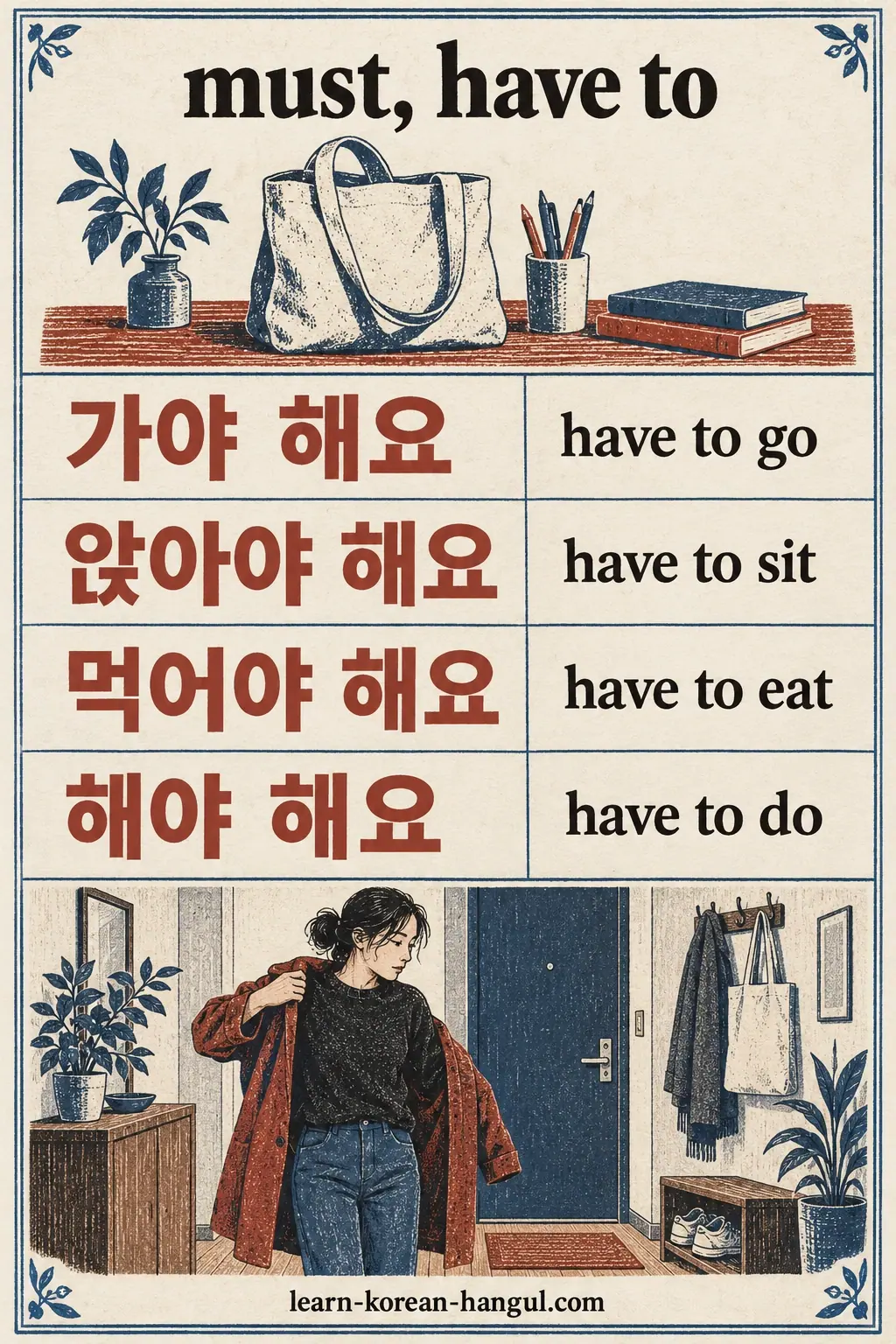
What you'll learn
- Attach -아/어야 to any stem, choosing between -아야, -어야 and 해야.
- Say "I have to..." and ask "Do I have to...?" in the polite style.
- Choose between 하다 and 되다 and spell 돼요 correctly.
- Say "had to" and "should have" with the right tense position.
- Tell -아/어야 하다/되다 apart from -아/어도 되다, -(으)ㄹ 필요가 있다 and -지 않으면 안 되다.
Before you start: you should know how to find a verb stem (drop 다 from the dictionary form) and the polite ending -아요/어요. If stems are new to you, read about verb stems first. Audio plays only when you press a button.
What Does -아/어야 하다/되다 Grammar Mean?

-아/어야 하다/되다 grammar means "you must do this" or "you have to do this." It joins two parts. The first part is -아/어야, which marks a condition that has to be met. The second part is 하다 ("to do") or 되다 ("to become"). Together they say "only if you do this does it work," and that idea becomes "you have to do this."
Here are the first two examples. The pattern is the same in both, and only the verb and the final word change.
- 내일 일찍 일어나야 해요. (naeil iljjik ireonaya haeyo.) [내일 일찌기러나야 해요] = "I have to get up early tomorrow."
- 숙제를 해야 돼요. (sukjereul haeya dwaeyo.) [숙쩨를 해야 돼요] = "I have to do my homework."
The first sentence uses 하다 and the second uses 되다. They mean the same thing. Most learners start with 하다 because it is the neutral choice, and then learn to recognise 되다 in speech. The pattern states a duty or a need. It does not say whether the speaker likes it. The next section shows how to build the pattern.
How Do You Form -아/어야 하다/되다?
-아/어야 하다/되다 is formed by dropping 다 from the dictionary form, adding -아야 or -어야 to the stem, and then adding 하다 or 되다. The choice between 아 and 어 follows vowel harmony. If the last vowel of the stem is ㅏ or ㅗ, add -아야. For every other vowel, add -어야. For 하다 verbs, the result is 해야.
| Dictionary form | Stem | Stem + -아/어야 | Polite form | Meaning |
|---|---|---|---|---|
| 가다 | 가 | 가야 | 가야 해요 | have to go |
| 앉다 | 앉 | 앉아야 | 앉아야 해요 | have to sit |
| 먹다 | 먹 | 먹어야 | 먹어야 해요 | have to eat |
| 보다 | 보 | 봐야 | 봐야 해요 | have to look |
| 일어나다 | 일어나 | 일어나야 | 일어나야 해요 | have to get up |
| 마시다 | 마시 | 마셔야 | 마셔야 해요 | have to drink |
| 하다 | 하 | 해야 | 해야 해요 | have to do |
The table shows one rule applied to seven verbs. Notice that the form before 야 is the same as the polite verb ending without 요: 먹어요 becomes 먹어야. If you already know the polite present, you can build -아/어야 by removing 요 and adding 야. The next three parts look at the groups of stems one at a time.
Stems Ending in a Vowel
A vowel stem often shortens when 아/어 is added. A stem ending in ㅏ keeps just one ㅏ, so 가 + 아 becomes 가. A stem ending in ㅗ joins 아 into ㅘ, so 보 + 아 becomes 봐. A stem ending in ㅣ joins 어 into ㅕ, so 마시 + 어 becomes 마셔. Examples:
- 저는 지금 가야 해요. (jeoneun jigeum gaya haeyo.) = "I have to go now."
- 이 영화를 봐야 해요. (i yeonghwareul bwaya haeyo.) = "I have to watch this movie."
Vowel stems are the simplest case. A stem with a final consonant looks longer on the page but follows the same rule.
Stems Ending in a Consonant
A consonant stem takes -아야 or -어야 directly, with no linking vowel. Choose by the last vowel: 앉 has ㅏ, so 앉아야. 먹 has ㅓ, so 먹어야. 읽 has ㅣ, so 읽어야.
- 약을 먹어야 해요. (yageul meogeoya haeyo.) [야글 머거야 해요] = "I have to take medicine."
- 여기에 앉아야 해요. (yeogie anjaya haeyo.) [여기에 안자야 해요] = "I have to sit here."
The spelling keeps the final consonant, but the sound moves to the next syllable: 먹어야 is spoken [머거야], and 앉아야 is spoken [안자야]. This follows the standard pronunciation rules (표준 발음법) of the 국립국어원 (National Institute of Korean Language) for linking a final consonant to a following vowel.
Two more groups need a short note, because learners expect trouble with them.
Do Irregular Stems, Adjectives and Nouns Change?
Irregular stems change before -아/어야, because 아 and 어 begin with a vowel. Use the polite form you already know:
- ㄷ-irregular: 묻다 ("to ask") becomes 물어야. 선생님께 길을 물어야 해요 = "I have to ask the teacher the way."
- ㅂ-irregular: 돕다 becomes 도와야. 친구를 도와야 해요 = "I have to help a friend."
- 르-irregular: 모르다 becomes 몰라야 and 누르다 becomes 눌러야.
- ㅡ-stems: 쓰다 becomes 써야 and 바쁘다 becomes 바빠야.
- ㄹ-stems: 만들다 becomes 만들어야. The ㄹ stays.
Adjectives take the same ending: 몸이 건강해야 해요 (momi geonganghaeya haeyo) = "You have to be healthy." With a noun, use the copula: 한국 사람이어야 해요 (hanguk saramieoya haeyo) = "You have to be a Korean person." After a vowel the form is -여야, as in 의사여야 해요.
With the forms clear, one sentence can be built step by step.
Worked Example: Building a Sentence with -아/어야 하다/되다

-아/어야 하다/되다 grammar works by turning a plain action into a duty. Follow the steps with the idea "I have to study Korean today."
- Start with the verb. The verb is 공부하다 (to study). Its dictionary form ends in 다.
- Find the stem. Drop 다. The stem is 공부하.
- Choose 아야, 어야 or 해야. The verb ends in 하다, so the form is 해야: 공부해야.
- Add 하다 in the polite style. 하다 becomes 해요. The full ending is 공부해야 해요.
- Rebuild the sentence. Keep the time word and the object: 저는 오늘 한국어를 공부해야 해요. (jeoneun oneul hangugeoreul gongbuhaeya haeyo.) = "I have to study Korean today."
Sentence
I have to study Korean today.
Show answer
저는 오늘 한국어를 공부해야 해요
You will know it worked when the subject, the time word and the object stay in place and only the last two words changed. The most common slip at this step is to put the polite form before 야, as in 공부해요야 해요. Always work from the stem. The sentence is now a duty, but the pattern has limits on tense and sentence type.
Which Tenses and Sentence Types Work with -아/어야 하다/되다?

-아/어야 하다/되다 works in the present, the past and the future guess, in statements and in questions. The tense goes on 하다 or 되다, the last word. The table shows the forms for 가다.
| Sentence type | Form | Meaning |
|---|---|---|
| Polite statement | 가야 해요 | I have to go. |
| Polite question | 가야 해요? | Do I have to go? |
| Colloquial | 가야 돼요 | I have to go. |
| Past (duty) | 가야 했어요 | I had to go. |
| Past (regret) | 갔어야 해요 | I should have gone. |
| Future guess | 가야 할 거예요 | I will have to go. |
| Formal | 가야 합니다 | I must go (announcements). |
| Written plain | 가야 한다 | One must go (essays, rules). |
Here is how some forms are spoken. 했어요 is [해써요], and 갔어야 is [가써야]. 가야 할 거예요 is spoken [가야 할꺼예요], because the ㄱ after -(으)ㄹ is spoken tense. The formal 합니다 is [함니다], with ㅂ before ㄴ spoken as ㅁ.
- 어제는 일찍 가야 했어요. (eojeneun iljjik gaya haesseoyo.) = "Yesterday I had to go early."
- 어제 일찍 갔어야 해요. (eoje iljjik gasseoya haeyo.) = "I should have gone early yesterday."
The two past forms are a very useful contrast. In 가야 했어요, the past is on 하다 and the speaker reports a duty that existed. In 갔어야 해요, the past is on the main verb and the speaker regrets that an action did not happen. Memorise one pair of sentences and the rule follows.
For a negative duty ("must not"), use a negative stem: 숙제를 잊지 말아야 해요 (sukjereul itji maraya haeyo) = "I must not forget my homework." The helper 말다 is used after -지 for commands and obligations. 말다 does not follow adjectives, so with an adjective use -지 않아야 하다 instead: 너무 비싸지 않아야 해요 ("It must not be too expensive"). To say "don't have to," do not use this pattern. Use -지 않아도 되다. The most useful contrast for a learner is next to the pattern that gives permission.
How Is -아/어야 하다/되다 Different from -아/어도 되다?
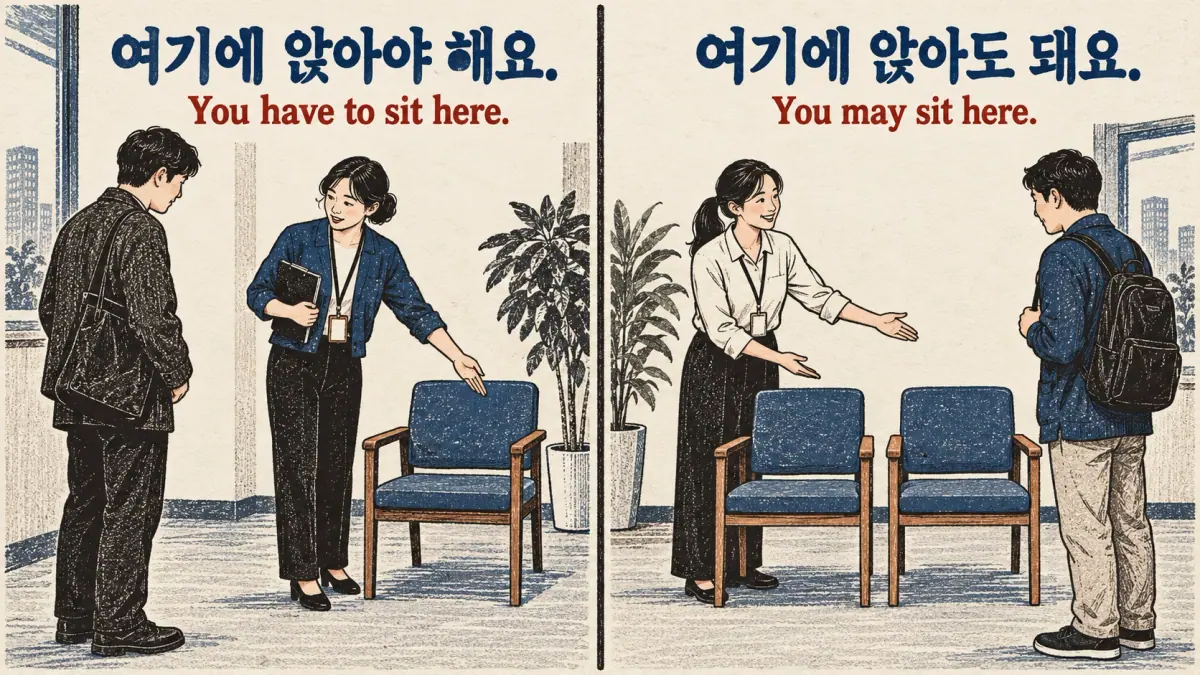
-아/어야 하다/되다 states a duty, while -아/어도 되다 gives permission. They differ by only one sound (야 versus 도), so learners confuse them. One says "you have to," the other says "you may."
| Point | -아/어야 하다/되다 | -아/어도 되다 |
|---|---|---|
| Meaning | must, have to | may, it's okay to |
| Function | obligation | permission |
| Attaches to | stem + 아/어야 | stem + 아/어도 |
| Example | 여기에 앉아야 해요. | 여기에 앉아도 돼요. |
| Meaning of example | You have to sit here. | You may sit here. |
The full rules are on the page for -아/어도 되다.
A second neighbour is -(으)ㄹ 필요가 있다, which also states necessity but sounds more formal and is milder. 이 문제는 다시 생각할 필요가 있어요 sounds like advice in a report. 해야 해요 sounds like a direct duty. See -(으)ㄹ 필요가 있다/없다 and the side-by-side lesson -아/어야 하다 vs -(으)ㄹ 필요가 있다.
A third neighbour is the double negative -지 않으면 안 되다, which also means "must" but is stronger: 가지 않으면 안 돼요 means "I absolutely have to go." The opposite of the whole group is -(으)면 안 되다, "must not." These contrasts lead to the smaller variations of the pattern itself.
Variations and Edge Cases of -아/어야 하다/되다

-아/어야 하다/되다 has four common variations: an emphatic form, a resolve form, a modifying form and an honorific form. Each one appears in real conversation.
- -아/어야만 하다. Add 만 ("only") for emphasis: 공부해야만 해요 means "I absolutely have to study." The speaker stresses that there is no other way.
- -아/어야겠다. This form means "I'd better" or "I think I should." It expresses the speaker's own decision: 이제 자야겠어요 (ije jayagesseoyo) [이제 자야게써요] = "I think I had better sleep now."
- Modifying a noun. Change 하다 to 할 to describe a thing: 해야 할 일 (haeya hal il) [해야 할 릴] = "things that have to be done." The ㄴ sound appears between 할 and 일, then ㄹ takes over, so the sound is [할 릴]. 해야 할 일이 많아요 means "I have a lot to do."
- Honorific -(으)시-. For a respected person, add -(으)시- before 야: 지금 가셔야 해요 (jigeum gasyeoya haeyo) = "You have to go now." See honorific -(으)시-.
In everyday talk among friends, 해야 돼 is very common alongside 해야 해. Write both words with a space: 해야 하다, not 해야하다. This lesson covers the common duty uses, not the whole family of obligation forms. The connector 아/어야 ("only if") also appears alone, as in 먹어야 힘이 나요 ("You have energy only if you eat"). The mistakes below show where the boundary causes real errors.
What Mistakes Do Learners Make with -아/어야 하다/되다?
Learners most often get the spelling, the tense position or the negative wrong. Four mistakes appear again and again.
- Spelling 돼요 as 되요. 해야 되요 is wrong. 돼요 is the shortened form of 되어요. Put 하 or 해 in the same slot: 해야 해요 fits and 해야 하요 does not, so write 돼요. The page on 되 vs 돼 explains the test.
- Putting the past on the wrong word. 가야 했어요 means "I had to go." 갔어야 해요 means "I should have gone." Mixing them changes the meaning.
- Using it for "must not." Negating 하다 (가야 하지 않아요) does not give "I must not go." At most it says that the duty does not exist, and for that Koreans normally say 안 가도 돼요 ("I don't have to go"). For prohibition, use -(으)면 안 되다 or -지 말아야 하다.
- Choosing the wrong vowel. 먹아야 and 앉어야 are wrong. Check the last vowel of the stem: only ㅏ and ㅗ take 아.
A quick check for any duty sentence: Is the stem followed by 아/어야? Is the final word 하다 or 되다? Is the past marker in the right place for the meaning? If all three answers are yes, the sentence is sound.
The practice set below tests these four points directly.
Practice and Answers
Try the four items before you read the answer key. Cover the answers with your hand.
- Choose the form. Complete: 저는 약을 ___ . (먹아야 해요 / 먹어야 해요)
- Fix the error. A learner writes 숙제를 해야 되요. Correct it.
- Translate. "I have to get up at seven tomorrow morning." Use 일어나다 and the polite style with 돼요.
- Write your own. Write one sentence about something you have to do this week, using -아/어야 해요. Then change it to "had to."
Practice · 6
Which sentence means "I have to go now"?
Show answer
지금 가야 해요.
-아/어야 해요 states an obligation. -아/어도 돼요 is permission, and -(으)면 안 돼요 is prohibition.
Add -아/어야 하다 to 먹다. Which form is correct?
Show answer
먹어야 해요
The last vowel of 먹 is ㅓ, so the ending is -어야.
Which spelling is correct?
Show answer
해야 돼요
돼요 is 되어요 shortened. 되요 is a common spelling error.
What does 갔어야 해요 mean?
Show answer
I should have gone.
The past on the main verb (갔어야) turns the obligation into regret. For "had to go," say 가야 했어요.
Which sentence means "I had to go early yesterday"?
Show answer
어제는 일찍 가야 했어요.
For "had to," the past goes on 하다: 가야 했어요. 갔어야 해요 means "should have gone."
Add -아/어야 하다 to 돕다 (to help). Which form is correct?
Show answer
도와야 해요
돕다 is ㅂ-irregular, so the stem changes before 아: 도와야 해요, as in 친구를 도와야 해요.
Answer key
- 먹어야 해요. The last vowel of 먹 is ㅓ, so the ending is -어야.
- 숙제를 해야 돼요. The spelling is 돼요, from 되어요.
- 내일 아침 일곱 시에 일어나야 돼요. (naeil achim ilgop sie ireonaya dwaeyo.) [내일 아침 일곱 씨에 이러나야 돼요] = "I have to get up at seven tomorrow morning."
- Answers vary. Check that 아/어 is chosen by vowel harmony and that the past version has 했어요. An example: 이번 주에 병원에 가야 해요 → 지난주에 병원에 가야 했어요.
If you can complete items 1 to 3 without the key, you can use the pattern in conversation. Next, the lesson hands off to related patterns.
What Should You Learn Next after -아/어야 하다/되다 Grammar?
After -아/어야 하다/되다 grammar, learn the patterns that give permission, cancel a duty and forbid. This lesson teaches the duty and does not cover permission, cancelled duties or the milder necessity pattern in depth. Those live on their own pages.
- Start with -아/어도 되다, which gives permission.
- Continue with -(으)ㄹ 필요가 있다/없다, which states necessity more formally.
- Learn how to cancel a duty with -지 않아도 되다, and how to forbid with -(으)면 안 되다.
- For requests not to do something, see -지 마세요 don't and -지 않다 negation.
- Return to Obligation and Permission to see every lesson in this set, or to the Beginner Grammar list for other A2 patterns.
With these steps, -아/어야 하다/되다 becomes automatic: take the stem, add 아/어야, and finish with 해요 or 돼요.
Frequently Asked Questions
What does -아/어야 하다/되다 mean?
-아/어야 하다/되다 means "must" or "have to." It states an obligation or a necessity. 일찍 일어나야 해요 means "I have to get up early," and 숙제를 해야 돼요 means "I have to do my homework." The two endings 하다 and 되다 mean the same thing. 되다 is just more colloquial than 하다.
How do I attach -아/어야 하다/되다 to a verb or adjective?
Take the stem and add -아야 if the last vowel is ㅏ or ㅗ, otherwise -어야, and 해야 for 하다 verbs. 가다 gives 가야, 먹다 gives 먹어야, and 공부하다 gives 공부해야. Then add 하다 or 되다 in the speech level you need. Adjectives work too: 건강해야 해요 means "You have to be healthy."
Can -아/어야 하다/되다 be used in the past tense?
Yes, in two ways. 가야 했어요 means "I had to go," with the past on 하다. 갔어야 해요 means "I should have gone," with the past on the main verb. The first looks at a duty that existed. The second regrets that something was not done. Choose by the meaning you want.
Is -아/어야 하다/되다 used in speech or only in writing?
Both. In speech, people say 해야 해요 and 해야 돼요, and friends say 해야 돼. In notices, rules and essays, the written plain form 해야 한다 and the formal 해야 합니다 are common. The speech level changes only the last word, so the pattern before it stays the same.
What is the most common mistake with -아/어야 하다/되다?
The most common mistake is the spelling 되요 instead of 돼요 in 해야 돼요. Another is putting the past on the main verb to say "had to": 갔어야 해요 means "should have gone." A third is using it for "must not." For that, use -(으)면 안 되다 or -지 말아야 하다.