
What you'll learn
- Attach -고 싶어 하다 to a verb stem and say the polite form (-고 싶어 해요) from memory.
- Report what a friend, a child or a family member wants, in the present and the past.
- Explain why the speaker's own wish uses -고 싶다 and a third person's wish uses -고 싶어 하다.
- Mark the person and the thing wanted with the right particles (은/는, 이/가, 을/를).
- Recognise the same -아/어 하다 pattern in words such as 좋아하다 and 싫어하다.
Before you start: you should know the plain wish pattern -고 싶다, which this lesson builds on, and how to find a verb stem (drop 다 from the dictionary form). Audio plays only when you press a button.
What Does -고 싶어 하다 Grammar Mean?
-고 싶어 하다 grammar means "(someone else) wants to (do something)." It reports a wish that belongs to another person. Korean treats wanting as a private feeling: you can feel your own wish directly, but you can only see signs of another person's wish. The pattern marks that outside view.
Two examples show the idea.
- 동생은 유학을 가고 싶어 해요. (dongsaengeun yuhageul gago sipeo haeyo.) [동생은 유하글 가고 시퍼 해요] = "My younger sibling wants to study abroad."
- 아이가 아이스크림을 먹고 싶어 해요. (aiga aiseukeurimeul meokgo sipeo haeyo.) [아이가 아이스크리믈 먹꼬 시퍼 해요] = "The child wants to eat ice cream."
The pattern has three parts: the verb stem (가), the wish word 싶어 (the connected form of 싶다, "to want"), and 하다 (to do). The 하다 turns the feeling into an action, so the sentence says that the person acts like someone who wants something. The next section shows how the parts fit together.
How Do You Form -고 싶어 하다?
-고 싶어 하다 is formed by dropping 다 from the dictionary form of a verb, adding -고 싶어, and then conjugating 하다. The first half of the pattern is the same as -고 싶다. Only the ending changes: 싶다 becomes 싶어 하다, and 하다 takes the tense and speech level.
| Dictionary form | Add -고 싶어 하다 | Polite present | Polite past | Meaning |
|---|---|---|---|---|
| 가다 | 가고 싶어 하다 | 가고 싶어 해요 | 가고 싶어 했어요 | wants to go |
| 먹다 | 먹고 싶어 하다 | 먹고 싶어 해요 | 먹고 싶어 했어요 | wants to eat |
| 보다 | 보고 싶어 하다 | 보고 싶어 해요 | 보고 싶어 했어요 | wants to see |
| 배우다 | 배우고 싶어 하다 | 배우고 싶어 해요 | 배우고 싶어 했어요 | wants to learn |
| 만들다 | 만들고 싶어 하다 | 만들고 싶어 해요 | 만들고 싶어 했어요 | wants to make |
| 듣다 | 듣고 싶어 하다 | 듣고 싶어 해요 | 듣고 싶어 했어요 | wants to listen |
The table shows one rule on six verbs. Spaces matter in the base form: the 국립국어원 spacing guidance writes a space before 하다 (싶어 하다), because 하다 attaches to the whole phrase 가고 싶어. Many writers attach it (싶어하다) in everyday writing, so you will see both. The next parts look at the stem groups.
Stems Ending in a Vowel
A vowel stem takes -고 싶어 하다 directly: 가다 becomes 가고 싶어 하다, and 배우다 becomes 배우고 싶어 하다.
- 친구가 한국어를 배우고 싶어 해요. (chinguga hangugeoreul baeugo sipeo haeyo.) = "My friend wants to learn Korean."
Stems Ending in a Consonant
A consonant stem takes -고 싶어 하다 directly as well, with no linking vowel. 먹다 becomes 먹고 싶어 하다, and 읽다 becomes 읽고 싶어 하다. After a final ㄱ or ㅂ, the ㄱ of 고 sounds tense: 먹고 sounds like [먹꼬], and 입고 sounds like [입꼬]. This comes from the standard pronunciation rules (표준 발음법) of the 국립국어원 (National Institute of Korean Language). Spell it plainly and say it tense.
- 형은 새 옷을 입고 싶어 해요. (hyeongeun sae oseul ipgo sipeo haeyo.) [형은 새 오슬 입꼬 시퍼 해요] = "My older brother wants to wear new clothes."
Do Irregular Verbs and Nouns Change?
Irregular verbs do not change before -고 싶어 하다. The ending -고 starts with a consonant, so 듣다 stays 듣고 (not 들고), 돕다 stays 돕고 (not 도우고), and 만들다 keeps its ㄹ. The only part that conjugates is 하다 at the end, and 하다 is the most regular verb in Korean: 해요, 했어요, 하세요.
Nouns do not take the pattern directly. To say that someone wants to become something, use 되다: 동생은 의사가 되고 싶어 해요 ("My younger sibling wants to become a doctor"). The formation is clear, so one full sentence can be built step by step.
Worked Example: Building a Sentence with -고 싶어 하다
-고 싶어 하다 grammar works by turning a first-person wish into a report about someone else. Follow the steps from "I want to go to Korea" to "My younger sibling wants to go to Korea."
- Start with the speaker's wish. 저는 한국에 가고 싶어요. (jeoneun hanguge gago sipeoyo.) = "I want to go to Korea."
- Change the subject. Replace 저는 with the third person: 동생은. The sentence 동생은 한국에 가고 싶어요 is now wrong, because 싶어요 cannot describe another person.
- Replace 싶어요 with 싶어 해요. The wish word becomes 싶어, and 하다 follows in the polite style: 싶어 해요.
- Check the particles. The person who wants takes 은/는 (동생은). The place takes 에 (한국에). If the verb has an object, it takes 을/를.
- Read the result. 동생은 한국에 가고 싶어 해요. (dongsaengeun hanguge gago sipeo haeyo.) [동생은 한구게 가고 시퍼 해요] = "My younger sibling wants to go to Korea."
Sentence
You will know it worked when 싶어요 has become 싶어 해요 and the subject is no longer 저. The most common slip at this step is changing only the subject and keeping 싶어요. Always change both. Now that the pattern is built, the next question is which tenses and sentence types work.
Which Tenses and Sentence Types Work with -고 싶어 하다?
-고 싶어 하다 works in the present, the past and the negative, and in statements. The tense goes on 하다, the last word. The table shows the forms for 가다 in different styles.
| Sentence type | Form | Meaning |
|---|---|---|
| Present statement | 가고 싶어 해요 | He or she wants to go. |
| Past statement | 가고 싶어 했어요 | He or she wanted to go. |
| Negative | 가고 싶어 하지 않아요 | He or she does not want to go. |
| Honorific | 가고 싶어 하세요 | An older person wants to go. |
| Formal statement | 가고 싶어 합니다 | He or she wants to go (formal). |
| Casual (banmal) | 가고 싶어 해 | He or she wants to go (to a friend). |
| Written plain style | 가고 싶어 한다 | He or she wants to go (essay, news). |
Questions need care. When you ask a listener "Do you want to go?", use the plain pattern: 가고 싶어요? The answer is the listener's own feeling, so the first-person form is right. A question with 싶어 해요 is used only when you ask about a third person: 동생도 가고 싶어 해요? ("Does your younger sibling want to go too?").
The negative has a pronunciation point. 가고 싶어 하지 않아요 is said [가고 시퍼 하지 아나요], and the ㅎ of 않아요 is silent between vowels.
- 어머니는 여행을 가고 싶어 하세요. (eomeonineun yeohaengeul gago sipeo haseyo.) = "My mother wants to go on a trip." The honorific -(으)시- on 하다 shows respect for the person who wants. See honorific -(으)시-.
- 아이들은 밖에서 놀고 싶어 했어요. (aideureun bakkeseo nolgo sipeo haesseoyo.) = "The children wanted to play outside."
The compatibility rule is simple: tense and speech level live on 하다, and the earlier verb never changes. The pattern gets clearer when it is set beside the speaker's own wish.
How Is -고 싶어 하다 Different from -고 싶다?
-고 싶어 하다 describes someone else's wish, while -고 싶다 states the speaker's own wish. The difference is a point-of-view rule. A speaker knows their own wanting from the inside and states it as a feeling. A speaker sees another person's wanting from the outside and reports it as behaviour.
| Point | -고 싶다 | -고 싶어 하다 |
|---|---|---|
| Meaning | I / you want to do | he, she or they want to do |
| Subject | first person (statement), second person (question) | third person |
| Helper word | 싶다, an adjective | 싶어 하다, built on the verb 하다 |
| Object particle | 을/를 or 이/가 | 을/를 |
| Example | 저는 가고 싶어요. | 동생은 가고 싶어 해요. |
| Meaning of example | I want to go. | My younger sibling wants to go. |
The helper word explains the difference. An adjective describes a state that its owner feels. A verb describes an action that anyone can watch. That is why 하다 appears in the third-person form: the wanting becomes an act you can report. For a longer comparison, see -고 싶다 vs -고 싶어 하다. Besides the comparison, the same shape appears in many everyday words.
Variations and Edge Cases of -고 싶어 하다
-고 싶어 하다 belongs to a larger family, the -아/어 하다 pattern, and it has a few edge cases. The family turns a feeling adjective into a verb that can describe other people.
- 좋다 → 좋아하다. 저는 커피가 좋아요 ("I like coffee") uses the adjective. 동생은 커피를 좋아해요 ("My sibling likes coffee") uses the verb, and the object now takes 를.
- 싫다 → 싫어하다. 아이가 채소를 싫어해요 = "The child dislikes vegetables."
- 무섭다 → 무서워하다. The ㅂ-irregular stem becomes 워 before an -어 ending: 아이가 개를 무서워해요 = "The child is afraid of dogs."
- 슬프다 → 슬퍼하다. 친구가 슬퍼해요 = "My friend is sad (and shows it)."
The family rule is the same one that creates 싶어 하다: take the adjective, add -아/어, and add 하다. Three further edge cases are worth knowing.
- Questions to the listener. Use -고 싶어요?, not -고 싶어 해요?, when you ask someone about their own wish.
- Stories and diaries. Narrators in written stories sometimes use 싶다 for a character's inner feeling, because the narrator can see inside. Learners should still use 싶어 하다 for outside reports.
- Spelling. Both 싶어 하다 and 싶어하다 are seen. The spaced form follows the 국립국어원 guidance, and this site uses it.
This lesson covers present, past and negative statements, not the progressive 싶어 하고 있다 or the guess form 싶어 하는 것 같다. Those belong to later lessons. The mistakes below come from mixing the two wish patterns.
Common Mistakes with -고 싶어 하다
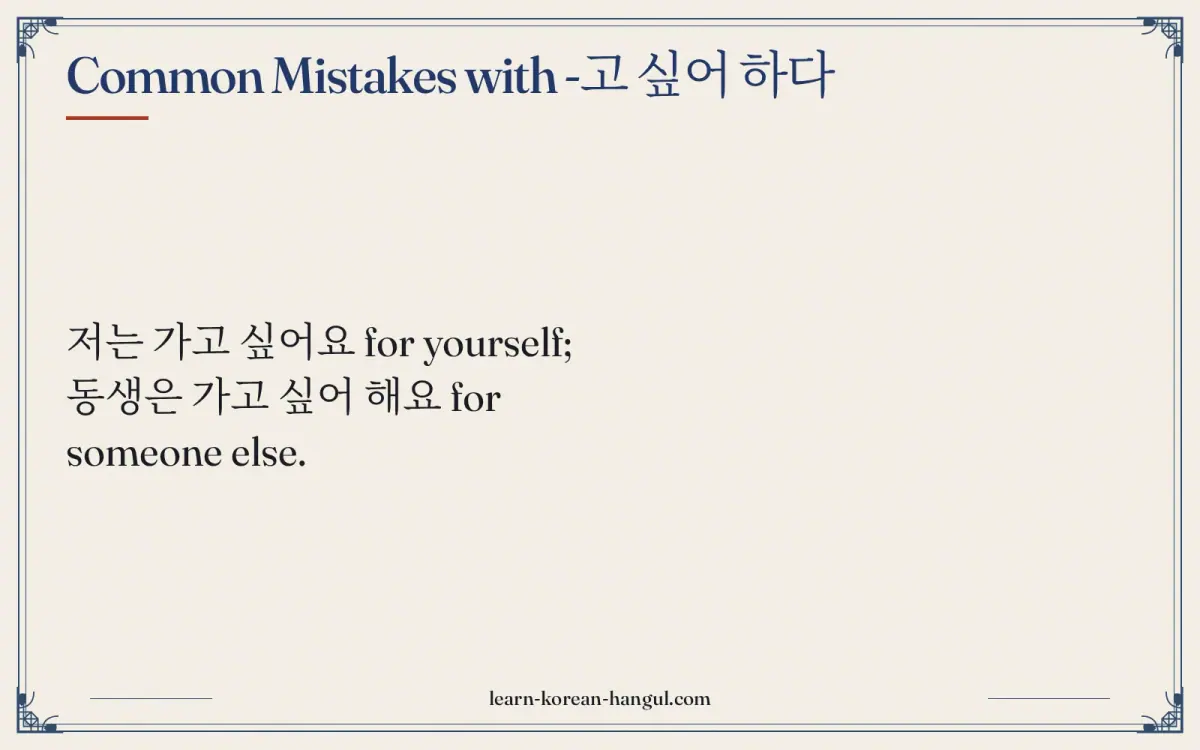
Learners most often mix up the subject and the pattern. Four mistakes appear again and again.
- Using -고 싶다 for another person. Learners often assume that 싶다 works like English "want," which fits any subject. Actually, 싶다 reports a feeling that only the speaker knows directly. 친구가 가고 싶어요 for "my friend wants to go" is wrong. Say 친구가 가고 싶어 해요.
- Using -고 싶어 하다 for yourself. 저는 가고 싶어 해요 sounds as if you are describing your own wish from the outside, like a report about yourself. Use 저는 가고 싶어요.
- Marking the object with 이/가. With the plain 싶다, the object can take 이/가. With 싶어 하다, it takes 을/를, because 하다 is a verb: 아이스크림을 먹고 싶어 해요, not 아이스크림이 먹고 싶어 해요.
- Changing the first verb instead of 하다. 갔고 싶어 해요 is wrong. The past goes on 하다: 가고 싶어 했어요.
A quick check for any report about another person: Is the subject a third person? Does 싶어 하다 end the phrase? Is the tense on 하다? If all three are yes, the sentence is sound.
The practice set below tests these four points directly.
Practice and Answers
Try the four items before you read the answer key. Cover the answers with your hand.
- Choose the form. Complete: 동생은 피자를 ___. (먹고 싶어요 / 먹고 싶어 해요)
- Fix the error. A learner says 친구가 영화를 보고 싶어요 about a friend. Correct it.
- Translate. "The child wanted to play." Use 놀다 and the polite past style.
- Write your own. Write one sentence about what someone in your family wants to do, using -고 싶어 해요. Then write what you want to do, using -고 싶어요.
Practice · 8
Complete the sentence about your younger sibling: 동생은 피자를 ___.
Show answer
먹고 싶어 해요
The subject 동생 is a third person, so use -고 싶어 하다. The honorific 하세요 is for an older person you respect, not a younger sibling.
How do you say "I want to go" about yourself?
Show answer
저는 가고 싶어요.
Your own wish uses -고 싶다; -고 싶어 하다 would describe your wish from the outside, like a report about someone else.
How do you say "The child wanted to play"?
Show answer
아이가 놀고 싶어 했어요.
Tense lives on 하다, the last word, so the past is 싶어 했어요 and the first verb never changes.
Which particle marks the thing wanted with -고 싶어 하다?
Show answer
을/를: 아이스크림을 먹고 싶어 해요
Because 하다 is a verb, the thing wanted takes 을/를; only the plain 싶다 also allows 이/가.
You ask a listener "Do you want to go?" Which question is right?
Show answer
가고 싶어요?
A question about the listener's own feeling uses the plain -고 싶다; 싶어 해요? asks about a third person.
How do you say "My mother wants to go on a trip" with respect for your mother?
Show answer
어머니는 여행을 가고 싶어 하세요.
The honorific -(으)시- goes on 하다 to show respect for the person who wants: 싶어 하세요.
Which word belongs to the same -아/어 하다 family as 싶어 하다?
Show answer
좋아하다 (from 좋다)
The family takes a feeling adjective, adds -아/어 and 하다, giving verbs such as 좋아하다, 싫어하다 and 무서워하다.
How do you say "He does not want to go" (polite)?
Show answer
가고 싶어 하지 않아요.
The negative is built on 하다: 싶어 하지 않아요.
Answer key
- 먹고 싶어 해요. The subject is a third person (동생), so -고 싶어 하다 is right: 동생은 피자를 먹고 싶어 해요.
- 친구가 영화를 보고 싶어 해요. The speaker reports someone else's wish, so 싶어요 becomes 싶어 해요.
- 아이가 놀고 싶어 했어요. (aiga nolgo sipeo haesseoyo.) The past ending sits on 하다.
- Answers vary. Check that the family sentence ends in 싶어 해요 and the personal sentence ends in 싶어요. An example: 아버지는 낚시를 가고 싶어 해요. 저는 집에서 쉬고 싶어요. (My father wants to go fishing. I want to rest at home.)
If you can complete items 1 to 3 without the key, you can report other people's wishes in conversation. The final section points to the next lessons.
What Should You Learn Next after -고 싶어 하다 Grammar?
After -고 싶어 하다 grammar, review the speaker's own wish, then learn wishes about situations. This lesson teaches reports about other people's wishes and does not cover requests, hopes about events or the progressive form. Those live on separate pages.
- Review -고 싶다, which states the speaker's own wish.
- Compare the pair side by side in -고 싶다 vs -고 싶어 하다.
- Return to Desire and Wishes to see every lesson in this set.
- Check the Beginner Grammar list for the other patterns at this level.
With these steps, the choice becomes automatic: use -고 싶어요 for "I" and "you," and use -고 싶어 해요 for everyone else.
Frequently Asked Questions
What does -고 싶어 하다 mean?
-고 싶어 하다 means "(someone else) wants to." It attaches to a verb stem and reports a wish that you can see from the outside. 동생은 가고 싶어 해요 means "My younger sibling wants to go." The subject is a third person, such as a sibling, a friend or a child.
How do I attach -고 싶어 하다 to a verb or adjective?
Drop 다 from a verb and add -고 싶어 하다: 먹다 becomes 먹고 싶어 하다. Then conjugate only 하다: 먹고 싶어 해요. It does not attach to adjectives directly. The thing wanted takes 을/를, as in 아이가 아이스크림을 먹고 싶어 해요. The wanting person takes 은/는 or 이/가.
Can -고 싶어 하다 be used in the past tense?
Yes. Put the past ending on 하다: 가고 싶어 했어요 means "wanted to go." The earlier verb never changes, so 갔고 싶어 해요 is wrong. For a lasting state, use the progressive 가고 싶어 하고 있어요 ("is wanting to go"), which learners meet at higher levels.
Is -고 싶어 하다 used in speech or only in writing?
Both. In speech, people say 가고 싶어 해요 or the casual 가고 싶어 해. In writing, news and reports use the plain 가고 싶어 한다 and the past 가고 싶어 했다. Many writers attach the helper and write 싶어해요 or 싶어한다, and both spellings are common.
What is the most common mistake with -고 싶어 하다?
The most common mistake is the reverse of the usual one: using -고 싶어 하다 for yourself. 저는 가고 싶어 해요 sounds as if you watch your own wish from outside. For your own wish, use 저는 가고 싶어요. The second slip is 친구가 가고 싶어요 for "my friend wants to go."