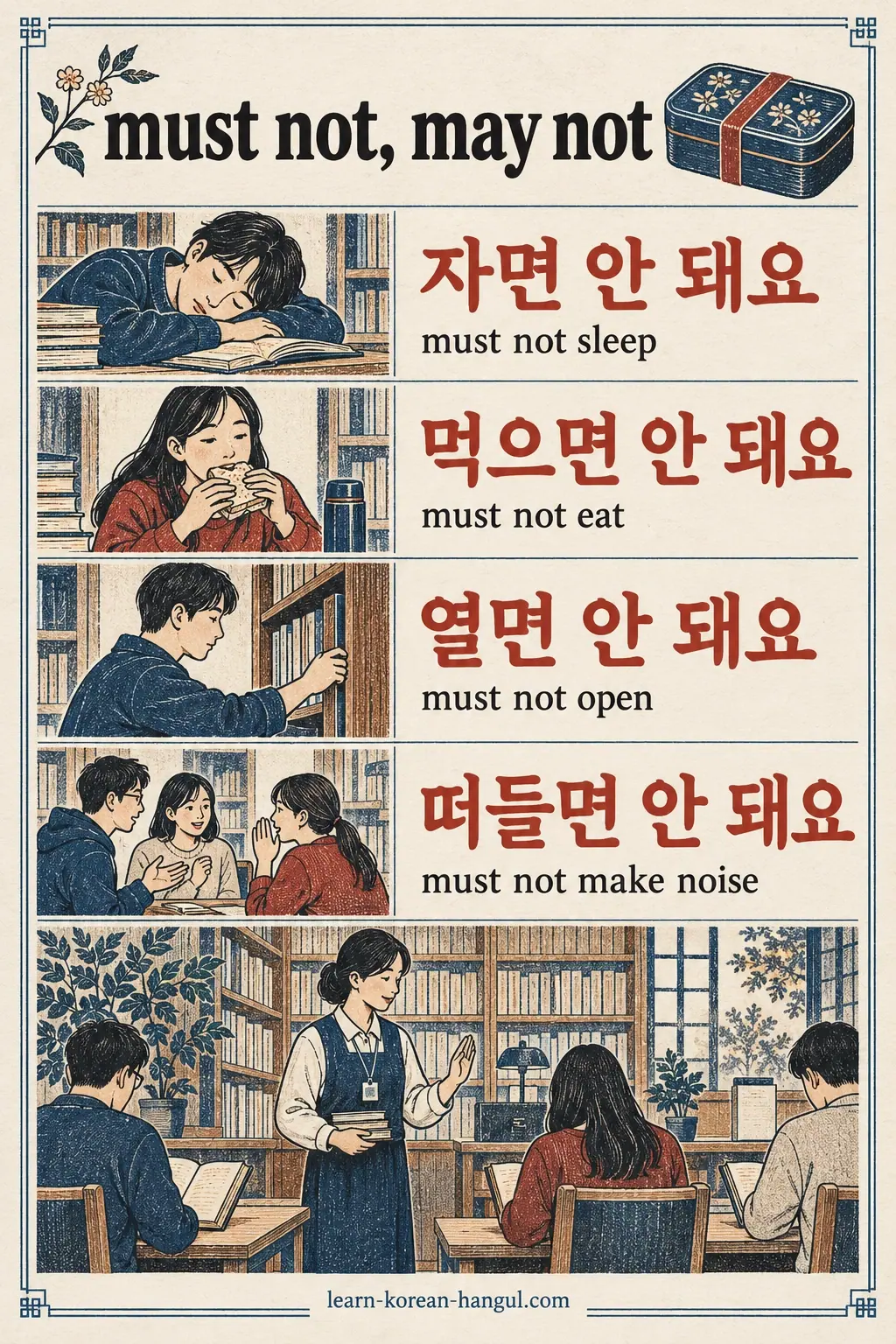
What you'll learn
- Attach -(으)면 to any stem, choosing between -면 and -으면.
- Say "You must not..." in the polite, formal and casual styles.
- Use the pattern for rules, signs and warnings.
- Explain why the pattern does not mean "if not."
- Tell it apart from -아/어도 되다, -아/어서는 안 되다 and -지 않으면 안 되다.
Before you start: you should know how to find a verb stem (drop 다 from the dictionary form) and the word 안 ("not"). If stems are new to you, read about verb stems first. Audio plays only when you press a button.
What Does -(으)면 안 되다 Grammar Mean?

-(으)면 안 되다 grammar means "you must not do this." It is built from two ideas. The first is -(으)면, which means "if." The second is 안 되다, which means "does not work" or "is not acceptable." Together they say "if you do this, it is not okay." Teachers, signs and parents use that idea to state rules.
Here are the first two examples. The pattern is the same in both, and only the verb changes.
- 여기에서 담배를 피우면 안 돼요. (yeogieseo dambaereul piumyeon an dwaeyo.) = "You must not smoke here."
- 수업 시간에 자면 안 돼요. (sueop sigane jamyeon an dwaeyo.) [수업 씨가네 자면 안 돼요] = "You must not sleep during class."
Notice that 안 is a separate word, written with a space before 돼요. It negates 되다 ("to be okay"), not the first verb. That is why the pattern does not mean "if you do not smoke." The listener hears the rule "smoking is not okay." The next section shows how to build the pattern.
How Do You Form -(으)면 안 되다?
-(으)면 안 되다 is formed by dropping 다 from the dictionary form, adding -면 or -으면 to the stem, and then adding 안 되다. If the stem ends in a vowel or ㄹ, add -면. If it ends in any other consonant, add -으면. The linking 으 only appears after a consonant, so the sound stays smooth.
| Dictionary form | Stem | Stem + -(으)면 | Polite form | Meaning |
|---|---|---|---|---|
| 자다 | 자 | 자면 | 자면 안 돼요 | must not sleep |
| 피우다 | 피우 | 피우면 | 피우면 안 돼요 | must not smoke |
| 먹다 | 먹 | 먹으면 | 먹으면 안 돼요 | must not eat |
| 읽다 | 읽 | 읽으면 | 읽으면 안 돼요 | must not read |
| 열다 | 열 | 열면 | 열면 안 돼요 | must not open |
| 떠들다 | 떠들 | 떠들면 | 떠들면 안 돼요 | must not make noise |
| 하다 | 하 | 하면 | 하면 안 돼요 | must not do |
The table shows one rule applied to seven verbs. The next three parts look at the groups of stems one at a time.
Stems Ending in a Vowel
A vowel stem takes -면 directly. 자다 becomes 자면, 가다 becomes 가면, and 들어가다 becomes 들어가면. Examples:
- 지금 들어가면 안 돼요. (jigeum deureogamyeon an dwaeyo.) [지금 드러가면 안 돼요] = "You must not go in now."
- 말하면 안 돼요. (malhamyeon an dwaeyo.) = "You must not speak."
Vowel stems are the simplest case. A stem with a final consonant needs one small extra sound.
Stems Ending in a Consonant
A consonant stem takes -으면. The 으 helps the consonant link to ㅁ: 먹 + 으면 = 먹으면, 읽 + 으면 = 읽으면, 늦 + 으면 = 늦으면. The only exception is a stem that ends in ㄹ, which takes -면.
- 여기에서 음식을 먹으면 안 돼요. (yeogieseo eumsigeul meogeumyeon an dwaeyo.) [여기에서 음시글 머그면 안 돼요] = "You must not eat food here."
- 너무 늦으면 안 돼요. (neomu neujeumyeon an dwaeyo.) [너무 느즈면 안 돼요] = "You must not be too late."
The spelling keeps the final consonant, but the sound moves to the next syllable: 먹으면 is spoken [머그면], and 늦으면 is spoken [느즈면]. This follows the standard pronunciation rules (표준 발음법) of the 국립국어원 (National Institute of Korean Language) for linking a final consonant to a following vowel.
Two more groups need a short note, because learners expect trouble with them.
Do ㄹ-Stems, Irregular Stems and Adjectives Change?
The ㄹ-stems take -면 with no change: 열면, 떠들면, 만들면, 놀면. Other irregular stems change only because -으면 begins with a vowel:
- ㄷ-irregular: 듣다 becomes 들으면 안 돼요 ("You must not listen").
- ㅂ-irregular: 눕다 becomes 누우면 안 돼요 ("You must not lie down").
- 르-verbs keep 르 before 면: 누르다 becomes 누르면 안 돼요 ("You must not press").
Adjectives take the same ending. 너무 비싸면 안 돼요 means "It must not be too expensive." For a noun, use the copula: 학생이면 안 돼요 means "(The person) must not be a student." That use is rare, but the shape is the same. With the formation clear, one sentence can be built step by step.
Worked Example: Building a Sentence with -(으)면 안 되다

-(으)면 안 되다 grammar works by turning an action into a rule. Follow the steps with the idea "You must not touch this."
- Start with the verb. The verb is 만지다 (to touch). Its dictionary form ends in 다.
- Find the stem. Drop 다. The stem is 만지. It ends in the vowel ㅣ.
- Choose -면 or -으면. The stem ends in a vowel, so choose -면. 만지 + 면 = 만지면.
- Add 안 되다 in the polite style. 안 되다 becomes 안 돼요. Keep the space.
- Rebuild the sentence. Put the object first: 여기를 만지면 안 돼요. (yeogireul manjimyeon an dwaeyo.) = "You must not touch this."
Sentence
You must not touch this.
Show answer
여기를 만지면 안 돼요
You will know it worked when the object (여기를) stays in front and the last two words are 안 돼요. The most common slip at this step is to attach 안 to the first verb, as in 안 만지면 돼요. That sentence means "It is fine if you do not touch it." The rule needs 안 right before 돼요. The sentence is now a prohibition, but the pattern has limits on tense and sentence type.
Which Tenses and Sentence Types Work with -(으)면 안 되다?

-(으)면 안 되다 works in the present and the past, in statements and in questions. All changes happen on 되다, the last word. The table shows the forms for 피우다.
| Sentence type | Form | Meaning |
|---|---|---|
| Polite statement | 피우면 안 돼요 | You must not smoke. |
| Polite question | 피우면 안 돼요? | Is smoking not allowed? |
| Formal | 피우면 안 됩니다 | Smoking is not permitted. |
| Casual | 피우면 안 돼 | You can't smoke (to a friend). |
| Past | 피우면 안 됐어요 | You were not allowed to smoke. |
| Honorific | 피우시면 안 돼요 | You (respected person) must not smoke. |
The present statement and the question have the same shape. Rising tone turns 안 돼요 into a question, and a written question mark marks it in text. 여기에서 먹으면 안 돼요? means "Is it not allowed to eat here?" The answer 네, 안 돼요 means "Right, it is not allowed."
The past form is spoken [돼써요]. The formal 안 됩니다 is spoken [안 됨니다].
- 그때는 여기에서 사진을 찍으면 안 됐어요. (geuttaeneun yeogieseo sajineul jjigeumyeon an dwaesseoyo.) = "At that time you were not allowed to take photos here."
- 여기에서 전화하면 안 됩니다. (yeogieseo jeonhwahamyeon an doemnida.) = "Phone calls are not allowed here."
Honorific forms are polite to the person the rule is aimed at: 여기에서 주무시면 안 돼요 (yeogieseo jumusimyeon an dwaeyo) = "You cannot sleep here" said to a guest, where 주무시다 is the honorific verb for 자다.
The pattern is not used for commands such as "Do not go." For a direct request, use the negative command instead. The most useful contrast for a learner is next to the pattern it pairs with.
How Is -(으)면 안 되다 Different from -아/어도 되다?

-(으)면 안 되다 refuses permission, while -아/어도 되다 gives it. They are a pair, and a good dialogue uses both: 앉아도 돼요? ("May I sit?") and 아니요, 앉으면 안 돼요 ("No, you must not sit").
| Point | -(으)면 안 되다 | -아/어도 되다 |
|---|---|---|
| Meaning | must not, may not | may, it's okay to |
| Function | prohibition | permission |
| Attaches to | stem + (으)면 | stem + 아/어도 |
| Example | 여기에서 먹으면 안 돼요. | 여기에서 먹어도 돼요. |
| Meaning of example | You must not eat here. | You may eat here. |
The full rules are on the page for -아/어도 되다.
Two other neighbours are close in meaning. The first is -아/어서는 안 되다, which means "must not" in a stronger, more formal way, as in rules, morals and public signs. 약속을 어겨서는 안 돼요 sounds like a principle. 약속을 어기면 안 돼요 sounds like a rule for a particular situation. See -아/어서는 안 되다. The second is -지 마세요, a direct request to one person: 가지 마세요 means "Please don't go." See -지 마세요 don't. A third neighbour is the double negative -지 않으면 안 되다, which flips the meaning to "must": 가지 않으면 안 돼요 means "I have to go." These contrasts lead to the smaller variations of the pattern itself.
Variations and Edge Cases of -(으)면 안 되다

-(으)면 안 되다 has three common variations and one spelling point: a wider sense of "this will not work", a spoken softener, a gentle request and the spacing of 안 돼요. Each one appears in real conversation.
- Not allowed, or not possible. The same words describe what does not work: 이렇게 하면 안 돼요 (ireoke hamyeon an dwaeyo) [이러케 하면 안 돼요] = "Doing it this way will not work" or "You should not do it this way." The context decides if it is a rule or advice. See also the shorter 안 되다 on its own, as in 컴퓨터가 안 돼요 ("The computer isn't working").
- A softener. Add 죄송하지만 ("I am sorry, but") before the rule: 죄송하지만 여기에서 먹으면 안 돼요. Service staff use this to refuse politely.
- A gentle request. Turn the pattern into a question: 지금 가면 안 돼요? means "Can't I go now?" It asks for permission softly, usually hoping for a yes.
- Spacing. Write 안 돼요 with a space. A closed word 안되다 exists with different meanings, such as "to be a pity" (안됐어요, "That's a shame"), and it is not the prohibition.
This lesson covers the plain prohibition used in daily life, not every use of 안 되다. Obligations and strong moral rules belong to the neighbouring patterns above. The mistakes below show where the boundary causes real errors.
What Mistakes Do Learners Make with -(으)면 안 되다?
Learners most often get the meaning, the refusal or the spelling wrong. Four mistakes appear again and again.
- Reading it as "if not." Learners translate 먹으면 안 돼요 as "if you do not eat." The sentence actually means "you must not eat." 안 negates 되다.
- Refusing with -아/어도 안 돼요. Use -(으)면 안 돼요 as the answer to "May I?" The form 찍어도 안 돼요 is not the normal refusal.
- Using -으면 after ㄹ. 열으면 and 놀으면 are wrong. A stem ending in ㄹ takes -면: 열면, 놀면.
- Spelling 돼요 as 되요. 안 되요 is wrong. The page on 되 vs 돼 explains the test. Put 하 or 해 in the same slot: 안 해요 fits and 안 하요 does not, so write 돼요.
A quick check for any prohibition: Is the stem followed by -(으)면? Is 안 a separate word before 돼요? Is the refusal made with 안 돼요 rather than 안 먹어요? If all three answers are yes, the sentence is sound.
The practice set below tests these four points directly.
Practice and Answers
Try the four items before you read the answer key. Cover the answers with your hand.
- Choose the form. Complete: 도서관에서 ___ 안 돼요. (떠들으면 / 떠들면)
- Fix the error. A learner says 여기에서 먹어도 안 돼요 to mean "You must not eat here." Correct it.
- Translate. "You must not run in the classroom." Use 뛰다 and the polite style.
- Write your own. Write one rule for a library or a classroom using -(으)면 안 돼요. Then write the same rule as a formal sign with 안 됩니다.
Practice · 6
Which sentence means "You must not smoke here"?
Show answer
여기에서 담배를 피우면 안 돼요.
-(으)면 안 돼요 is the prohibition. -아/어도 돼요 gives permission, and -아/어야 해요 means "have to."
Add -(으)면 안 되다 to 열다 (to open). Which form is correct?
Show answer
열면 안 돼요
A stem ending in ㄹ takes -면, not -으면, so 열 + 면 = 열면.
Which reply correctly refuses 사진을 찍어도 돼요?
Show answer
아니요, 찍으면 안 돼요.
The refusal pairs -(으)면 안 돼요 with the permission question. 찍어야 돼요 would mean "I have to take them."
What does 가지 않으면 안 돼요 mean?
Show answer
You must go.
The double negative "if you do not go, it is not okay" means "you must go." The first 않 negates 가다, and the 안 before 돼요 negates 되다.
Add -(으)면 안 되다 to 늦다 (to be late). Which form is correct?
Show answer
늦으면 안 돼요
늦 ends in a consonant other than ㄹ, so it takes -으면: 늦으면 안 돼요.
What does 안 만지면 돼요 mean?
Show answer
It is fine if you just do not touch it.
Here 안 negates 만지다, not 되다. For the prohibition, 안 goes right before 돼요: 만지면 안 돼요.
Answer key
- 떠들면. 떠들다 ends in ㄹ, so it takes -면.
- 여기에서 먹으면 안 돼요. The refusal uses -(으)면 안 되다.
- 교실에서 뛰면 안 돼요. (gyosireseo dwimyeon an dwaeyo.) [교시레서 뛰면 안 돼요] = "You must not run in the classroom."
- Answers vary. Check that -(으)면 is attached to the stem, 안 is separate, and the formal version ends in 안 됩니다. An example: 도서관에서 떠들면 안 돼요 → 도서관에서 떠들면 안 됩니다.
If you can complete items 1 to 3 without the key, you can use the pattern in conversation. Next, the lesson hands off to related patterns.
What Should You Learn Next after -(으)면 안 되다 Grammar?
After -(으)면 안 되다 grammar, learn the pattern it pairs with, then the stronger and the opposite forms. This lesson teaches the plain prohibition and does not cover formal moral rules or obligation in depth. Those live on their own pages.
- Start with -아/어도 되다, which gives permission.
- Continue with -아/어서는 안 되다, which is the stronger, more formal prohibition.
- Learn the direct request -지 마세요 don't and the general negative -지 않다 negation.
- Return to Obligation and Permission to see every lesson in this set, or to the Beginner Grammar list for other A2 patterns.
With these steps, -(으)면 안 되다 becomes automatic: take the stem, add -(으)면, and finish with 안 돼요.
Frequently Asked Questions
What does -(으)면 안 되다 mean?
-(으)면 안 되다 means "must not" or "may not." It states that an action is not allowed or not acceptable. 피우면 안 돼요 means "You must not smoke," and 늦으면 안 돼요 means "You must not be late." It comes from -(으)면 ("if") plus 안 되다 ("it does not work"), so the literal sense is "if you do it, it is not okay."
How do I attach -(으)면 안 되다 to a verb or adjective?
Drop 다 and add -면 if the stem ends in a vowel or ㄹ, or -으면 if it ends in another consonant. 자다 gives 자면 안 돼요, 열다 gives 열면 안 돼요, and 먹다 gives 먹으면 안 돼요. Adjectives follow the same rule: 비싸면 안 돼요 means "It must not be expensive."
Can -(으)면 안 되다 be used in the past tense?
Yes, but the tense goes on 되다, and it describes a past rule. 그때는 사진을 찍으면 안 됐어요 means "At that time you were not allowed to take photos." Never put the past on the main verb: 찍었으면 안 돼요 is not the past of this pattern.
Is -(으)면 안 되다 used in speech or only in writing?
Both. In speech, people say 안 돼요 (polite) and 안 돼 (casual). On signs and in announcements, they use 안 됩니다, as in 여기에서 전화하면 안 됩니다. The rule is the same at every level. Only the last word changes with the speech level, so the form is easy to adapt.
What is the most common mistake with -(으)면 안 되다?
The most common mistake is reading it as "if not." Learners see -(으)면 and 안 and think "if you do not." In fact, 안 belongs to 되다, so the pattern means "if you do X, it is not okay." A second slip is using it to answer "May I?" with -아/어도 안 돼요, which is not how a refusal is built.